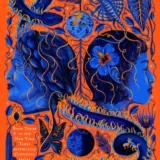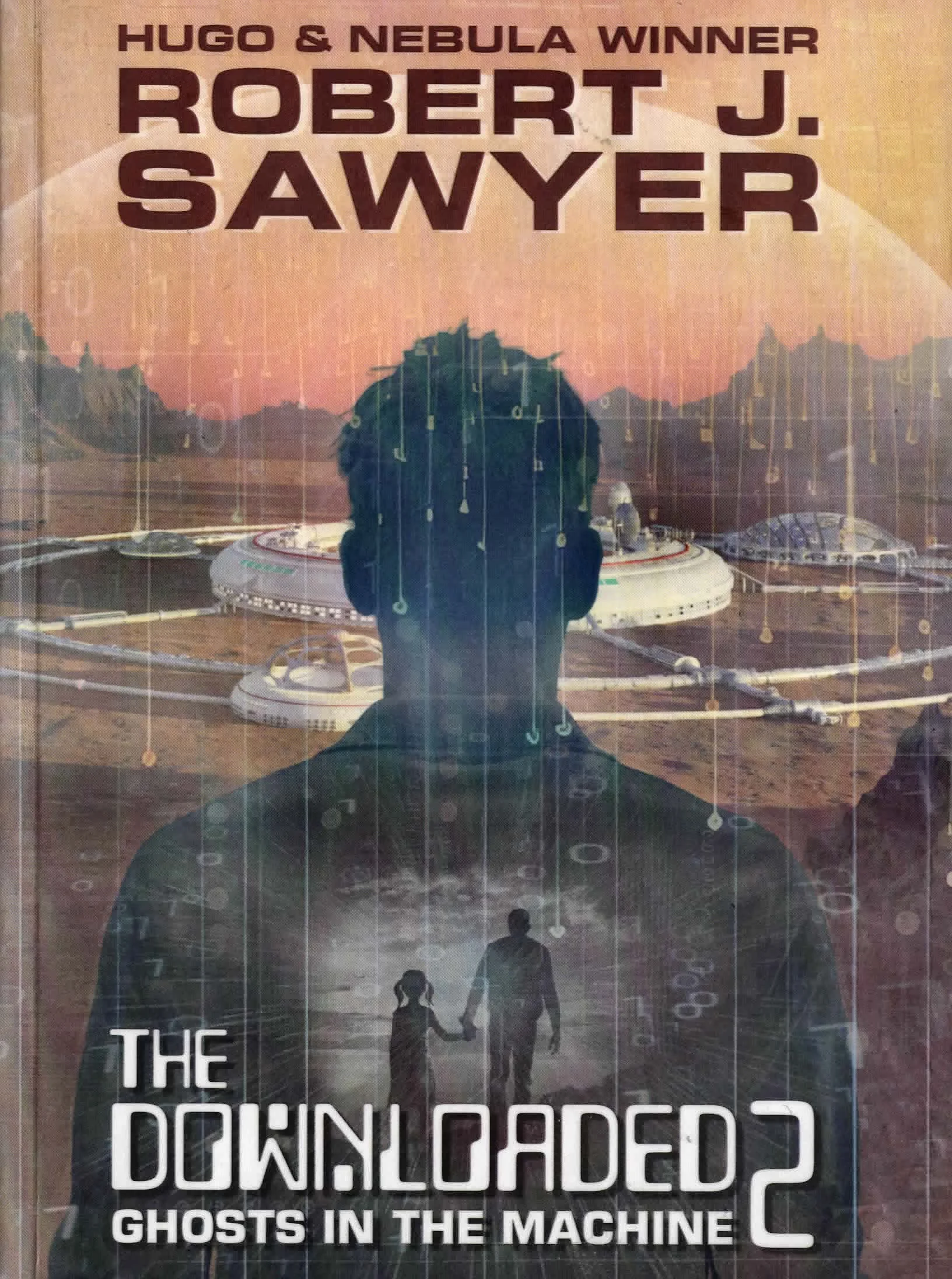
Full disclosure: I didn’t buy this book; I got an ARC (Advance Reader’s Copy) from the author (Figure 1). (That doesn’t influence my review—when I don’t like something, even if the author’s a friend, I say so.)
Before I get into it, I’d like readers to know that you don’t have to have read the previous book (The Downloaded) to enjoy this book; everything you need to know about the characters and their situation is explained (without “data dumps”) as you go along, so if you’re one of those who won’t read a sequel or series book until you have all of them, go ahead and read this one. You won’t regret it. Like all of Robert Sawyer’s previous books (at least all I have read) this is straight science fiction (albeit not the “nuts & bolts” type) that explores not so much the how or why of the science, but the human aspects of it. What happens and how are just the mechanisms that lead to the very human story itself. (And that’s Sawyer’s big strength, and what makes his books so fascinating.)
The book takes place in the far future; in fact, over 500 years from now. There are three main protagonists: Roscoe Koudoulian, who was imprisoned in a virtual cage for a murder he committed in a fit of passion; Letitia Garvey, captain of a crew of astronauts who were headed (they thought) for Proxima Centauri; and Valentina Solomon, who had virtually transitioned for reasons that will be explained. Other characters include Marie Dubois, wife of Roscoe; Mikhail Sidorov, crew member; Dr. Chang, one of two crew physicians; Reywan, friendly Martian (more about that later).
The protagonists’ story begins in the late 2050s, when a crew of two dozen, including two Canadians, uploaded their consciousnesses into a quantum computer while their bodies were cryogenically preserved for a trip to Proxima Centauri on Earth’s first interstellar voyage. The crew members knew that the trip would take 500 years. At the same time, a number of convicts were also uploaded and cryogenically preserved in a test for a new penal system—in exchange for this test, their sentences would be reduced to some months. This “uploading” and freezing took place in Waterloo, Ontario. There were provisions made to ensure the power for this computer would continue; otherwise the virtual worlds, including those consciousnesses, would decohere, and be lost forever.
Unfortunately for all, shortly after the uploading and freezing, a nuclear war broke out on Earth, and most of humanity died, with the exception locally of a small group of Mennonites, who kept to themselves and didn’t depend on technology for survival. The timers for the uploaded (including the prisoners) expired after 500 years, and the bewildered downloaded were loosed into a world of rubble. After a while, the two groups integrated, and Roscoe was elected mayor of the new group, which contacted the local Mennonites and was itself contacted by the descendants of the Earthly colonists of Mars—who had genetically altered themselves into a new type—nearly a whole new species—of human: tall, coloured blue (for UV protection) and with a single gender. In those 500 years, the Martians had advanced science way beyond what had been known in the 2050s.
The Martians (for so they think of themselves) feel that humans—especially half of this expanded group) are “brutish, nasty and short,” and want nothing to do with them generally, but with Reywan’s help, they agree to fix the starship so the crew can continue their journey—but not to Proxima; they’ve discovered that it’s actually a hellhole rather than someplace humans can colonize—to Zeta Tucanae, which is a suitable place. There’s another complication: a 1000-kilometer-wide extrasolar meteor is about to hit Earth (in just a few weeks), which will liquidate the whole crust of the planet. Buh-bye, everything on the surface! But the Martians will make a dome on the other side of mars where the joined group (less the astronauts, minus half their number who want to stay) can live. The astronauts begin re-uploading in preparation for the journey.
But there’s another complication—it’s been four years since they downloaded; and when they upload again, they find versions of themselves that are four years younger than they are now! With only weeks to go before the Earth’s surface is liquidated (sorry…), who are the real people? Who goes where? And other issues—Valentina’s original male persona is here in the virtual world, and he doesn’t know who she is! There are more twists and turns—handled very well, I must say—in this book than in any detective book, movie or play I’ve read or seen! Who gets the bodies when they re-download? What happens to the ones without bodies?
There are more complications—Roscoe’s first wife (and his daughter and infant son) were left behind 500 years ago, willy-nilly. His second wife was Valentina—but she refused to stay downloaded because she couldn’t physically transition; neither of the two doctors have the technology to change her body (and the Martians won’t help), so she uploaded, and Roscoe remarried. Then something happens to his present wife, Marie—this guy has the worst luck with women! Then he finds out that one of the new virtual consciousnesses is his daughter! Worse yet, the quantum computer can’t handle the load—Roscoe is warned by the computer that if the extra people aren’t deleted within a very short time, ALL the virtual consciousnesses will be deleted—crew and duplicates as well! (And Roscoe’s long-lost, long-dead daughter.)
It’s obvious to me that Sawyer was having the time of his life putting complications between these people and their lives. I spent a good time chuckling over each new complication. And the writing is hilarious to me, and full of movie quotes and bits.
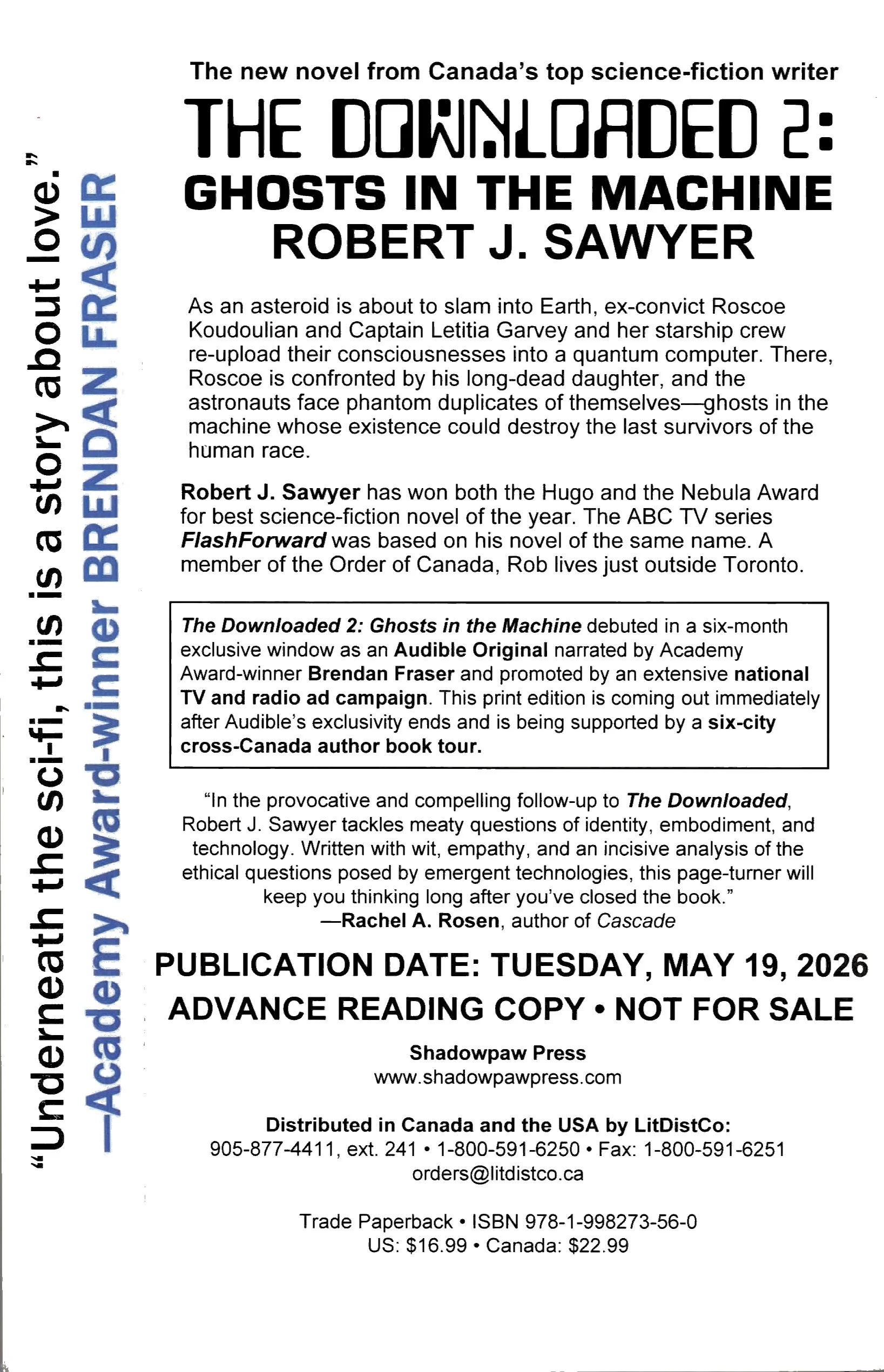
Of course, because of spoilers, I’m condensing all the above and leaving out the whole rest of the story. This book’s not yet available as a Kindle book, because it’s published by Edward Willett’s Shadowpaw Press; it is, however, available as an audio book, read by Academy Award-winning actor Brendan Fraser and three others. I recommend either one; I’m sure you’ll have as good a time as I did; the writing is clear and involving, and it moves along briskly. Correction: Robert tells me he retained the ebook rights for himself, and the ebook is available from Science Fiction Writer Robert J. Sawyer: Buying Links. Prices vary depending on where you are.
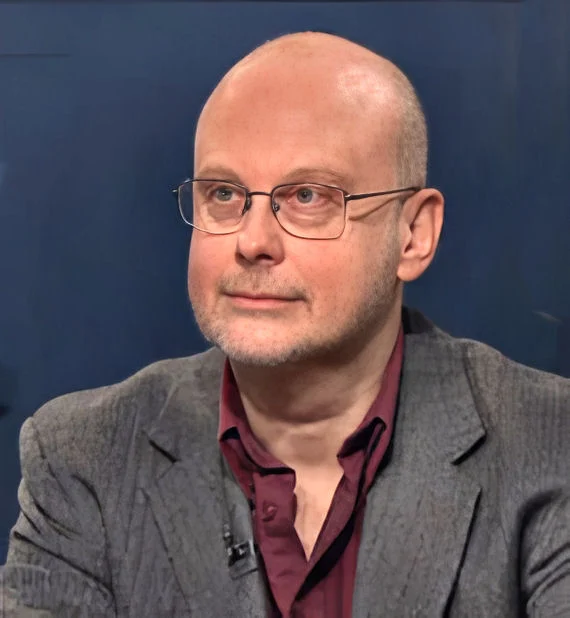
Photo in Figure 2 found on julianjames.org. Used for review purposes.
NOTE: This column is in no way written, edited, proofed or composed by AI, though some of my photo editing software uses it in some capacity. This is a human column and will remain so.
Please let me know what you think about this column. I’m on Facebook, or you could email me (stevefah at hotmail dot com). Let me know whether you liked it or not. And if I made any typos or factual errors. My opinion is, as always, my own, and doesn’t necessarily reflect the views of Amazing Stories or its owner, editor, publisher or other columnists. See you next time!

Steve has been an active fan since the 1970s, when he founded the Palouse Empire Science Fiction Association (PESFA) and the more-or-less late MosCon in Pullman, WA and Moscow, ID, though he started reading SF/F in the early-to-mid 1950s, when he was just a sprat. He moved to Canada in 1985 and quickly became involved with chairing or helping run Canadian cons, including ConText (’89 and ’81) and VCON. As a fan, he’s published a Hugo-nominated (one nomination) fanzine, New Venture, and he’s founded two writing groups (Writers’ Bloc and Writers of the Lost, Ink). He’s emceed and auctioned art at many West Coast and Northwest conventions including one Westercon. As a writer, he’s published a couple of books and a number of short stories (including one in Compostella [Tesseracts 20], and has collaborated with his two-time Aurora-winning wife Lynne Taylor Fahnestalk on a number of art projects. As of this writing he’s the proofreader for R. Graeme Cameron’s Polar Borealis and Rhea Rose’s Polar Starlight publications. He’s been writing for Amazing Stories off and on since the early 1980s. His column can be found on Amazing Stories most Fridays.