The short conclusion to the entitled claim is that Kirk’s reputation is entirely owing to the ubiquity of television. His exploits, largely only hinted at owing to 1960s family values censorship, would be entirely forgotten had John Grimes’ adventures reached an audience even a tenth of the size of Star Trek’s.
Star Trek’s James T Kirk is presented as the stereotypical sailor with a girl in every port; a man who is not above using sexual attraction, if not magnetism, to advance his causes, whether they be escaping from an alien gladiatorial contest, putting down an escape from a Federation loony bin or even impersonating a god and raising a family. It’s up to the Trekkies to figure out the episode references, but one could name just about every one of the 79 original series episodes and find Kirk involved with a female of some kind or other, though it is highly likely that he drew the line at the Horta, even if she was obviously fertile.
Not so fast, says Chandler’s Grimes. ‘I’ve tapped a few truly alien females of the non-humanoid variety and I’m still calling the cat a bastard!’.
Kirk’s oeuvre extends to 79 television episodes and 6 feature films. Grimes has got 20 Novels and 36 shorter stories under his belt. It’s a fair comparison, especially considering that a novel length work would yield more than a film’s worth of screen time.
So what’s the tally? If we were privileged to witness a bull session during which Kirk and Grimes began a sexual exploits one-upsmanship contest, what would Grimes lead off with, and where would he conclude (as the hands-down winner who would forever after be getting sidelong glances from anyone who heard the tales)?
At the beginning, of course. One of the things that sets Chandler’s early works apart from most of his contemporaries was his willingness to include sexual relationships in his stories and see them in print —at least once Kay Tarrant’s pen was no longer editing them: John W. Campbell’s secretary/editorial assistant was apparently famous for bowdlerising the contents of Astounding Stories from 1938 until the 70’s. It is reported, though not necessarily reliably, that she was once heard to say ‘Sexual Revolution? Not in MY magazine!’.

In his very first adventure The Road to the Rim (1967), Grimes is described as an ‘insufferable puppy’ by the object of his attention, one Jane Pentecost, a Purser aboard a civilian transport that Grimes is taking to join up with his first assignment as a Federation officer. Jane is actually a kind of Mata Hari, plying the space lanes and using her wiles to recruit experienced crew to the Rim World’s cause. That group of worlds is planning on seceding from the Federation, but needs a space Navy to have any hope of success. The hook she plants takes a long time to set, but it eventually does, as late in his career Grimes will end up as a Rear Admiral in the Rim Worlds Confederacy Navy.
There’s nothing outre about Grime’s fling with Pentacost. He is an eager, young, inexperienced pup, she’s a bit of disgruntled jadedness who, probably more out of boredom than anything else, takes pity on the young Ensign. This being his loss of virginity moment, it has both desired and undesired effects. Grimes becomes infatuated and enthralled with Pentecost, willing to risk his budding career in the Survey Service to her desires, while also suffering from a near-terminal case of Puppy-Love, which Jane finds annoying and inconvenient to her role as Rim Worlds’ honey pot.
The ensuing drama of The Road to the Rim finds John falling into the proverbial shit and coming up smelling of roses: his actions see him grossly violating Federation regulations but managing to do so in a way that finds him getting promoted and transferred, rather than cashiered.
And he got laid. An experience that the young Ensign discovers he is not only very fond of, but wishes to repeat, as often as is possible and seemingly with as much variety as possible. It is strongly suspected that the depictions of the ‘variety’ of Grimes’ encounters would have been more… ‘various’… were it not for both actual and perceived censorship.
When next we meet up with the horny young goat in To Prime the Pump (1971), he has been assigned to the FSS Aries, which is paying a visit to the ‘planet of the rich bitches’—El Dorado. The planet was terraformed and as a result only billionaires are allowed residency, with their wealth allowing the planet to remain independent of Federation control.
There’s a problem though. No children have been born on the planet for quite some time and the El Doradans call upon the Federation for medical assistance. What the Federation doesn’t know though is that the El Doradans know what their problem is—someone needs to die to ‘prime the life pump’, and it won’t be an El Doradan. Grimes would not be in this story if he wasn’t the intended victim, but, as usual, he manages to turn the tables, killing one of his would-be assassins and in the bargain having an affair with an El Doradan Princess, fathering the first child to be born there, and incidentally helping to renew the population of an entire planet. That’s at least a tie with Kirk’s being around when the Genesis machine is used.
In The Hard Way Up (1972), a collection of short stories detailing Grime’s rise from strong-willed, pedantic, annoying, barracks-lawyering, PITA Ensign to a strong-willed, pedantic, annoying, barracks-lawyering, PITA of a Lieutenant and ship commander, there’s not much opportunity for philandering. That’s reserved for the higher-ranking officers. Following the Aries’ return to base, Grimes briefly serves aboard FSS Pathfinder, where he meets and has an affair (a long running one) with Dr Margaret Lazenby, (son or no, he’s not slowing down) an officer of the FSS scientific branch. He is then given his first command as the captain of a courier ship, a ship with a small crew of hardy young men (being messenger ships, they frequently travel at high acceleration, meaning high gravities). During one mission (‘The Sleeping Beauty’, 1970), Grimes is tasked with transporting a Shaara Queen’s Egg to a new Shaara colony. The Shaara are one of Chandler’s few non-humanoid alien races, being drawn along the lines of social insects, like bees, but that fact does not curtail the hanky-panky.
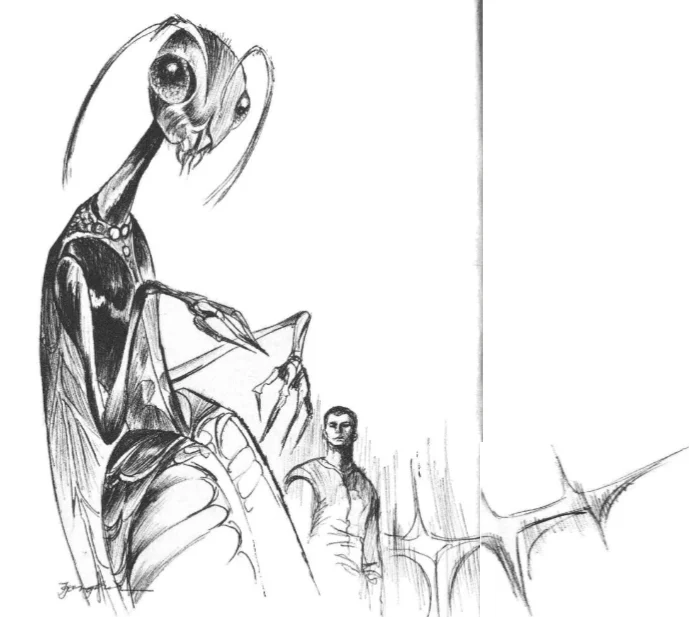
During the journey the ship experiences a breakdown of its drive and the egg hatches. Shaara Queens control their workers and drones via telepathy and the human crew falls under her sway, with Grimes appointed to the role of Drone. Fortunately for Grimes’ future dignity (no way he’d be able to command a larger ship with ‘he gets it on with bees’ floating around the gun room), Grimes discovers that alcohol weakens her control and completes his mission. This was a case in which ‘candy is dandy, but liquor was quicker’ was applicable, but not in the usual way.
Later, during the same command, Grimes presumably has an affair with at least one Australian school teacher (‘The Mountain Movers’, 1971). He is then passed over for a promotion (like they’d ever promote that randy ne’er-do-well) and ends up having to transport an FSS Commissioner (one on the promotions board, no less), who is not too impressed with him. Perhaps it is because he chose to have an affair with her secretary almost as soon as the airlock doors were closed). (‘What You Know’, 1971.)
However, circumstance intervenes, the ship’s drive breaks down yet again and Grimes must seek assistance from the independent Royal Skandian Navy. His passenger, Commissioner Dalwood, becomes smitten with the Skandian King and has an affair with him, which Grimes learns of only because of his dalliance with Dalwood’s secretary. Apparently, Grimes is not above employing a bit of professional blackmail and he wins his promotion.
Wait. We’re just getting started.

Ashore and awaiting a command suitable for his new rank, as a supernumerary Grimes is ordered to assist Una Freeman, an officer in the Federation’s newly formed Skymarshal’s Corps, which was created to deal with an increase in ship hijackings (The Broken Cycle, 1975). There’s rivalry between the Corps and the Navy which causes much friction, though not of the kind we are presently interested in. Nevertheless, Freeman and Grimes eventually find themselves on a ship’s boat, attempting to dock with a freighter that had been hijacked and booby-trapped with a nuclear weapon. As the two attempt entry, the bomb detonates. Rather than destroying them, the explosion hurls the two into an alternate dimension (historically the first time such a thing occurs on the Rim, though not the last), where they are captured by a machine intelligence, placed on an Edenic world and expected to populate it with their progeny, which will become a slave labour force for the machine entities.
Both Grimes and Freeman resist, even despite various forms of persuasion and coercion, including aphrodisiacs. Frustrated, the machine intelligence sends them back to where they came from and the two spend quite some time aboard a space rescue buoy where the forms of entertainment, as well as the menu, are lacking in variety. Nevertheless, Una and John manage to find ways to occupy themselves prior to being rescued.
Note that this is the second time that Grimes has been used in efforts to repopulate an entire planet.
Time passes and Grimes is promoted to Commander and given command of FSS Seeker, a medium-sized command, tasked primarily with survey, rather than military, duties. Seeker is tasked with conducting a census of an unexplored region of space, where it is believed there may be several ‘lost colonies’ (planets colonised by lost ships while using an older, unreliable FTL drive) (Spartan Planet, 1968). Indeed, there are and one such, dubbed New Sparta, turns out to have been settled by a ship commanded by a captain and crew who were fond of various aspects of ancient Greece. After being thrown off course and managing to find a habitable planet, the survivors of ITC Doric found a colony ostensibly established along the lines of the ancient city state of Sparta: no women and a ‘birth machine’ used to replenish the population.

This is one of Chandler’s more controversial works. Published in 1968 (notably more than a year before Greenwich Villages’ Stonewall Riot), Chandler doesn’t shy away from depicting the kind of society that has evolved on Sparta, albeit it one based on 60s stereotypes, incomplete understandings and, perhaps, some prejudice. Nevertheless, it is somewhat remarkable that the novel was even published at the time and represents one of the genre’s few attempts to engage with this aspect of human society during this phase of the genre.
FSS Seeker sets down to much fanfare, is greeted by the local King and members of Seeker’s crew are introduced, including Dr Margaret Lazenby (with whom Grimes has renewed his affair). The sight of a human female on Sparta is shocking… and titillating for many of the colonists who find themselves strangely drawn to this ‘deformed’ creature. Overly enlightened is not one of the strong suits of this novel.
Eventually Lazenby and Grimes discover the birth machine, the history of New Sparta and the fact that another, more advanced lost colony in the region has been manipulating New Sparta for its own economic benefit, and the entire sham is revealed. Grimes and Lazenby assist in the appointment of a new, more enlightened King, one who will protect New Sparta’s legacy while opening it up to trade with the rest of the galaxy.
While the depiction of an entirely homosexual society is stereotyped and cringe worthy in some cases, the concluding fact is that the world should be left to evolve its own society as it sees fit, now that it has been informed of its true nature. While the contents itself may not be all that enlightened, the conclusion is pretty forward thinking, for 1968.
Grimes’ next encounter involves another lost colony (the tally of known lost colonies is now at 13, with Grimes rediscovering an unprecedented number of them), and has his second recorded dalliance with a non-human, this one mediated by ice cream rather than liquor and actually consummated (The Inheritors, 1972).
Federation operatives uncover potential human trafficking involving an uncharted world discovered by a ship of the Dog Star Line (a fairly large merchant fleet concern. And ‘yes’ all of their ships are named for dogs) who are hoping to keep its rediscovery secret so they can establish a monopoly on trade with it.
Their plans are interrupted by Drongo Kane (Grime’s early bete noire) who is not so secretly absconding with the colony’s inhabitants for the white slave trade. The Dog Star Line calls in the ‘Galaxy’s Policemen’ (The Federation), but Grimes finds he is unable to intervene as the human-appearing inhabitants of the planet Morrowvia are not human beings, they are ‘Underpeople’, humanoid, with human intelligence, but derived from non-human genetic stock, a concept made famous by the author Cordwainer Smith.
Chandler goes to great lengths in this novel to play in Smith’s Instrumentality of Mankind universe (details of which appear in an article written for the Cordwainer Smith blog, found here). As events unfold, Grimes has an affair with the Mayor of one of the Morrowvian city states, proving that there is at least one cat that he would never ‘call a bastard’. Eventually, and only because Grimes himself is a fan of 20th century science fiction, the Morrowvians are saved and Drongo is chased off.
Grimes’ next adventure is perhaps his most fraught. It is very clearly based on Mutiny on the Bounty, with Grimes inhabiting the Bligh role (The Big Black Mark, 1975). Yet another lost colony hunt uncovers the existence of Botany Bay, an idyllic, near perfect world with a very Australian-derived culture. Naturally, Grimes gets it on with the mayor of a major city on Botany Bay. Prior to that, he had a shipboard affair with Jane Russell, one of his crew. (The prohibition against officers having affairs with lower ranks is apparently not that strongly enforced in this Federation.)
Well feted on Botany Bay, his crew does not want to leave. Grimes prevails but once off-planet, the crew mutinies. Russell persuades the other mutineers not to shove Grimes out the airlock, setting Grimes and the ship’s doctor adrift in a lifeboat instead. The mutineers return to Botany Bay with a story that allows them to go native. Grimes gets rescued, returns with help and attempts to arrest the mutineers, but out of loyalty to Russell eventually allows them to escape. Rather than face a courtmartial, he resigns his commission and takes a position as a shipmaster aboard the El Doradan Baroness D’Estang’s ship—she’s studying lost colonies and happened along at just the right time (The Far Traveler collection, 1979).
Grimes is quite attracted to the Baroness and, although she is well aware of this, she frustrates his advances. They pay a call on the Farhaven lost colony (‘The Far Traveler’, 1977), to discover that a semi-sentient fungus has taken over the colony, where it telepathically controls the colonists. Grimes falls under its sway and engages in sexual relations with other colonists, participating in a fungal menage-a-trios. Eventually the Baroness uses Grimes’ lust for her to lure him away and break the fungus’ control. Grimes and the Baroness have several additional adventures, each ending in frustration for Grimes. Eventually he wears down her resolve but just at the point of consummation, Drongo Kane makes an appearance (‘Journey’s End’, 1979). The Baroness finds Kane’s piratical nature much more to her liking, but out of gratitude and no small amount of pity, gifts Grimes with her ship’s pinnace in lieu of parting pay.
Grimes goes into business as a courier and takes a job delivering the mail for the Tiralbin colony, they’re shipping strawberries to Bogarty (Star Courier, 1977). Tiralbin’s postmistress takes a shine to Grimes and opts to accompany him on a ‘working vacation’. Even though there’s a lot of physical activity during the trip, seemingly little work actually gets done before the drive breaks down.
They are ‘rescued’ by a Shaara rogue-queen’s ship who discover while searching the pinnace that Grimes has been recording his encounters with Tamara, the postmistress (a hedge against claims of abuse); they find human sexual congress amusing. This fits their future plans for gaining supremacy over a world inhabited by humanoids; there’s a religious war going on amongst the indigenes that the Shaara intend to exploit by favouring the new religion which supports the Shaara. The old religion is a sex cult. Grimes and the postmistress are pressed into service as the debased gods of the old religion, and are forced by the Shaara to perform publicly. However, the humans manage to escape and turn the tables, but not until after the two have had their fill of that working vacation.
While awaiting word on a regular shipping job, Grimes takes temporary employment shuttling supplies to a prison on a moon of Helmskirk colony (‘Grimes and the Jailbirds’, 1984), which is overseen by a very repressive regime. He begins an affair with one of the inmates and helps her escape. She is suitably grateful.
His next adventure is a convoluted one. Grimes fails to read all of the instructions while transporting a pair of exotic animals which use pheromones and perhaps a bit of telepathy to trap their prey via sexual attraction. Finding the creatures harmless and appealing, he allows them to roam the ship until it is almost too late and Grimes has to kill them in order to save himself (To Keep the Ship, 1978). Now stranded on Bronsonia, following a trial where he is found liable and his ship in hock for legal fees, he takes a ship keeping job (much like Chandler’s real-life captaincy of the Australian aircraft carrier HMAS Melbourne). The ship is seized by revolutionaries. Grimes is forced to ferry the insurrectionists around, picking up additional fighters and equipment.
Of course he has an affair with one of them. The revolution goes bad but Grimes manages to escape with his love interest and her friend, along with the revolutionaries’ war chest. He takes them to a planet of master biologists where they can get their appearances changed. His paramour, Susie, gifts him with a miniature version of herself created from ‘left over material’. Grimes begins his return voyage, the container holding the simulacra breaks. Eventually the ship becomes infested with ‘Little Susies’, which he attempts to exterminate, but ends up trapped in his own airlock. Fortunately, a Federation ship comes to his rescue and even more fortunately, Margaret Lazenby is among its crew. She assists Grimes in concocting a reasonable story. Returning to Bronsonia, he gets out of hock by taking a job ferrying a star investigative reporter—Fenella Pruim—around on her assignments.
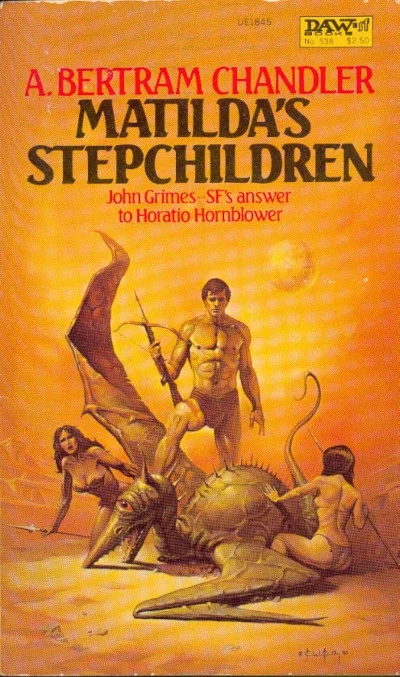
That first assignment takes John and Fenella to the New Venusberg colony (Matilda’s Stepchildren, 1979), a ‘pleasure planet’, where pretty much anything goes. Pruin is investigating because there are rumors of all manner of unsavory and illegal practices taking place, and she finds them: not only can ‘discerning’ clients participate in S&M activities, including fatal ones, there’s also another white slave trade conspiracy taking place, this time with kangaroo-derived underpeople (this novel, Matilda’s Stepchildren, introduces the characters Shirl and Darleen, who would later inspire the Japanese Manga adventures of The Dirty Pair). Grimes and Pruin’s real reason for visiting the colony are uncovered by the authorities, they are captured and become the main attraction in the ‘snuff palace’ but manage to escape with the assistance of Shirl and Darleen, eventually hooking up with the Baroness d’Estang, who happens to be a majority shareholder in the colony. She institutes major changes to practices there, while also helping Grimes, Pruin and the underpeople get off planet.
Once again on shaky financial grounds, Grimes ends up selling his golden pinnace and, along with several other grounded spacers, purchases a used freighter, naming it Sister Sue (Star Loot, 1980). At this time Grimes is also inducted back into the Federation Survey Service as an intelligence operative and encouraged to become the Commodore of a privateering fleet, where he hooks back up with Una Freeman, who is now the head of anti-pirating operations. This adventure doesn’t feature all that much foreplay, but it is a re-telling of the earlier, Empress Irene novel Space Mercenaries, 1965.
Following the privateering adventure, Grimes loses his Master’s Certificate, but is assigned by the Federation to become the Planetary Governor of the New Liberia colony (The Anarch Lords, 1981). He’s really been sent to the planet to throw a monkey wrench into the government’s slave-holding ways and ends up assisting with a revolution, meeting and having an affair with Su Lin, another Federation operative and one of the leaders of the rebellion. As his final act as planetary Governor, Grimes issues himself a new Master’s Certificate.
In his last chronicled adventure—The Wild Ones, (1984)—Grimes inherits a humanoid robot from his father, as his mother will no longer tolerate its presence in her home. The implication as to why is fairly obvious. Later, towards the conclusion of this adventure, Grimes is re calibrating the Manschenn drive aboard Sister Sue and has prescient visions of himself as a Commodore of the Rim Runners fleet and of Sister Sue renamed Faraway Quest. And arrive on the Rim he does, although Chandler did not see fit to detail those circumstances. Like Forester’s recounting of Horatio Hornblower’s adventures, the early novels detail the latter half of Grime’s career, while the later novels detail the character’s origins. It should also be noted that, having been published during a less forgiving era, these tales are not nearly as titillating nor explicit as the ones already recounted. This could be put down to the era, or perhaps are owing to Grimes settling into a marriage.
We next meet Grimes (chronologically) when he has already emigrated and is now the Astronautical Superintendent of the Rim World’s merchant fleet and a Commodore of its Naval Reserve. He’s spent some time opening up new worlds to trade with the Rim Worlds Confederacy (which has successfully seceded from the Federation) and is now seeking to solve the problem of effecting trade with a cluster of anti-matter worlds, by championing the development of an entirely new FTL drive. Catch the Starwinds (1969) is a one-off, actually featuring a character named ‘Andy’ Grimes, but we’ll ignore that for now, in favour of mentioning that the new drive engenders travel into alternate realities, one of which is a Rim Worlds Confederacy that is run by a matriarchy which seems bound and determined to emulate the Patriarchy in discrimination and cruelty.
In Into the Alternate Universe (1964), Sonya Verrill (who will eventually become Mrs John Grimes), a Federation operative, is sent to the Rim to investigate ‘Rim Ghosts’—sightings of people and ships that may be from alternate realities. They are successful in their attempts, ending up in a space between realities, a place occupied by The Outsider, a construct featured in the earlier Derek Calver stories (The Rim of Space and The Ship From Outside), and a place where Verrill’s former lover—Bill Maudsley—apparently disappeared. From there they attempt to return to their own timeline but end up in an alternate Rim Worlds, one where Maudsley and a different Verrill are happily together. Our Verrill decides she likes Grimes better and another attempt at returning to their own reality is successful. Thus begins Grimes’ longest-standing relationship.
Grimes and Verrill retire and plan to use their pension monies to purchase a freighter and go into business for themselves. A number of interesting adventures await, including Grimes’ visit to the ‘Hall of Fame’ (1969), a pocket universe inhabited by literary characters—so long as the works they appear in continue to be read.
And since we’re still reading Chandler’s offerings, we know that Grimes still lives and, while Grimes still lives, there’s a good chance that he’ll be enjoying the occasional dollop of trollop under Sonya’s watchful eye.
As for Kirk, what’s he got to say for himself? A salt vampire, an ambulatory rock, an Orion slave girl who might just be following orders, some doctor who claims to have a son by him, and a bunch of rumors about what kind of relationship he really has with his first officer.
At least in Grime’s universe, there’s no ‘Scotty’ threatening to ruin a really good excuse.
For some detail on Admiral Kirk’s romantic history, here is an excellent piece by Dalton Norman & Rachel Hulshult: https://screenrant.com/star-trek-every-captain-kirk-love-interest-romance/
This article was originally published in the Australian Science Fiction magazine Aurealis, #181, June 2025.

Steve Davidson is the publisher of Amazing Stories.
Steve has been a passionate fan of science fiction since the mid-60s, before he even knew what it was called.