
Since last week’s column featured an early Conan book (Ace Double D-6, Conan The Conqueror by Robert E. Howard, with The Sword of Rhiannon by Leigh Brackett), I thought I might delve just a little deeper into this interesting fantasy (not SF, not “sci-fi”) character. For those of you familiar only with the Schwarzenegger movies, it may surprise you to know that not only was this the first real continuing “Sword and Sorcery” character, but that character is now over 80 years old since his creation. And if, in your reading/movie-going, etc., you’ve never encountered this character, you might be in for a treat! Conan lived in the far past, “before the oceans drank Atlantis,” and was a Northern barbarian from a place called Cimmeria; taught to be self-reliant (Cimmerians have a god named Crom, who watches them from a high place and doesn’t answer prayers; or rather, if he does, he’s likely to do something you don’t want him to do, so Cimmerians tend to take care of themselves) and left home at an early age to become first a thief, then a mercenary, a pirate and, finally, a king by his own right of conquest. Conan was invented by a pulp writer named Robert E. Howard.
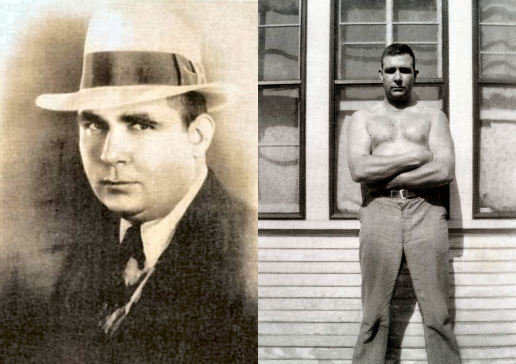
Briefly, Robert E. Howard grew up in oil country in Texas in the 1900s. Born in 1906, by the time he was 13 he’d already lived in seven little Texas towns; his father, a country doctor, kept the family on the move until they settled in Cross Plains, then a small town of about 2000 people, depending on oil booms. Although he returned to Cross Plains, he took his last two years of high school in Brownwood, the Brown County seat. Howard himself said he’d always wanted to be a writer, claiming he wrote his first story at nine. He made his first professional sale (to Weird Tales) at age 18. After graduation he tried a succession of jobs, finding that being an author (at least in the 1930s) wouldn’t pay the bills, even though Howard had begun selling to several major markets. Since his father’s practice was barely keeping them above water, when his mother became ill, Howard’s writing had to pay a lot of her medical bills in spite of his father’s professional discounts. He spent a lot of time in her final years taking personal care of her. As most people know, when his mother entered her final coma, Howard killed himself, giving rise to all sorts of Oedipal rumours and ideas.
Because the author’s usual photo is a kind of chubby-cheeked studio photo like Figure 1 (left), one could assume that—coupled with the knowledge that when his mother entered her final coma, Howard drove out into the desert and shot himself in the head—he was a wimpy little “Mama’s boy.” But if one delves deeper into REH’s biography, several things come to mind to dispute that idea: one, that he grew up in oil country in the ‘20s, and was an avid amateur boxer in very good shape (see Figure 1 right), so he was no wimp—he was often called “Two-gun Bob” (a reference both to his fists and to the adventure prose he wrote); two, he was a life-long melancholic who sometimes described himself as a failure and wrote morbid, suicidal poetry; and three, caring for his mother was something he did as a self-described “reason to live,” making the idea of an Oedipal suicide rather ridiculous. For more information on this complex writer of great adventure tales, please check out the Robert E. Howard United Press Association’s website at https://www.rehupa.com.
Although Howard’s first professional publication (in Weird Tales) came in 1925, his first Conan story—oddly enough, a “King Conan” tale (a rewrite of a King Kull story)—wasn’t published until 1932. The second Conan story, “The Tower of the Elephant,” came out in 1933; not a king at that point, Conan was a young thief of 17. During the next three years, a further fifteen Conan stories were published; four more were finished but not published during his lifetime, and a further four were never finished. Figure 2 shows three Weird Tales covers for Conan stories by Margaret Brundage; left is “Queen of the Black Coast,” May 1934; middle is “The Devil in Iron,” August 1934; and on the right is “The Hour of the Dragon,” December 1935. Brundage’s forte was painting “damsels in distress,” not muscular barbarians, as you can see from these pictures; Conan looks like someone from a ‘30s “romcom.”

Some of the Conan stories were reprinted in the Avon Fantasy Reader series edited by Donald A. Wollheim. Whether it was Avon’s policy or Wollheim’s, current readers are stymied by the series not publishing the names of the cover artists. Number 10, shown here, is by “L.S.”—who also did #11 (and maybe one or two more)—but despite a pretty thorough search of the internet, I have been unable to track this artist down. Like the later Gnome Press covers by Ed Emshwiller, Number 10 shows a fairly medium-sized, rather Roman-looking Conan in spite of the description in the story inside by Howard himself: By the side of the caravan road a heavy cross had been planted, and on this grim tree a man hung, nailed there by iron spikes through his hands and feet. Naked but for a loin-cloth, the man was almost a giant in stature, and his muscles stood out in thick corded ridges on limbs and body, which the sun had long ago burned brown. The perspiration of agony beaded his face and his mighty breast, but from under the tangled black mane that fell over his low, broad forehead, his blue eyes blazed with an unquenched fire. Blood oozed sluggishly from the lacerations in his hands and feet. The alert reader will recognize this scene from the John Milius movie, Conan the Barbarian.

Although REH wrote a lot of memorable characters (Bran Mak Morn, Solomon Kane, King Kull), we are concerned here with Conan, the character that—thanks partly to L. Sprague de Camp—has caught the public’s imagination. [Had I been aware of the Howard connection at the time, I would have asked de Camp about him at the only time I got to spend a while talking with him, which was at Lester’s and Judy Lynn del Rey’s party at the 1976 Worldcon in Kansas City, MO. Jon Gustafson (my co-editor/art editor) and I were invited by Ian Summers, the del Rey Books art director, because of New Venture’s strong slant on art and Jon’s columns for both NV and Richard E. Geis’s Alien Critic fanzine.]
Howard had problems continuing to write series characters like Conan, and it’s quite possible that even had he lived the well might have dried up, so that the four unfinished stories might have still been the last he ever wrote on the subject. He himself voiced that opinion in a letter to either H.P. Lovecraft, with whom he carried on lengthy corresondence, or one of this close friends. Writers such as de Camp himself (along with Bjorn Nyberg), Lin Carter, Robert (Wheel of Time) Jordan and Steve Perry (Matador) and many others (about fifty stories and books have been written by people other than REH) have continued to write new Conan stories. And that’s just books; there have been films, TV shows, comics and graphic novels and even plastic models/maquettes/action figures of and about Conan.
As for me, I first encountered Conan when I was a pre-teen at the Tyndall Air Force Base library in Panama City, Florida in 1958 or so; the base library had one bookshelf designated for SF and fantasy (I don’t believe Forry Ackerman had coined the term “sci-fi” yet, but I could be wrong); said bookshelf included not only several of the Gnome Press books, with dust jackets, but also books like Ian Fleming’s Moonraker, which had to be science fiction, right?, because it had rockets in it! (This in spite of the fact that Tyndall AFB was one of the bases preparing the United States for its upcoming role in the space race.) The Conan books caught my eye and my imagination, and I was very please to find, after we moved to Everett, Washington, that the Everett Public Library had copies of those very same books.

Figure 4 shows the Gnome Press covers of the original Conan stories: from left, Kelly Freas, left middle, Ed Emshwiller (EMSH), EMSH again, and on the right, Wally Wood. Freas appears to show a fairly young Conan; a believable portrait of a young freebooter (and an image that stuck in my mind for years). In Emsh’s two he looks a bit older; in some ways they’re both reminiscent of the original Ace double I showed in last week’s column and the Avon Reader cover, too. Although I’m a big Wally Wood fan, due to his EC Comics (Weird Science) and Mad Magazine stories (the early, comic-book MADs), I must admit this is a pretty awkward image.

Because this is not intended to be a definitive history of, or compilation of Conan images, I intend to be selective in what I post; it’s mainly to pique your interest in Conan and the works of REH. If what I’ve written interests you, you can find much more information—and more comprehensive information—on the internet.
So anyway, Conan appeared first in magazines, then in hardcover collections, and then in paperbacks. The definitive Conan image for paperbacks was Frank Frazetta’s Conan, as in Lancer’s 1966 edition of Conan the Conqueror, which contained four stories by Howard with some revision by L. Sprague de Camp. Figure 4 shows what a mess an art director can make of a good original painting. The original Frazetta is on the left; the cover is on the right. There was also a Jeff Jones Conan, but I’m not sure what book it was on. Jeffrey Catherine Jones did a number of Howard covers in the ‘70s, I believe, but which ones were Conan will have to wait for another column.

Conan’s first non-written-word appearance was, I believe in Marvel’s Conan the Barbarian comic in about 1970 or so. Written by Roy Thomas, it featured John Buscema’s artwork (Figure 6); similar to the Frazetta image of the muscle-bound hero with long hair and glowering eyes, Buscema’s Conan eventually—although it had to contrast with the images of such artists as Barry Windsor-Smith (Figure 7), Alfred Alcala and others—became to me, the definitive image of Conan. I was so taken with the Todd McFarland maquette of King Conan, sitting on the Lion Throne of Aquilonia, that I had to get it; it now sits proudly on a shelf in our living room (Figure 8). You can tell by looking at the figure, that Conan is not finding that being a king is all it’s cracked up to be. He would rather be almost anywhere else fighting something or someone.
The comics and graphic novels have been numerous, including Marvel’s The Savage Sword of Conan series, and some of the best “comic” artists in the world—people like Gil Kane, Neal Adams, Dick Giordano, Jim Starlin, and Walt Simonson provided art. Roy Thomas was the editor and primary writer for the series in the first few years. I believe there’s a current Conan series running in Dark Horse comics, though I haven’t seen one recently; artists on the original series (Dark Horse has also published Marvel reprints) include Richard Corben and José Villarubia.


There are also Conan card games, computer games, board games, role-playing games and so on; of them I can’t say much, because I’ve never seen any of ‘em, not being much of a gamer.
And then there are the Conan movies and TV series. Of the TV series I can’t say much, because I only saw one episode of the Ralf Möller Conan the Adventurer; I must say I was very unimpressed. There have also, according to Wikipedia, been an animated series of the same title before the live-action one, and an animated one called Conan and the Young Warriors, which I’ve never before heard of, let alone seen.
Then there are the movies, of course, of Arnold Schwarzenegger’s (John Milius, Director) Conan The Barbarian (1982) and Conan the Destroyer (1984), with a third movie planned, which never came about (it was apparently turned into King Kull, with Kevin Sorbo in the title role—if you think about it, this is a reversal of the first published Conan story!). Although very loosely based on Howard’s work (an early script for another director had been written by L. Sprague de Camp, which may have been part of what Oliver Stone based his screenplay on), they apparently based the first movie on bits and pieces of actual Conan lore with a whole bunch of stuff tossed in for good measure. I won’t describe the movie here; you can find it on IMDB and/or Rotten Tomatoes; Arnold’s slightly wooden acting was helped by the presence of (among others) Sandahl Bergman, Max von Sydow and James Earl Jones.

(I was already familiar with “Ahnold’s” acting chops, having seen him in Streets of San Francisco with Karl Malden and Michael Douglas, as well as—if memory serves—Hercules in New York among other TV and movie roles; his accent in those roles was very thick. I met director John Milius in an elevator at the Denver WorldCon in 1980, and asked him if Arnold’d had any vocal coaching; I may have been one of the first people to do an “Ahnuld” imitation when I said, “I hope he doesn’t say “Py Khrum!”
“Don’t worry,” Milius told me, “We’ve gotten him the best vocal coaches money can buy.” Well, you ask a silly question, you get a silly answer.) Anyway, accents or no, faithfulness to the canon or no, the movie was a success—not a huge one, but enough to convince the studio to continue, and it served as Arnold’s breakout role—and Conan the Destroyer was made. In part, it was based on “A Witch is Born,” (See figure 3) and starred—besides Arnold—Sarah Douglas, Mako, Wilt Chamberlain (his first movie role), a 15-year-old Olivia d’Abo, Grace Jones (easily the most appealing actor in the movie) and a really bad actor named Tracey Walter as a thief. (The scene where Conan is nailed to a cross was in the first movie, but should rightfully have been in this one.) In spite of good production values and some good actors—even Arnold did some half-way decent acting, not the least in a “drunk” scene—the movie was not a financial or critical success, and the third movie was never made as a Conan movie. At the end of Conan the Destroyer, a scene (Figure 10) shows Conan as King Conan, and promises the next film, Conan the Conqueror.

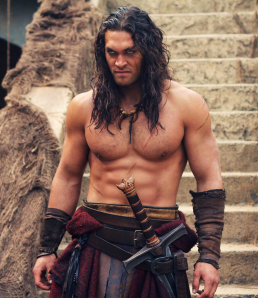
Then a couple of years ago, a new Conan movie–taking very little from Howard’s work, as far as I could see, though I’ve only watched it once, starring Jason Momoa—previously seen as Khal Drogo in George R.R. Martin’s Game of Thrones TV series (Figure 11). Momoa was bigger than the role, in short. He played a smarter Conan, a bit less muscle-bound than Arnold—but the script let him down. It was neither exciting nor involving; in fact, I can’t even remember any of the other actors in it. He could have revitalized the whole Conan movie scene, but with poor direction and a poor script, he didn’t have a chance. ‘Nuff said, as Stan the Man Lee often remarks.
And now we come to something we Conan fans figured would never happen: the new Arnold Schwarzenegger Conan movie has been announced; I believe the title is going to be The Legend of Conan. It may come out this year (2014) or next, but it’s supposed to happen. I have no idea at this point who’s directing—though Paul Verhoeven (Starship Troopers et al.) is rumoured–and whether it is going to be based loosely or tightly on Howard’s work, but I’m at least a little excited. The producers have said it’s going to be written for the older Schwarzenegger, and promised it will be his Unforgiven! (Clint Eastwood’s Oscar-winning movie.) I’m a bit worried about Verhoeven, considering what he did to Starship Troopers, but otherwise I look forward to it; how about you?

Next week, I intend to look at a few Ace Double covers and talk about the art thereon. There were several “mainstay” artists for Ace during the time Ace was producing the Doubles; Kelly Freas, Jack Gaughan, Ed Valigursky, Ed Emshwiller and John Schoenherr among others, but the above artists did (in my opinion) a tremendous job. See you then!

Steve has been an active fan since the 1970s, when he founded the Palouse Empire Science Fiction Association and the more-or-less late MosCon in Pullman, WA and Moscow, ID, though he started reading SF/F in the early-to-mid 1950s, when he was just a sprat. He moved to Canada in 1985 and quickly became involved with Canadian cons, including ConText (’89 and ’81) and VCON. He’s published a couple of books and a number of short stories, and has collaborated with his two-time Aurora-winning wife Lynne Taylor Fahnestalk on a number of art projects. As of this writing he’s the proofreader for R. Graeme Cameron’s Polar Borealis and Polar Starlight publications. He’s been writing for Amazing Stories off and on since the early 1980s. His column can be found on Amazing Stories most Fridays.






Recent Comments