
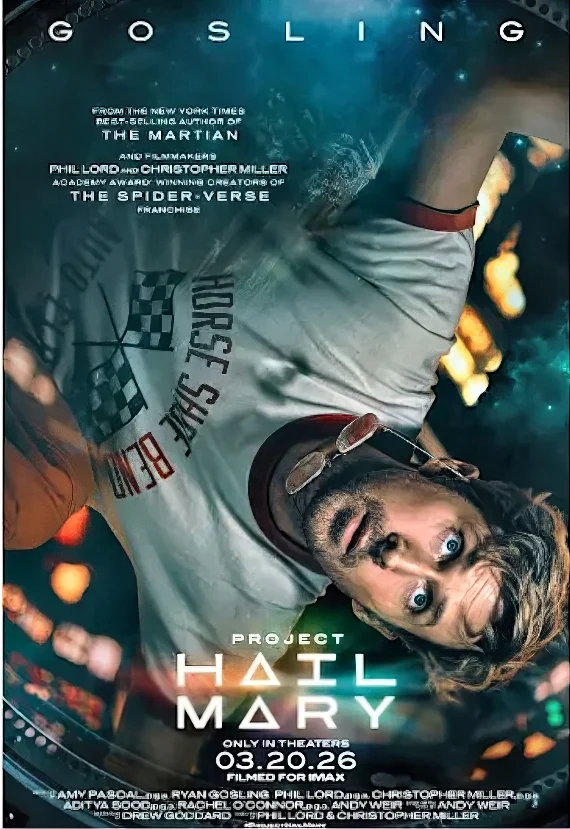
From Amazon MGM Studios, released in the latter part of March, comes the second movie based on an Andy Weir book. The first one, of course, was The Martian. (Because it’s Amazon, you can expect it to stream on or about June 19 on Prime.) Since I’m not a scientist, I can’t say this for sure, but like The Martian, some of the science in this seems a bit loosey-goosey, but again, like that other movie, it’s extremely entertaining. This is being called the first big hit of the year as well as the best Ryan Gosling movie so far, with a 95% or so Rotten Tomatoes score from critcs. Of course, as we well know, the popular view and the critics’ view don’t always align, but I can say that both I and the Beautiful and Talented Lynne Taylor Fahnestalk found it fun, well acted, and well produced—with a few echoes of the Stanley Kubrick epic 2001: A Space Odyssey (Figure 4), if maybe not as visually stunning, since most of the action takes place within a few rooms of an ISS-like spaceship. But like The Martian, it holds your attention quite well for the 2 hours and 37 minutes it’s onscren.
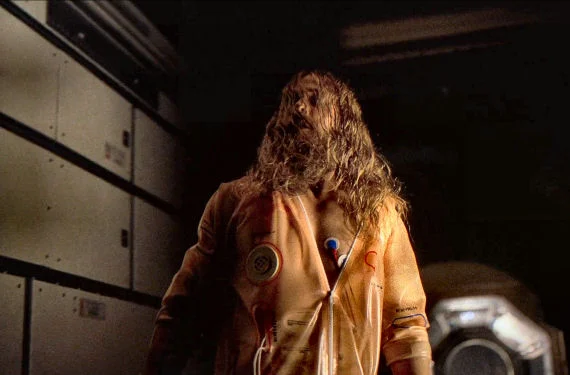
When the movie opens, we see flashing red and blue lights, and meet Ryland Grace, who is in a zippered bag like a body bag from the coroner. He’s hairy and bearded (Figure 3) and has no idea who or where he is; he and we learn his past from flashbacks as the film progresses. We learn he’s got a Ph.D. In molecular biology and is teaching at the middle school level.
How do we learn that? In a flashback, Grace learns that he was accosted one day by a woman (Sandra Hüller) from an official (unnamed) government agency, who wants to know if he’s the person who wrote a thesis claiming that the common belief that life can’t arise without water is wrong. He admits to it, and she says he has to come with her. It seems that an astronomer named Petrova discovered an infrared line between Venus and the Sun, which is now named “The Petrova Line.” The government has sent a probe to/through the Petrova line, and brought back a sample of “space dots,” which appear to be inside that line. They want Grace to examine it and tell them what it is, because, since the Petrova Line was discovered, the sun—our sun—has begun dimming, and they need to find out what it is and stop it or else all life on Earth could be in trouble. As in extinction level trouble
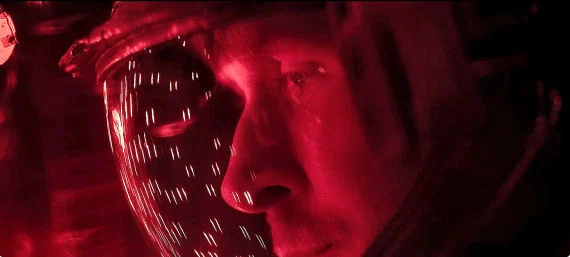
As Grace gets used to being in space, he discovers more about who he is and why he is in space. It was already discovered that there appeared to be something—“Space dots”—inside the Petrova line that was affecting our sun and that if something weren’t done within about 30 years, it would be very bad for the Earth; but there was a planet within telescope distance that also had a Petrova line to its own sun, which wasn’t dimming the same way. A mission had to be mounted to find out why—and, with extinction staring Earth in the face, so to speak, bring the solution back, and that’s why Grace was here, and why the movie is named as it is. We all know that in sports a “Hail Mary” is a desperation movie that shouldn’t succeed to save a game (but sometimes does).
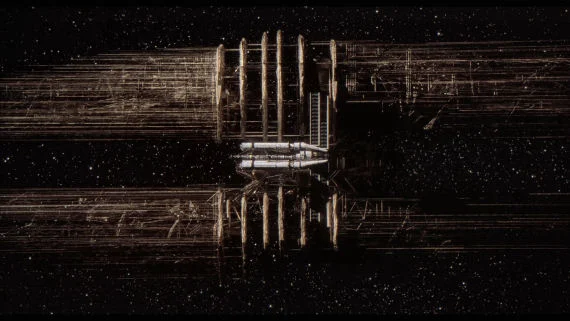
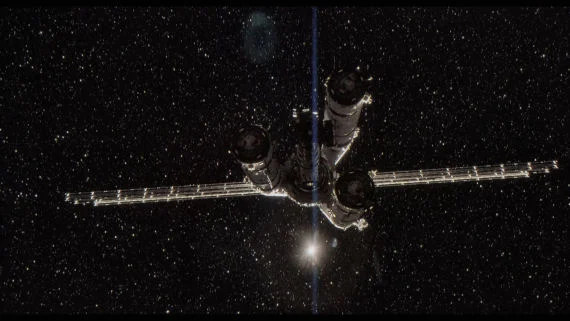
But when Grace arrives at his destination 11 years later, he is met by an alien spaceship (Figure 5). Although this film has some Kubrick touches (Figure 4), when he attempts to avoid the alien ship, he pulls some Star Wars maneuvers that even I can tell wouldn’t really work (that’s part of what I meant about “loosey-goosey” science). How he meets the alien and learns to communicate—not to mention the solution to the “dimming sun” phenomenon—make up the rest of the film.
I’d love to continue narrating, but here I must leave you, so as not to spoil a major part of this movie, including the outcome of Grace’s mission. (It’s similar to an NDA–the writing is good that I don’t want to spoil your enjoyment, so I’m not disclosing much.)
NOTE: This column is in no way written, edited, proofed or composed by AI, though some of my photo editing software uses it in some capacity. This is a human column and will remain so.
I’d like to hear what you think about this column, especially this week, which is a very short one because I tried very hard to avoid spoilers other than minor ones. I’m on Facebook, or you could email me (stevefah at hotmail dot com). If you liked it, let me know—if you hated it, let me know why. My opinion is, as always, my own, and doesn’t necessarily reflect the views of Amazing Stories or its owner, editor, publisher or other columnists. See you next time!

Steve has been an active fan since the 1970s, when he founded the Palouse Empire Science Fiction Association (PESFA) and the more-or-less late MosCon in Pullman, WA and Moscow, ID, though he started reading SF/F in the early-to-mid 1950s, when he was just a sprat. He moved to Canada in 1985 and quickly became involved with chairing or helping run Canadian cons, including ConText (’89 and ’81) and VCON. As a fan, he’s published a Hugo-nominated (one nomination) fanzine, New Venture, and he’s founded two writing groups (Writers’ Bloc and Writers of the Lost, Ink). He’s emceed and auctioned art at many West Coast and Northwest conventions including one Westercon. As a writer, he’s published a couple of books and a number of short stories (including one in Compostella [Tesseracts 20], and has collaborated with his two-time Aurora-winning wife Lynne Taylor Fahnestalk on a number of art projects. As of this writing he’s the proofreader for R. Graeme Cameron’s Polar Borealis and Rhea Rose’s Polar Starlight publications. He’s been writing for Amazing Stories off and on since the early 1980s. His column can be found on Amazing Stories most Fridays.





Recent Comments