‘Literary Forensics’ is a term used to describe the act of applying forensic techniques to the uncovering of lost stories, unpublished editions and hidden literary history. It is an informal discipline, usually only practiced by amateur sleuths who happen to discover something funny or ‘off’ while poring over dusty file folders hidden in dim university basements housing the works and papers of their literary obsession(s). Or a task for a fan of a particular Australian author, attempting to find and catalogue every last comma, semicolon and period ever pressed to paper by a portable typewriter’s keys in pursuit of creating a concordance of the author’s works.
A Bertram Chandler, Australia’s own Captain of Science Fiction, wrote some 36 novels, 225 shorts, 4 poems and 54 non-fiction pieces between 1944 and 1984. Not counting the ‘missing’ ones. All of which, save for one short story, have been published over the intervening years in venues ranging from Fanzines to more formal publications, though many of them may not be easily obtainable.
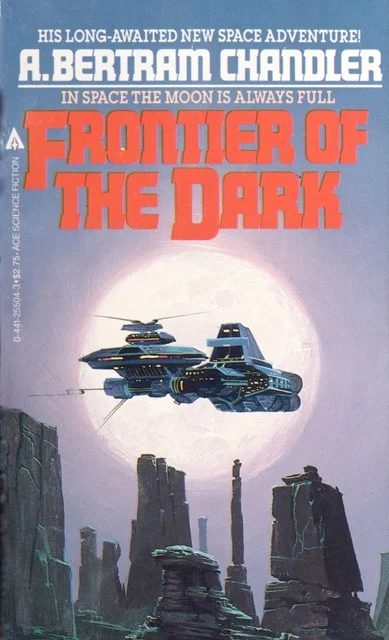 Availability was not always the case, with two aspects of the author’s life contributing to this: Chandler’s ‘day job’ was as an officer in the Merchant Marine, serving on ships plying the waves of the southern Pacific. This meant that he did not keep files of his stories. When encouraged to expand his novelette Frontier of the Dark (1984) into a novel by Harlan Ellison, he claimed that he did not have a copy of the manuscript. Ellison, a huge fan and friend of Chandler’s, provided a copy of that story’s only magazine appearance (Astounding Stories) out of his own collection.
This means, of course, that there are no filing cabinets where a ready-made set of the author’s complete works are to be found. (It also makes the consistent conformity of detail in his works all that much more remarkable.)
The day job also meant that Chandler was not really free to work the convention circuit, which meant that there were fewer fans obsessively collecting and querying the author, fewer panels where authorial ‘secrets’ might be revealed.
Fortunately, in regards to literary forensics, it really only takes one or two individuals keeping track of things to get the ball rolling.
Over the course of that 40-year career, Chandler wrote a handful of stories that did not precede his death into publication; he sold a small number of stories that were intended for publication but, owing to the vagaries of that business, never made it to the reading public. He also re-used a handful of plots, substituting one set of characters for another, which can be confusing for the reader if they’ve already read one and believe the other to be a ‘new’ story. And he wrote at least two stories that ‘went missing’.
The vast majority of Chandler’s previously unpublished work was folded into Dreamstone’s memorial volume From Sea To Shining Star (1990), which, sadly, is now out of print. It’s only there that one can read ‘Man Alone’—an alternate reality Rim Worlds tale where psionics has been outlawed (in the mainstream Rim Worlds, psionics are routinely used for FTL communications purposes)—and ‘Hindsight’—a Rim Worlds back-grounded, largely a fictionalised autobiographical account of female relationships.
 Another story, this one a Grimes tale, ‘Grimes and the Gaijin Daimyo’ (a Kitty Kelly story), was resurrected for publication in Jack Dann’s second volume of Australian short science fiction Dreaming Again (2008). It had originally been purchased for publication in an anthology being planned by Paul Collins, but that never happened. It remained in Paul’s files for quite some time until Chandler fans began querying about it, at which point he made arrangements for it to be published in Jack Dann’s anthology, and it can still be found there. Paul had to perform a bit of literary forensics of his own in clearing it.
And then there is the story sold to Harlan Ellison’s planned The Last Dangerous Visions. Ellison made a point of asking Chandler for something as he believed that Chandler had already evidenced a willingness to embrace the edges of the genre, at least by having previously included some adult themes (see Matilda’s Stepchildren (1979), involving Grimes’ visit to a pleasure planet) in earlier works. Chandler complied with the request and that story is, so far as we are presently aware, the one and only short work that has remained out of print.
It’s titled ‘True Believers’. Its existence confirmed in a photograph of the manuscript by Ellison’s biographer, Nat Segaloff, but it did not make the cut for the forthcoming J. Michael Straczynski version of The Last Dangerous Visions (planned for October 2024 release). It is not known whether that story is a Rim Worlds, John Grimes tale or something completely different.
There are also, however, two known Grimes tales that went missing for quite some time and, while the forensic clues that led to their being recovered may be considered thin by some, contemporary Chandler scholars have all agreed that those lost stories have indeed been found. But before recounting the Carter-like excavation, a short aside is needed regarding Chandler’s re-use of both character, theme and plot on several notable occasions.
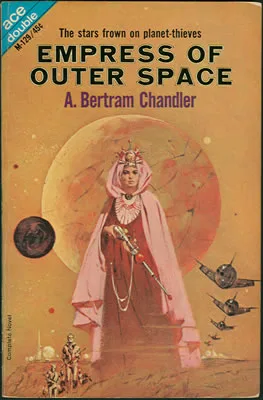
John Grimes is, if course, Chandler’s most well-known and enduring character, though he had several others that made more than one appearance. There’s Christopher Wilkins of The Alternate Martians/The Coils of Time (1964); there’s Derek Calver of The Rim of Space (1961) and The Ship From Outside (1961); there’s the crew of ICC Epsilon Draconis (nicknamed the Eupeptic Dragon) in ‘Swap Shop’ and ‘In the Box’ and then there’s ‘Princess’ Irene Trafford, a character that has been described as ‘John Grimes in drag’, who appears in The Empress of Outer Space (1965), Space Mercenaries (1965), Nebula Alert (1969) and the Grimes-centred tale The Dark Dimensions (1971) (which also features Poul Anderson’s Ensign Flandry as a character.).
 There’s a bit more to it than that though; the novel Star Loot (1980), in which Grimes, between service with the Federation Survey Service and the Rim Worlds Naval Reserve, becomes the Commodore of a privateer fleet that is commissioned to serve as blockade runners by a planet attempting to breakaway from the Hallichecki Hegemony. (Chandler’s stories featured only a handful of alien races, the bee-like Shaara and the bird-like Hallicheki.)
In Space Mercenaries, Irene Trafford and her husband take on the same role—commissioning and commanding a privateer fleet to run a blockade of a breakaway Hallicheki planet. Of course, it’s actually Grimes who is in drag, as Space Mercenaries was published in 1965 and Star Loot in 1980.
Chandler would re-purpose another short story that showcases his love of the Shaggy Dog style of tale. ‘Operation Starquest’ only saw publication in the Australian magazine Man (1960), while ‘And Another Redskin Bit the Dust’ would not make an appearance until the publication of the fix-up novel The Far Traveler in 1977.
‘Another Redskin’ is one of those missing stories mentioned previously. Both Starquest and Redskin feature the discovery of what is believed to be a lost colony and, upon finding the star ship that went missing, evidence from orbit seems to suggest the ship is under attack by the indigenes of that planet. An attempt at rescue is made, at which point it is revealed that the humans aboard the colony ship are long dead and gone and it was native children playing a version of cowboys and Indians (natives vs invaders) that had been observed. Both stories take place within a Rim Worlds setting.
The existence of two stories that might be missing was revealed through notes written within the pages of a copy of the Marcon XIII convention’s program book. A Bertram Chandler was the convention’s Guest of Honour, the convention’s Chairman (Ross Pavlac a Worldcon Chair and a huge fan of Chandler’s) and the program book contained both a ‘John Grimes Autobiography’ and a complete bibliography of the author’s works up to 1978.
That program book was the Chairman’s own copy and listed in that bibliography were two stories noted as being slated for publication in David Hartwell’s Cosmos Science Fiction and Fantasy Magazine in 1978. The magazine folded at the end of 1977. The two stories were titled ‘Let Seeping Dogs Lie’ and ‘And Another Redskin Bit the Dust’ (and, yes, that title would not fly today).
Upon being contacted, the late, lamented Hartwell professed no memory of the stories (he was contacted to attempt to obtain the manuscripts to get them into print).
The only real clues as to what might have happened to those stories (other than, of course, mouldering in some file cabinet somewhere) was the time frame in which they were mentioned.
 In the 1970s, Chandler was going gangbusters, with some 12 novels published during the decade. The one closest in time frame to the period was The Far Traveler (December 1977), a ‘fix up’ novel consisting of a handful of shorter works tied together with some additional bridging work.
The other bit of forensic evidence was the fact that Chandler often drew his story titles from lines found within the story’s text. The short stories ‘What You Know’, ‘The Bird-Brained Navigator’, ‘Fall of Knight’, ‘The Man Who Could Not Stop’, and even his first published story ‘This Means War’ are examples of such.
Prior to the discovery of the Marcon XIII program book, it was known that The Far Traveler novel consisted of four previously published stories—‘The Far Traveler’, ‘The Long Fall’, ‘The Sleeping Beast’ and ‘Journey’s End’. All of those stories originally published in the mid to late 70s—‘The Far Traveler’ in Analog, August 1976, ‘The Long Fall’ Amazing Stories July 1977, ‘The Sleeping Beast’ in Amazing January 1978 and ‘Journey’s End’ in Amazing February, 1979.
The curious thing, and the third clue, is that they appear in that order in the novel. They are followed by a comparatively longish section seemingly unrelated to any previously published work and then concluding with and .(??) In other words, there is a roughly two-story length gap between these sections in the novel’s text.
This realisation was only triggered during a re-read of that novel sometime after obtaining the Marcon XIII information. (This illustrates the contribution that authorial obsession can make.)
Following another re-read with that information in hand, it was confirmed that the lines ‘and another Redskin bit the dust’ and ‘Let sleeping dogs lie’ both appeared within the previously unnamed sections of The Far Traveler.
It has therefore been concluded, at least by the loose knit, internationally based society of Chandlerphiles, that both of those stories, with perhaps minor differences between short story and fix-up novel versions, had been found.
At this point, it’s a near certainty that all of Chandler’s completed manuscripts, save that one held for The Last Dangerous Visions, have seen print. A remarkable accomplishment for an author who didn’t keep records.

Steve Davidson is the publisher of Amazing Stories.
Steve has been a passionate fan of science fiction since the mid-60s, before he even knew what it was called.