
Last week I did a post entitled: Dear Publishers, listen to authors and put reader’s first where I held traditional publisher’s feet to the fire for things they were doing wrong and I thought they should address. But I’m an equal opportunity finger-wagger, so today I’ll put the shoe on the other foot and turn my attention to self-published authors and some things that they need to pay attention to.
For those that don’t know, I don’t take sides in the self verses traditional war. I see pros and cons to both, and since I’ve been successful at each, I think I can talk with a bit of authority on the subject. But here is my problem with self-publishing…there are two ways of going about it, and all too often writers chose the wrong one. So let’s get started.
Be the publisher
The above statement seems like common sense, and yet so many people don’t think of self-publishing this way. There are many who simply notice those who are successfully self-published and think it is some kind of get rich quick scheme. They belief you can simply toss a book up and the money will flow in…yeah right. If you think that, I also have a nice bridge that you might be interested in. But publishers know that not every book is going to be profitable, and they do everything they can to give each one a good shot. This means:
- Not all books deserve to see the light of day: There is a reason so many books are rejected…most aren’t any good. So just because you have a trunk load of dubious quality early novels doesn’t mean you should just dust them off and hit “publish.” You might believe there is no harm, thinking “What do I have to lose.” The answer is a lot. Your reputation is the most important commodity you own and if you disrespect readers by putting out something not ready for prime time you’ll have to change your name to remove the stink. I wrote twelve novels before the one I eventually debuted with. Eight of them were simply for practice. They are staying where they should. Where only I know what resides on those pages.
- Production values matter: Publishers think carefully about the packaging of the book. This includes: title, cover, taglines, back-of-the-book copy, categories, keywords, metadata. They don’t leave anything to chance and consider how each decision might effect sales. You are now responsible for these things — that is a good thing — embrace the freedom — but do every bit as good a job as “a real publisher” because if you want to be successful, you need to think and act like one.
- Editing is essential: With the exception of a few small presses, that simply publish what is submitted, every publisher spends a significant amount of time and money on editing. This starts with structural editing which examines the piece at a very high level. It is here where extraneous scenes are cut, character motivations are scrutinized, pacing is fine tuned, and whole new sections may need to be written. After that, comes copy editing. Making sure all the commas are in the right place, tenses agree, and there are no homophone errors or incorrect word choices. When self-publishing you’ll need to be twice as good to get half the credit so you’ll need to pay even more attention to this then books traditionally published. Last but not least is the proofing and layout checks. Producing a book can be a long and exhausting experience but don’t stumble right before the finish line.
Not the easy way out
Yesterday I was posting on this thread on reddit in the writing sub: Does anyone else feel like Self-Publishing is the “easy way out”? If you take heed to the first section of this post you’ll understand just how ludicrous this statement is. Not only do you have your original job to do (write the book) but now you are a one-person publishing company with responsibilities for activities that generally span several departments: production, marketing, sales, distribution. For my traditionally published books there are 10-15 people involved in getting it to market. Each of their roles are essential, and as a self-published author that now all falls to you. So for those who tell you, “You can just hit publish and that’s it.” Run very far and very fast because they don’t have a clue.
Indistinguishability
If you REALLY want to be successful when self-publishing, your books MUST stand toe-to-toe when compared to those coming out from New York. If I (or your readers) can tell it’s a self-published book, then your chances of success go down by a factor of 10. Only the truly exceptional reads can survive a bad cover design…I’m looking at you Hugh Howey (and you know I love you bro) but it is only because he had such fabulous writing that his book didn’t get lost with the terrible initial covers that he released with. Take a look at these:
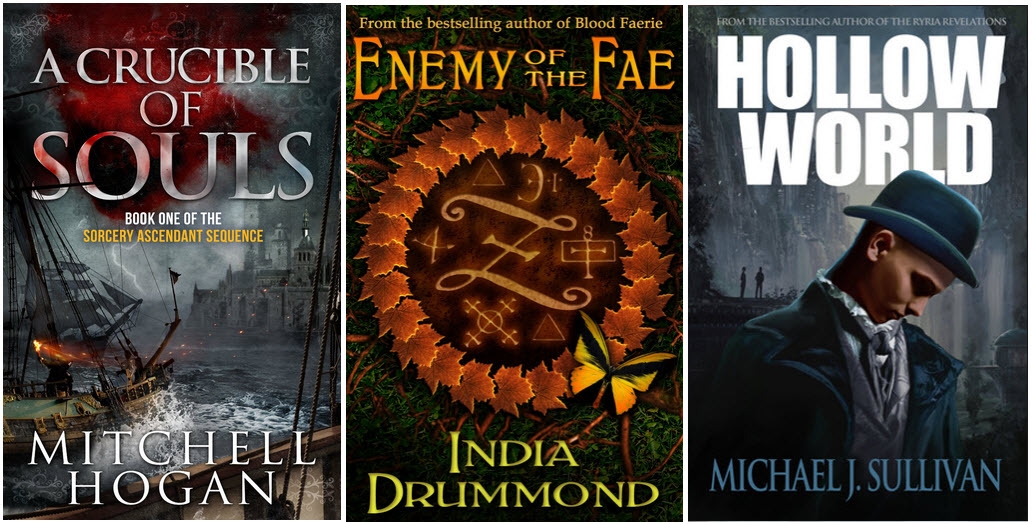
All self-published books — but with every bit of professionalism that New York puts into their own covers. I often report on the the bestselling epic fantasy titles and when Mitchell’s book started hitting the list, I had to dig a bit to determine if it was self or traditionally published — this should be your goal as well.
Don’t be a vanity publisher
What do I mean by that? A vanity publisher is one that could care less whether a book sells any copies. They are designed to do one thing, stroke a would-be author’s ego by putting a finished book in their hands so they can hold it up and say, “Look, I’m published.” A vanity publisher doesn’t care about quality or whether a book is “worthy” of being out there. All to often I see self-publishers doing exactly that. Slapping together something and hitting publish and dooming themselves to failure and adding to a see of dross. Again, I’ll hearken back to opening section. Real publishers focus on sales and cultivating a readership, so should you.
In conclusion
Self-publishing is not for everyone, and if you aren’t planning on doing it right, then don’t bother doing it at all. The world doesn’t need one more poorly edited, badly formatted, ugly book with substandard writing. Can it be viable? Absolutely. If done well, it can outperform traditionally published titles, but go into it with your eyes wide open. If you aren’t willing to do what it takes to produce something at the level of quality required, then seek traditional publishing and give up some of your profits to someone else to do what is needed. The world always has room for another quality book that is well produced. Keep your eye on that objective and, if you can deliver, there is no reason you won’t be successful.

Michael J. Sullivan is a speculative fiction writer who has written twenty-five novels and released nine. Eight of his fantasy books (The Riyria Revelations, and The Riyria Chronicles), were published by Hachette Book Group’s Orbit imprint. Hollow World, a science-fiction thriller was released by Tachyon Publications. The first four books of his new series, The First Empire, has sold to Random House’s Del Rey imprint, and the first book is scheduled to be released in the summer of 2016. He can be found on twitter, through his blog www.riyria.com, and on his facebook page and his publisher’s page for the series.








Excellent, if somewhat painful, advice! Tough love, perhaps. But self-publishing requires quality work if it is going to be anything other than a “vanity press” effort. In fact, one might argue it needs to be BETTER than what the big publishers are putting out if it’s to succeed. “Good enough” might work for some efforts, but not for self publishing. A self-published book must be as close to perfect as is humanly possible.
Glad you liked it. I agree with you that in many respects self-published books have to be twice as good to get half the credit.
I think I generally disagree with your post, sir.
First, bad Covers. Ever been to Goodshowsir.co.uk? It’s full of BAD, nay, HORRENDOUS covers put out by the mighty Publishing Industry. Bad covers are not unique to Indies (that’s what we prefer to be called, apparently. My guess is to avoid the Vanity Press association).
Secondly, there is absolutely no reason why any Indie can’t produce an edited,polished book that needs no one else to “fix”. I agree, many don’t pay to polish, it can show. But so can “professionally” published books.
No, the real difference between indie and Big Publishers is advertising. Big Publishers have deep pockets and can afford to get the word out on their books. They can get them put in store windows, prominently displayed on shelves, or run expensive print ads or even commercials. Most indies just starting out can’t do that. Which means we have to rely on LUCK to find our readers.
But you know what, even that is altered by genre choice. I am fairly certain you can write something that is fifty shades of crap, but as long as it is a smut/erotica book, it will sell. It’s literary porn, and there’s a HUGE market that doesn’t care whether it’s good, edited or has nice covers. The proof is in the numbers. The number of sales, that is.
For those of us endeavor to actually tell stories, we face the same kind of gatekeeper mentality Lit Agents and Publishers have subjected us to for decades when we foolishly throw our work into the slush piles. Readers are being told almost daily that indie = terrible. This article all but screams that- you’re implying that indies need to fix something that’s broken.
Being good didn’t get you published- being what some gatekeeper liked did. Similarly, if the brainwashing of readers would stop, we’d find them buying books based on taste and not following brand-driven, marketed pushes away from indies so the Publishers and Lit Agents can continue to prop up their dinosaur business model.
Business should be about providing what the customer wants, not telling them what they want. And writing is a business.
It’s good to disagree – it provides for a more well rounded discussion. I often disagree with posts.
I’ve not been to the site you mentioned – but I still stand by the fact that good covers are essential. Just because traditional publishing has put out some bad covers doesn’t mean that they aren’t important. Are the books you cite big sellers? I suspect not.
“Secondly, there is absolutely no reason why any Indie can’t produce an edited,polished book that needs no one else to “fix”.”
Almost every book goes through some form of critical review…either by the author(in a revision), a trusted friend, loved one, writing buddy, critique group, beta readers etc. I didn’t say you needed to “hire people” but the thought that a writer can sit down one day at page one…type until the end and then push publish is a ridiculous notion. But, no I don’t think you can publish a first draft and all that “good enoug” – well you can but I doubt you will find success in that.
“No, the real difference between indie and Big Publishers is advertising.” This just isn’t so. Most books released from publishers have NO marketing budget – zero, zip none. Co-op dollars (the thing that gets you special placement like an endcap, new release table, in the store window) costs a great deal and only a very few number of books get this additional money. Most books in these premium spots are books that have sold from authors who move 100,000+ copies. Print ads and comericials!!? I’ve seen maybe 4 authors with these in my lifetime: Steven King, James Patterson, David Baldacci, and Brad Meltzer. I think you might want to do some publishing research to get a REALISTIC expectation of book marketing.
People who say it is “all about luck” are generally people who haven’t made it…hence, “I wasn’t lucky.” Success is a direct result of hard work, writing a book that people love so much they spread the word, and then rinsing and repeating. As Jefferson said, “I’m a big believer in luck and I find the harder I work, the more of it I have.”
“I am fairly certain you can write something that is fifty shades of crap, but as long as it is a smut/erotica book, it will sell. ” It is true that romance and erotica have strong sales. But obviously that isn’t true. There are thousands of books in these genre’s that never earn any money. But I’m willing to be proven wrong. Go write one yourself and report back your sales figures. I’m gonna guess that it’s much harder than you think it is.
“This article all but screams that- you’re implying that indies need to fix something that’s broken.” I actually think self-publishing “done right” isn’t broken in the least. I, and many others have made a very good living off of how unbroken it is. But yes, there are 100 times more people who aren’t successful because the way they are approaching publishing is broken and won’t lead to success. This article is attempt to show them how to change their fortunes.
“Being good didn’t get you published- being what some gatekeeper liked did.”
I was self-published long before I was traditionally published and the only gatekeeper I had to prove myself to is the only one that matters…READERS. I’m pretty sure it was the strength of my sales that got me the traditional deal. I wasn’t writing in some mold they were trying to conform their readers to, I proved to them I could generate income.
Readers are anything but brainwashed. What they want is quality – and they don’t care from where that comes. But if you don’t present a well packaged product, and offer a good reading experience, they will find someone else that will. This article’s focus, as with the feature before this one which was addressed to traditional publishers, is on focusing on what the customer wants. No where does it address TELLING customers what they want.