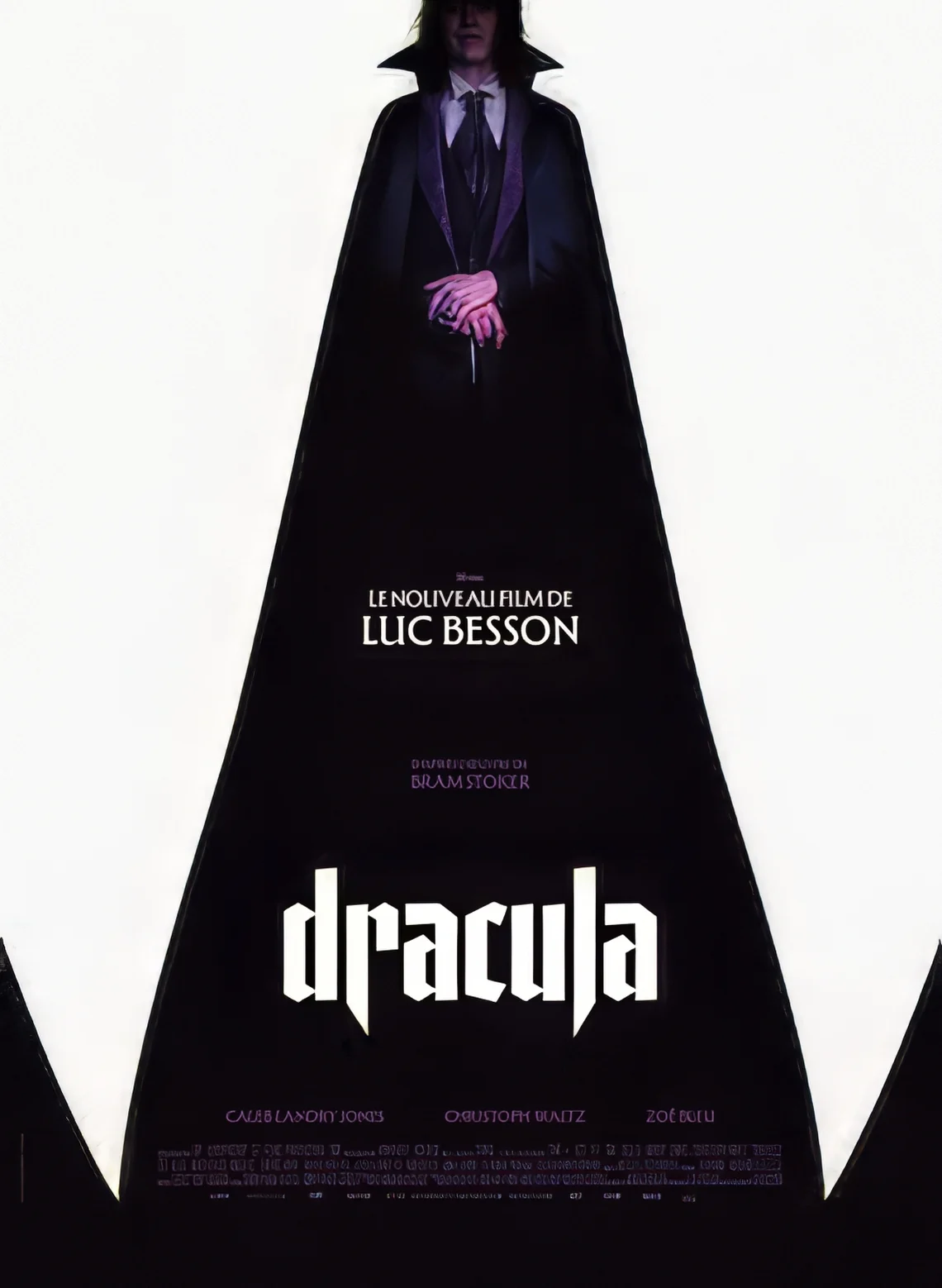
***Because the storyline is so well known, I’m not sure whether I should announce spoilers. So just in case, I will talk about this movie with spoilers, but if you saw the 1992 Dracula movie with Gary Oldman, you’ve already seen most of this one.
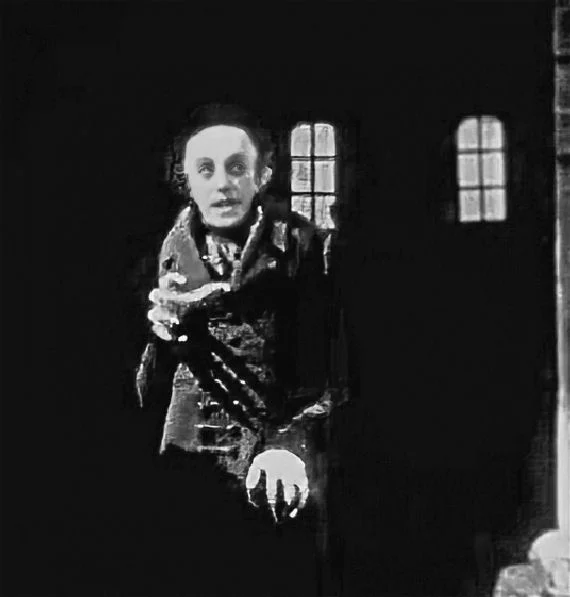
It’s hard to believe that anyone could think there was something new to be milked from Bram Stoker’s 1897 novel Dracula. I think the first film verision was F.W. Murnau’s 1922 unauthorized version, called Nosferatu (Figure 2) (in an attempt to ward off a suit—which it didn’t; Stoker’s widow succesfully sued Murnau and the studio); it is a brilliant silent adaptation of Stoker’s novel, which some feel is still the definitive movie version of the book. Click on the name for one YouTube link. Subtitled “A Symphony of Horrors,” and starring Max Schreck as the vampire, it stands as pretty much the first-ever full-length horror movie, even counting Thomas Edison’s 1910 Frankenstein, which was much shorter and not well adapted.
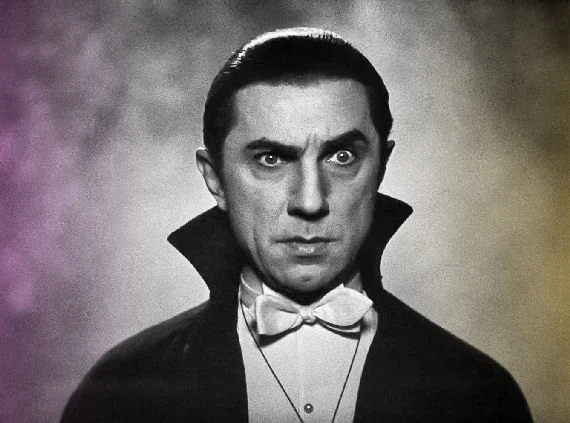
Drilling down to later versions of the main novel (not counting vampire movies that didn’t involve the Stoker Dracula), possibly the next significant version would be Tod Browning’s 1931 adaptation of the stage play of the same name, starring Bela Lugosi as Dracula (Figure 3). Lugosi had previously played the vampire onstage, and the movie was a popular and critical success. In fact, it’s a good bet that many moviegoers still view his portrayal as definitive. (Odd fact: Browning filmed the familiar version at Universal Studios by day; at night, the same sets and costumes were used in filming a Mexican, Spanish-language, version, that some prefer to the English-language version.) I have the “Universal Monsters” DVD set, but haven’t yet had the time or courage to watch the Mexican version all the way through. (I’m afraid I’ll like it better than the Lugosi version?)
There have been dozens of movies featuring the character; maybe the best-known ones were the Hammer films (British) with Christopher Lee as the vampire and Peter Cushing as his nemesis, Van Helsing. Played straight as horror/vampire films, they were extremely popular. There were also TV adaptations; my favourite ws the 1973 Jack Palance one—Palance has always successfully played a menacing role, usually as a mobster; his Dracula was almost animalistic. There were dozens of “Dracula” films not based in any way on Stoker’s book, but borrowing character/vampire traits from the Browning film, mostly. And let’s not forget the humourous ones, like Mel Brooks’ Dracula, Dead and Loving It (with Leslie Nielsen in the title role) and the “Blaxploitation” movies like Blacula with William Marshall; and Eddie Murphy as A Vampire in Brooklyn. The next most significant version, in my opinion, was 1992’s Bram Stoker’s Dracula, directed by Francis Ford Coppola, with Gary Oldman in the title role (Figure 4). The Coppola film is also significant, because Luc Besson’s critics say he copied a lot from this movie
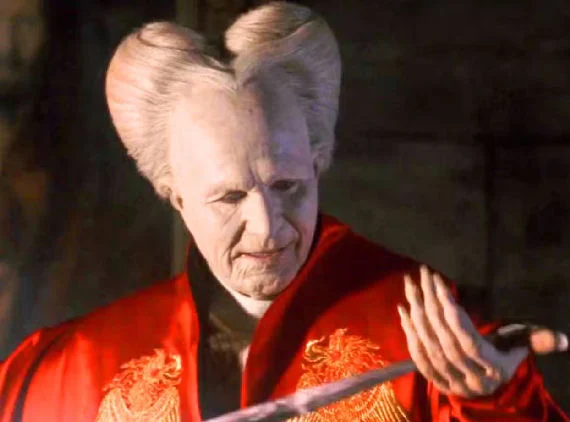
According to what I’ve read, Besson said that he thought the romance theme of the original book has been ignored in the previous film adaptations, and the book was actually about the love between Dracula and his bride. But according to Wikipedia (and we all know that source is unimpeachable, right? Ha.), the romance subplot is not in the original book. I haven’t read it for decades, so I can’t verify that; Wiki says that there was a sequel by Stoker’s heirs that brought in the subplot. However, it occurs the same way in this movie as it does, basically, in the Coppola film.
The movie begins 400 years ago in Wallachia, which is part of Romania, historically—although a) I think it would have been pronounced “Vallachia” because in many parts of Europe a “w” is pronounced like “ve”; and b) it appears that Romanians would have called it Țara Românească instead, so there’s a kind of fail right off the bat. Anyway, Prince Vlad (Caleb Landry Jones) is apparently a newlywed, because he and his Elisabeta (Zoë Bleu) spend most of their time in bed (or up against the wall, or in a chair—whatever) until his men break in to armour him and tell him he has to right the invading Turks. To keep her safe, rather than fortifying the castle to the hilt, Vlad sends her off on a horse iwth a 4- or 5-man escort, headed who-knows-where. Vlad tells the head priest that God had better keep Elisabeta safe or he’s in trouble (God, not the priest, we assume). Naturally, the Turks ambush her and her escort, who are all killed, and they catch her. Fortunately—well, maybe not—Vlad finishes the main body of enemies and catches up to her just in time to toss his sword at the Turk holding her, but… oopsie! The sword goes through him and into her and she dies. And now I see I’ve forgotten to show you Caleb Landry Jones as Dracula (Figure 5).
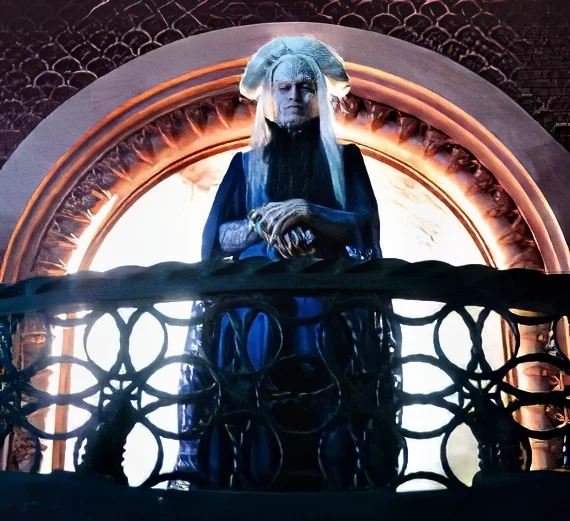
So Vlad gets all p-o’d at God and goes berserk, back to the castle, and swears that from now on he is God’s adversary, taking the name ”Dracula,” which means ”Dragon.” And says something like he will wait forever for her to be reborn. (This is fairly close to what happens in the Coppola movie.) 400 years later, we meet a lawyer named Jonathan Harker (although Besson moved the action from England to France, oddly enough, he kept the English names of Harker and his fiancée, Mina Murray) before his nuptuals, is sent to Romania/Wallachia to do a real-estate deal with Prince Dracula (no mere count, this guy. He proudly tells everyone he is a prince!).
Dracula’s servants are living gargoyles, little ones (not terribly convincing CGI, btw), and unlike the previous adaptations, there are no ”brides of Dracula.” Dracula’s about the kill Jonathan and drink his blood, when he (Drac) is talked into letting Jon live because his fiancée (surprise, surprise!) is the spitting image of Elisabeta! (Who woulda thunk?)
Sorry, I’m already starting to go off this movie at this point, because Drac looks somewhat like Oldman—elabourate hairdo and all—in the other film. But I wait. Drac gets ready to head for Paris to find his love he’s been waiting for, for 400 years—but he hasn’t been idle: he’s created lots of other junior vamps and a special ”no woman can resist it” perfume while he was waiting. So he eats a convent full of nuns—okay, he drinks their blood—to become young again, and heads off in a wagon full of his loyal subjects—Romanians who worship him, apparently.
If you’ve seen the other movie you can guess what goes on—there is no Van Helsing; instead Christoph Walz plays a priest who is part of an Order that has been tracking Drac for the last 400 years—it appears that all he has to do is sincerely apologize to God, and he’ll be allowed to die. And Walz has a boxful of stakes and hammers and stuff to help him along.
There is a celebration going on in Paris, but Drac (using almost the exact accent as Oldman, which I thought Gary had created himself), insinuates himself into Mina’s inner circle, aided by one of his created vamps, Maria (Matilda De Angelis), who’s replaced Lucy Westenra in this movie as Mina’s bestie. There’s a whole bunch of kerfuffle, and everyone ends up back in Romania at Drac’s castle, along with a whole bunch of (I presume) Romanian soldiers, who are intent on killing or capturing Drac and rescuing Mina, who by now has become the full-fledged reincarnation of Elisabeta. (Drac’s been using his hypnotic powers on her and she’s remembered her former life.)
You can guess the ending. I’ll leave that for your edification, and just tell you what I thought of the film. I thought that, overall, it was kind of okay, and kind of meh. The best actor was Christoph Walz, IMO, though Caleb was a good imitation Oldman. The plotline was unsurprising, as I had seen the Coppola movie; I don’t think Besson, whom I really respect as a filmmaker, added much to the legend or the filmography of Dracula. The CGI was, except for the dang gargoyles, okay by today’s standards. There was a long dance sequence partway through that not only didn’t really add to the movie, it kind of broke up the rhythm of the film. I still don’t know what to make of it. I can’t say I really recommend this as a canon Dracula movie; but I didn’t hate it. If you can stream it for cheap, go ahead; otherwise, wait for it to hit commercial TV.
NOTE: This column is in no way written, edited, proofed or composed by AI, though some of my photo editing software uses it in some capacity. This is a human column and will remain so.
If you have anything to say about this column, email or message me. I’m on Facebook, email me (stevefah at hotmail dot com), or just leave a comment here. Let me know whether you liked it or not—even if you hated it, let me know, please. My opinion is, as always, my own, and doesn’t necessarily reflect the views of Amazing Stories or its owner, editor, publisher or other columnists. See you next time!

Steve has been an active fan since the 1970s, when he founded the Palouse Empire Science Fiction Association and the more-or-less late MosCon in Pullman, WA and Moscow, ID, though he started reading SF/F in the early-to-mid 1950s, when he was just a sprat. He moved to Canada in 1985 and quickly became involved with Canadian cons, including ConText (’89 and ’81) and VCON. He’s published a couple of books and a number of short stories, and has collaborated with his two-time Aurora-winning wife Lynne Taylor Fahnestalk on a number of art projects. As of this writing he’s the proofreader for R. Graeme Cameron’s Polar Borealis and Polar Starlight publications. He’s been writing for Amazing Stories off and on since the early 1980s. His column can be found on Amazing Stories most Fridays.