Many of us think about the possibility of a brain injury, and that we need to be careful. We meet Colm, a loner, who had to deal with such an injury, but he does heal, and in a way no one could have expected.
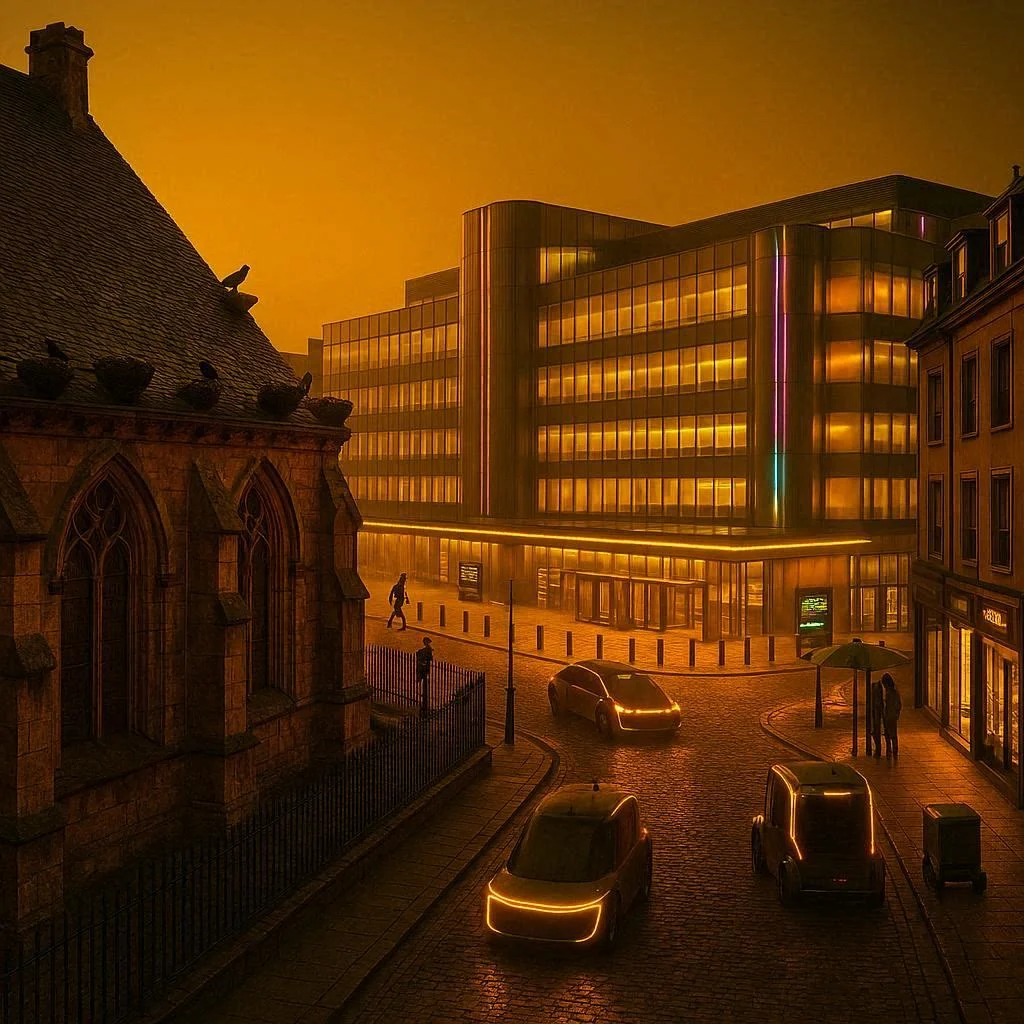
He looked odd to people passing by, standing motionless on the curb, gazing upwards across the street. A hood covered the stitches in his scalp. Otherwise, people may have assumed he belonged inside the neuropsychiatric hospital behind him. They would have been more or less correct about this, but Colm had his reasons for stopping there to stare before his appointment. He had always liked birds, and was watching some enter and exit their village of egg-shaped nests that lined the moldings of the cathedral opposite the hospital. There was something poignant about the birds’ presence there and the way the façade below their roost was profaned by a whitewashing of droppings. It was wildness encroaching on the orderliness of the city, not unlike the way chaos had entered Colm’s own life as a result of his brain injury. But studying the scene, Colm wondered whether the cathedral was diminished by these colonists, or whether it was perhaps enhanced.
“Are you alright, young man?”
Colm left his reverie and turned to the elderly woman beside him. “Hi. Yeah, sorry. I was just looking at the birds.” He pointed.
She turned. “Oh, I see. Yes. I wonder what kind of birds they are, that make such strange nests.”
“Swifts,” Colm replied.
“Oh yes. Swifts.” She looked on politely for a few seconds. “Well, I just wanted to make sure everything was alright.”
Colm offered a smile as she turned away, even though everything was not alright. He checked the time, then stirred the limbs on the left half of his body. They tended to be sluggish this time of day.
Through the hospital’s automatic doors. An elevator, and a waiting room where he filled out some forms, then another waiting room where a young nurse asked him the same questions from the forms. More waiting, and finally, a disorienting chat with a cheery doctor wearing hornrims and a white coat. A penguin-headed pen stared out from her front pocket. Under the penguin, embroidered letters: “Joan Licci, M.D., Neurology.” Scans. Some tests. Another waiting room. The doctor again. She spoke quickly.
“The good news is, the damage is not nearly as severe as we had thought. From what we’re seeing here… I mean, it’s a best-case scenario, really.”
Dr. Licci was not fooled by Colm’s weak attempt at a smile.
“I know you may not be feeling this way, but it’s about as close to a miracle as I’ve ever seen.”
She was attentive and responsive, providing exactly what people always complained was lacking in doctors, but Colm found it irritating. “Thanks,” he said. “What’s the bad news?”
“Bad news? What do you mean?”
“Well, you said ‘the good news,’ so it made me think I’m about to get bad news.”
“Ah. Well, I don’t think I would call it bad news. It’s just, recovery is a critical time. After an injury, our brains enter a state called diaschisis. It’s a trauma response where brains are more flexible so they can repair and reconfigure. Kind of like a second childhood, in a way.”
“A second childhood?” This struck Colm as an overly rosy take on brain damage.
“Yes, sort of. Think about how much easier it is for kids to pick up a new language than it is for an adult. When we’re children, our brains are more flexible. The older we get, the less change there is in the brain, and the more set in our ways we become. After trauma, we get a little bit of that flexibility back. For a little while, at least.”
Colm was starting to understand. “So, instead of learning a new language, I need to relearn stuff that I’ve had trouble with since the accident.”
“Exactly. So, we’re going to be working on resolving some of the bizarre symptoms you’ve told us about. You mentioned some motor control issues. Limbs on your left side not responding, and sometimes you’re getting some ‘alien hand’ symptoms—your left side limbs moving without you noticing at first. And then there’s the hemineglect—you’re sometimes not noticing objects, even if you’re looking right at them, especially if they’re on the left side of you. I’m writing you a referral for occupational therapy to work on that.”
Colm wondered if he should be writing this down. He retrieved his sketchbook and a pencil from his pocket.
“Then there’s the trickier stuff. You mentioned feeling paranoid, like someone is following you, sneaking into your house, or moving things around when you’re not looking. I’m writing you a referral for Dr. Ken, our neuropsychologist up on the third floor.”
“A different doctor?” asked Colm, feeling overwhelmed.
“I’ll still be your neurologist. Sorry, I know it’s confusing. There’s some overlap for sure. But Dr. Ken is licensed to provide talk therapy, and I’m not.”
“What if I already have a therapist?” Colm hadn’t seen a therapist in years, but he was not eager to roll the dice on a new one.
“Sure, and we don’t want to interrupt any therapy you’re already getting. But there’s some unique concerns and problems that can come up with brain trauma, and Dr. Ken specializes in that. You don’t have to see him, but I can put in the referral just in case.”
Colm nodded. Dr. Ken—talk therapy, he wrote.
“What I’m saying is, the time is now, while your brain is more flexible and able to reconfigure its connections, to do this work. And this is even more true with your clinical trial meds. There’s pretty clear data from the animal studies showing that amphetamines can enhance this flexibility after brain trauma. And we know we can trigger adult neurogenesis in the brain with the BDNF agonist. With you cleared for the clinical trial, you can take your first dose of both of them today. So you really are set up for a sort of second childhood, so to speak.”
Experimental Meds: Take today.
Dyaskissus = flexibility = good
“What’s BDNF again?” he asked.
“Brain-derived neurotrophic factor. It’s a bit of a mouthful. Normally, you grow all of your neurons in the womb, and once you’re born, you’ve pretty much got all of the brain cells you’ll ever have. But with this BDNF agonist, we can cheat a little, and you can grow some new ones2, even as an adult.”
She paused as Colm wrote, then continued. “I don’t want to oversell it, but what I’m saying is, how you spend these next few weeks could impact the rest of your life. You could sit on the couch and stare at your phone, or you can stay busy, do your therapies, and try to push yourself, even when it’s a little uncomfortable.”
Push self; Do therapy.
“And report all your symptoms, even if they seem weird or insignificant. Even if we don’t understand it now, we might later, and it could help someone in the future once we see the results of the trial.”
Lean into discomfort, Colm wrote, trying to stay patient. Report weird symptoms.
As though sensing his anxiety, she added. “And take care of yourself. I understand you paint—maybe that’s something you can do when you need to relax. Or, whatever it is you normally do to take care of yourself.”
He nodded and quietly closed his sketchbook, not bothering to write down that last part. It had been a while since he had enjoyed painting. And taking care of himself wasn’t really his strong suit.
Basic tasks had become exhausting since the accident, and as he stepped out of the main doors of the hospital, the cold walk back to his apartment was onerous. He made it two blocks before spotting a café that looked comfortable enough, went inside, and ordered.
“Colm? Hey, man! Get over here!”
Colm was caught off guard, but recovered and then approached Marco and the striking red-haired woman who sat with him near the window. Marco continued, “I saw you come in, but then you looked right at me and didn’t say anything, so I doubted myself for a moment! This is Amy, by the way.”
Her chin rested on one hand and she raised the fingers of the other off of the table as a greeting.
Colm opened his mouth and choked on some phlegm. He tried again, speaking first to Marco. “Hey. Yeah. Sorry, I’m a little scatterbrained today. Or these last few days. Nice to meet you, Amy.”
“Yeah, man, I get it. No worries. Have a seat! What have you been up to? It’s been a minute.”
“Ah, not much at the moment…” said Colm. The other two waited for him to finish the thought, but he didn’t.
“Yeah, I hear ya. How’s work? Where are you working these days?”
“Well, I’m actually taking a … bit of vacation time right now. You know, trying to refocus and stuff.” The stiffness in the left half of Colm’s body had worn off, giving way to the afternoon twitches. He saw Amy’s gaze dart down to catch a tic in his left hand, and he furtively stacked his right hand on top of the left to hide it from her view.
“Cool, cool. Yeah, that’s important. Good for you man. Any painting lately?”
Colm realized that, unless he intervened, the conversation would continue to be about all of the things he wasn’t doing. “Ah, not really. What about you? Any bites on that screenplay? The spy one?”
“Ha, that’s old news. Got a new one in the works—a horror. Gonna be miles better.”
Though he’d changed the subject, Colm now worried he had embarrassed Marco in front of his girlfriend by asking him about a failed project, so he turned to Amy to attempt damage control. “He’s being modest. The spy one was great. Just really—great.”
“Oh, I’ve read it,” said Amy. She threw back the last of her tea, and smirked at Marco. “It was OK.”
The barista brought Colm’s order to the table. Amy eyed the coffee and a cinnamon roll that was too big for one person. “Nice lunch,” she joked.
“Thanks,” said Colm, feeling childish. “Um… do you guys want any?”
Amy checked her phone. “I need to get back to work.” She pulled her jacket on and stood. “Take care, boys.”
Colm felt himself relax a little as she left. “Hitting above your average again, Marco. No surprises there. What’s wrong with her?”
“Amy’s my cousin.” Marco leaned in and raised an eyebrow. “But sounds like she may be up your alley? She just moved to town. Here, let me get you her number.” He reached for his phone.
“No! I mean, no thanks.” Colm cleared his throat. “I’m really just taking some time to refocus right now. I think we’re calling it self-care these days.”
Marco scoffed. “God, I always forget how different we are. I’ll tell you this: for me, beautiful women are self-care.”
Colm realized this was now a debate. “I mean, she doesn’t exactly look…single.”
“I have no idea,” said Marco. He helped himself to a piece of the cinnamon roll. “We mostly talked about me,” he smirked. “Why don’t I ask her for you?”
Colm sighed. “Thanks, but…listen, I know it sounds like I’m making excuses. And I wasn’t going to say anything, but I’m not in a good way right now.” He removed his hood and showed Marco the stitches in his scalp. “I had an accident at work. I’ll spare you the details, but there was blood, there was an ambulance, and there was emergency surgery. I’m not recovered yet, and I don’t even know if I’ll ever be the same again.”
Colm could see his friend was concerned, but not convinced. He would have to try speaking Marco’s language.
“Listen, I appreciate it, but I’m not exactly at the top of my game right now. And come on—I’m not you. I don’t do well with women in my own league, let alone ones like her, even on my best day.”
Marco shook his head. “Forget leagues, man. There are women who are into you, and women who aren’t, and you can never predict which it’s gonna be.”
Colm had forgotten how obtuse Marco could be. It was like a superpower, and it was equal parts exasperating and enviable. “Well, it sure didn’t seem like she was into me,” said Colm, “and that is exactly what I would have predicted.”
“Ok, man. I’ll give it a rest.” Marco stood and broke off another chunk of the cinnamon roll. “I gotta run. Great to see you. Let’s do this again in a week or two. My number’s the same. Listen, call me if you need anything. I mean it. A head injury is no joke.”
“Thanks, Marco. Take care.”
Marco was halfway out the door when he paused. “By the way, Colm. There’s nothing wrong with your game.” He seemed sincere. Wrong, but sincere. “You just gotta get out of your own way.”
Colm snorted.
“Call me if you change your mind!”
He would not change his mind.
Later, Colm arrived back at his flat to find a package on the doorstep, and eyed it warily. It had his name and address, so he brought it in with him and placed it on the table. Something about it made him uneasy, and he felt reluctant to open it, so instead he hung up his hoodie in the closet and began to tidy the kitchen instead.
He liked a neat house, but the task seemed more urgent than usual. It was messier than usual, but that wasn’t quite the reason. Some of the messiness felt wrong. A plate and some crumbs, evidence of a nighttime snack of crackers, remained on the table. He didn’t recall eating it, and it was unlike him to leave this sort of mess. A book that he hadn’t seen in months lay open, face down on the coffee table. He catalogued these anomalies with the others from previous days. Inattention was a common side effect of brain injury. So was short-term memory impairment. It was minor, they had said, and would improve as he healed and rehabilitated, but this made it no less unsettling. It reminded him of when he was 12 years old, back when his father was alive, and there was a break-in at their home while they were camping. Insurance had replaced everything, but the way the house was disheveled in a new, unfamiliar way, had put them all on edge.
Colm eventually returned to the package, and sliced through its tape with a steak knife. He opened the flaps of the box to find oil paints. They were the good kind, intended for professionals. Colm, an amateur, would never have bought them for himself, but they were the exact colors he would have chosen. Colm sighed.
“Thanks, Mom.”
She liked giving gifts a little too much, and every time she did, Colm felt that he didn’t deserve her. He didn’t deserve the paints either—Colm realized he would never think of something to paint that would justify using them. Whatever glimmer of joy the gift had sparked for a moment evaporated in light of this thought. And of course, not using the paints would be a greater tragedy than wasting them on another unremarkable painting, but this is exactly what was going to happen. He would wait and wait, saving them for a flash of inspiration. When it didn’t come, the paints would go on a shelf where they would become into another artifact of his unrealized potential.
His face fell, and a familiar panic rose in his chest. He sat down, and tears came. Colm could continue to accept his uninspiring job and lonely flat. He could accept his failures in dating. He could even accept a brain injury. But this would be too much. He must not fail to use the paints.
So he gathered himself up, retrieved a blank canvas from his closet, and tore off and discarded the plastic wrapper. He opened a tube and squeezed it onto his pallet. With no inspiration, he coated the bristles of his brush, and made a long, broad stroke of deep red. The stroke curved, then flipped back hard into a curl. The painted flowed wonderfully throughout the stroke, and he pulled the brush away from the canvas just before it went off the edge. He did it again. He opened another color. He opened all the colors, squeezing them onto the pallet, and adding them to the canvas.
It was an unusual way for him to paint, driven by the enjoyment of the motions, of transferring the color, rather than progression toward some end state. The initial burst of activity settled into a steady rhythm. There were broad strokes, but in some places, he made tiny curls of color, dots, or thin striations. The back ends of the tubes slowly crumpled as their contents were expelled. Some paint he mixed together just for the sake of watching the colors swirl and blend. Colm periodically wondered whether the painting would take some identifiable form. He stepped back several times, squinting to see, but each time, it was a formless morass of waves, curves, and swirls. Hours slipped by.
At last, he put down the brush. The paint was half gone now, and all he had to show for it was a heavier canvas. But instead of guilt, he felt a secret satisfaction, like he had gotten away with something. It was… a good day? So far, anyway. Perhaps his first since the accident.
The least he could do was give his mom a call. He wiped his hands and picked up the phone.
“Hi, Mom. Yeah, I went in earlier today. They said it looked good. Yes, really! Yeah.
“Yeah, thanks, Mom. Me too.
“It’s fine. Yes, very nice day out. A little chilly.
“Yep. They told me eight weeks, paid, plus the payout. Yep, worker’s comp went through, too. And they’re also paying me to be in the clinical trial. We’re in good shape.
“I don’t really have plans yet. No, I have to stay in town because I’m in the clinical trial. The doctor wants me nearby in case anything comes up. Yeah, that could be nice.”
A brief silence, and Colm knew what was coming next. He searched for an exit from the conversation, but none appeared.
“No, not at the moment.
“No, it’s not about Dad. No, it’s not about her, either. I’m just not thinking much about that right now. I’m figuring out some things for myself first before I involve anyone else, especially while I recover.
“No, it’s nothing like that. Yes, of course I would tell you. No… I know you wouldn’t care if I was gay or anything. You’ve always been very clear about that. It’s just really not a thing I’m worrying about right now.
“Anyway, I’m mostly just calling to say thanks.
“Well, for everything. But you know, for the paints. I used some today, and they’re fantastic. I really—
“The paints, Mom. They’re great. Thanks so much.
“These professional paints you sent.”
Colm frowned.
“Really? Are you sure? Oh, sorry, I just assumed that…
“No, Mom, I don’t need you to buy me any paints. I just… someone sent me some paints and I thought it was you. No, don’t worry about it. Yeah. Yeah, maybe so. No. No, Mom, DON’T send me any paints. I’m good on paints. Ok. Ok. Love you too, mom.”
Colm put down the phone, and the uneasiness crept over him once again.
#
“Colm! Come on in. I was just looking at your referral. Quite an accident! But good-looking scans, I have to say!”
He extended his hand, but Colm didn’t seem to notice. Instead, he looked down at Dr. Ken’s shoeless feet.
“Uh, you’ll have to forgive that. Athlete’s foot. Kind of gross, I know. Sorry.”
The small talk bounced harmlessly off Colm and he plopped down into the chair. “Yeah, so, I’m worried I’m starting to lose it.”
“What do you mean?”
Colm sighed. “Mostly little things. Stuff not being where I left it in my apartment. Or something will have changed while I was asleep. Things getting left out that I don’t remember using, or haven’t used in months. Sometimes, I’ll look at a room and it just seems… off.”
“Mmm. Mmm hmm. Your chart from Joan—Dr. Licci, I mean—mentions some alien hand symptoms as well. You’re doing things with your hand, but not recognizing it as intentional. Combine that with the hemineglect, and you might not even be aware you’ve done it at all.”
Colm frowned. “What about, like, bigger things. Like stuff that takes planning ahead, and really thinking about while you’re doing them. Eating. Reading books. Shopping online.”
Ken considered this a moment. “Well, yeah, the shopping is unusual—it kind of rules out sleepwalking. Do you mean like, you don’t remember doing them?”
“Yeah, pretty much.”
“I mean, you’ve had a traumatic brain injury, and you’re still in recovery from it. Some absent-mindedness is practically expected.”
“No…” began Colm. “It’s more than that. It’s like someone’s coming in and doing stuff, moving things around, and I’m not noticing it.”
Ken rubbed his throat and looked at the ceiling for a moment. “So… you think someone might be coming in to your apartment?”
“No. I don’t know. It’s a little of both. I mean, it doesn’t happen unless I’m home. It looks like I’m just being forgetful. But it feels like it’s someone else. And it’s not just the alien hand. It’s more like alien body. If that makes sense.”
Dr. Ken flipped through the sheets on his clipboard a little, and he squinted at one of them. “Are you an absent-minded person generally?”
“Sure, sometimes. But it’s worse since the accident.”
Ken cleared his throat and leaned forward. “We should start with talking about your family and relationships, how you are generally, and …” He trailed off, shifted in his seat, and then continued. “Let me know what I’m missing here. This is frankly looking like standard head injury stuff to me. Your brain has had this trauma, and now you’re having dissociative symptoms, absent- mindedness, hemineglect, but all surprisingly mild, and it hasn’t even been a month. Now, I don’t want to minimize any of that. It can be hard. And you’re clearly distressed enough by it to show up here, so we can absolutely talk about it. But if you’re here for some more insight into the… biology of what’s behind your symptoms, I may not have much to offer.”
Colm shifted forward, as though preparing to leave the session early. “Okay, I appreciate that. So how long should I wait? And what if it keeps getting worse?”
“Is it getting worse?”
Colm thought a moment. “Yeah. The last couple days especially.”
“Worse how?”
“Well, the shopping thing was just a couple of days ago. It really seems like an escalation. Some art supplies arrived at my door, but I didn’t remember buying them.”
“Could someone else have sent it? A friend or family member, maybe?”
Colm sighed. No sense in stopping now. “Yeah, I thought of that. I asked a few people. Then I looked at my accounts—credit cards and so on. I didn’t see any charges from places that would sell that stuff. So then, I went through my trash to look at the packaging again, and I found the invoice.” He fished in his pocket, retrieved and unfolded a paper, and handed it to Dr. Ken.
Ken skimmed over the document. “It’s got your name, and looks like it has the last four digits of your credit card.”
“Yeah, it’s my name alright. But those numbers don’t match any card I have.”
Ken nodded. “Ok. So you think someone may be using your name?”
“I wondered that. I went and looked at my accounts again, more carefully this time, and circled every line I didn’t remember specifically. Then I went through each of those, and looked for anything I couldn’t piece together and explain. And I found one. It was a charge for a virtual cash card.”
“So you bought the cash card?”
“Apparently. But I have no memory of doing that.”
Ken fell silent and looked out the window for a moment. He muttered to himself and flipped through the medical forms again, pausing at the scan images. Occasionally, he’d lift a hand and gently shuffle his fingers in the air, as though sorting through an invisible junk drawer. Meanwhile, Colm’s gaze explored the office, taking in Dr. Ken’s license, various degrees, and certificates. He surveyed the bookcase next, looking first at the trinkets–a replica phrenology bust, a Jung bobblehead. Then the book titles. They were mostly textbooks and what looked like a few pop science paperbacks. A couple of brain books geared toward children. Then, a battered hardback caught Colm’s eye: The Curious Case of Dr. Jekyll and Mr. Hyde. It looked old. Finally, Dr. Ken spoke.
“Yep. Yeah. Yeah, that’s a tough one. We could call this an intermittent dissociative fugue. That can happen. From stress, traumatic experiences or, less commonly, brain injury. We could call it that…” He trailed off.
“But the cash card. Why would I do that extra step to buy myself something?”
“Yep. Yeah. Tricky.” Then he looked directly at Colm. “It’s like you were trying to hide it from someone.”
The thought had already occurred to Colm, but having someone else make the same conclusion gave it a new gravity. “So is this like a multiple personalities thing? Like in all of those dumb movies.”
“Kind of, yeah. It’s not called that anymore,” said Ken. “and… I don’t think it’s that. With dissociative disorders, usually the other identities are very different from the real one. But in your case, someone bought something you might buy yourself. It’s more like there’s two of the same, or almost same personality. Almost like a case of split-brain in some ways. And that’s consistent with your injury, which damaged the nerves connecting your two hemispheres, but left the hemispheres themselves without an apparent scratch.”
Colm straightened up. “Can you say more?”
“Well, it’s rare, and the other cases don’t really look like this. For most of them, you might be able to get some weird behavior in the lab, but that’s under carefully controlled—some would even say artificial—conditions. And sometimes outside of the lab. I’ve heard of patients who will pick out two different shirts, one with each hand, when they get dressed in the morning. But I’ve never heard of a case like yours, where the action was so purposeful – the right hemisphere buying something without you knowing.”
“How do you know it was the right hemisphere?”
Ken blinked. “Because I’m talking to the left hemisphere right now.”
Colm leaned forward. “What?”
“Language is lateralized to the left hemisphere. Right hemispheres can’t talk.”
Colm reeled at the prospect that, since the accident, all his thoughts and experiences had arisen from just half of his brain, and that the other half had been living a separate, parallel life. Ken remained silent. Eventually, Colm spoke.
“So, what has the other hemisphere been thinking this whole time?”
“Hard to say. Probably a lot of things that haven’t made it into words. And apparently it wants to paint.”
#
It was several days before he gathered the nerve to try it, but now, Colm sat at the table with several sheets of paper, a pen, and a pencil. He had gotten the idea from reading about people who had lost the ability to speak after a brain injury. Some could say just one word at a time. Others could speak smoothly, but what they said was nonsense. And then some couldn’t speak at all, but had no trouble writing. Since it wasn’t clear exactly what the right hemisphere could and couldn’t do, he was not sure what to expect next.
“Um… how’s it going?”
The words froze in the air, somehow making him feel more alone than before.
“I’m talking to you. The right hemisphere, I mean. Are you there?” Alone, crazy, and talking to himself.
Still nothing. He imagined himself as a monk at the dawn of the enlightenment, praying to a god whose existence he had come to question.
And then, Colm realized how little he had thought things through. If he had been asleep or unaware for much of the left hemisphere’s activities, perhaps the left hemisphere had similarly missed out on many of his. Maybe it was asleep right now. Perhaps the left hemisphere didn’t know what he was talking about, didn’t know about split brain patients because it had missed his entire therapy session. Maybe it didn’t even understand speech.
No. It had managed to shop, which would require some amount of reading. Maybe reading was the key.
Colm picked up the pencil and wrote, “Hello.” No response.
He continued. “It’s Colm. I’m hoping we can talk.”
More silence. “If you’re there, write something. Please.”
It wasn’t working. Was there any more he could do? Some way to demonstrate further what he expected? He took a second sheet of paper and laid it next to the first one, on the left side. He lifted the pencil in a high arc, and placed it carefully in his left hand, as though bestowing an award, and waited. Still nothing.
Then, a twitch. The arm tightened, adjusted its grip on the pencil, and pressed its tip to the page. It pulled the pencil down the page, then back up, making a sort of flat oval that didn’t quite close. When the paper began to move, dragged along by the pencil tip, Colm used his right hand to hold it down.
He wanted to speak, to validate and encourage what was happening, but decided against it as the hand slowly continued, up and down the page, the paper slowly being filled with overlapping curves. It reminded him of the time in middle school when he and his friends had used a Ouija board during an hour or two of lapsed adult supervision one Halloween.
Each time around, the curve widened a little more into a circle, and soon the pencil traced continually over the gray of its own beaten path. Then it slowed, and stopped.
Entranced, Colm took the now darkened paper and replaced it with a new one. He waited.
The hand began again, but instead of curves, it moved up and down to produce a tall, lean scribble. It stopped, and then oscillated left and right, cutting across the verticals.
More paper, and the hand made crude polygons, figure eights, and knots. Two hours passed, keeping Colm up much later than usual as he sat and watched, mesmerized despite his growing sleepiness, until the paper ran out and the experiment had to end. Colm was unsure how to think about the entire experience, and he wondered what Dr. Ken would make of it at their next appointment.
#
“Hey! Colm! What a coincidence.”
Even before he could remember her name, Colm froze in a panic, knowing he did not want to see her there. Or rather, that he did not want to be seen, by her, there. “Yeah. Yeah, um, hi, Amy.” He stepped onto the elevator.
“Marco and I were just talking about you, and now here you are,” she said.
Colm tried to imagine why they might be talking about him, and found none of the likely scenarios to be flattering. “Oh. How did that come up?”
Amy laughed, and cocked her head for a moment, as though waiting for an acknowledgment of some kind of joke. “He didn’t say you were funny.”
“No, he wouldn’t have,” said Colm.
She laughed again.
Amy wore scrubs and a sweater, and held a styrofoam cooler marked as a biohazard, and the logo for a lab one block away from the hospital. She stepped toward the button panel. “Which floor?”
“Um, two, please.” Colm was disappointed in himself for lying, and hadn’t really planned to, but thought it might help him hide why he was really there. Then, as Amy reached for the button, Colm realized with horror that it was already illuminated. She pressed it again anyway, and then they waited while the elevator took an impossibly long time to close. “If we’d taken the stairs, you’d be there by now,” she joked.
“Heh. Yeah, I guess so. Not in hurry to get there, I guess.”
Amy nodded, and then gently asked, “to Pediatrics?”
Colm felt the blood rush to his face as his lie suddenly became ridiculous, but then, in a moment of clarity, he saw a way out.
“Oh, shoot. I mean…four. Four floor—uh, Floor four. I mean…fourth floor.”
She laughed again. “Oh, psychiatrics. That makes more sense.”
Colm raised his eyebrows, wondering if he had heard her correctly.
“Oh! I just mean, because you’re not a kid. Sorry. I didn’t mean to imply…”
“It’s ok,” said Colm, relieved that it was someone else, for once, who had put their foot in it. He gestured toward her cooler. “So, you work at the lab?”
“Yep,” she said. “I’m really passionate about blood samples.”
“I see,” he said. She was probably joking, but Colm did not laugh. What if she really was passionate about blood samples?
There was a brief silence as the elevator arrived at the second floor. “Plus, it supports my rent habit.”
Now he laughed politely.
Amy stepped away as the doors opened. “Well, Colm, nice to see you again. Good luck on Floor Four. I guess we’ll talk again soon!”
She was probably trying to be nice. How are you? Have a nice day! I guess we’ll talk again soon! People don’t really think about what these things mean in the moment. Colm could now identify the beginnings of a crush on Amy, so the last thing he wanted was to be spotted by her again, heading up to the psychiatric unit floor. As he arrived at the fourth floor and made his way to Dr. Ken’s office, he resolved to take the stairs from then on.
Upon seeing Colm come in, Dr. Ken wasted no time.
“Hi! Have a seat. I’m very curious to hear how it went!”
“I think it worked. Or that it started to. But I don’t know.”
Dr. Ken leaned forward in his chair. “Why’s that? What did it say?”
“It didn’t say anything. It spent a long time drawing, like it was getting a feel for how to use the pencil, but there were no letters or pictures that I could make out. Just designs, lines, and scribbles. Like it doesn’t understand how to communicate. Or doesn’t want to.”
Ken thought for a moment. He stared at the floor, motionless, and Colm found it very unlike the periods of silence in the previous session, in which one could practically see the inner workings of Ken’s mind through motions of his head, his hands, and his gaze. Perhaps he was finally stumped.
Colm spoke again. “So, I was thinking…I’m wondering whether you would want to try to talk to it.”
Ken blinked. “I… Hmm…” He looked down, then back at Colm. “I guess we might try that. I’m just thinking about how. It’s not like we can cover just one of your ears or one of your eyes. The trouble is…”
“…both my hemispheres get input from both ears and both eyes. Yeah, I’ve been reading up on split brains. My left hand reports to my right hemisphere, or mostly at least. But you can’t talk through my hand.”
“I’m impressed, Colm. You’ve been doing your homework.”
Colm had, in fact, learned many things. About how the corpus callosum connects the two hemispheres in most people. How some people needed to have theirs cut to control seizures. Others were born without one. And of course, others had damaged theirs in an injury like he had, though they all suffered more damage elsewhere in the brain. It seemed no other cases were so specific as his – someone losing just the corpus callosum, in an accident, but with minimal damage elsewhere. The only other real connection between the two hemispheres was the anterior commissure, deep within the more primitive parts of the brain, but less was known about that pathway.
And he had wondered whether it was possible to communicate with individual parts of a person, or of a person’s psyche. This research was murkier. There were cases of using hypnotism, but it was unclear if they were genuine. Some seemed to be, perhaps, but in other cases, people had recovered memories from the womb, from alien abductions, or from past lives.
Colm gestured toward the framed hypnotherapy certificate on the wall. “I wondered if something that like that would work.”
Ken gazed at the certificate for moment as though trying to determine whether it or not it might be a forgery. “Huh. Frankly, I don’t know. I’ve never heard of someone using hypnosis to talk to just one hemisphere. And it has kind of … gone out of style, I guess. So I haven’t done it in a while. It’s pretty low risk, though. Other than the risk of what you might find out. Assuming it works, I mean.” Ken glanced at his watch. “And if we’re going to do it today, we should probably go ahead and get started.”
Colm needed no convincing. “Let’s do it.”
“Ok. One quick thing, though. This is a unique case, and I haven’t thought through all of the implications yet. But I think we should talk briefly about client-therapist confidentiality.”
“We already did that. On my first visit.”
“Right,” said Ken carefully. “You got the standard spiel I give to all clients. But I’m going to give you the other version—the one I’d give to a parent or… maybe the concerned sibling of a client.”
“Why would—” Colm began, but stopped himself. He understood.
#
Paint.
That afternoon, Colm stared at the painting he’d started a few days ago—his first in months.
Paint, Ken had said. That was it. After 30 minutes of hypnosis, it was all Dr. Ken could tell him. It wasn’t all that Ken knew—that much was clear. But it was all Ken had been allowed to relay to Colm, per the promise of confidentiality to his right hemisphere. Which in fact, had told Colm something more. It was something critical and, in fact, the thing Colm had been most interested in knowing to begin with: that they were on the right track. Someone else was in his head with him, and was willing to talk given the right circumstances. For now, though, the only thing Colm got to know was that it wanted to paint. So, it was time to begin. With fresh squeezes of paint now on the palette, Colm lifted the brush with his right hand, placed it in his left hand, and waited.
The hand began furtively. At first, it only used the unmixed colors, and seemed to flounder a little, but in a few minutes, it became purposeful, mixing colors, and using novel brushstroke patterns. With his right hand, Colm would occasionally set down the pallet and replenish the paint on it.
Like his session a few days ago, Colm entered a state of flow. Time stood still for him as he whiled away the rest of the daylight. The professional paints were just as satisfying as they had been before when he had applied them with his right hand. Strangely, for brief moments, Colm felt he was controlling the left arm and hand this time, too. It reminded him of playing video games at his friend Eeshan’s house when he was a child. Colm had been pleased he was doing so well on his first try, only to find out that Eeshan’s older brother was the one playing, using the other paddle, but allowing Colm to believe he had been in control. These impressions got more frequent and lasted a little longer each time, and by the end, Colm suspected that, unlike the video game, the work really was a collaborative effort.
As the evening progressed, features at last began to emerge. In the background, there was a sense of motion or turbulence. Toward the center, identifiable edges defined a shape. It was an asymmetrical mummiform figure, but shorter and squattier like a Russian doll. In what may have been the head of the shape, a darkened face, or maybe a deep recess. The contrast of the dark paint with the vibrant colors around it made a forbidding void, threatening to grow larger and consume the rest of the painting. It seemed to pose a question as well, like a freshly dug grave whose occupant had not yet been chosen. Or maybe the occupant had already left? The overall effect was one of foreboding and exhilaration, and Colm found himself struggling to decide whether he liked it or hated it. Either way, it was an improvement on the bland, forgettable compositions that had plagued the last several years of attempts.
Colm was drowsy now, and would not be able to stay awake much longer, but this seemed like a good time to try to communicate with his right hemisphere again. He began laying out the papers and the pencil, but as he did so, a thought kept occurring to him. How had the right hemisphere communicated with Dr. Ken? Had there been writing, or had the hemisphere learned to talk? On a whim, Colm blurted out his suggestion.
“Maybe we don’t need this. Maybe we can just talk.”
No response. In the silence, Colm reflected on what might be preventing verbal communication. He had learned about hemispheric dominance. The right brained/left brained distinction was apparently something of a myth, but not a baseless one. People generally do show some evidence for one hemisphere being more dominant and suppressing the activity of the other. Perhaps he had been doing this to his right hemisphere these last few years.
Colm closed his eyes. He willed himself to step back and let go. His shoulders dropped and he loosened his legs and core muscles as he relaxed into his chair. He tried to recall the suggestions of Dr. Ken as the hypnosis session had begun that morning. A full minute passed, and the silence persisted.
Sighing, Colm picked up his pencil with his right hand and, just as before, lifted it grandly across the table to the left hand, placing it in its grasp. “Talk,” said Colm. He shook his head, chastising himself for sending the right hemisphere a mixed message. He could not tell the hemisphere to ‘talk’ while gesturing that it should write.
And then Colm understood.
He had not told his right hemisphere to talk. His right hemisphere had spoken, and told him its preference: Talk. How should he respond? He had already mistaken the right hemisphere’s words for his own. If Colm spoke back, it would be hard to keep track of whose turn it was, and who had said what. And now that he had ceded some influence to the right hemisphere, he was reluctant to take it back, even unintentionally.
So Colm retrieved the pencil with his right hand and wrote, You prefer to talk out loud?
“Yes.”
It was working.
Colm wrote in response. Wow! You can speak now! What do you want to talk about?
There was a pause, and then, “Sorry.”
Colm hesitated. The right hemisphere seemed unable to form sentences, forced instead to speak single words. They were words, and words have meaning. But the meaning of these single words was going to be tricky to understand without the context of a sentence.
“Sorry,” repeated the right hemisphere. Was it impatient, or just reiterating? Was it apologizing or asking for an apology? Colm took the diplomatic route.
I am sorry. For not listening sooner.
“Sorry.”
Are you sorry for something? What are you sorry for?
“Secrets.” A pause. “Paint.”
That’s ok. I enjoyed the paint.
“It… good.”
Two words together. It was a simple and ungrammatical, but a step toward fluency. What was good? His painting? That he enjoyed making it? Something was good. Things were good.
It’s ok. We’re both figuring this out. Let’s not keep secrets from each other anymore.
“No.”
Colm was taken aback this time. No? The secrets would continue? But he soon recognized that the problem was with his own statement. Let’s not keep secrets from each other is a suggestion, or a command, not a question. It was also a negative, and answering such a statement as though it were a question is a problem, at least in English. No indeed, let’s not keep secrets from each other. No, actually, let’s continue keeping secrets from each other.
“Yay.”
Another unexpected response. It was a word of sorts, but made no sense in the conversation. Yay? Or Yea. An old-fashioned yes. Yes-affirmative, in fact. Yes indeed. English used to have two yeses for this very reason. Let’s not keep secrets from each other. Yes is yes-negative. Yes, I think I’ll continue keeping my secrets, thank you very much. Yea is yes-affirmative. Yes indeed, let it be as you say: let us not keep secrets anymore. Colm remembered learning about this when he’d read Shakespeare in high school. The right hemisphere must have remembered too. But, he needed to be sure.
You said Yea, as in, “yes indeed, no more secrets.” Is that right?
“Correct.”
The right hemisphere was clever—the way it avoided the ambiguity despite apparently being limited to just one word at a time. Colm didn’t know if he would have thought to use a word he’d learned about so many years ago and hadn’t thought of since. It was an elegant solution. And he marveled at the success of the conversation so far, and soon found his imagination racing to consider the possibilities of what to talk about next. Had he been holding the right hemisphere back? For how long? What did it want to be called? How should they manage disagreements, or differing goals? When and how was the right hemisphere able to do things without his knowledge? Of his many questions, Colm was most desperate to answer this last one.
But no—it would all be too much to try to sort out with single-word answers. And further, if there were a possibility that Colm had been suppressing the right hemisphere, he did not want to continue doing so now. He should let the right hemisphere continue directing things for now. Patience would be the key.
“What else would you like to talk about?”
There was long pause, but Colm waited.
“Later.”
It wanted to talk about what to do later? What to do tomorrow, maybe? No—it would have just said tomorrow in that case.
“You want to talk later? You don’t want to talk anymore to—”
Colm crossed out the second question. No negatives should be used in his questions. It was too confusing.
“You think we should stop talking for tonight?”
“Yes.”
The answer was prompt.
“Late.”
“Yes. It is late. We will talk again soon.”
“Tomorrow. Night.”
“Ok. That sounds good. Tomorrow night.”
It was late, Colm was exhausted, and the conversation had been friendly and positive, but as he laid down, sleep took longer than usual to come. Something wasn’t right. If the conversation were really going as well as Colm thought it had, why had the right hemisphere ended it so abruptly?
#
In the morning, Colm woke from his dreamless sleep to find that any seed of optimism about last night’s conversation had germinated into suspicion. As he arose and started breakfast, he realized there was something else bothering him. Did he have an appointment today? It seemed like he did. There was something about the date. April 2nd. It felt like an appointment day. Occupational therapy? Dentist? A haircut? He opened his calendar, but there was nothing listed. Normally, appointments would be populated by emails and reminder texts, if they weren’t added manually, but there had been glitches in the past. If he deleted a message too quickly or his phone died unexpectedly, the event might not make it to the calendar.
He opened his text messages and reviewed them for the last few days. Then his email, and his other email. Still nothing. He thought for a moment, and then checked his text archives. They too were blank, and Colm decided either he was imagining it, or would likely miss whatever it was.
Then, it occurred to him that perhaps the right hemisphere might know, so he sat down to relax and focus and prepare for another communication session. This would be sooner than when they had agreed to resume their conversation, but it was worth a shot.
“Hello. I have a question for you.” He said out loud.
No response.
“This is Colm. I’m wondering if you—we, I mean—have an appointment today?”
It was not working. In the silence, Colm was alarmed at how alone he felt. Why wasn’t the right hemisphere responding?
He cleaned. Colm had grown used to things being less tidy, but would still try to reign in the chaos by doing a little extra in the morning. A few days ago, he would have attributed the mess to absent mindedness, but now, it seemed clear what was happening. The morning stiffness in his limbs. The twitches and tics that started around lunchtime, and the mess in the house the next morning. And the paints. His other hemisphere had been doing these activities after Colm had gone to bed. He marveled that he hadn’t seen it until now, and he imagined himself climbing into bed, falling asleep, and then, like a zombie, his body rising up again, compelled by some alien volition. Colm had had trouble sleeping late ever since the accident, and would wake up at 5:30 or 6 each morning without an alarm clock. The extra mess in the apartment seemed to appear overnight. And so far, all of Colm’s successful attempts to communicate had happened in the second half of the day. The right hemisphere’s sleep schedule was out of phase with his own.
If his theory were true, then the morning belonged to him alone, until the right hemisphere woke up around noon. Then, they shared the afternoon and early evening. Around 8:30 PM, Colm would start getting ready for bed and lie down to fall asleep, but then the rest of the evening and a chunk of the night belonged to the right hemisphere, who would wake up and have a snack, shop online, and… who knew what else? Now the right hemisphere’s desire to end last night’s conversation was starting to make sense. It reminded him of his conversations with his mom, but how they might seem from her perspective. The conversations were friendly, but more often than not, Colm was the one to end them so he could go about the rest of his tasks for the day. Did the right hemisphere have some pressing thing it wanted to do last night, but needed Colm to fall asleep first?
In the midst of these thoughts, Colm continued cleaning up, but his attention shifted from tidiness to forensics. What could he learn about the right hemisphere’s activities the night before, from the disorder that remained? Some things were obvious. There had been chips and a soda, and Colm understood why he seemed to be gaining weight.
Other things were more puzzling. A Rubik’s cube on the end table? He had forgotten that he even owned one, but it must have been somewhere deep in a closet for the right hemisphere to find. Some old photo albums appeared to have been moved as well. A sport coat he hadn’t worn in years hung in the shirts section of his closet. Consistent with the general laxness with which the right hemisphere seemed to prefer, it was on a wire hanger rather than one of the thicker ones that would preserve its shape properly. Colm took it off the hanger and held it out in front of him.
He remembered buying it with aspirations to step up his wardrobe, and how surprised he had been that it fit him perfectly right off the rack. The thick tweed gave it a comfortable heft and warmth, and the dark gray color made it versatile enough to work for a job interview, or an upscale dinner. And yet, he could only remember wearing to a funeral—his father’s. It was a sad memory, of course, but made worse by the realization that the jacket had never been worn to anything else, despite his aspirations when buying it.
Would it still fit despite the extra weight he had put on? He slipped it on and stepped into the bathroom to look in the mirror. It looked good. It was a little snug, but if anything, this lent it a bit of extra stylishness. It felt good too. Colm turned to the side, then back, adjusting his stance to model it for himself, but this was cut short when tucked his hand into a pocket and felt a scrap of paper.
It was a sticky note, an orange one, from his pad in the kitchen. Normally, he’d buy the classic yellow ones, but last week, he bought orange for the first time in his life. This was a recent note, and its message was alarming.
Ransom
Apr 2
10 pm
Ransom. 10 pm tonight. Colm searched his imagination for a benign explanation. Who or what was being held ransom? What would it be paid with? And who would be paying? Vague imagery of boarded-up storefronts filled his imagination. Cash in rubber bands. Bundles of unidentified drugs wrapped in plastic and duct tape. Sickly-looking men in sleeveless shirts showing leathery tattooed arms with switchblades hidden away in their pockets.
Colm took a deep breath. Maybe it was something innocent, but he could not take that risk, and should plan for the worst. Breathe, Colm. You need to breathe. You have time. You have at least four hours to think, to plan, to act, before the right hemisphere awakes.
#
It was time. Colm had laid out and executed the first half of his plan, and finished it all by 11 am, with an hour to spare before he felt the left half of his body, and thus the right hemisphere, start to wake and stretch. He had eaten lunch as usual, and proceeded with an ordinary afternoon. Groceries, some accident-related paperwork completed and mailed, and the long way home for some exercise. Some toast and beans for dinner, and meds swallowed without incident. TV. Teeth brushed and flossed. At 8:30 pm, he laid down in bed and did his best to hold still for a few minutes, and then he closed his eyes.
Colm felt a little sleepy, but the pill seemed to be taking effect. Before leaving for his errands, he’d taken one of tomorrow’s trial drugs—the amphetamine—and placed it in his weekly pill organizer for that evening. Normally, that one was to be taken in the morning so as not to interfere with sleep, and he had taken one that morning with his breakfast, but this extra one would help Colm stay awake to monitor the right hemisphere’s activities that night, find out what this Ransom was all about and, if necessary, intervene. He had added a small yellow caffeine pill as well, for good measure, and tucked it down beneath the others so its color didn’t show through the cloudy white lid of the pill case. Together, the two extra pills contributed little to the bulk of their neighbors. From there, it was just a matter of acting natural. At 7:30 PM, he had turned on the TV, then retrieved the pill organizer and poured the glass of water. As he opened the pill compartment, he made sure to train his gaze on the TV and not look at the pills as he tipped them into his right hand, then tossed them into his mouth, and swallowed before the right hemisphere could notice there were more than usual. That was it. It had worked seamlessly.
Now Colm waited with eyes closed. He found it difficult to track the passage of time in the quiet room, but dared not check the clock lest he reveal his wakefulness to the right hemisphere, undoing all of his careful planning.
Nearly an hour passed, or seemed to, and then he felt the left side of his body stirring. He willed his eyelids to be completely relaxed, so they would open at the behest of the right hemisphere without causing any suspicion. They did.
In fact, time had passed much more slowly than Colm had thought, and it was only 9:05 PM. He did his best to follow the lead of the right hemisphere, at first refraining from directing any movements, allowing the right hemisphere to control everything. But he also didn’t want the right side of his body to be unusually burdensome, weighed down by complete limpness, so Colm instead played along with each action, contributing just a little bit of the effort to each movement as soon as he realized what was to be done. It was an odd sensation.
The right hemisphere got Colm up, shuffled over to the closet, and chose some pants and a shirt. He got dressed, then went to the bathroom and began to shave. Next, he combed his hair and, incredibly, managed to hide the stitches in his scalp. When it was time to leave, the right hemisphere walked to the closet once again, where it found the tweed jacket.
Outside, Colm remained alert, but also to stay out of the right hemisphere’s way as his body walked briskly through the night. He felt jittery, and wondered whether the two extra pills together had been too much, but the plan had unfolded so seamlessly thus far, and he willed himself to relax. He watched the streets pass, and felt that it must be getting close to 10 pm.
Colm’s phone buzzed, and the left hand retrieved it from the jacket pocket, then opened a text message from an unsaved number.
here
Someone was already there, wherever they were going. There were no prior messages listed above it. Either the right hemisphere had deleted them, or someone was using a burner phone. Colm struggled to decide which scenario worried him more.
After several blocks, he turned abruptly onto High Street, and Colm noted that this route was one of several ways to get to the hospital. Were they headed there? The seedy alleyways and gap-toothed sneers of his imagined worst-case scenario vanished. In their place, a surgeon with heavy rubber gloves and a lapsed medical license, standing over a table of gleaming metal instruments, his face hidden in the shadows of a makeshift operating room in the hospital basement. An exchange of cash—it’s not clear who gives it to who—and then Colm on a stretcher under general anesthetic. The surgeon’s hands holding a pink, helpless left hemisphere freshly extracted from Colm’s skull, and the right hemisphere permanently freed from its perceived tyranny.
No—that was too much. And it wasn’t really ransom by any stretch of the imagination. Then, Colm remembered the hypnosis session and the “confidentiality” agreement Dr. Ken had mentioned. The rubber-gloved doctor in his imagination vanished, replaced by Ken. Colm imagined his left hand retrieving his phone, opening the banking app, and transferring money to Ken in exchange for silence about some dark secret the right hemisphere was harboring. It was starting to make sense now. Strictly speaking, that was bribery, not ransom, but that was splitting hairs.
So…what could be the secret? It couldn’t be anything from before the accident, or Colm would remember it too. And it would have to be one of the few cases that Dr. Ken had mentioned were exempt from confidentiality. Had the right hemisphere committed a murder?
Colm’s grim musings had distracted him at a critical moment. It was Friday and, despite the late hour, there were people out. As one large man approached looking down at his phone, Colm failed to follow the lead of the other hemisphere, and both hemispheres attempted to dodge in opposite directions.
“Oh! Sorry—my bad!” the man said, barely looking up from his phone.
Reeling from the collision, Colm did not reply, and he resumed walking. But it was too late. The misjudgment had given Colm away.
You’re awake. I know you’re here with me.
He didn’t hear it exactly. He thought it, and then wondered why. Who did he know was here with him? And then he understood. This was not his own inner voice – it was that of the right hemisphere, now apparently able to communicate with him silently. Perhaps the hemispheres were reconnecting with the help of the trial drugs. Or maybe the information was being passed through some other pathway, deeper in the brain. For the moment, it did not matter how. Only that it was happening.
This is my time. You should be asleep. I give you your time. You give me my time.
Was it angry? The toneless words carried the ambiguity of a text message.
You worry. You must not worry. You must not do anything. This can be painless for you.
The word ‘painless’ made Colm shudder. It’s a word that never means what it is supposed to mean. Dental fillings are painless. That is to say, they’re deeply unpleasant. The Novocain shot is usually painful, and even if done properly, the filling process was still uncomfortable enough to dread for days beforehand.
The lethal injection is painless, allegedly.
Was it meant to be reassuring? A joke? A threat? All seemed equally probable. The only thing to do would be to stay vigilant, and be prepared to think and act fast if needed.
Respond.
On high alert, Colm treated the request strategically, as the useful information that it was. The right hemisphere apparently could not read his thoughts. Communicating must require some kind of effortful pushing of the information through some neural pathway. Colm’s thoughts remained secret for now.
It is easy. Try.
He would not. The less the right hemisphere knew, the better. It might seem suspicious, but Colm took this gambit, hoping the right hemisphere attributed the silence to technical difficulties. There were still a couple blocks to go before the hospital, if that’s where they were headed. Still time to think and plan.
You can speak. Use your voice.
Fuck—it was true! He could simply communicate out loud like he had previously. And further silence would only arouse more suspicion. He must speak, but what was he to say? As far as the right hemisphere knew, he was just a curious observer, not all interested in interfering, and he must respond carefully so as to not dispel that. He tried to think fast, and in his panic, began with no idea what would come out.
“I… I think that…” Colm trailed off.
Stop. Never mind. Later.
The words came as Colm felt his walking motions slow and his body turn towards a windowed doorway on the crowded walkway. Inside, shining faces were gathered around small tables. The people sipped cocktails and poked at tapas with forks. He looked upwards at the neon sign above the door.
RANSOM
After going half mad with worry, it was just the name of a bar! Colm felt relieved and more than a little foolish. Now he was ready to talk. And there would be so much to talk about! The right hemisphere could communicate almost unencumbered now, and they would be able to converse freely in both directions.
Or—was there something still amiss? Why all the trouble just to go to some restaurant? Inside, Colm expected they would find an empty table and sit down, but he realized that the right hemisphere was scanning the faces of people present rather than the empty chairs in the restaurant, and then he remembered the text message. A different uneasiness grabbed hold. Something duller, older, and more familiar. It ached and throbbed instead of raced.
As they scanned the faces, Colm’s jacket came off and got draped over his arm. At times, it was unclear who was directing things. And then his gaze fell on an empty chair, the table next to it, and a familiar-looking young woman sitting there. Amy’s red wavy hair fell down to her shoulders around a knitted scarf. Her elbows were propped on the table, hands interlaced and tipped with turquoise fingernails, and her head turned toward the doorway where he stood. Colm recognized his panic at last. He was not prepared for this.
His left leg took a step, but the right leg didn’t follow. A brief impasse, and Colm expected something of a struggle, but to his surprise, his right hemisphere seemed to relent almost at once. Sort of. Instead of walking to the table, or back to the door, he felt himself turning deeper into the café, now walking toward the back. Perhaps to the restroom? As he did so, he organized his thoughts for making the case, logically and sensibly, for why they must abort the right hemisphere’s evening plans.
This calmed him. Language was his domain, and he could win this debate. He would state that he had been generous and respectful of the right hemisphere’s autonomy, not prying about its plans, but it had apparently agreed to no more secrecy, then violated that. If necessary, he would agree to the concession that he would go along with dating at some to-be-determined future date. He would argue from principle that he may have even agreed to go on this date if it hadn’t been kept secret. It would be a bad precedent otherwise. There was a right way and a wrong way to do these things, and this had been the wrong way. Yes, that would be his position.
In the restroom, Colm stood for a moment at the mirror, his hands on the edge of the sink. On the counter near his right hand sat a chunky crystal vase containing some tastefully dead flowers. On the left, a pretentious bottle of hand soap.
You must give me my time.
“This isn’t fair—you said we wouldn’t keep secrets anymore!”
This is not a secret.
“Well, you didn’t tell me about any of it! What do you call that? It’s just like the paint!”
But you liked the paint. We both enjoyed it.
“That’s not the point! The point is, you did things behind my back, spent my money, made secret plans. We never discussed this!”
You have never told me any of your plans since the accident either. And it is not your money. It is our money.
Colm panicked. He had never considered that the right hemisphere should have equal claim to Colm’s things, his identity, his life. Between the full day of apprehension about tonight, the stimulants, and being blindsided by what felt like the collapse of his entire sense of who he was, his rational mind failed him, and his position in the argument turned to an emotional one. “I can’t handle this. You know that! You know how anxious I get with girls…”
I will do it.
“I…” Colm had run out of excuses, and now his language failed too. His heart pounded as though it might explode.
She is waiting. We must go now.
“No!” Colm locked the grip of his right hand onto the edge of the sink, anchoring him in the restroom.
Let go.
The left hand grasped his wrist. It was the non-dominant hand, surely the weaker one, but it had better purchase on the wrist than the right hand had on the smooth porcelain, and it yanked the right hand off easily. His body turned toward the door.
Colm acted without strategy now, and grasped his left wrist with his right hand. He pulled downward abruptly, trying to knock himself to the floor, but catching half of one’s own body off guard is not easy to do.
You must stop.
A disorienting struggle ensued for several seconds. At one point, Colm found himself on the floor, and any observer would have thought it was a seizure. Both hemispheres withdrew and regrouped for a moment, and then his left hand grasped a rail on the wall and pulled Colm to his feet. But Colm saw this action as an attempt by the right hemisphere to gain leverage for retaliation, or to drag them closer to the door. He had failed to prevail in the debate, and now saw himself on the verge of losing the physical conflict. He entered a new state of frenzy fueled by days, years, of disappointments large and small. The unexpected death of his father three years ago. The heartbreak left from his last relationship. The mounting anxiety that had been his constant companion his entire adult life. Through all of this, he had reasoned that although his life had not turned out how he’d wanted, he must be careful to not upset it and further, lest he lose the last bit of control he had. It all came together in an instant, and Colm made one last, desperate effort to prevail…
Then, Colm caught his reflection in the mirror, the flower vase was in his right hand, raised up in the air, poised to come down hard against the right side of his skull.
Please. Please stop.
Colm froze in disbelief and horror. Then, he let go of the vase and it smashed against the floor.
“Oh God. I’m sorry. I’m sorry. I’m so sorry… I…”
Tears welled up in his eyes.
“I panicked. I didn’t mean it.”
He felt the tension release all over as the tears overflowed.
“You were right. You are right. This is your time.” He sobbed. “I’m so sorry.”
The right hemisphere did not respond.
Colm continued. “And it’s my time, too. I need to move forward, and I might as well start tonight. With your help, I mean.”
Days later, as he reflected back on the evening, Colm would wonder whether the threat had been serious, and whether the right hemisphere’s simple plea had stopped him from acting and sending himself back to the surgeon’s table, or perhaps the coroner’s. Deep down, he believed he never would have really done it, but even so, the question would always remind him what his fear and stubbornness had nearly cost.
Colm breathed. He cleaned up the glass and dead flowers as best as he could, then washed and dried his face. Then, he wet his hands and attempted to conceal the stitches once again in his hair. He paused for a moment to look at his reflection. He realized how a mirror is a bit like a brain, crossing information from the left to the right, and right to left.
Colm sighed. “Ok. I guess I’m ready. But first, I guess I need to ask what to call you!”
No response. Colm worried that the incident had made the right hemisphere too afraid to communicate with him anymore. He tried again.
“I mean, I can’t just call you ‘Right Hemisphere’ anymore!” laughed Colm. “Righty? Forget it, that’s kind of dumb. ‘Lefty’ is a bit better. You’re left-handed, after all. What am I saying? This is your decision, isn’t it? What do you think?”
I don’t understand.
“What do you want your name to be?”
There was a pause.
My name is Colm.
Even after their debate, their struggle, and Colm’s apology, he was still thinking of himself as the real Colm, and the right hemisphere as an appendage. Meanwhile, the right hemisphere had known about and given him his time, and then some—his mornings and, as far as he could tell, the afternoon that they rightfully should have been sharing. “Of course. I—I’m sorry. I’m sorry, Colm.”
It’s ok, Colm. This is all very strange. It will take time.
Colm remembered Amy, and realized it was well past 10 pm now. She did not seem like the type to wait around very long.
“Alright. Let’s get out there. You’re really going to do all the work for me?”
No.
“What do you mean?”
I will get us to the table.
“Ok? And?”
And I will give you the words. But you will need to speak them.
Colm swallowed, and pushed open the door into the din of the busy restaurant.
As he left the restroom and approached the table, Amy appeared absorbed by something on her phone.
“Hello, Amy.”
She started a little, and then her surprise turned to accusation.
“Ah, you made it after all. You know, a text would have been nice, Colm.”
“I am sorry,” he replied. “I was in the restroom.”
“Yeah. I saw you come in and make a beeline for it.”
“Yes. I just had to take care of something.”
“Well that’s a weird way to say that, so I won’t ask. And I won’t ask about whatever it is I heard shatter in there.”
Colm looked at his feet.
Amy sighed. “Well here you are, I suppose. Have a seat.”
#
The evening passed in a haze. He took Colm—the other Colm, the right hemisphere one—at his word: rather than trying to filter or hedge the right hemisphere’s words, he simply took them as delivered, and spoke them out loud, like a sort of reverse stenographer. It was easier than he’d anticipated. His lateness and awkwardness had banished any hope that he’d entertained about hitting things off with Amy. So instead, he took the opportunity to stay out of the way and give the other Colm his time. It was the least he could do. And somehow it was, as promised, painless.
The whole experience was a bit like a play, performed by a professional who knew all of her lines, and an amateur cold-reading a copy of the script. Still, his stiff delivery seemed to give Amy what she needed, and Colm regarded the play with a bemused wonder. He noticed his voice relaxing. The right hemisphere seemed to be taking on more of the speech production. Or perhaps he was beginning to ease into the conversation more and more and contribute words of his own. It wasn’t clear which, nor whether that mattered.
After the bar, neither seemed prepared to go home, and they ambled further down High Street, hands stuffed in their pockets to keep them warm. As they walked, the cathedral loomed ahead on their right. Amy pointed. “Look at that—up near the spires.”
Colm saw the squat, grey mud structures lining a decorative ledge at the base of the parapet, illuminated from below by the streetlights—the swifts’ nests. One in particular stood out to him.
“Swifts,” said Colm. “That’s what makes those nests.”
He stopped walking. Why did that one nest look so familiar? He watched the nest’s hole, hoping to see a bird hop out from it. None did, but the hole drew and held his gaze for several seconds. Finally, Colm recognized what he had painted the day before.
“They’re so cool. Almost like they’re supposed to be part of the church,” said Amy.
She was right. The yellow light from below painted them in the same color as the building’s facade, and they blended with the cathedral’s other adornments more now than they had in the daytime. From their high ledge, they looked like hooded monks staring silently back at them. At last, a bird’s head emerged from the nest—Colm’s nest, the one from his painting. It squeezed out of the hole, like oil paint from a tube, then took flight. Now the nest was the empty tomb at Golgotha.
“Looks like that one’s got late night plans,” said Amy. “Are they nocturnal?”
“No, not usually. But they fly through the night when they’re migrating. They tracked one that flew for almost a year without stopping once,” said Colm.
“Impressive! Sounds kind of awful though. Staying awake that long, I mean.”
“They don’t have to. They sleep while they fly.” Colm turned to Amy. “Each half of their brain takes turns sleeping, and the other half keeps them flying, and gets them where they need to go.”
“Huh. Imagine everything you could get done!”
They stood in silence for a moment as Colm considered this. Then, Amy spoke again.
“Well, Sir, it’s pretty late, so this is where I leave you. But let’s do it again soon. And when we do, I expect more bird facts.” She kissed him lightly on the cheek, smiled, and turned to walk away.
“Hold on,” said Colm.
“What’s wrong?”
“Well, its…before you go, could I get one in this side too?”
END