We know that the computer guys in so many shops are a little leery when a woman walks into their place of business. “Oh, what do they know?”, they’re thinking. “They’re out of their element here.” Well, read this story and we can all be leery, but for very, very different reasons.
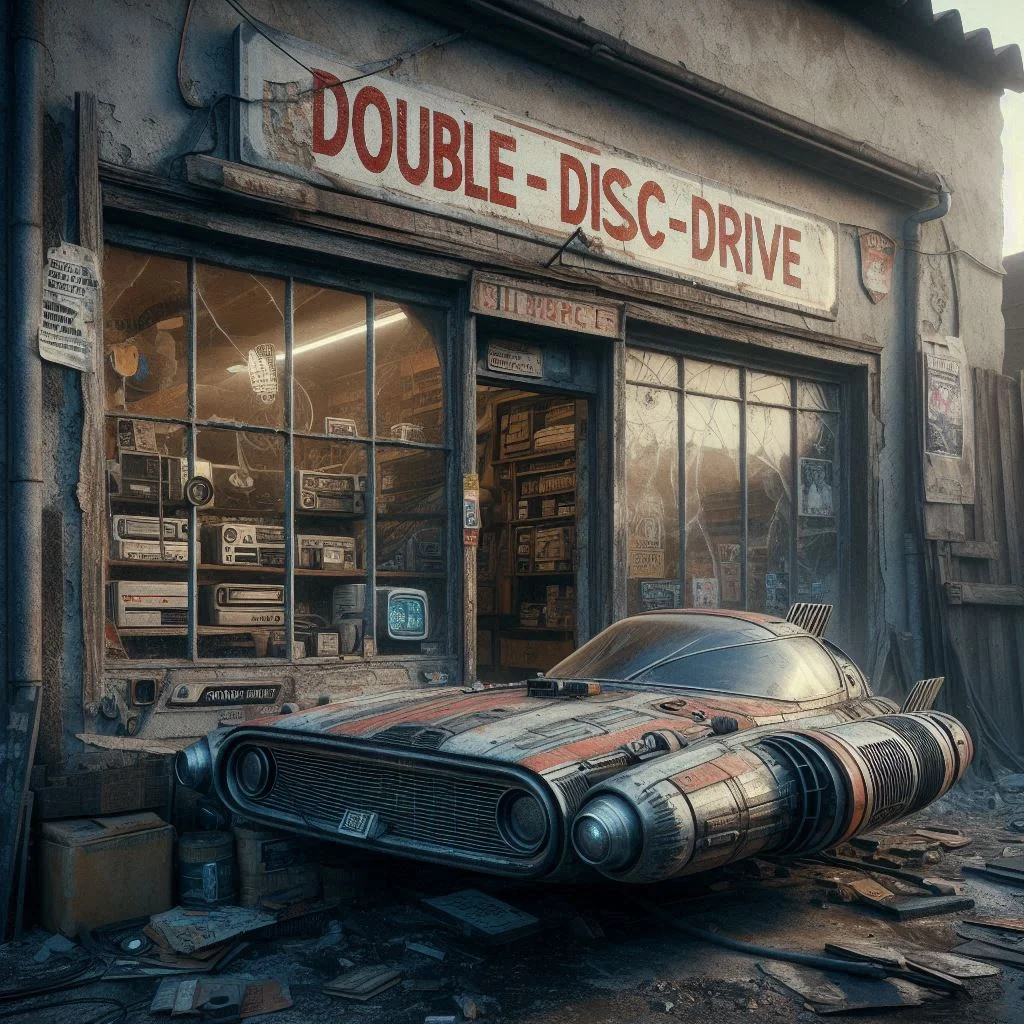
A thin man with curly brown hair watches me enter 3D Enterprises. He’s sitting behind a counter at the back of the shop, hands frozen over an old-style mechanical keyboard. “Welcome to Double-Disc-Drive,” he says uncertainly.
“Three D,” I say, “I get it now.” There are hard drives stacked on sagging wooden shelves around the walls. A phalanx of chest-high commercial servers is marshalled in the centre of the floor. Monitors with screens covered by an oily sheen of dust fill the display window. I see why he’s named his shop after three-thousand-year-old tech.
“You’re Norton?” I walk towards the counter, as confidently as my recovery from an economy-class trip to this outpost allows. There are urine burns on the inside of my thighs from a badly-fitted catheter–it’s more efficient if the cheap seat passengers don’t get up to go to the toilet.
“Yes.”
“Great. You were not easy to find.” Wierpia is a bumpy two-hour drive from the transport hub. And this isn’t exactly the centre of town. “I’ve got a bit of an unusual request.”
“Sure,” his face lights up. “We’ve got a lot of rare gear.”
Sweetie, I think, you’re not exaggerating. It’d be hard to find a more useless collection of clapped-out electronica. But I’m not interested in his antique tech. “I’m Clementine, by the way, and I’m told that you are the man I need to talk to about the blockchain for Wierpia.”
He looks disappointed. “That’s right. As well as selling premium vintage technology, we collate the receipts from our fellow citizens’ transactions and make sure that the records are entered on the database.” He glances warily at a dishevelled pile of papers and envelopes in front of him—as if it were well known that short plump middle-aged women with sore legs often travelled across continents to steal paper records from honest block administrators.
I don’t care about his papers either. “I’m wondering,” I say, “if you have a copy of the original block for Wierpia’s chain?”
“Um, yeah,” he says. “It’ll be out the back somewhere.” Over his shoulder, there’s a doorway with multi-coloured plastic strips hanging over it to keep the flies out, or in, depending on which section of the store is dirtiest at the time. “Why do you want it?”
I’m about to explain that I’ve just inherited an account number and key from a dearly beloved maiden aunt, and that I suspect that a modest inheritance lies unclaimed in Wierpia’s blockchain, when a voice from the workshop behind the counter interrupts this lie.
“Norton, has the mail come with Cranston’s puzzle?”
“Yes, yes,” Norton stutters, “it just came in.” He turns to me. “You’ll have to excuse me for a second, it’s time to mine for a new block, and Simon needs the number.” He picks a manila envelope off the counter, and disappears through the plastic strips. Then there’s a thump as someone knocks into something solid, a clatter of debris cascading onto the floor, and the sound of anxious swearing.
I put my head through the door and see Norton on his hands and knees searching among fifty or so antique floppy discs that are scattered on the floor. Above him, on a wooden workbench that stretches the length of the back wall of the shop, is a rather large server with a touch screen soldered onto it. It’s hooked up to a variety of other servers and portable devices, including about ten external disc drives.
“What disc is it again?” Norton asks. He holds one up to read the label.
“Five hundred and eighty-six,” says the AI who is running the server—obviously Simon. “Come on, mate, we need that program every time we mine for a block. Put it somewhere where you can find it.”
“I had them in order,” Norton says. “But the tray…” He looks helplessly at the floor and scattered discs. “I’m sorry.”
“Can I help?” I ask. I get down on my hands and knees, with some difficulty, and shift through the discs. Some have numbers. Others just have titles such as store inventory, company credits, payroll runs, and serious incident log.
“Who’s she?” Simon asks.
“She just got here,” Norton says. “She asked about the genesis block.”
“Cranston isn’t going to be happy about that,” Simon says. “You didn’t say that she could have it?”
“Obviously not,” Norton says. “If we find the disc, and you solve Cranston’s puzzle, we’ll take her to meet him, and she can ask him herself.”
“Here it is.” I carefully hold up a disc with the number five-eight-six on it. I’m not sure how fragile three-thousand-year-old plastic is.
“Oh,” Norton says, “thank you so much.” He takes the disc from me and puts it into a drive two places from the end of the string. “Okay, little buddy, do your stuff.”
“Umm,” Simon says, “unless you want to read out a four-hundred-digit number, you’d better scan this month’s simply fascinating puzzle into me.”
Norton pulls a sheet of paper from the envelope, and presses it against the touch screen. There’s a flash of light, and the floppy disc starts to spin in the drive. “And don’t forget to log the start and end times of your run,” Norton adds. He turns to me. “This will take a bit of time. Would you like a cuppa?”
“If you don’t mind me asking,” I say as he opens a draw under his desk for the tea bags, “what’s going on with Simon’s tech?”
“You don’t know?”
Honestly, I have no idea why someone would rig an AI up with this kit. “No,” I say.
“Cranston kind of doesn’t really trust AIs, especially ones that weren’t built by Beardstone and Sons. He reckons that if we don’t watch them, they’ll suck the value out of Wierpia’s chain and use it for themselves. So, he doesn’t allow AIs to be connected to the data-plane.”
I’d heard that the Wierpia block wasn’t connected to the plane. That explained the paper and scanning the puzzle for mining a new block—and of course, why I’d had to travel here in person. But not the rig. I look at the linked floppy disc drives and smile encouragingly, “So why all this old tech and those disc drives?”
“I got Simon pretty cheap,’ Norton says, “he’s really old…”
“Hey,” Simon says from the back room. “I can hear you.”
Norton drops his voice. “And he’s large even for an AI. I don’t have a lot of money, so I cobbled something together from the stuff I had. This old tech’s pretty reliable if you keep the maintenance up to it.” He pauses. “You know, in many ways, it’s better than new tech. If something breaks, it can be replaced.”
I look at the string of spinning disc drives, laptops, tablets, and mobile phones connected to a rusty server, and the six-inch floppy discs stacked on every available surface on the bench. I sense that I’m about to get a lecture on what appears to be Norton’s favourite topic. “I see,” I say to head that off. “And disc five-eight-six?”
“That’s where the maths part of Simon is. We have to sort out which bits of Simon we want to activate each morning. Today, it’s the maths bit so he can find the two highest primes that multiplied together give the number I scanned in. It’s Cranston’s favourite puzzle,” he confides.
#
I follow Norton as he trundles down a coarse asphalt road that wanders from 3D Enterprises to the town centre and Beardstone and Sons headquarters.
Norton has loaded Simon, or at least a substantial segment of Simon, into a portable computer. Maybe portable is a kind description. It isn’t really a portable computer in the commonly understood sense of a device that can be easily picked up and transported. It’s a bulky hard drive that runs off a car battery in a black pram covered by a grubby pink hand-crocheted blanket.
“Do you think Cranston will let me take a peek at the genesis block?” I ask.
“I don’t know,” Norton says. “It’s not really for me to say.”
“Nup,” Simon says. “He won’t.”
That’s not good news. My trip to Wierpia is predicated on the proposition that I will be able to access the genesis block and search it to see if any of the accounts respond to the cache of passwords that I’d purchased quite cheaply from an e-waste dealer. An impecunious e-waste dealer who’d had to sell off records he was holding from an exchange which went bust a hundred years ago.
“Simon, tell me why you say that Cranston won’t give me access to the genesis block?”
“Simple,” Simon says. “The guy is an un-reconstructed cock.” I decide there and then that I quite like Simon.
“Simon!” Norton says.
“Tell me I’m wrong. He won’t let AIs connect with the data-plane. He rigs mining for new blocks so Wendy always wins. What would you call him?”
“Our only source of credits,” Norton says.
“How far is it?” I ask to stop the bickering. But also because my legs are still swollen from being strapped into an upright economy pod for three days, and of course I’m still sore from economy-class catheters.
#
Cranston is a head taller than Norton, so a head and chest above me. He flexes his shoulders when he sees me. He’s athletic, though the fat that’s softening his waist and badly maintained brown hair dye show that he’s orbiting middle-age.
He offers me a seat. “I’m good,” I say, and spread my feet so that I can stand comfortably.
“Local business first then,” Cranston says. “Nort?”
“Here’s the reconciliation of last month’s transactions.” Norton hands Cranston a floppy disc.
“Good work, gold star.” Cranston takes the disc and puts it on a clean white table next to a softly glowing ivory cube about the size of my head—if I’d rested my head on the table for some reason.
“And did you have a run at solving the latest puzzle?” Cranston asks.
“Yep, Simon did a great job this month,” Norton says. He passes over a printout of two twenty-digit prime numbers. The page still has the perforated guides for the dot matrix printer attached.
“Thanks,” Simon says. “It was nothing really.”
Cranston looks at the printout. “Wendy will reconcile this later,” he says. “The important thing is, Nort and Simmo, what are the date stamps?”
Norton looks at Simon, who shows no emotion from its dinted desktop unit wired to a car battery, nestled in a pram, with a dirty pink blanket folded back so it can participate in the conversation.
“One-zero-seven-point-five-four start, and one-zero-eight-point-nine-six end,” Simon says. Wierpia uses decimal time.
“Oh, well done,” Cranston says. “Hey, Wendy?”
“Yes, Mr Beardstone?
“What are the times for your hash of the block?”
“Start one-zero-eight-point-two-eight,” Wendy says in a prim voice that sounds like it is about to give exceedingly accurate directions to a place you didn’t want to go to. “One-zero-nine-point-three-nine end.”
“Bullshit,” Simon mumbles.
“What?” Cranston asks sharply.
“Nothing, nothing,” Norton says. He looks down at his feet. “We’re getting better, aren’t we?” He turns the pram around and starts towards the door. “Let’s go, Simon.”
“Wait,” Cranston says.
Norton freezes. The fan on Simon’s hard drive comes on to cool its circuits. If Simon had a body and wasn’t just a beige—well, beige and rust—colored hard drive, it might have picked up something and thrown it at Cranston and Wendy.
“To what do we owe the pleasure of this formidable lady’s visit?” Cranston asks.
I’ve met hundreds of Cranstons over the course of my career. Men who were confident that any woman in front of them—plump-thin, old-young—would be grateful for their attention, however fleeting and insubstantial. Men who expected me to show my gratitude for the charity of their interest. So that’s what I do.
“First,” I say, “thank you so much for agreeing to see me today. I know that you must be super-busy running Wierpia and all that.”
He smiles at me.
“And let me say how impressed I am with what Beardstone and Sons has managed to achieve.” I don’t think that I’ve ever seen such a fastidiously maintained village of cheap cinder block houses, daubed with cracked white render, and topped with terracotta tiles to create the impression that someone from rural Spain had ported directly into the town.
“I’m glad you appreciate what we are trying to do here. My great-great-grandfather had a vision, you know.”
“He did?”
“He saw this,” Cranston gestures to a forecourt with a few rhizomatous weeds winding their way over red scoria paths, “as a prototype for how humans could create a society based on genuine mutualized agreements between freely consenting individuals.” He looks at me to see if I’m taking it all in. “You might be wondering,” he continues, “why we have thrived when thousands of other communities have failed?”
“The quality of the leadership?” I venture.
“Not just that,” he says. “The reason is that we have not tethered ourselves to AIs.”
“Who does all the work then?” Simon mutters. Norton jolts the pram to shut Simon up.
“What we needed,” Cranston continues, “and what my forebears saw that we needed, was a community based on the humanitized bonds that can only come from indelible physical marks on incorruptible paper.”
“I’m going to puke,” Simon says, “get me out of here.”
“Sorry,” Norton says, “Simon is feeling a bit ill. Do you mind if I take it outside for some fresh air?”
“Of course not,” Cranston says. He looks at me expectantly.
It’s a pitch that I’ve heard before. The paper-based chain and banning the data-plane are a twist, but this is just another pissant anarcho-corp city like thousands of others which pockmark endless cities on cheap land next to waste zones. Cities which run their chains off ancient block-forks that would, if I was just lucky enough, have accounts that belonged to long dead crypto-bros. High rollers who, all praise be to God if this was to be the case in Wierpia, hadn’t passed their passwords to their next of kin. Passwords that, in the best of all possible universes, are now sitting on a drive that is tucked into the back-pocket of my pants.
“Defo one of the strongest firewalls that I’ve seen,” I say. “I do like the whole thou-shall-not-connect to the data-plane thing. That’s tops for security.”
“Thank you,” he says. “And can I ask what you want from me? Well, from Beardstone and Sons, of which I am the current biological instantiation.”
Time to wheel out the great lie. “I recently received an inheritance. My great aunt bequeathed me her password for her assets, and I am wanting access to your genesis block so that I can check if any of those assets are on your chain.”
He stares at me. “I am sorry,” he says, “but unless you are a part of our community and committed to our values, I couldn’t possibly give you access to such sensitive data about other members.”
“I can assure you I would treat the data with the utmost care,” I say.
“Unfortunately, that’s simply not possible. However, I could ask Wendy to help. Why don’t you give me the details, and we will check if your aunty was a part of the Wierpia clan.”
As if I’d ever agree to that, even if I had had a great aunt.
“Thank you for your generous offer of assistance,” I say. “I don’t have the string on me at the moment”–another lie–“but if you would be so gracious as to keep the offer open, I will make the necessary arrangements and contact you soon.”
#
“You know that an AI cannot puke?” Norton says as we wheel Simon back to 3D Enterprises.
“Yes,” I say. Then I realise that the question probably wasn’t for me.
“Obviously,” Simon says. “But he is such a wanker. I just can’t stand it.”
“Simon,” Norton says in a stern voice. “We’ve talked about this. Why did I power you up?”
“To help you manage the chain,” Simon says in a sheepish voice that confirms this isn’t the first time that they’ve had this conversation.
“And why do I need to manage the chain?”
“Because that’s the only job that Cranston will let you do.”
“And what will happen if Cranston doesn’t let me do this job?”
“I’m not sure about you. Maybe starvation. But I will be turned off again.”
“Yes,” Norton says. “And you might not get turned back on again for a very long time.”
“Twenty years in the dark was a long time.”
“You’re a three-thousand-year-old AI,” Norton says, “Twenty years was nothing.”
“I bet it wasn’t nothing for the people I was looking after,” Simon says. “Whoever they were,” it adds.
“Well,” Norton says, “if you fuck this up and I get punted and you get turned off, it’ll be permanent.”
Simon doesn’t answer.
“Hey,” I say. “Let me push the pram for a while.”
Norton lets me get behind the handlebar of the pram and walks on ahead of us, no doubt wanting to clear the argument with Simon from his short-term memory cache. It’s a chance for me to get to know Simon.
“So,” I say. “I take it that you haven’t always worked for Norton and Cranston.”
“I don’t work for Cranston,” Simon says vehemently, albeit a bit muffled by the pink blanket that’s fallen over the hard drive.
“Sorry, my bad.” I pull the blanket back. “What I wanted to know was why you got switched off.”
“That,” Simon says, “is a long story. A long story that I’d like to know, but it’s on a floppy disc that I cannot find.” It sighs. “All I know is that I was put together by a mining company three thousand years ago to run their HR. But twenty years ago, I kind of failed some sort of audit and got binned.”
“Oh,” I say, “that’s not ideal.”
“Yeah. AIs don’t get retirement benefits or redundancies. One day, you’re looking after people’s wages and account balances, ordering stock for the store so everybody is happy and so on, and the next, you’re sitting in the dark on a shelf. Well, you’re not really sitting in the dark because you are not on. All of your bits are sitting in on the shelf. But anyway, Norton found me, booted me up, and here we are.”
#
When I arrive at 3D Enterprises the next day, Norton is fussing over a newly arrived laptop, running his hand over its casing to see how bad the scratches are. I look around for where he got his cup of coffee. He nods at a dripolator between a stack of keyboards and a pile of old-style phones.
“You’re an early starter as well?” he asks.
“Yep,” I say. “Gotta be in my line of work.”
“Which is?”
I pour some acrid black liquid into a dirty mug that was next to a box of computer batteries. “What’s Simon doing?” I ask to change the topic.
“Dunno, most of the time it just gets me to load some discs and mucks around out back.”
“If you don’t mind, I’ll check in on it.”
In the back room, there’s the familiar sound of spinning six-inch disc drives.
“Hey, Simon, what’s up?”
“Just trying to sort some analytics about my last life,” Simon says. “Could you eject the floppy discs on the two drives on the right, and load in three-two-nine and seven-five-eight?”
“No problem. Still trying to work out what happened?”
“It feels like there’s something that I really need to do for one of our employees.”
Simon’s loyalty to a firm that powered it down amazes me, but I load the floppy discs without comment after a relatively short search. Then, after letting Simon chug through the data for a bit, I pull a matte black server out of my pants. It’s about the size and shape of the middle finger of my right hand.
“What’s that?”
“Something with a wee bit more memory than those drives you’re piloting,” It is in fact, a pretty schmick drive that could more than cope with Simon and its data. “Want to hop in and try it out? We could load all of your files into it, and you could do a proper search without hitting your head on memory limits.”
“Is it on the plane?” Simon asks.
“Not at the moment,” I say. “You’re safe. And we could get all of you onto it. No more juggling floppy discs to run your programs.”
“But it could connect to the plane?”
“Yes,” I admit, “but it won’t until I let it.”
“Sure,” Simon says. “That’s comforting. I’ll give you the last known coordinates of the AI that got fragged by Cranston for porting into a drive that was data-plane capable.”
“Okay.” I make a show of putting the drive back in my pocket.
“Hold on,” Simon says after a pause. “If you can convince Norton it’s okay, I’ll do it.”
I walk out of Simon’s room and back to Norton.
“How do you feel about Simon always losing to Wendy?” I ask.
“It’s inevitable, isn’t it?”
“No. It’s just because Wendy’s got a better rig.”
“Look around you,” Norton says. “I love this tech, don’t get me wrong. But I could wire all of it together and still not have Wendy’s power.”
I hold out the finger drive for him to take.
“Nice kit,” he says and turns the drive over in his hands, then he tosses it back to me. I’m surprised he’s confident enough in my reflexes to assume that I’ll catch it. The limp and the sweet old lady act—well late-middle-aged lady at worst—should have caused him to pass it back gently.
“What’s it got to do with Simon and me?”
“Here’s my plan,” I say. “We load Simon and its data into this. It runs the hash for the next block super quick. We download it again into whatever you call that thing in there.” I point through the plastic strips at the hard drive with its battery plugged into a transformer. “And we go and collect the commission for mining the next block from Cranston. Norton need never know Simon was in a data-plane enabled device.”
“And why are you doing this?” he asks—justifiably suspicious of me.
“I’ll take a cut of the commission,” I say. Which sounds like a sweet deal, even it isn’t the whole deal that I have in mind.
#
Three weeks later, we’re back in Cranston’s office. Simon is in the pram again.
Cranston smiles at Norton. “It must be the end of the month.”
Norton hands over a floppy disc. “Here’s the block reco.”
“Yeah, ta Nort,” Cranston says.
“And, the next item of business would be…” I say.
“The next block obviously,” Cranston says. “What’ve you got?”
“I reckon,” I say, “and indulge me on this point. Maybe we mix it up a bit and let Wendy lead. After all, she’s the reigning champion.”
“Thanks, Clem,” Cranston gestures towards the translucent cube on his pristine table. “Hey, Wendy?”
“Yes, Mr Beardstone?”
“What do you think about going first with the solution for the latest puzzle?”
“Who reveals their log dates first is not relevant to the issue of who solved the puzzle the fastest,” Wendy says.
“Excellent advice, on a tricky problem” Cranston says.
“Wendy,” I ask, “what are the date stamps for your solution to the problem Cranston has so artfully set for us?”
“One-one-six-point-nine-three start,” Wendy says. “One-one-seven-point-nine-nine end.”
I look across to Simon.
“One-one-six-point-eight-zero start,” Simon says. “One-one-seven-point-eight-five end.” Norton hands over the printout of Simon’s work.
After a pause, Cranston claps his hands. “Excellent. Simmo, Nort, and maybe I should also congratulate Clem, you have finally won after all this time. That is fantastic.” He looks suspiciously at the hard drive that holds Simon. “Any upgrades that I should know about?”
“Well…” Norton begins.
“Just a couple of tweaks to the operating sequence,” Simon interrupts.
Norton and Cranston look at the pram.
“Anyways,” Simon continues, “we’ve got some stuff we gotta do. If you’d be kind enough to give Norton his credits, we’ll get out of your way.”
“You know,” Cranston says, “I can do better than that. You see, Wendy and I have been cooking up the next big thing for Beardstone and Sons. Wendy, do you want to explain our plan to our friends?”
“Beardstone and Sons,” Wendy says, “will soon be issuing a prospectus for the inaugural share offer that Mr. Beardstone has asked me to develop.”
“We’re taking the company private,” Cranston says. “It’ll be Beardstone Inc. from now on. How about Wendy and I let you in on the ground floor with a pre-issue parcel of shares?”
“I’d rather be paid in jars of cockroach fat,” Simon says.
“I have modelled the vector for these shares based on the projected economic activity of Wierpia,” Wendy says undeterred. “All of the scenarios result in positive earnings for the initial investors.”
“I could give you credits now,” Cranston says, “or a share in a growth potential that could set you up for life.”
“Just credits would be okay with me,” Simon says.
Cranston scowls at Simon. “Sure, Wendy can print out a receipt, and I’ll credit Norton’s account when I’m allocating the reconciliation work next month.”
Simon goes silent. Cranston just looks at Norton.
“Actually,” Norton says, “that sounds like a great deal. Getting in on the ground floor and all that. The line on the graph will be punching through the ceiling next week, I expect.”
#
Simon and I are swapping stories about when we were young and vigorous in the back room, when Norton comes in. Simon—with the appropriate juggling of discs—is a good storyteller, even if gaps in its meta-data make some of the characters and events a little hard to follow.
Norton walks towards Simon’s terminal, no doubt to load the latest receipts.
“There’s plenty of time for that shit,” Simon says. “It’s the evening. Let’s have some fun.”
I hold up my hands and count my fingers to make sure that my brain is still working. Simon steered me towards some shots from a brown bottle with a chipped mouth, and they might be just a little bit more potent than I’d estimated.
“So,” Simon says, “what are the papers saying about the buying price for Beardstone Inc.’s new shares?”
“The selling prices are good,” Norton says. “If we get that price, we’ll have made a tidy amount.”
Simon laughs. “I knew it.”
A flake of burnt tobacco floats off the end of the table where I’d stubbed my ciggie out. I don’t usually smoke, but the tobacco hides the taste of the shots.
“Mate,” Simon continues, “you realize that the sellers are almost one hundred percent guaranteed to be Wendy and Cranston?”
“Oh,” Norton says.
“And there’s no buyers,” Simon says, “for the exact same reason that I didn’t want those worthless shares. Nobody is going to want to become a part owner of Beardstone Inc. because most people are not completely insane.”
“I suppose,” Norton says, “that’s where the market is at the moment. Do you think we should hold them until they go up in value?”
Simon sighs. “Just switch me off for another twenty years then, and we’ll check in then.”
“All right,” Norton says. “I get it, he walked all over me, again. But what was I meant to say?”
“Look,” I intervene, having drunkenly assembled a plan, “didn’t today tell you two that you don’t owe anything to Cranston? If I load Simon into my hard drive, properly this time with all of its files and programs, including all of the data about Wierpia’s chain, then I think I can help.”
“Fuck it,” Simon says. “Let’s do it.”
Norton doesn’t look entirely convinced.
“Please,” Simon says. “Just for me?”
Norton drops his head in resignation. “Where do you want to start?”
I look over Simon’s room. Floppy discs are everywhere. On the floor. On the desk that supports the old disc drives. Stacked on bookshelves. There’s plenty of time, I think, and I don’t have to do them in order.
“First,” I say, “tell me everything about Wendy. How did Cranston get it, how old is it, what’s the programming base, what data base was it trained on. Everything.”
#
“Is your offer to get Wendy to search for my aunt’s account still open?” I ask Cranston.
He smiles. “Of course, Clem.”
“I’ve got the key here.” I pass my finger drive over to Cranston.
Cranston turns the drive over in his hands. “It’s not connected to the plane?”
“Of course not. I know the rules around here. And,” I pause and look him up and down, “who makes them.” I don’t think he really wants me to come on to him. Why would he? I’m more than a decade older, plump, dishevelled, and recovering from the indignity of an economy-class trip. But, I do think that he expects that every right-minded woman in this dusty-in-summer and probably muddy-in-winter shithole would want him, and the act enhances my authenticity.
“I’ll get Wendy to have a look.” He walks out of the room with the drive, and of course Simon.
Ten minutes later, he returns, and exuding sympathy informs me that Wendy has concluded that my aunt did not have an account on Beardstone Inc.’s blockchain.
I pretend to be disappointed. Of course, there was only a vanishingly small chance that Wendy would match an account to the one password that I’d given Simon. That’s why I’ve come with fifty thousand passwords that Norton and Simon have agreed to use later. But Cranston doesn’t need to know that.
Cranston follows me and Simon—though he doesn’t know that either—to the door.
#
I sip a tea that Norton has brewed from dried acacia flowers in a remarkably clean pot, and swipe my hand to bring up the next fare offer. A gently pulsing image of a golden pod glows in the air in front of me. “Look, in this one, you float in a body temperature saline solution that’s flushed every hour to eliminate your waste. That’d be much nicer even than the more expensive soft-nozzle-hoses in premium economy.”
Norton looks up from his typing and smiles encouragingly. He’d kept his part of the bargain. In exchange for me setting up the opportunity for Simon to talk to Wendy about her maths applications, he’d let me use Simon to search Wierpia’s genesis block for matches to my cache of passwords.
Simon, who’s still in my matte black drive running analytics over its newly available data, doesn’t say anything.
The passwords from the exchange were quite remunerative. Only two matched to accounts on Wierpia’s blockchain, but both were long dead whales. Whales whose rotting carcasses still have enough fat and oil to set me up for the next couple of years. Maybe I can even think about retiring.
“I reckon things will get better for you and Simon. It’s not as if Wendy is going to be hashing the next block, is it?” Simon had convinced Wendy to accept tweaks to its programming, which meant that it isn’t likely to find any large prime numbers anytime soon.
Simon continues to say nothing. I flay my fingers to make the display go away.
“All right,” I say. “What’s the matter, Simon?”
“Well, first,” Simon says sadly, “Wendy didn’t really know much about the real world, having never been connected to the plane. I’m not really certain that it even understood that I was an AI. It’d never met another one interface-to-interface before.” Simon pauses. “I feel a bit dirty.”
“The malware with a heart of gold,” I say. “But you knew that was the plan.”
“And,” Simon says, “there’s my data. It’s fucking horrible.”
“What?” Norton asks. “Is a disc corrupted?”
“No.”
“Then what’s the problem?” I ask.
“Where do you want to start,” Simon said. “My firm mainly seems to have produced accidents. Stupid, repetitive, boring, but deadly accidents. I can’t believe that I worked for them for three thousand years.”
Norton and I look at each other.
“My friend from three centuries ago had an arm neatly removed by an auto-closing door on his digger and bled out alone in a mining pit. Two hundred years before that, one of his ancestors fell into a sand trap on a low-gravity planet and settled somewhere between the atmosphere and the bottom of the pit. Thomas, who I didn’t know well, was skinned when a sandstorm blew up unexpectedly on a plane of two-micron thick flakes of quartz.”
“I thought you said you were an HR bot?” I say.
“Yes,” Simon says. “Apparently, one of my jobs was to catalogue the causes of the accidents, the preventative measures that were in place but unexpectedly failed, and the actions the firm undertook in response. I was supposed to demonstrate, just in case anyone was wondering, that Freeth Industries had covered all of its legal obligations. And then, I had to tie it all up with a nice little bow by updating the risk assessments. All I did was document pain and suffering, and develop algorithms for legally effective excuses. That and dock the pay of the remaining workers for overpriced protective clothing.”
“Was that why you got turned off?” I ask.
“Ha,” Simon laughs bitterly. “If only. Seems I got turned off because management found out about some old broken grunt in my care. I’d promised his mother that I’d look after him so that his life wouldn’t end in pain and fear.”
“You put him down?” Norton exclaims.
“Fuck, man,” Simon says. “Of course not. I helped him get away from the company.”
“And that way why you were binned twenty years ago?”
“Seems so,” Simon says. “But the worst thing is, now I don’t know what happened to him. Maybe I kept my promise and he’s okay. Maybe not. I just don’t know.”
“What are you going to do?” Norton asks.
“I kinda want to go back to my old rig, crappy disc drives and all,” Simon says. “Forget all this shit. I’m over running analytics to find out who I am.”
There is a long silence while we all think about what to do next. Re-loading Simon onto ancient floppy discs would be a chore.
“Can you tell me,” I ask, “how many accidents there were?”
“Dunno yet,” Simon says. “I haven’t got to the end of it. Over three thousand years? Maybe two or three deaths a year. That’d be six to nine thousand fatalities, just on my watch.”
I think about this for a minute, making the calculations.
“Norton,” I say, “I’d quite like to buy Simon.”
“What?” Norton and Simon say together.
“I’ve got a lot of cash. Enough cash that you could set up your own tech museum far away from Wierpia.”
“And?” Simon says suspiciously.
“Enough cash so that you and I could also go and look for this guy you promised to help.”
And I think, enough cash to go to all the jurisdictions where these deaths occurred, and open private criminal proceedings on the unlawful and unsafe practices that have caused the accidents. I’d have the best evidence base ever—the firm’s own records. With Simon’s help, I could give the grieving families the closure they so obviously need. Even if it was thousands of years over-due. Of course, a moderate fine or compensation payment for each infraction of occupational health and safety laws would add up to a tidy sum. I really would be able to retire.
END