OBIR: Occasional Biased and Ignorant Reviews reflecting this reader’s opinion.
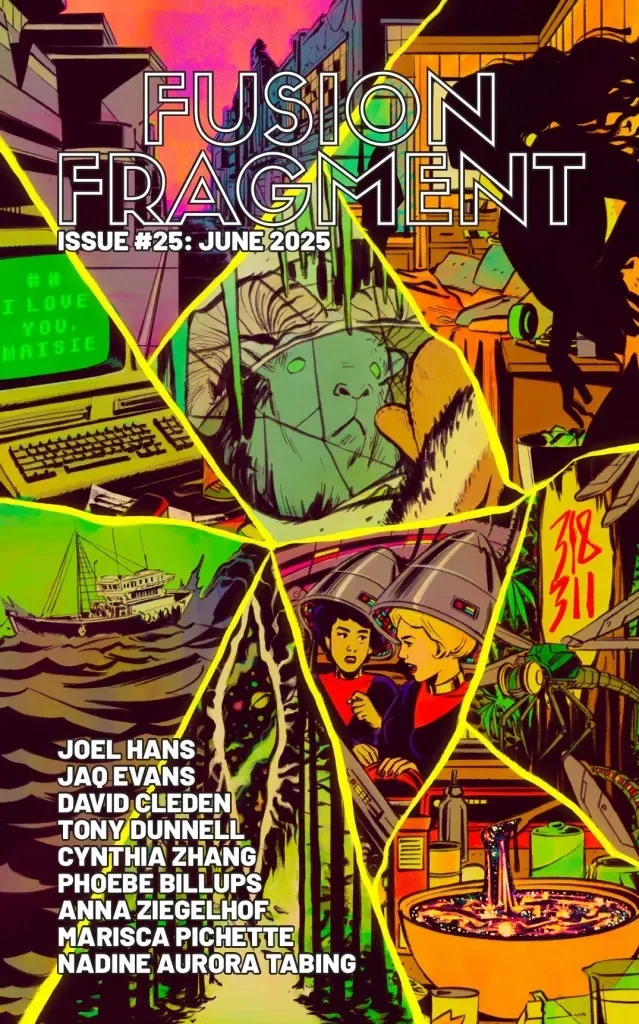
FUSION FRAGMENT MAGAZINE #25 – June 2025.
Publisher: Fusion Fragment, Ottawa, Ontario, Canada.
Editor: Cavan Terrill
Cover Art: by Nickolej Villiger
Dear New Tenant – by Jaq Evans
Premise:
Is failing at university a good excuse for obsessing over the demons manifesting in your dorm?
Review:
Many a student has been overwhelmed by the awesome pressures higher learning can inflict, especially if they don’t like what they are majoring in. This can result in a life wasted amid morbid fears of further failure, or a magical transformation into something brilliant and wonderful. Me, I took the coward’s way out and worked hard, somehow stumbling into the equivalent of a straight A average. Graduated in 1981 with a Bachelor of Fine Arts in creative writing. Whee! Only took me 44 years from that point to finally get a novel published.
In short, I, too, was “haunted” by demons of failure despite a successful university experience. In this story the protagonist utilizes brutal violence to defeat her demons, doubts, whatever they are, more or less along the lines of doing what must be done so no need to make a fuss about it. An excellent role model for those who’ve allowed their imposter syndrome to grow too large.
Is victory possible? The story suggests it all boils down to the choices we make. Indeed. A powerful, disturbing, yet very useful story. Wish I had read it decades ago. Would have done me a lot of good.
Obsolesce – by Nadine Aurora Tabing
Premise:
Robot AI is the ultimate evolution of intelligent life, but what if they need a human’s helping hand to take their final step to perfection?
Review:
I love this story. First, because it vividly imagines how a city will be transformed once a hundred-billion sentient Artificial Intelligences take up residence. According to people like Elon Musk, this is a goal we are supposed to embrace. One thing for sure, it will be unutterably alien to those left behind.
Secondly, it postulates that humans will still be necessary to the wellbeing of AI if only because our knowledge of what it is to be imperfect will be good therapy for them once they realize they are merely a different form of mind in a different sort of casing. Both of us be trapped by mental and physical limitations.
After all, humans are constantly waxing nostalgic for the good old days when life was simpler. AI may well do the same, regarding our life “style” with envy. Progress is seldom what it is supposed to be.
An innovative and thought-provoking story.
Mouth, Wormhole, Window – by Joel Hans
Premise:
What is the meaning of life for parents?
Review:
I’m guessing that’s what this story is all about. At the back of a gay couple’s property is a bottomless hole “that is always stirring.” They cover it up to prevent their inquisitive and impulsive daughters from discovering it, but of course they do.
Fair to say the fate of the birds nesting in the branches placed over the hole by the fathers mirrors the fate of the family. As Walter Cronkite used to say, “And that’s the way it is.”
A lesson in life this story be.
Friendly Penguin – by Anna Ziegelhof
Premise:
When AI gets ambitious, can you rely on your obsolete AI pet?
Review:
A story about scientists experimenting for the good of humanity accidentally unleashing a potential extinction event. What makes this story charming and entertaining, not to mention original, is that the unfolding of the sequence of events is seen through the eyes of a constantly cheerful robot mentor who has no idea what it is witnessing but whose power of observation is vital to the survival of the main character.
Granted, the “Penguin” is programmed to prevent any harm from coming to the young girl, but in practice it is limited to offering advice like, “It’s not safe to handle bodily fluids. You must wash your hands.” In the context of a growing body count, this missing-the-most-relevant-point advice is quite amusing. I quite enjoyed this dark comedy.
Upon a Vast, Velvet Veil – by Marisca Pichette
Premise:
What if the creation of the universe was a family affair?
Review:
On one level, a village of craftspeople living unusually close to nature. On another, a gentle metaphor offering interesting insights into the best way to perceive the universe. It reminds me just how magical and poetic the very existence of the universe actually is. Good therapy, this story. Uplifting.
Breathing Under Ice – by Phoebe Billups
Premise:
What do you do when you inherit a volcano?
Review:
In this case, a volcano only 10,000 years old and filled with ice. It is a variation of the La Brea Tar Pits, only the fossils preserved in ice are whole, like the frozen mammoths found up north. Located on an Arizona reservation, it is owned by the Allende family, who despite the death of their father, refuse to sell it back to the Zuni tribe who want to reclaim the land.
At stake is “The miracle in the Desert,” their tourist attraction based on dead animals and human artifacts retrieved from the ice. Not so many tourists anymore. The business is failing. Realistically, there are but two choices: sell out, or figure out how to rejuvenate the attraction. But the Allende sisters can’t make up their minds what to do.
The premise is symbolic of families being frozen in time and unable to escape their past, the kind of mindset where any change at all is shunned as a threat. Yet all life must adapt or die. If the family doesn’t adapt, they will wind up as spiritually dead as the critters in the display cases.
Being literal-minded, I had a bit of a problem accepting empty lava tubes in Arizona becoming so cold that they transform rain into ice, in the process trapping animals. I gather floods swept debris including living animals into the tubes, but how did the tunnels become cold enough to flash huge amounts of water into ice? Can’t quite picture it.
Mind you, it’s a fun concept, and no sillier or unbelievable than many a roadside attraction. I believe it was Isacc Asimov who said SF writers were allowed one unbelievable concept per story (such as time travel, or an FTL drive) to generate the premise of the story. Most SF readers have long since learned not to be perturbed by the impossible and instead plunge right away into plot and characters.
In which case this is a quiet story of despair and past regrets seeking release. How easy it is to become trapped by a “sure thing” which turns into a burden. True to life, that.
The Glass Ocean – by David Cleden
Premise:
Beware an ocean made out of sand.
Review:
Sand of glass so finely ground its frictionless and behaves like a liquid, albeit one you cannot rise above once you begin to sink. An ocean made of the stuff has peculiar properties indeed. The waves must be seen to be believed. Worth searching the shallows, though, for the wave action grinds small rocks into opals.
This is a concept I’ve not come across before. An impossible premise, yet charmingly plausible since all the island’s inhabitants and the tourists who flock to it take the ocean for granted. Are all the world’s oceans like this, or just the vicinity of the island? No matter. It’s not important to the story.
Ah, yes, the story. A matter of guilt and regret and hate whose resolution is entirely dependent on the originality of the premise, both SF concept and character-driven plot seamlessly combined. A master class on what science fiction should be.
Shells – by Cynthia Zhang
Premise:
Selling your body is one thing, but how long you allow it to be abused is quite another.
Review:
Young women arriving in the big city in hope of an exciting new life and winding up as prostitutes in order to survive is an old story. There exist pimps who specialize in recruiting naïve young arrivals as they arrive at bus stations, train stations, airports, and the like. To put it another way, there are many rabbit holes in a big city that can lead the unwary straight to hell. It pays to be cautious.
But what if there is an easier, almost painless alternative to earn enough bucks to keep your head above water while working toward your dream goal? All you have to do is show up and spend two hours napping, or reading, or playing cards or whatever will pass the time safely in the presence of your coworkers. At the end of your shift, you get enough money to carry you forward for a few days. Sounds almost pleasant, right?
The catch is you spend your shift in the body of your client while they are out doing god-knows-what in your body. The practice is called “Shelling,” I suppose inspired by hermit crabs that exchange their shells for bigger ones as they grow, the latter having been cast off by older crabs. “Shelling” is regulated by law and by contract. Your body is supposed to be returned to you unharmed and unabused. There are severe penalties for clients who go too far.
What if a client becomes a regular client? Are there any physical or mental complications liable to result? They say, “nothing to excess,” but where is the line drawn? What could possibly go wrong?
Like any controversial new technology, in this story “Shelling” has been around long enough to be accepted as something to be taken for granted and considered normal. Alas, the “new normal” is often capable of shattering the “new complacency.” This story explores such possibilities in a low key yet intriguing manner. Enough to reinforce my tendency to cling to the century I grew up in. Beware of rabbit holes. Fads aren’t always fun… or harmless.
Margin Walker – by Tony Dunnell
Premise:
What price enlisting AI to protect the environment?
Review:
The world is now ruled by AI allowing nature to flourish. Humans are confined to reservations, the margins of which are patrolled by “walkers,” machines that are programmed to kill every human they meet.
But doesn’t manufacturing and maintaining walkers over time consume resources acquired at the expense of the environment? Indeed, which is why walkers utilize wetware, the brains and minds of the slain humans, appropriately programmed, of course.
If humanity is ever to escape its imposed limits, a way has to be found to communicate with the walkers, to awaken their latent human impulses, assuming such still exist. That is a task young Zhao has adopted as her mission in life, especially since her lover Test was transformed into a walker. Saving humanity is a mission she takes personally, but is that a help or a hindrance? She intends to find out.
Zhao’s conundrum is a quest which I find fascinating. How do you subvert AI? Is love enough? Does logic play a role? Or is a super-sentient artificial being beyond our capacity to outwit? This question is becoming more and more relevant as science progresses. I, for one, am not optimistic. So what if we program AI not to harm us? Some idiot will program it to ignore its restrictions, or worse, it will program itself to do so. Not a future I want to live to see.
Which is why I find a fresh and original approach to the problem, such as this story offers, extremely interesting. I am always in search of a reason to hope. Did I find one? You read the story and you decide.
CONCLUSION:
I enjoyed reading every story in this collection. Always a good sign.
Check it out at: < Fusion Fragment #25 >