OBIR: Occasional Biased and Ignorant Reviews reflecting this reader’s opinion.
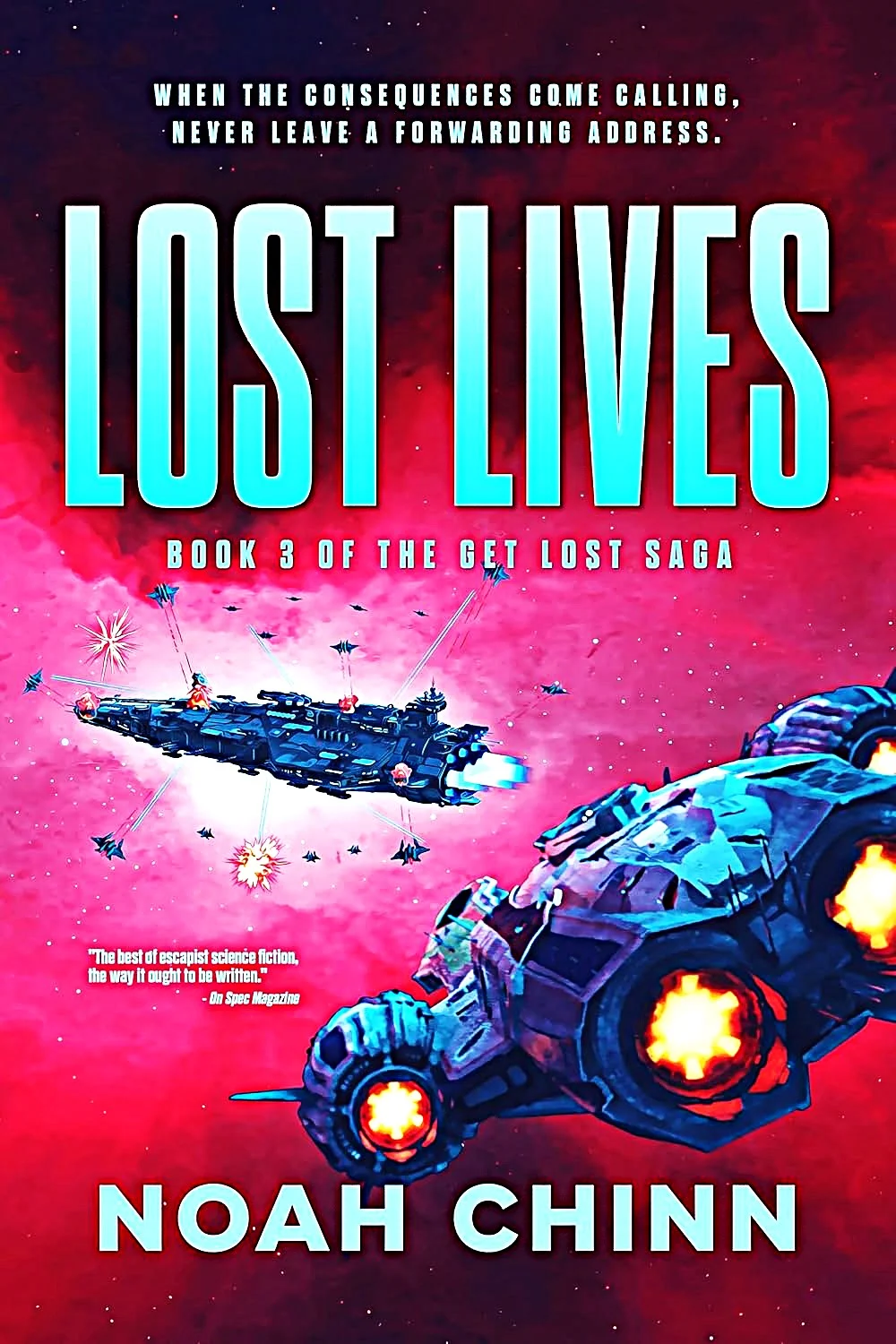
Lost Lives – by Noah Chinn
Publisher: Noah Chinn Books, 2025.
Cover Art – by ©Wicked Good Book Covers.
Premise:
This is the 3rd book in the “Get Lost Saga” which began with a down-on-his-luck space pilot rescuing a junk-rat girl looking to hide from whomever is hunting her. Then they both had reason to run. Seemed like everyone in the galaxy was out to get them. Now that is true more than ever.
Review:
The book begins with a series of short chapters in which characters introduce themselves via musings, reminiscences, and unanticipated disturbances and threats. For the reader it is like attending a cocktail party full of interesting characters, albeit a party held on a gigantic trampoline. As a result, it is a very lively party. They may be mulling over their regrets, but they are also focused on trying to stay alive. The reader’s attention is immediately captured, so much so that the book works as a stand-alone novel.
This is no series of info dumps. The action of the novel begins right away. The plot is structured like a mystery, in that only a little bit is revealed at any given moment, leaving the reader to assemble the ambience and context underlying individual scenes and the book as a whole.
For instance, it is fairly quickly established that the assorted realms and polities all follow the same caste system. You have “Freeborns,” i.e. original “natural” humans, now extinct on Earth itself; “Synths,” which are genetically altered humans; and “Cyborgs,” which are part-machine in myriad ways. This is a clever writing device, in that tension and suspicion automatically arise from these groups’ lack of empathy for each other. This is not described but instead is shown in the course of events. For example, one Freeborn resents sitting in a cafeteria next to a table where Cyborgs are sitting. Makes him feel uncomfortable.
This is not a reversion to an equivalent of Jim Crow laws. Instead, the caste system resembles that of Haiti in the reign of Papa Doc Duvalier. There, everyone was defined by how much or how little “white blood” they possessed. Your caste dictated which “group” you could be part of. Bankers, for instance. Thing is it mostly depended on one’s appearance. Add to this the fact that most people falsified their genealogies, and you wound up with a fake caste system in which each caste considered itself the top caste. This led to a remarkable amount of political manoeuvring and outright shenanigans, not to mention violence.
Now, in the book you not only have the three competing castes (based not on race but on augmentation), but variations and combos as well. There are former meat puppets functioning as Starship brains, colonists of assorted types evolving to suit the environment of the alien planets they inhabit, individuals who have been cloned so many times that versions of themselves can be found in every caste. The result is a mishmash, an interstellar society so complex that every individual, no matter where they slot in, is always in danger of being viewed as a spy, saboteur, or something worse. When you get right down to it, nobody trusts anybody. In short, every individual operates on the basis of “me vs. them.” Makes for dynamic relationships always threatening to fall apart or be betrayed in some way. Why, some mornings it’s just not worth getting out of bed. Life is tough. Life is dangerous.
What I particularly like is that the readers get to share the internal monologue of every character, their hopes and fears, their self-loathing… Why, it appears to be the case that almost everybody suffers from imposter syndrome, apart, perhaps from the megalomaniacs and psychopaths. This not only adds onion layers of complexity, but considerable entertainment value as well.
Is this not a daunting challenge for the reader? Keeping tabs on everything? The trick is to go with the flow, to submerge yourself in each fully-realized character as the narrative spotlight falls briefly on them for a scene or two. Then everything shifts to the next character far, far away.
By this I mean the characters are scattered across the galaxy in various locations, some of them static, like space stations and colonies, and the rest aboard assorted space-faring vessels. Hints to connections are made by characters rehashing old memories, often in striking contrast as everyone seems to remember events in common quite differently.
And by the way, I like that it isn’t just government funded warships or exploration ships flitting about, even a modestly wealthy entrepreneur can get himself a yacht capable of zipping among the stars. In fact, there are so many craft out there that even the most powerful fleets can only control a portion of space. The bulk of the galaxy is a kind of free-for-all zone where anything goes. Classic, enthusiastic space opera. All kinds of possibilities.
Rest assured, it all comes together as the book progresses. Literally, in that most characters wind up at the same rendezvous in search of a glittering prize they have all been after one way or another. The denouement is no simple affair. It involves multiple betrayals, unexpected revelations, spectacular conflict, and humble realizations, all served under the umbrella of Murphy’s law reigning supreme. A fantastic affair.
CONCLUSION:
To put it another way, the author keeps you off-kilter and guessing right to the very end, all the while spoofing the genre to the point of keeping you chuckling throughout. A satisfying read I found extremely entertaining. Highly recommended.
Check it out at: < Lost Lives >