In 2009, a young man named Hajime Isayama, who had matriculated in the manga program at Kyushu Designer Gakuen school in Oyama, Japan. After winning a “Fine Work” award at a 2006 major Magazine manga contest, where he had submitted a one-shot work called Attack on Titan (Shingeki no Kyojin), he moved to Tokyo and worked at an internet café in order to continue writing and drawing manga. (‘m sure I don’t have to explain manga to my audience.) He submitted several works to a weekly called Shōnen Magazin, starting in 2008, winning a couple of awards including a “special encouragement” award. These works were all one-shots.
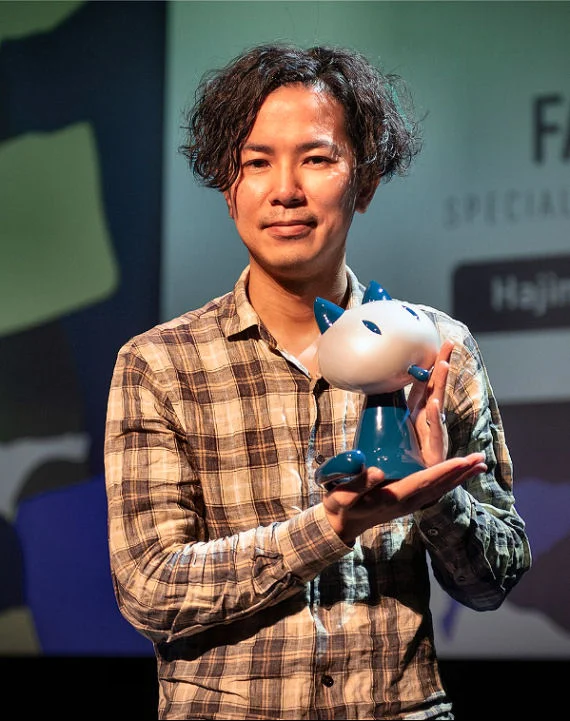
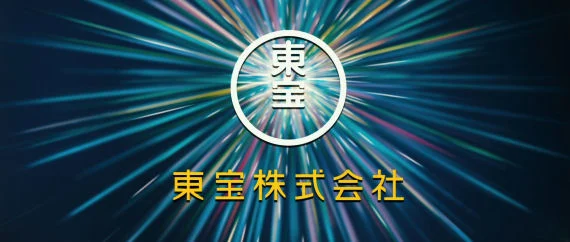
In 2009, his serial Attack on Titan (based on his one-shot) won an award and was published in a monthly, Bessatsu Shōnen Magazine, also garnering other awards and nominations in the following couple of years. From there, he had nowhere to go but up. Attack on Titan took 12 years to finish, spawning four video games, a TV series, several novels and about 7 live-action films. And that’s in addition to the one-shot mangas he did. Busy fellow, eh? Figure 1 shows the Toho Studios logo; they released the live-action films, the first one of which (2018) we’ll be talking about today. (Anyone who follows Japanese films (Godzilla, etc.) is likely very familiar with this logo already.) Disambiguation: somewhere about 2010, I remember seeing ads for a live-action film of the same name, which was all about attacking Saturn’s moon Titan; something about water. I never saw it.
Here’s the bare bones of the plot (first movie only); I may or may not follow up with the other movies, but that will mean searching them out. In an unnamed future time, humanity has been attacked by giant beings resembling humans, called Titans, whose sole purpose appears to be attacking and eating humans. Humanity—the remnant that remains—has been forced to build high (they appear to be about 30 feet tall) and thick concrete walls—three of them, concentric—to keep out the Titans. It also appears that humanity was divided into rich and non-rich, from what I could hear; I think the rich hid in the center behind the third wall. This was never followed up, but maybe in one of the other movies.
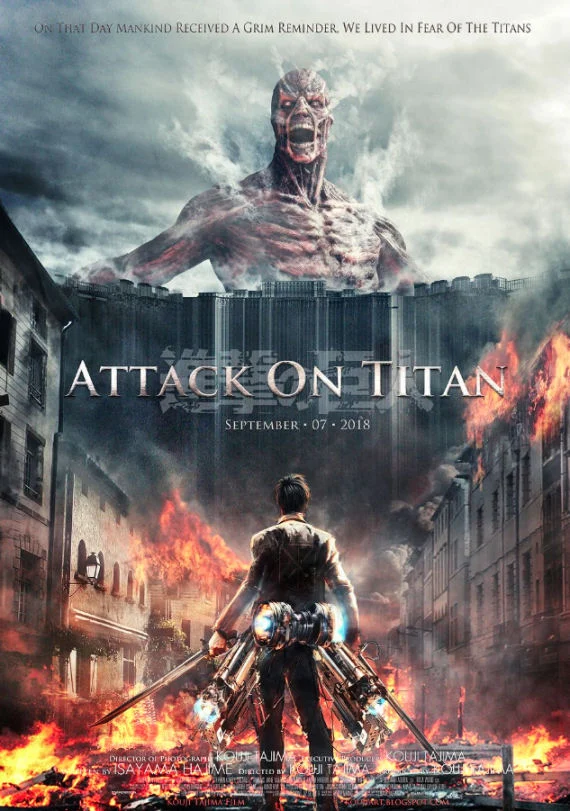
The people have lived in peace for a century, which is enough for many to disbelieve in the actuality of Titans, though there is an army maintained to patrol the area of the outer wall and keep people away as well as to watch for further Titan activity. We are introduced to three young people; there is enough space inside the walls to have several separate towns, and the three young friends live a semi-rural life in Monzen. It appears that, even though the townspeople have cattle and farmland, there’s not always enough to eat. Technology is forbidden, as “Machines caused all sorts of bad things in the world.” Eren is the wild one who wants to go outside the wall and see what’s out there; his friends Mikasa and Armin are easily persuaded to go along, at least to the wall itself. It appears Mikasa has a little bit of a crush on Eren, and Armin the same for her. Eren convinces them that the Titans are either dead or nonexistent, since nobody’s seen one for a hundred years.
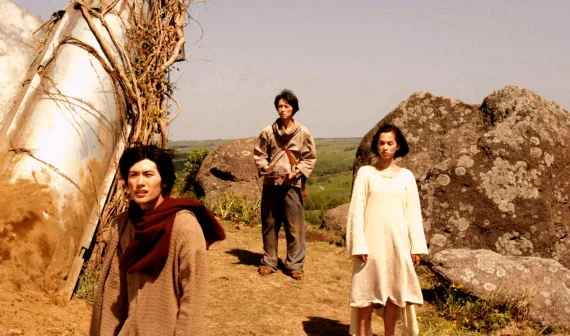
At the wall they are caught by the leader of a detachment of the guards, but their commander says they’re just like he was at that age, refusing to arrest them for coming close to the wall. At that moment, loud booming noises begin, and the wall begins to shudder. Pieces of debris, including an old, broken helicopter that had been stuck on a platform near the top, come cascading down, and a terrifying face, surrounded by clouds (Figure 3) of a humanoid creature which is at least 20 feet taller than the wall appears over it. This creature—a Titan—continues to pound the wall, and part of it collapses, allowing more Titans inside. The guards load and fire their cannon and the first half-dozen Titans collapse. Everyone cheers, but the Titans quickly regenerate and stand again, grabbing and eating the soldiers! The friendly commander is pulled apart! All the citizens of Monzen scream and rush to get away from these deadly humanoids. The guards shout that the Titans must truly be immortal!
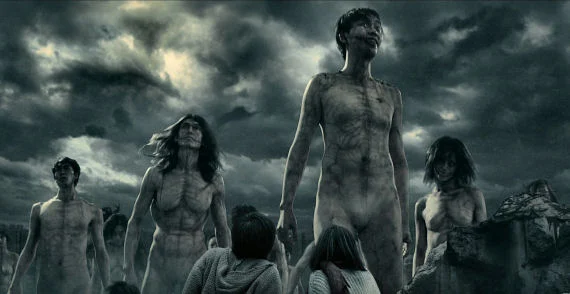
The Titans appear to be large (20-30 feet tall) naked human beings but with extra wide tooth-filled mouths—they seem to have no primary or secondary sexual characteristics. They are male and female (again, with no nipples or other sexual organs, and appear to have only one desire—to eat as many people as possible. They’re messy eaters, too, seldom eating a person whole: they usually bite the victim in half, dropping great gobs of blood and viscera. The three—Eren, Mikasa and Armin—are carried along by the crowd, which tries to cram into the largest building in town, but Mikasa stops to pick up a baby, whose mother was torn away from it by the crowd. While Eren is forced to go into the building and the doors are barred, he sees Mikasa crouched in the street holding the baby, while a Titan approaches her.
Things go from bad to worse—though Eren forces his way out of the building while the Titans tear the roof off and begin eating those inside, he can’t find Mikasa again. He and Armin join the army and begin training on the new invention—it’s a gas-powered cylinder attached to a belt with two prongs on wires that shoot out to attach the wearer to a building—and that person can “fly” like Spider-man, who uses his webs in the same way. Eren and Armin learn that there is a way to kill Titans—using a pair of swords and the flying apparatus, if they remove the nape of a Titan’s neck, the Titan will fall down and disintegrate. (Swords seem to be an integral part of the Japanese psyche, it seems.) There are rumours of a “death angel”—a woman who is proficient at killing Titans with this new method.
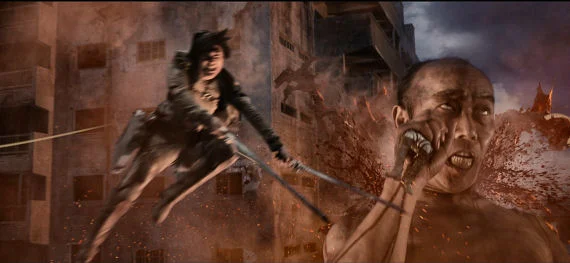
Eren and Armin meet up again with Mikasa, who is the “death angel.” She tells Eren that the world is a terrible place; she has changed entirely from the happy young woman who started this movie. “The baby,” she says, “was devoured. I was too…” and she raises her shirt to show him a bite mark on her side which covers from her hip almost to her armpit.
When this movie was released, it was part of a two-movie package, I understand; I have not yet seen the second part, which is called Attack on Titan II: The End of the World. This first part ended in the middle of a battle, which is where I’m going to leave you—even though it’s an older movie, I’m sure a lot of you don’t want me to spoil everything. For me, it’s a fascinating glimpse into part of the general Japanese psyche. Japan and the Japanese have had a relationship with death that many Westerners can’t comprehend, going back centuries. We in the Western world are often flabbergasted by news reports of students committing suicide after failing tests; of the “suicide forest” in Aokigahara, and going back to the days of Bushido, the code of the samurai, which includes a ritual form of death called seppuku.
The above is not a condemnation per se of that Japanese trait; a lot of Westerners are committing quick or slow suicide by using “killer” drugs like fentanyl; by living lifestyles designed to end lives either by work habits or eating and drinking the wrong things or to excess; by smoking, and so on. (I can’t claim I’m innocent either—it took me years to quit smoking.) But there is a strange fascination here in the West about various aspects of Japanese culture. I, too, share that fascination: I have had Japanese friends—exchange students—in high school; I took two years of Japanese in college; and so on. So I will in all likelihood, find and watch the second part of this package named above. And report on it here.
Okay, I’ve bent your figurative ear, now it’s your turn: what did you think of this column? I’m on Facebook, or you could email me (stevefah at hotmail dot com). If you liked or hated it, let me know. My opinion is, as always, my own, and doesn’t necessarily reflect the views of Amazing Stories or its owner, editor, publisher or other columnists. See you next time!
Note: this column is not written or edited with the use of AI; it is the product of a human mind—mine! Although I have nothing against AI, I don’t use it to produce this column in any way.

Steve has been an active fan since the 1970s, when he founded the Palouse Empire Science Fiction Association (PESFA) and the more-or-less late MosCon in Pullman, WA and Moscow, ID, though he started reading SF/F in the early-to-mid 1950s, when he was just a sprat. He moved to Canada in 1985 and quickly became involved with chairing or helping run Canadian cons, including ConText (’89 and ’81) and VCON. As a fan, he’s published a Hugo-nominated (one nomination) fanzine, New Venture, and he’s founded two writing groups (Writers’ Bloc and Writers of the Lost, Ink). He’s emceed and auctioned art at many West Coast and Northwest conventions including one Westercon. As a writer, he’s published a couple of books and a number of short stories (including one in Compostella [Tesseracts 20], and has collaborated with his two-time Aurora-winning wife Lynne Taylor Fahnestalk on a number of art projects. As of this writing he’s the proofreader for R. Graeme Cameron’s Polar Borealis and Rhea Rose’s Polar Starlight publications. He’s been writing for Amazing Stories off and on since the early 1980s. His column can be found on Amazing Stories most Fridays.