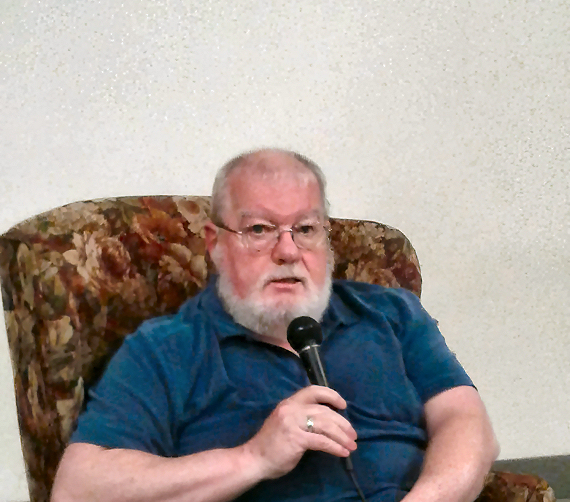
Scott Edelman, former editor of Science Fiction Age magazine (1992-2000) and the media titles Sci Fi Entertainment and Science Fiction Weekly, not to mention an author of both DC and Marvel comics, knows a little something about magazines and contracts.
Yesterday, on his Blog he posted the following:
A dream denied: My 54-year quest to publish a short story in F&SF
where he details his quest to sell a story to the Magazine of Fantasy and Science Fiction (which has long been considered a prestige title), finally cracks that market and then must ultimately withdraw his submission over an inability to come to an agreement on contract terms with Must Read Magazines, the publisher of F&SF, Asimov’s Science Fiction and Analog Science Fiction and Fact (MRM also publishes Alfred Hitchcocks and Ellery Queen’s).
Scott keeps such good records that he was even able to post a copy of the rejection slip he received for his first submission to F&SF, from 54 years ago!
He initially saw that (final) first sale to F&SF as a triumph and the ultimate endorsement of his philosophy of writing and submitting fiction: Never Give Up, Never Surrender.
THEN he got the contract.
Scott writes:
However — between the time of my submission and the story’s acceptance, a new owner had bought not only F&SF, but Analog and Asimov’s as well. And therein lies our tale.
Because two months after my story was accepted, my contract arrived, a contract about which there have been rumblings across the writing community. A contract similar to the ones which caused P. A. Cornell to pull a story that had been accepted by Analog, and resulted in Kristine Kathryn Rusch announcing she’d decided to walk away from both Analog and Asimov’s entirely.
Still, I lived in hope, and was willing to believe I could negotiate my way to a revised contract I’d be willing to sign. After all, Benjamin C. Kinney had done so, even though it took him 27 emails to do it. I was confident I could do the same.
It took 34 email exchanges discussing possible changes to that contract before Scott finally realized that they would never come to an acceptable agreement.
However, before offering detail on why, he notes this:
But before I do, I want to preface this by making it clear I have nothing but good things to say about editor Sheree Renée Thomas. Her words of praise as she accepted this story moved me greatly, and her perceptive comments and suggested tweaks ably demonstrated her strengths as an editor. It breaks my heart to disappoint her by pulling a story which was intended to appear in the next issue of F&SF. But, alas, I must. (Disclosure: Sheree Renée Thomas has an essay in the recently released Amazing Selects’ title The Martian Trilogy.)
It IS important to remember that there is often separation between the editorial and business sides of a publisher.
Scott’s concerns about the contract begin with this:
I was surprised on receiving my contract to discover this clause, one which I’d thought SFWA had gotten Must Read Magazines to remove from their boilerplate —
The first right to develop or license the development of special projects, including, but not limited to, games, toys, T shirts, calendars, and other items based upon characters, ideas, or plots from the Work, for which we shall pay you a sum equal to a pro-rata share of 50% of the net revenues received by the Publisher from such projects, less production, development, or distribution costs incurred by the Publisher with respect thereto.
The good news is that MRM removed that clause when asked. But I shouldn’t have had to ask.
Another clause removed at his request during negotiations was one that would have had MRM acting as his foreign agent Scott notes that while the MRM contract offered him a share of the revenue, his own efforts would net 100% of such sales.
But then he ran into the indemnification clause. A clause that is meant to “hold harmless” one party in the event of (usually specific) legal actions against them by third parties. Say, for example, someone decides to sue the magazine for defamation because of a story they published. With an indemnification clause, the author of that story may have agreed to cover the costs of legal defense and any final settlement.
Reasonable – IF limited and specified.
This was not the case with MRM’s contract:
All other contracts I’ve signed with such a clause end with verbiage referring to claims or suits “sustained,” otherwise that would allow for out-of-court settlements over which I’d have no control and for which I’d be expected to reimburse a publisher. So it’s important that word “sustained” be added. As an example, other contracts I’ve signed have it phrased something like, “Author hereby agrees to indemnify and hold harmless Publisher against any cost, loss, damage, expense, and judgment in any action finally sustained resulting from any breach of Author’s warranties and representations herein, etc.” That word “sustained” in important. The exact verbiage may vary as long as that word remains.
MRM responded with an offer to slightly modify the clause –
Unfortunately, the words “reasonably settled” invalidate the protections given by “alleged breach finally sustained,” and I wouldn’t be able to sign a contract with that language.
Let me just toss off a hypothetical.
Say an unhinged individual were to claim my story was based on their actual life, and sue us both. Or that I plagiarized the story. Or any other imagined harm.
With the language “reasonably settled” as part of the contract, F&SF could respond by saying that instead of mounting a defense in the face of a malicious suit, they would pay a few thousands dollars to settle, since that might be cheaper than hiring a lawyer. Some might even call that reasonable, no matter how likely it would be for the individual to lose at trial. And because of those words, I would therefore be required to reimburse F&SF, if that was the decision F&SF made to make the suit go away.
I would not be able to sign any contract — and have never been asked to before — unless it only asked to me hold a publisher harmless in the case of breaches eventually sustained.
Following more back and forth, Scott responds with:
Let me attempt one more time to explain why even your most recent clause is unacceptable. Take one example — the last few words of your new suggested clause — “or one that is reasonably settled.”
Reasonable to whom?*
Imagine someone brings a nuisance suit.
Some might say it would be reasonable to settle out of court, as it might be less expensive than to mount a legal defense.
Someone else might take a moral stand, and insist it’s never reasonable to settle out of court.
There should never be words in contracts the meanings of which are open to debate.
He also offered them several examples of clauses in contracts he’d found acceptable and had signed:
You warrant and represent that you have the right to grant the rights herein granted; that the rights granted here are free and clear; and that your work will not violate any copyright or any right of any third party nor be contrary to law. You agree to indemnify the above listed Editor(s), publisher, and any licensees thereof for any loss, damage, or expense (including reasonable attorneys’ fees) arising out of any sustained claim* inconsistent with any of the foregoing warranties and representations.
And here is the sad kicker:
After much back and forth, ultimately, Must Reads Magazines would not be moved. And since I refused to forfeit the protections which had been incorporated in every other recent contract I’ve been offered in the field, I regretfully withdrew my story.
(Visit his Blog to read the final version of his suggested indemnification clause.)
He then makes the decision that, since Analog and Asimov’s are owned by the same publisher and offer the same kind of contract, he needed to withdraw his submissions to those publications as well. (Scott has previously been published in Analog.)
Scott concludes with the following:
It is therefore merely my opinion — not a legal opinion, for I am not a lawyer, but merely a personal opinion — that it would be foolish for any writer to sign a contract containing that word “alleged,” particularly when it goes against the standards of our industry* and is absent from every other contract I can remember signing.
But more important than that is — remember that no dream* — not even one 54 years old — is worth a perceived risk.* If I can walk away from fulfilling that dream, so can you…
Our condolences to Scott.
***
Although I am a publisher, I come to that position following a history of the creation of various types of intellectual property – trademarks, patents, fiction, publications, games – and have had to wrestle with the same kinds of contractual issues described by Scott. If I have learned anything in regards to those subjects it is the following:
If you are even mildly unclear on the implications of a clause in a contract – get an attorney (who specializes in the area of concern).
Be VERY circumspect about the degree of control you offer: rights sold should be as minimal in scope and as short in duration as is possible to negotiate.
DO NOT SIGN AN UNACCEPTABLE CONTRACT JUST FOR PRESTIGE OR DREAM FULFILLMENT.
If anything in a contract makes you uncomfortable, don’t ignore those feelings.
If one publication liked your work enough to offer you a contract, another one will as well. (Scott notes that all of the stories he withdrew have since been placed with other publications. Never give up, Never surrender!)
*(Editor’s emphasis added.)

Steve Davidson is the publisher of Amazing Stories.
Steve has been a passionate fan of science fiction since the mid-60s, before he even knew what it was called.