Like many “Baby-boomers” (post-WWII kids, mostly—I was born in 1947), I grew up watching TV; shows like Winky-Dink (1953-57); The Mickey Mouse Club (1955-59, among several Disneys including Walt Disney Presents); Captain Kangaroo (1955-61); and The Adventures of Superman (1952-58). The latter was to have an enduring effect on my life and outlook. (I refer here to the years I was most likely to have watched the programs; some like Captain Kangaroo were on for many more years.)
In fact, when I was about 8, living in Duluth, MN, I invented my own superhero in imitation of Superman, although a bit different: my hero was called “Black Hoof,” and could turn into a super-powered horse! (He came, of course, from the planet “Hoofla.”) When playing with my friends or alone, I wore a green towel on which I pinned Black Hoof’s symbol—a white circle with a black horse’s hoof on it—onto the back of the towel. My mother put a stop to that when she found me jumping off the doghouse roof (flying, I thought); she was afraid I’d try jumping off a higher roof.
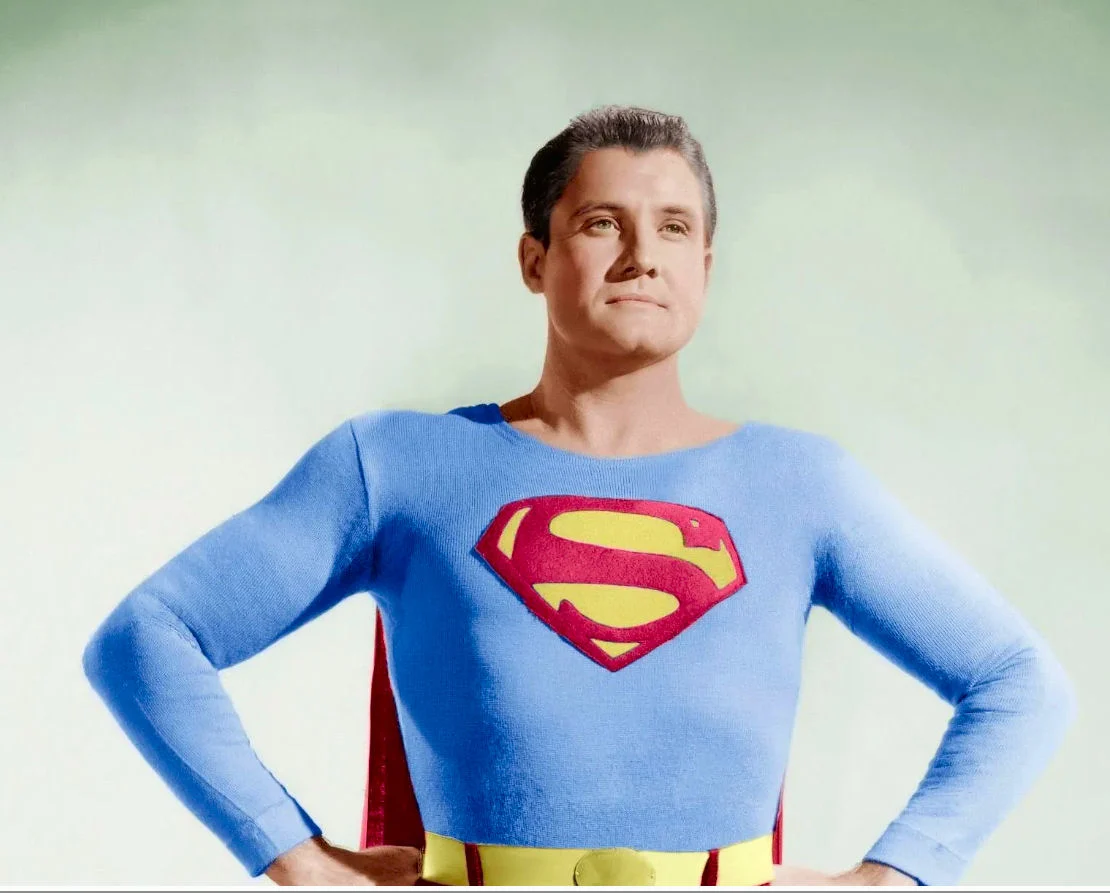
Anyway, “my” Superman was George Reeves, who wasn’t built like the later Supes played by other actors—he was older, hardly buff, but he was a manly man with a good sense of humour. (His jokes weren’t as corny as, say, Arnold Schwarzenegger’s.) His Clark Kent was also not a weakling—he occasionally mixed it up with the show’s often kind of cartoonish villains. But it was a show for kids, and it seems Reeves wanted to be someone—in both incarnations—someone kids cold look up to.
It is said that the novelist Philip Wylie (author of Tomorrow!, When Worlds Collide and After Worlds Collide (both with Edwin Balmer) publshed a book in 1930 (Gladiator), which is might have inspired Superman. The titular character in that book was given a super-serum by his scientist father in vitro, before he was born, so that he could have the “strength of an ant” and the “leaping ability of a grasshopper.” He would also prove to be bullet-proof. Wylie would apparently inspire several othe comic-book/movie characters—according to comic historian Richard A. Lupoff. Wylie’s The Savage Gentleman was uncannily similar to Lester Dent’s Doc Savage; and When Worlds Collide may have inspired Alex Raymond’s comic strip Flash Gordon.
Be that as it may, when young writer Jerome Siegel and equally young artist Joe Shuster came up with their Superman, which was published in the first issue of Action Comics in 1938, it wasn’t long before that character had captured the imagination of a nation. At first, like Wylie’s Gladiator, Superman could run fast, leap vast distances (no flying), was extra strong, but as the years and the various iterations passed, he began to fly and develop extra “powers”; the well-known phrase “Faster than a speeding bullet—more powerful than a locomotive,” came into the public consciousness when the Fleischer brothers, Max and Dave, who had a studio known for moving cartoons like Betty Boop, Popeye, and Koko the Clown.
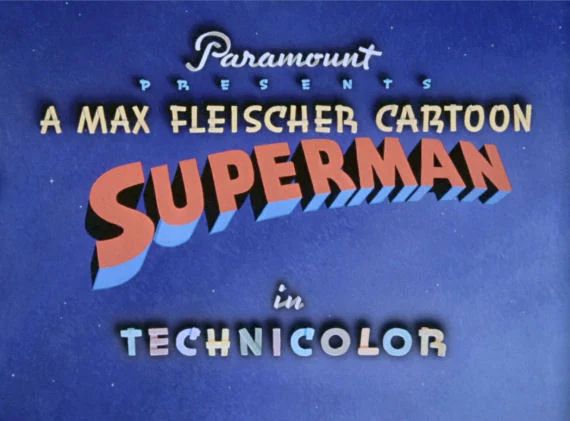
Max Fleischer was the producer, and Dave Fleischer was the director of the first nine Superman cartoons, and many people think that these cartoons were the best Superman films of all time; certainly they were ground-breaking for the time. Producer Max had actually invented rotoscopy some years earlier, which is tracing of live-action frame by frame for animation; these cartoons used a lot of it. The brothers’ main interest, however, was a new full-length animated film—they were trying to outdo the Disney studio—Mr. Bug Goes to Town, and that took a lot of their money and time. Paramount, the owner of the movie rights, asked them to do a series of Supes shorts, but due to Mr. Bug, they didn’t want to do it, so they quoted $100,000 per episode, hoping to dissuade Paramount. To their surprise, Paramount offered $50K per episode, an almost unheard-of amount for a cartoon. Their first nine episodes (Supes was voiced by Bud Collyer, who also did the radio Superman’s voice) are considered milestones in the history of, not just animation, but Superman himself.

As the character moved from comic version to screen cartoon to radio version, Supes evolved, firming up his background, his costume, and so on, gaining new powers and a love interest (hinted at in the Fleischer cartoons) with Lois Lane. Figure 4 shows some of the evolution of the “S” symbol on his chest and cape; it originally looked like a policeman’s sheild (Figure 4, top left 1938), then evolved to the 5-sided diamond shape we’re familiar with today—in fact, I was disappointed to lose the “S” that even Brandon Routh in Superman Returns sported, for the stylized, almost art-deco “S” on David Corenswet’s chest in 2025. In order, top to bottom and left to right, Figure 4 shows the original Joe Shuster design on Action Comics #1, then below it, Action Comics #26 (1940), again by Shuster, that is shaped almost like the more modern ones; followed by (top-right) the Fleischer Studios’ “S” logo and, below that, the “S” that Kirk Alyn in the movie serials (all b/w) wore on his chest.
But back to the Fleischer ‘toons. As I’d said above, they were putting most of their time and finances into their full-length animated movie, hoping to successfully compete with Walt and his Mouse gang. Mr Bug failed at the box office, and the Fleischers found themselves in deep money trouble. Max and Dave were fired, and Fleischer Studios was reorganized into Famous Studios in 1942 (Max and Dave quarrelled, and went their separate ways); Famous produced eight more episodes, but the emphasis was more on the World War then raging. Although the animation was the same as before, the storylines suffered, and for modern audiences, the racist content is a bit too much in several. All episodes are available—upscaled—on YouTube, or on a Blu-Ray from Warner, which now owns all rights to Superman. By the way—if you’re interested, I found a striking resemblance to the Fleischer Supes cartoons’ theme and the song “Star-Spangled Man With a Plan” from Captain America, the First Avenger. I’m not claiming that the latter copied the theme, because they’re obviously different (and from different studios: the former is DC, the latter Marvel), but there’s something… see if you can see it. Fleischer: https://youtu.be/S1LAdRODHvY?si=_TYREE2nIhBw7bF4 and Captain America: https://youtu.be/rtSrWn7eYbU?si=Zu86jXrgZarD96fd.
Superman the character continued to evolve in the comics; he graduated from Serials to full-length movies. George Reeves starred in Superman Vs. the Mole Men in 1951, before he became TV’s top hero. Reeves starred in The Adventures of Superman, first produced for syndication rather than network airing from 1952 to 1958; the first two years in black-and-white; the next four years in colour. Possibly because there was and still is a lot of mystery about George’s death (was it murder or suicide? The courts said suicide), there would be no more movie Supermen until the Christopher Reeve/Alexander Salkind four starting in 1978. (Some film/Supes buffs consider Chris Reeve (no relation to George Reeves) to be the best live-action Supes of all time. Nic Cage almost became Superman—he desperately wanted, I’ve read, to play that role—but it didn’t happen. You can see some AI-assisted footage of Nic fighting a giant spider in the recent Flash movie.

And now we come to 2025 and the new Supes movie—a reboot of the whole thing written and directed by James Gunn, featuring David Corenswet as Supes/Clark Kent; Rachel Brosnahan as Lois Lane; Nicholas Hoult as Lex Luthor; Nathan Fillion as Guy Gardner/Green Lantern; Edi Gathegi as superhero Mr. Terrific; and Isabela Merced as Hawkgirl. (In-joke: Alan Tudyk, Pom Clementieff and Michael Rooker play/voice some of Superman’s robots. They’re all fairly well-known SF/F character actors.) Gunn has changed more than the logo (Figure 5); without spoilers I can’t say a lot. The “new” version of the “S” is actually a revision of one used in the comic Kingdom Come in 1996, by the way.
I’ve jumped over several live-action TV series, including the Superboy series (1988-1992) helmed by Alexander Salkind (see above); Lois and Clark (Dean Cain and Teri Hatcher) 1993-1997; Smallville (2001-2011) with Tom Welling, Michael Rosenbaum and Kristin Kreuk; and the movies Superman Returns, with Brandon Routh, Kate Bosworth and Kevin Spacey; the Zack Snyder-helmed Man of Steel with Henry Cavill, Amy Adams and Michael Shannon; and the TV series Superman and Lois, with Tyler Hoechlin and Elizabeth Tulloch. I’ve also skipped any number of animated TV and movie appearances, like Super Friends, as I didn’t watch any of ‘em. (I’m more fond of the live-action ones.) I’ll be covering more in a later column; this one is mainly to express some ideas and introduce the subject (again, I know—but it’s a favourite!)
I’d like to hear what you think about this column. I’m on Facebook, or you could email me (stevefah at hotmail dot com). If you liked it, let me know—if you hated it, let me know so I can do better! My opinion is, as always, my own, and doesn’t necessarily reflect the views of Amazing Stories or its owner, editor, publisher or other columnists. See you next time!

Steve has been an active fan since the 1970s, when he founded the Palouse Empire Science Fiction Association (PESFA) and the more-or-less late MosCon in Pullman, WA and Moscow, ID, though he started reading SF/F in the early-to-mid 1950s, when he was just a sprat. He moved to Canada in 1985 and quickly became involved with chairing or helping run Canadian cons, including ConText (’89 and ’81) and VCON. As a fan, he’s published a Hugo-nominated (one nomination) fanzine, New Venture, and he’s founded two writing groups (Writers’ Bloc and Writers of the Lost, Ink). He’s emceed and auctioned art at many West Coast and Northwest conventions including one Westercon. As a writer, he’s published a couple of books and a number of short stories (including one in Compostella [Tesseracts 20], and has collaborated with his two-time Aurora-winning wife Lynne Taylor Fahnestalk on a number of art projects. As of this writing he’s the proofreader for R. Graeme Cameron’s Polar Borealis and Rhea Rose’s Polar Starlight publications. He’s been writing for Amazing Stories off and on since the early 1980s. His column can be found on Amazing Stories most Fridays.