
Just FYI, this is a full review with spoilers! As Fred Foy the announcer used to say when introducing the Lone Ranger, “Return with us now to those thrilling days of yesteryear.” This column is a “double redux,” as I wrote a similar column about this movie some years ago. The other night a movie was on TV, and The Beautiful & Talented Lynne Taylor Fahnestalk (my wife) said, “Why don’t you write a review of this, since we enjoyed it so much?” And I said, “Sure, why not?” (Then I found out I’d already reviewed it, but it was five years ago. I’m guessing most of the people reading this didn’t read that, so here goes.
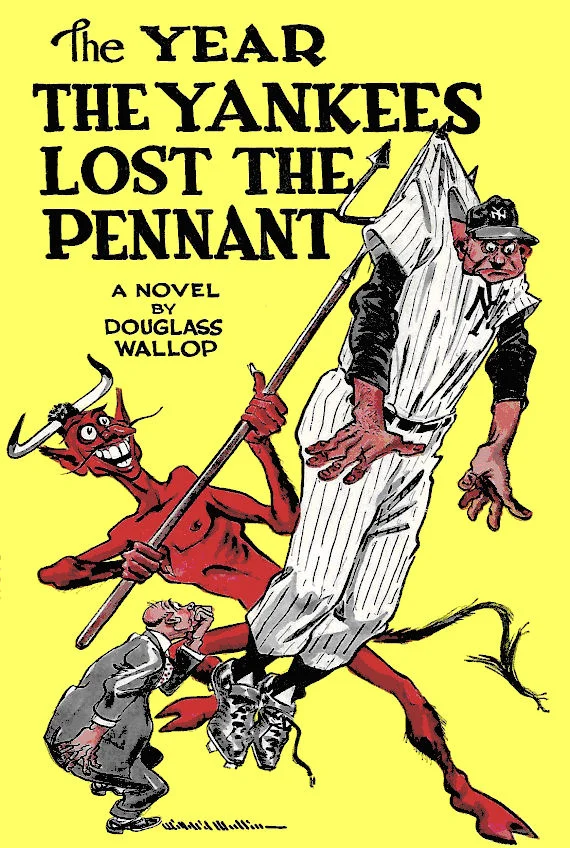
When I was in high school, I looked in the local thrift stores for science fiction or fantasy (SF/F) books in hardcover (at that time they weren’t usually even a dollar), and I found what I thought was an oddity—something about baseball and the Devil. The book was Douglass Wallop’s The Year the Yankees Lost the Pennant (Figure 1); it was a cute, fun little read, and I enjoyed it.

When I found out it had been made into a Broadway musical (Figure 2), I went to the library, but the library didn’t have it. The musical had a “book” (the basic adaptation/text of the musical) by Wallop himself with a script by George Abbott and music & lyrics by Richard Adler and Jerry Ross.) And then I saw the film version on our black-and-white TV. But the library did have the record of the movie version. I’ve played that soundtrack a lot over the years. Thanks to my mother’s taste in music, I learned to love a lot of different kinds of music, including musical theatre.
As I said, I found the movie version of the soundtrack at the library and learned all the songs. Most of the cast was the same as the Broadway (and touring) cast; it ran for over 1,000 performances. And a number of the songs went into the collective consciousness—“Whatever Lola Wants,” “You’ve Gotta Have Heart,” “Shoeless Joe From Hannibal, Mo” and so on. (My personal favourites were Ray Walston’s “Those Were the Good Old Days” and the Gwen Verdon/Bob Fosse “Who’s Got the Pain?”; the latter mostly because of the superb dancing. (Fosse was a dancer and choreographer—You may have seen the Roy Scheider “not really a biopic” about Fosse (and directed by him) called All That Jazz.

The film had to have been popular still in the late 1960s, because there was a TV version (General Electric Theatre) in 1967 (figure 3), starring Phil Silvers in the Applegate role and Lee Remick as Lola; Jim Backus (you may know him from Gilligan’s Island or Mr. Magoo the cartoon) played coach/manager Benny. Rather than trying to copy the film version, this version had the TV version of blue-screen backgrounds (called “chromakey”) so that cartoon-like sets could be matted in, or the players matted into the sets. Instead of actual ballpark action, there were fast still sequences. This version is available on YouTube.
Here’s a thing: unless you’re an older person, like me, you may not care much for this show; for one thing, it sprang out of the national obsession with baseball—which was called “America’s Pastime”—and which has subsided a whole bunch from what it was in the fifties and earlier. Football was mostly played in high schools and colleges; in the ‘50s, when this book was written, baseball was the King of Sports in the U.S. Most boys played sandlot baseball (or stickball in very urban areas); many towns had a minor-league team; it was on radio and television—and major-league scores on newsreels in theatres—and everyone knew, pretty much, every major-league player and their stats.
For another thing, it was very much of its time in attitudes between men and women; I’ll get into that in a bit. It took me until just recently to get a DVD copy of the movie (off eBay); it came from some outré place like Kazakhstan, believe it or not (Figure 5). Here’s what the show is about:
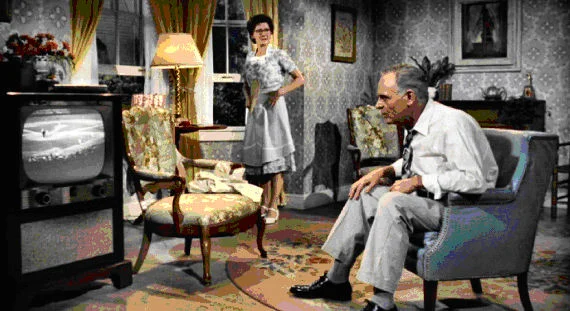
Joe Boyd, a middle-aged man (Robert Shafer, film & B’way) living in Washington DC with his wife Meg (Shannon Bolin both on film and on stage), is a lifelong fan of the Washington Senators; his team, however, has been mired in mediocrity for decades, despite being one of the original American League clubs. (According to Wikipedia, they had six last-place finishes in the ‘40s and ‘50s. They were moved to Minnesota in 1960, becoming the Minnesota Twins, and Washington wouldn’t get a new MLB team until the Montreal Expos became the Washington Nationals in 2005.) The fact that the Yankees were about to win another pennant and the Senators weren’t even going to make the playoffs got the better of Joe on one hot summer night (his wife, Meg, talks about the summer heat in Hannibal, Missouri, her home town) while he’s watching the Sens lose on TV (Figure 4). They sing “Six Months Out of Every Year” about how he’s barely there during the baseball season. When his team loses, Joe swears he’d sell his soul to the Devil for a chance to help the Sens win the World Series against their deadly rivals, the New York Yankees.

His wife goes to bed, and Joe steps out onto the porch. Mr. Applegate (Ray Walston) is there; Applegate convinces Joe that for the right consideration (his soul), Joe can physically help the Sens by becoming a younger ballplayer Applegate claims to be a big Sens fan and to hate the Yankees. Joe—as an insurance salesman—convinces Applegate to add an “escape clause” in case he, Joe, changes his mind. Joe becomes a younger man—“We’ll call you Joe Hardy,” Applegate says—and Joe Hardy (Tab Hunter on film, Stephen Douglass on stage) goes inside to get his old glove and baseball shoes, singing “Goodbye, Old Girl” as he does so. Applegate calls a taxi and they leave. (Neither Shafer nor Bolin was a particularly good singer, in my opinion. According to my wife, they might have been chosen to contrast with the younger actors. It’s a plausible theory.) And here’s the first thing that wouldn’t sit well with today’s audiences: Joe abandons his wife of many years in order to fulfill a long-held dream. And he’s supposed to be the good guy?
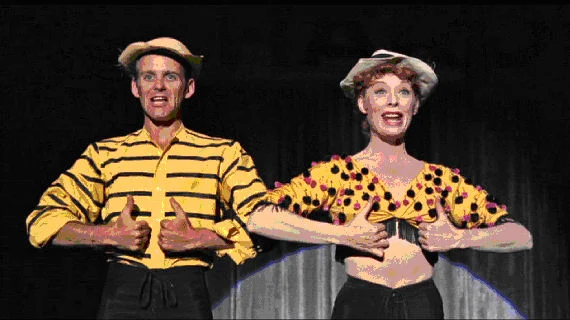
Next day, at the stadium, several of the players are discouraged, but their manager, Benny Van Buren (Russ Brown, film & stage), tells them not to give up, and they sing “You’ve Gotta Have Heart.” Applegate convinces Benny to give Joe a look; Joe rushes to put on his shoes, but they don’t fit—Applegate says “Oops! Must’ve overlooked that detail,”) and one of the other players lends Joe his shoes. Joe hits every ball thrown to him out of the park, and Benny puts him on the team (he wanted to work him up from the farm club, but Joe has no time—if he’s not done by a certain date, Applegate has him forever). A female reporter, Gloria Thorpe (Rae Allen, film & stage) noticed his shoes didn’t fit, and the team joins her in singing “Shoeless Joe From Hannibal, MO” (Figure 4), one of the three best-choreographed scenes in the film.

The team continues its rise with Joe Hardy at the center of attention, and Joe’s wife, Meg, sings “There’s Something About an Empty Chair” after her best friends (also from Hannibal)—including Jean Stapleton (whom we know better as Archie Bunker’s wife from All In The Family)as Doris Miller’s sister—tell her he’s not coming back. Just then, Joe shows up at the front door to rent a room so he can be close to her, even though she doesn’t know who he really is. He’s now a famous ball player, so that works out for a while (until Applegate intimidates her into thinking Joe staying there would be a scandal and he has to leave). The last thing Applegate wants is Joe thinking of home, so he sends for his best asset, Lola (Gwen Verdon, stage and film) to seduce Joe so he will fall farther from grace and miss his exit date (his escape clause). She tells Applegate Joe will be a pushover, singing “A Little Brains, A Little Talent.” After all, she’s seduced many men while working for Applegate; many of whom have committed suicide when she throws them over.
Applegate introduces Lola to Joe in the locker room after a game; she does a song-and-dance to convince Joe to take up with her (“Whatever Lola Wants”), but he’s having none of it. He’s happily married, and though she’s a nice girl, well, he’s a square.

The latter song, “Whatever Lola Wants,” is yet another old-fashioned angle on the male-female role: she dances around and drops into baby talk as a seductive ploy. Personally, I find that stuff not only ridiculous but very off-putting. I’m sure the modern woman would too; but in the ‘50s, that was a somewhat common thing (think of songs like “My Heart Belongs to Daddy”—the whole Daddy/Baby thing demeans both men and women, in my opinion). And this is the least successful bit of Bob Fosse’s usually great choreography, too. Lola’s failure gets Applegate’s goat, and he sings about how easy it used to be to bring people to damnation, with “Those Were the Good Old Days,” while Lola joins a Joe Hardy fan club. “I’m boring from within,” she tells Applegate (but she’s lying; Joe has won her over to his side.)
Meanwhile, the Senators are now in second place, with Joe’s help, winning ten games in a row. There’s a show being put on by the fan club; Meg’s friend Sister Miller (Jean Stapleton) does a rendition of “You’ve Gotta Have Heart” with a bevy of young boys in baseball uniforms, and we come to one of the two absolute highlights of this movie—Bob Fosse and Gwen Verdon (Figure 8) perform a terrific number called “Who’s Got The Pain (When They Do the Mambo)?” Two of the top dancers in America at the performing peak of their lives deliver a number that can’t be beat.
Meanwhile, Applegate’s been busy; he hints to Gloria Thorpe, the reporter—who’s just gone to Hannibal to check up on Joe’s background—that “Joe Hardy” is really Shifty McCoy, who was banned from baseball. A hearing is called, and Gloria calls the Hannibal postmaster, who says he’s never heard of Joe, but Applegate gets the hearing postponed till 7:30 p.m., saying he has a witness flying in who knows Shifty. The three women, Meg, Doris Miller, and Sister Miller, decide that since they know Joe’s a “good boy,” they will testify that he was indeed from Hannibal—because the fact that he chose Hannibal to be from is a compliment to Hannibal. This is the last day that Joe has to be free of Applegate, but he can’t get out of the hearing room until just after midnight, so even though he’s vindicated, he’s damned because the escape clause has expired.
In the second-best song-and-dance routine of the film, Joe and Lola go out to commiserate with each other by bar-hopping, singing “Two Lost Souls.” Lola (with limited assistance from Hunter) does an absolutely perfect ‘50s “beatnik” dance with the patrons of one club, proving once again that Verdon’s one of the best dancers of the day (remember that this is still 1958, and beatniks [or “beats”] were the hippies and goths of their day). Next day’s game will be the game that puts the Senators in—or lets them out—of the playoffs, and Applegate plans to make Joe throw the game, thus ensuring lots of disappointed fans, broken hearts, lost bets, strokes, etc. But Lola drugs his nightcap, and Applegate oversleeps, getting to the ballpark in time for the last out of the game, which will win it or lose it for the Sens. In retaliation, he puts Lola back in the body she wore 300 years ago in Salem, Mass, where she was counted the “ugliest girl in town” and she reverts to what appears to be a “traditional” witch image, with a crooked back, hook nose, and warts.
Joe is on his way to catch the third out—a fly ball—when Applegate turns him back into the old Joe Boyd (thereby voiding the contract) but Joe catches the ball anyway, winning the game… and sneaking off from the outfield as joyous crowds flood the field. He quickly changes in the locker room and catches a cab to home, reuniting with Meg. Game and film over, and exeunt omnes, as the Bard used to say.
Tab Hunter was chosen for the film over Douglass, who originated the role on stage, because Tab was the “hot property” of the time. (Same reason Audrey Hepburn was chosen over Julie Andrews for My Fair Lady, or Vanessa Redgrave over Andrews and Richard Harris over Richard Burton for Camelot.) Hunter was chosen for “hunk appeal” to female moviegoers—he wouldn’t come out for another couple of decades—but his popularity began to wane fairly early. (In those days the studio controlled all aspects of stars’ public lives, so you never knew—although many suspected—who was really straight. It was considered suicide to be outed, or known to be gay. A number of “hunky” male stars, like Hunter, were actually closeted, but the studios made sure they either married, or were seen dating, female stars. Nowadays, audiences are more likely to say “who cares? An actor acts!” A much healthier attitude, methinks. This film isn’t available in its entirety on YouTube, but you can find most of the songs as clips on that platform.
Comments? Sure, you’ve got ’em. I’d like to hear ’em, too. Just comment here, or on Facebook—or you can email me: stevefah at hotmail dot com. (Just keep it clean, okay?) My opinion is, as always, my own, and doesn’t necessarily reflect the views of Amazing Stories or its owner, editor, publisher or other columnists. See you next time!
Tags: Column 417, Retro Review Redux, : Damn Yankees (1958), Douglas Wallop, The Year the Yankees Lost the Pennant, Fred Foy, the Lone Ranger, Lynne Taylor Fahnestalk, Broadway musical, George Abbott, Richard Adler and Jerry Ross, film version, “Whatever Lola Wants”, “You’ve Gotta Have Heart”, “Shoeless Joe From Hannibal, Mo”, Ray Walstonv“Those Were the Good Old Days”, Gwen Verdon/Bob Fosse, “Who’s Got the Pain?, Roy Scheider, All That Jazz, TV version, General Electric Theatre, 1967, Phil Silvers, Lee Remick, Jim Backus, Gilligan’s Island, Mr. Magoo, chromakey, cartoon-like sets, available on YouTube, “America’s Pastime”, King of Sports, Robert Shafer, Shannon Bolin, the Washington Senators, New York Yankees, Minnesota Twins, Montreal, Hannibal Missouri, “Six Months Out of Every Year”, sell his soul, “escape clause”, Tab Hunter, Stephen Douglass, “Goodbye, Old Girl”, “You’ve Gotta Have Heart”, shoes don’t fit, Rae Allen, “Shoeless Joe From Hannibal, MO”, “There’s Something About an Empty Chair”, Jean Stapleton, “A Little Brains, A Little Talent”v“Whatever Lola Wants”, off-putting, demeans both men and women, “Those Were the Good Old Days”, Bob Fosse and Gwen Verdon, “Who’s Got The Pain (When They Do the Mambo)?”, top dancers in America, “Two Lost Souls”, Salem Mass, “ugliest girl in town”, Audrey Hepburn, Julie Andrews, My Fair Lady, Vanessa Redgrave, Richard Harris, Richard Burton, Camelot, “hunk appeal”, come out, Hunter actually closeted
Excerpt: This week Steve retro reviews what he considers to be a fun and very good Broadway musical on film. Do you like musicals? He does, and he gives us the whole story (yes, with spoilers). Read on…

Steve has been an active fan since the 1970s, when he founded the Palouse Empire Science Fiction Association (PESFA) and the more-or-less late MosCon in Pullman, WA and Moscow, ID, though he started reading SF/F in the early-to-mid 1950s, when he was just a sprat. He moved to Canada in 1985 and quickly became involved with chairing or helping run Canadian cons, including ConText (’89 and ’81) and VCON. As a fan, he’s published a Hugo-nominated (one nomination) fanzine, New Venture, and he’s founded two writing groups (Writers’ Bloc and Writers of the Lost, Ink). He’s emceed and auctioned art at many West Coast and Northwest conventions including one Westercon. As a writer, he’s published a couple of books and a number of short stories (including one in Compostella [Tesseracts 20], and has collaborated with his two-time Aurora-winning wife Lynne Taylor Fahnestalk on a number of art projects. As of this writing he’s the proofreader for R. Graeme Cameron’s Polar Borealis and Rhea Rose’s Polar Starlight publications. He’s been writing for Amazing Stories off and on since the early 1980s. His column can be found on Amazing Stories most Fridays.








Recent Comments