We were fortunate to gain contributions to this book from some marvelous authors…and literary scholars.
Here are some excerpts from their various pieces which we hope will intrigu and inspire you:
“YOU ARE THE DREAMER and the Dream.” That is the central line of Star Trek: Deep Space Nine’s legendary episode, “Far Beyond the Stars” (Season 6 Episode 13). Written by Ira Steven Behr and Hans Beimler, based on a story by Marc Scott Zicree, and directed by actor Avery Brooks, (who played Captain Benjamin Sisko in the series), the episode took a break from DS9’s ongoing Dominion Wars storyline to explore Earth’s own deep history with this standalone episode. It opens with Captain Sisko mourning the loss of a friend. He then experiences a vision from the Prophets (noncorporeal aliens who exist outside linear time and can access the past, present, and future simultaneously) in which he experiences life as Benny Russell, a Black writer in 1953 New York.
Russell works for Incredible Tales Magazine, where he is shown sketches of a space station for an upcoming issue that resembles his own Deep Space Nine. He then writes a story about Deep Space Nine and its Black captain but struggles to get it published—a far-too-familiar experience for Black writers, especially of genre fictions, in midcentury America. Further mirroring the reality of that time, Russell and his female co-worker, Kay Eaton (who publishes under her initials or a pseudonym, both common workarounds at that time), are then informed that they are to be excluded from staff photos since the company can’t feature a picture including a “Negro and a woman.” Though his story is eventually accepted for publication, the owner of the magazine choses to pulp that month’s issue rather than publish a story featuring a Black hero—and Russell himself is fired. Throughout this vision, Russell is repeatedly visited by a preacher (Sisko’s father) who tells him, as the voice of his ancestors, that he is both “the dreamer and the dream.” And that’s where we find ourselves with John P. Moore’s Afrofuturist story, The Martian Trilogy.
The Black literary canon becomes difficult to trace from the dime novel authors of 19th century to the pulp magazines of the 20th century due to difficulty being published, especially from the 1920s to the 1950s. Pulp adventure stories in magazines like Amazing Stories, Weird Tales, and Zeppelin Stories largely featured larger than life Anglo-Saxon male protagonists; underdressed, helpless white women; and exotic locales. If brown figures were depicted at all, they were in terms of uncivilized/colonized racial stereotypes. In short, these were stories that centered, made comfortable, and catered to their white male audience. Any depictions of good qualities in Black characters (Read: humanity and complexity) invited pushback at best or exclusion at worst. Black writers were barred from these venues unless their writing ignored race entirely; their ethnicity a byword best kept secret. But it wasn’t as if Black readers at the time didn’t also hunger for such bold adventure tales. In the age-old battle of genre fiction versus the literary canon, Black pulp stories faced double marginalization, brought hope and escape; romance and adventure; overcoming familiar dangers in spectacular fashion.
Moore’s Black-centered worldbuilding is subtle: his future St. Louis boasts a 179-story “Negro Times Building” (presumably designed, built, and occupied by successful Black people) and his Mars is populated by beautifully dark women (as future beauty standards have no care nor regard for colorism).
Maurice Broaddus
John P. Moore’s Martian Trilogy, a vibrant echo from the 1930s, emerges now, a fascinating example of early Black genius unfurling its wings into the cosmos through the Illustrated Feature Section. His narrative, a dazzling space opera birthed from an era that often-dimmed Black brilliance, painted worlds of Martian politics and love with hues of indigenous self-determination. Imagine the era: the Great Migration reshaping American cities, the Harlem Renaissance bursting with Black artistic output, yet systemic oppression still clinging to the nation like a persistent shadow. Within this landscape, Moore presented a vision where African Americans were not only charting paths to Mars but encountering other Black civilizations, complex and self-governing. His characters, like S.Q. Brent, a “well-known Negro novelist,” embodied a future where Black intellectual and scientific prowess was the norm, not the exception. The Martian societies, with their subterranean cities and advanced technologies, challenged the prevailing racist tropes of the time that depicted non-white “others” as primitive. Moore’s audacious reversal of the colonial narrative—where Martians resolve their own conflicts rather than being “saved” by human intervention—was a quiet revolution in popular fiction, reminding us that our stories have always been without limit, charting courses through galaxies known and yet to be discovered.
My own World Fantasy Award-winning Dark Matter anthologies were not merely collections of stories. They were an act of reclamation, a deliberate unearthing of hidden stars. In their introductions, I sought the invisible, and in that quest, canonical shifts began, challenging a historical narrative that too often overlooked or minimized Black contributions to speculative thought….This vision of Black ingenuity and agency, much like Moore’s depiction of advanced Martian civilizations and S.Q. Brent’s intellectual prowess, speaks to a consistent desire across Black speculative fiction to imagine Black people not just surviving, but thriving and innovating in future worlds. It was within these pages that Ralph Ellison’s Invisible Man, a deep journey through societal estrangement and existential quest, was brought into conversation with speculative thought, revealing its inherent fantastical undercurrents—the protagonist’s journey through the hidden, absurd, and often hallucinatory landscapes of American racism as a form of subtle, yet profound, speculative fiction.
Sheree Renée Thomas
With The Martian Trilogy, we not only see that Black folks were writing science fiction. They were writing pulp! Escapism, pure and simple with themselves at the center: Black explorers and Black Martians and Black love. Nice pieces of weighted fluff that allowed us to relax and breathe and dream.
We are all aware that everything that is buried has value. John P. Moore, The Martian Trilogy, and the history of the Illustrated Feature Section, however, truly do. They not only have value; they are treasures.
Once again, the U.S. finds itself in an existential crisis over the little white (culture) lie central to the American mythos. Artifacts such as the short stories in this book help us to combat that lie. However, most importantly, it allows us to claim one more bit of our cultural heritage, to breathe, and have a bit of fun while doing it; to dream; and to aspire to be what we have always been—the very lifeblood of the American Experiment—whether we are thanked or not.
Bill Campbell
The concept that there is something out there in addition to Earth, its inhabitants and influences, is not questioned in these oral histories; the belief in a collective universe where communication is written in the stars isn’t far flung—it accepted as fact. In that regard, our earliest science fiction practitioners created their stories from a place that removed the fantastical nature of the storytelling and allowed it to stand as a solid backdrop in the same way that magical realism does in urban fantasy. It was reflective of their experiences, and therefore diverse. But then, human nature—the proclivity of bias, suppression, and war—muted those voices, stripped their work from view, silenced them. What would the world, let alone the literary landscape, look like if people had not been separated from each other, if living spaces had not been colonized and communities siloed, if famine and genocide had not made impractical the pondering of the night sky and what lay beyond? One can only imagine what worlds would have been considered mainstream if the world had not been enslaved by prejudice, the desire to dominate, and greed.
Afrofuturism attempts to reintroduce the world to a future that includes us and does so by reintroducing the past in the form of historical infusion, technological advancements, discoveries, and pontification. It is what creativity is supposed to be: speculative. We step into the future with an understanding of the past, ushered forward on the wings of cyberpunk and Afro-fantasy tales to reclaim the future.
L. Marie Wood
WAIT—there was an African American space opera published in 1930?
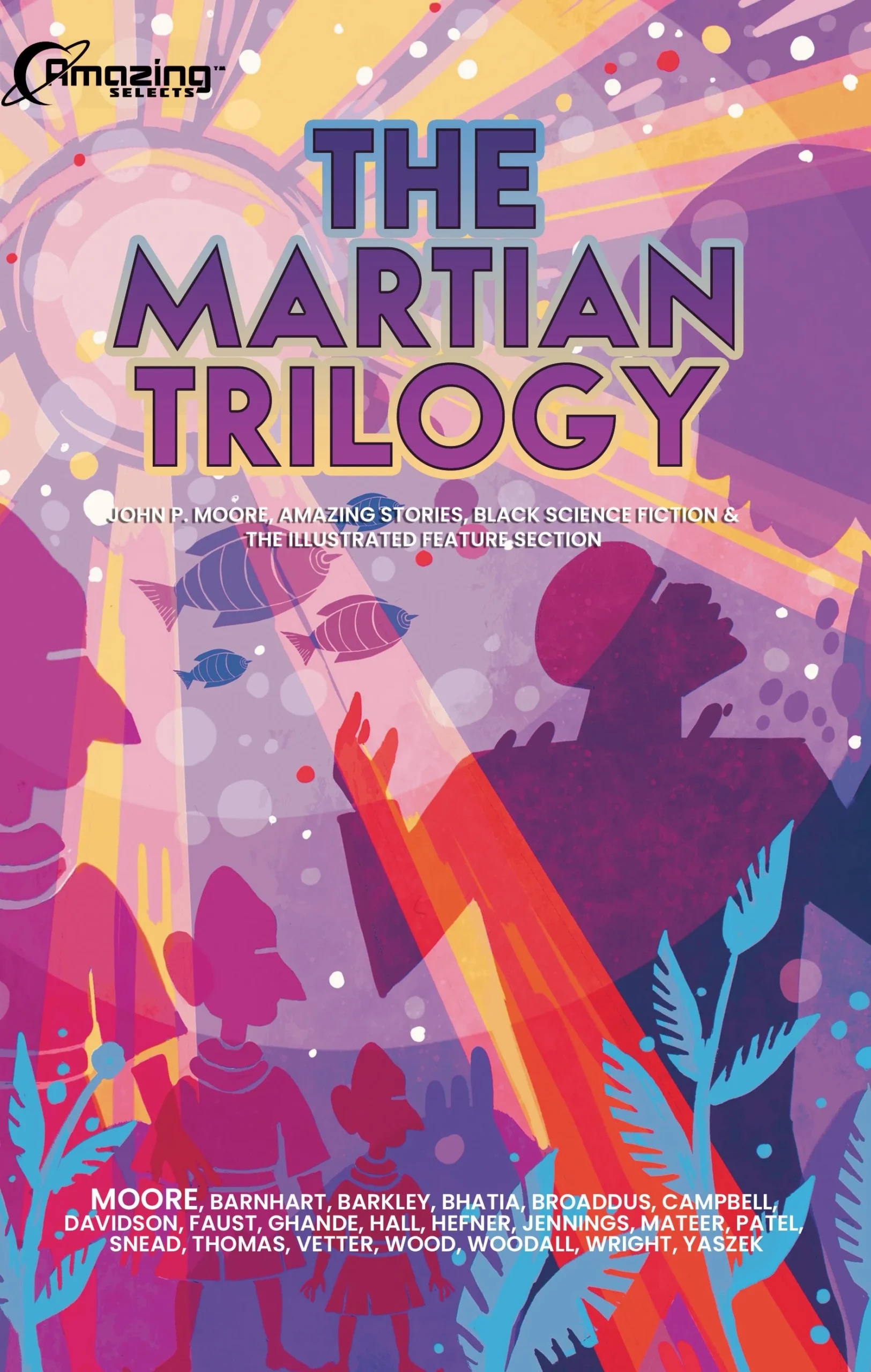
Set on September 8, 2030, John P. Moore’s The Martian Trilogy is a serialised science fiction story offering a future utterly devoid of a civilisation-and-humanity-ending threat from mechanically simulated intelligence, ecological chaos, or fascism.
The Martian Trilogy is instead an aspirational adventure story bursting with interplanetary travel, astounding alien technology, ancient interkingdom warfare, and an old-fashioned murderous “love” triangle. Its narrative centre, S.Q. Brent, is a wealthy, 33-year-old bachelor and “well-known Negro novelist.” Living in a Philadelphia mansion, Brent is wealthy enough to employ Bennett, his “faithful manservant,” chef, and bookworm fan who serves him breakfast in bed before drawing his morning bath. Brent is such an aspirational character that when he puts on his dressing gown, he even stretches luxuriously.
Minister Faust
That stated, the things that sent Moore’s Mars tales into hibernation are less certain. Did the politics of Moore’s editors go “out of style” and drag his work in its wake? Did the waning presence of fiction in newspapers make the idea of looking for it in long-gone periodicals seem pointless—until such activity met success? Did some aspect of the tales themselves—perhaps the stereotypically familiar differences between the “ugly-looking, superstitious little” Elsians and their “somewhat more … earthly” Pragian rivals—spark readerly embarrassment in a later era?
That stated, the things that sent Moore’s Mars tales into hibernation are less certain. Did the politics of Moore’s editors go “out of style” and drag his work in its wake? Did the waning presence of fiction in newspapers make the idea of looking for it in long-gone periodicals seem pointless—until such activity met success? Did some aspect of the tales themselves—perhaps the stereotypically familiar differences between the “ugly-looking, superstitious little” Elsians and their “somewhat more … earthly” Pragian rivals—spark readerly embarrassment in a later era?
Edward Austin Hall
To Moore’s credit, he crafted a story under literary constraints to appeal to a wider population of subscribers than Hopkins (180,000 vs. 17,000) to uplift the African American imagination, ascribe scientific achievements to them, and tout new Black beauty standards that dovetailed with the Harlem Renaissance’s cultural movement.
His science fiction was free of the sentiments and allusions concerning that “peculiar institution,” paving the way to a new sense of the future for African Americans. The rediscovery of his works will hopefully encourage readers to seek out speculative artworks by other Black authors that celebrate Black female excellence in all its forms.
K. Ceres Wright
That stated, the things that sent Moore’s Mars tales into hibernation are less certain. Did the politics of Moore’s editors go “out of style” and drag his work in its wake? Did the waning presence of fiction in newspapers make the idea of looking for it in long-gone periodicals seem pointless—until such activity met success? Did some aspect of the tales themselves—perhaps the stereotypically familiar differences between the “ugly-looking, superstitious little” Elsians and their “somewhat more … earthly” Pragian rivals—spark readerly embarrassment in a later era?
This parallel development is particularly clear when we consider the origins of Moore’s story, which reveals the existence of not one but two branded “Amazing Stories” in the 1930s: Hugo Gernsback’s celebrated specialist science fiction magazine and the less-remarked-upon Illustrated Feature Section (IFS) column that was home to Moore’s story. It is critical to remember that Black speculative fiction existed with the full support of the Black media, and that it was read in significant numbers well before Samuel “Chip” Delany’s entrance into the genre. This is not meant in any way to undermine the significance of Delany’s contributions as a Black pioneer in white speculative spaces but to make symphonic resonances between Black authors from different communities and times who have both exerted agency and innovation in genre fiction.
Moore’s remind us that there have always been communities of readers interested in sophisticated dreams of speculative delight—and economic systems and media ecologies to support them. The future was always diverse, it is our human differences, coupled with a long-time lack of access to the correct archive, that narrowed the spectrum. With a newly doubled understanding of what “Amazing Stories” meant to Black and white audiences in 1930, we are prepared—like Moore’s Martians—to honor these broadcasts of brilliance and attune our souls to listen and learn so that our own stories would be worthy of broadcasting a millennium from now.
In 1933—just three years after the publication of Moore’s Martian Trilogy—Swiss-born astronomer Fritz Zwicky, who was looking to find the “missing material of the universe,” introduced a new concept for recognizing the measurable impact of something—even if unseen—that held the celestial heavens together. Uncredited, but undeniable, that “missing material” was—
Dark Matter.
I would argue that John P. Moore’s Martian Trilogy—and the contributions of all the other early twentieth century Black creators, publishers, readers whose works remain unseen—are the Dark Matter of Science Fiction.
Dedren Snead
From the introduction by Chris M. Barkley:
Just as the spectacular debut of Gene Roddenberry’s Star Trek in North America in September of 1966 changed everything for science fictions fans, I can just imagine that the publication of The Martian Trilogy may have had something of the same effect on some of the younger African Americans reading this serial in the pages of the IFS of their local Black newspapers.

Steve Davidson is the publisher of Amazing Stories.
Steve has been a passionate fan of science fiction since the mid-60s, before he even knew what it was called.