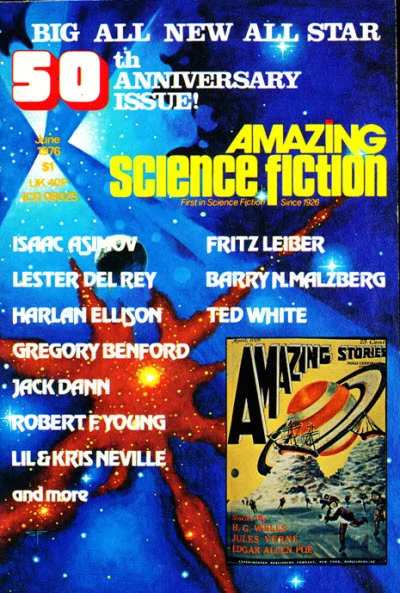
Fifty years and a couple of months from now – IF “now” was fifty years ago to the day (May 21st), I would be receiving the following issue of Amazing Stories in the mail:
 and I would read the following in Ted White’s editorial:
Your larger line of text goes here. “Welcome to our 50th Anniversary issue. This issue marks not ony a milestone in the history of this magazine, but a milestone in the history of science fiction.
Before 1926 there was no science fiction.
~
Gernsback saw Amazing as a place in which to gather together stories of miraculous inventions and the frontiers of science. He wanted to give his readers the same sense of wonder he I himself experienced from the explorations of science and invention. … His motives were at least in part evangelical.”His actual accomplishment was not the one he intended — at least not in a primary sense, although many scientists have noted that sf was an early stimulus toward a career in science — but it was far greater and more sweeping: Gernsback accidentally created a new branch of literature, giving it both name and identity.”
Fifty years on and I find myself the owner and publisher of Amazing Stories rather than a subscriber and avid reader, and Ted White, according to a recent post on Facebook, is in palliative care, following a fall. (If you wish to send him your good wishes, you can contact his daughter here.)
My how things can change over the course of a half-century.
(Obligatory – how-in-the-hell-have-fifty-years-gone-by?)
But while we still do not know what “time” is, we do know some of its characteristics very well, one of them being that it stops for no being.
***
I do intend to discuss our forthcoming 100th anniversary issue in some detail, not the least of which will be a reveal of our intended cover art, but first I wanted to reminisce a little about that Amazing Stories that arrived in my mailbox (and which I subsequently purchased multiple copies of for collection and “investment” purposes).
As you can see from the cover, there’s nary a 21st century sciencefictionist to be found. This makes sense. Time travel still resides on the fictional side of the aisle.
On the other hand, there are names featured that harken back to the origins of the genre as well as its golden age, and certainly lets not forget l’enfant terrible from the fifties.
Here’s the table of contents:
Editorial essay by Ted White
Birth of a Notion short story by Isaac Asimov
Natural Advantage short story by Lester del Rey
The Death of Princes short story by Fritz Leiber
Strange Wine short story by Harlan Ellison
Starhiker novella by Jack Dann
Down Here in the Dream Quarter essay by Barry N. Malzberg
Welcome to the Machine short story by Ted White
Ghur R’Hut Urr short story by Robert F. Young
Milk into Brandy short story by Kris Neville and Lil Neville
The Amazing Interview: Alfred Bester interview by Darrell Schweitzer
Verses for a Golden Age poem by Barry N. Malzberg
The Science in Science Fiction: The View from Titan essay by Gregory Benford
The Clubhouse (Amazing Science Fiction, June 1976) essay by Susan Wood
all of which you can read here on the Internet Archive.
You young ‘uns may not recognize all of those names but I can assure you that they all belong within the pages of an Amazing Stories fiftieth anniversary issue. It has been my honor, privilege and pleasure (well…) to have known and worked with many of those individuals, one of whom goes back to First Fandom and a couple of others who are “First Fandom” adjacent, by which I mean that they were around and involved with SF in one fashion or another right at its inception.
I suppose that about the highest praise I can offer to Ted White’s tenure as editor is that I’m not aware of a single issue in which I didn’t find a single story that wasn’t worth its read. Some were “ok”, others were “great”, but the over-riding takeaway is, every single one of them was worth engaging with. I didn’t waste valuable reading time on any of them and that, I can assure you, is a feat almost unparalleled in the history of our genre. Not once did I think “What a POS!”, nor never came close to hurling an issue against the wall.
OF COURSE tastes vary, but that was my impression and perhaps that is why Amazing Stories through all of its eras made such an early impression upon me.
But there’s more.
In the 70s, I had the privilege to attend a very good (Nationally Ranked) public high school; one of the things they offered were half-year “electives” in pretty much every subject. One of those elective classes in the English Department was Science Fiction and, owing to my demonstrated wide knowledge of the genre (even back then!), I served as something of an assistant teacher for the class (a role I would reprise in College).
One of the subjects discussed (and lamented) was the treatment that the genre received from the literary hoi poloi. Science Fiction was not worth consideration. Not worth taking seriously. Not worth reviewing and always subject to ridicule.
Fortunately (or so I thought at the time) Aldiss’ Billion Year Spree was newly published and I and the class ate it up; here was proof that the mainstream literary crowd was WRONG! The genre had a pedigree that could be traced back to the very beginnings of the literary arts. How dare they impugn the likes of Moore, Swift, Lucien, Bacon with their snide, erudite remarks.
Over the years I became more familiar with the academic side of our literature and gradually changed my views: Aldiss had made an appeal to the very people who were keeping the genre down and they rejected that appeal despite the evidence and I came to the informed conclusion that Aldiss was the one who was wrong. The critics were right. The genre had its roots in ancient literature, certainly, but no more so than any other branch of literature we were familiar with then and now. The Science Fiction GENRE began with Gernsback’s editorial in the first issue of Amazing Stories.
Imagine my shock when I discovered upon a re-read of that 50th anniversary issue, that Ted White had written the exact same thing! This surely must have been a subconscious influence upon my own thoughts.
I’ve already quoted above from his opening paragraphs, but let me share some more of it before continuing:
There were occasional “scientific romances”, the works of authors who, like Verne, were as likely to follow up a novel like 20,000 Leagues Under the Sea (science fiction by today’s definition) with a sequel like Mysterious Island (largely an adventure storv). But the genre of science fiction did not then exist. When an author wrote a novel in which a hidden land of dinosaurs was discovered (as Arthur Conan Doyle did) he did not immediately categorize it in his mind as a genre work. It was a novel, no more and no less.
~~~
His actual accomplishment was not the one he intended — at least not in a primary sense, although many scientists have noted that sf was an early stimulus toward a career in science — but it was far greater and more sweeping: Gernsback accidentally created a new branch of literature, giving it both name and identity.
Proto-sf had existed for years, of course, as noted. Indeed, scholars in the field like to trace the antecedents of science fiction back to the ancient Romans at the very least; But proto-sf was not science fiction for the simple reason that neither its authors nor its readers recognized it as such.
(emphasis mine)
Here, he gets to the meat of the matter:
The importance of this move is two-fold.
On the one hand, as modern authors within the field are proud of complaining, science fiction was’ “ghettoized. It became a distinguishable sub-branch of literature and as such became a focus for scorn and ridicule, much of which survives even today. (A recent issue of Newsweek once again, raked sf condescendingly over the coals; the author of the piece was Peter S. Prescott, a man whose low opinion of science fiction was already on record and was surely known to Newsweek’s editors. But that is a subject for another editorial.) Modern authors of science fiction thirst for literary acceptance and have called for an end to sfs “ghettoization,” under the mistaken illusion that this will benefit their own careers. As we shall see shortly, this is happening, and it does irot bode well for any of us.
The contempt in which science fiction is held by those outside the field is due not to the fact that the field) genre/ghetto exists, but has been, from the first, caused by the closed minds and shuttered imaginations of those who feel this contempt. There have always been those who scorned visionaries and mocked them, and these people see in science fiction a vision which they cannot accept. In the twenties they mocked not only science fiction as it existed then, but rocketry pioneers like Goddard — with questions like, “Once your rocket goes above the atmosphere, what will it push against?” Their “common sense” told them that interplanetary travel (a theme long identified with sf) was an impossibility and those who believed in it were fools. That attitude, as such, is rare now, but how often have we seen in the news media in reports of manned landings on the moon, probes to Mars and Venus and Jupiter, etc., phrases like “this isn’t some sci-fi-fanatic’s dream — this is real”? I really can’t see much point in arguing with such people; their minds are closed and, like all those who’ve fettered their imaginations, they are best pitied.
~~~
In fact, science fiction magazines were not “pulp” magazines in any sense for the first four years of their existence — Amazing and the Wonder family of magazines (started by Gernsback after he left Amazing) were not published in the pulp format, did not use either the same type of paper or the same size (pulps were smaller) and were not priced as pulps (sf magazines cost more
~~~
I said that the importance of the creation of science fiction as a genre in magazine form was two-fold. The second aspect of that importance was positive. Even as sf became a literary ‘ghetto” within the confines of the science fiction magazines, it developed traditions and began to grow.
When proto-sf was published, before the inception of Amazing, it had few if any traditions upon which to build. The author might not have even read anything similar to what he proposed to write, and he certainly could not expect his readers to be familiar with the concepts he chose to use. Thus, most — if not all — proto-sf was grounded in mundane reality. The story began in a contemporary setting. If it was a story of the future, it began with a contemporary protagonist who had to be transported to the future (the most common device was to fall asleep, as Rip van Winkle did, for hundreds of years). If the story was set on another planet, the protagonist had to be transported there — ^as John Carter was, for example, by “astral projection.” Each story had to start with the familiar before it progressed to the unfamiliar.
Once Amazing appeared, this became less and less necessary. Here, in a magazine devoted to science fiction, where the readers expected the unfamiliar, traditions began to develop. Authors could easily see what their peers were writing, and when one author came up with a new idea another could elaborate on that idea in a subsequent story. Thus, certain devices and traditions came into existence. It was no longer necessary to invent spaceflight each time an author wanted to write an interplanetary story. In time he could take for granted certain conventions pertaining to spaceflight. When interstellar stories began appearing, authors began cooking up means of travelling faster than light. Today one has only has to murmur, ‘ftl,” or “hyperspace. ’ The reader understands. Similarly, authors explored the paradoxes of ‘time travel, each building more sophisticated concepts upon the foundations laid down earlier.
Make no mistake: this did increase , the “ghettoizatiqn” of sf. To follow the stories you had to be increasingly familiar with the concepts employed — you had to know the shorthand. But the benefits were enormous. Nearly every important work of science fiction produced between the years of 1930 and 1960 owes its existence to the previous body of science fiction already in print. And the increasing development of sophisticated skills in the field — the increasing emphasis on style and characterization — were made possible only because there existed a body of literature upon which to build and better.
~~~
If we were to view this process topographically, we might say that proto-sf was a horizontal process, each work existing independently and on the same plane with every other work. With the founding of Amazing and magazine-sf, science fiction became a vertical process, each work built on top of previous works, all science fiction being funnelled into one vertical area — the medium of sf magazines.
~~~
The shift of original material away from the magazines has been brought ‘about primarily by this economic shift, which favors books over magazines. But what this bodes for science fiction is not good.
To put it plainly, we’re leaving the “ghetto” at last.
I can hear the authors cheering. Their cheers are not appropriate.
The death of the science fiction magazine, as an institution, is upon us. In practical terms, it has already occurred; the survivors are anachronisms.
Once more science fiction has become a book phenomenon. To return to our topographical view once more, the vertical column is spreading out horizontally again.
~~~
No longer does sf appear within a limited marketplace; no longer can it. be easily followed by either its readers or its authors.
Once again authors are writing in a vacuum. Unaware of what their peers are writing (except for the most notable among Uiem), and unsure of who their readers are. Books don’t publish letter columns. The feedback is minimal.
~~~
What’s to be done? Unless an angel appears and lavishes great amounts of money upon the sf magazines — an uncertain proposition at best — I don’t expect a reversal of the present trend. Science fiction as we’ve known it is going to change. It’s going to become broader-based, require a less sophisticated readership, and become diluted. The traditions may die; they will certainly not be built upon. The best of the new authors will still become known to the inner circle of readers who communicate among themselves — the fens — but the wider audience will find them on a hit-or-miss basis.
Wow, huh?
That fragmentation and loss of internal feedback perhaps finds its best current expression in the objections to “poaching” of genre by so-called “literary” authors; no background leads to misunderstanding and misuse of tropes, “world building” that turns out to be narrative-based rather than logical extrapolation (you go where the LOGIC leads and figure out ways to deal, rather than twisting the logic to fit the desired narrative: in real scientific experimentation, they’d be accused of manipulating the data to support their theory).
As Ted suggests, there’s no magic bullet. Which is one reason why we should be continuing to support those publishing efforts that are trying their best to maintain that shared feedback loop.
Which, oddly enough, brings us back to the 100th Anniversary issue of Amazing Stories.
Here is the cover
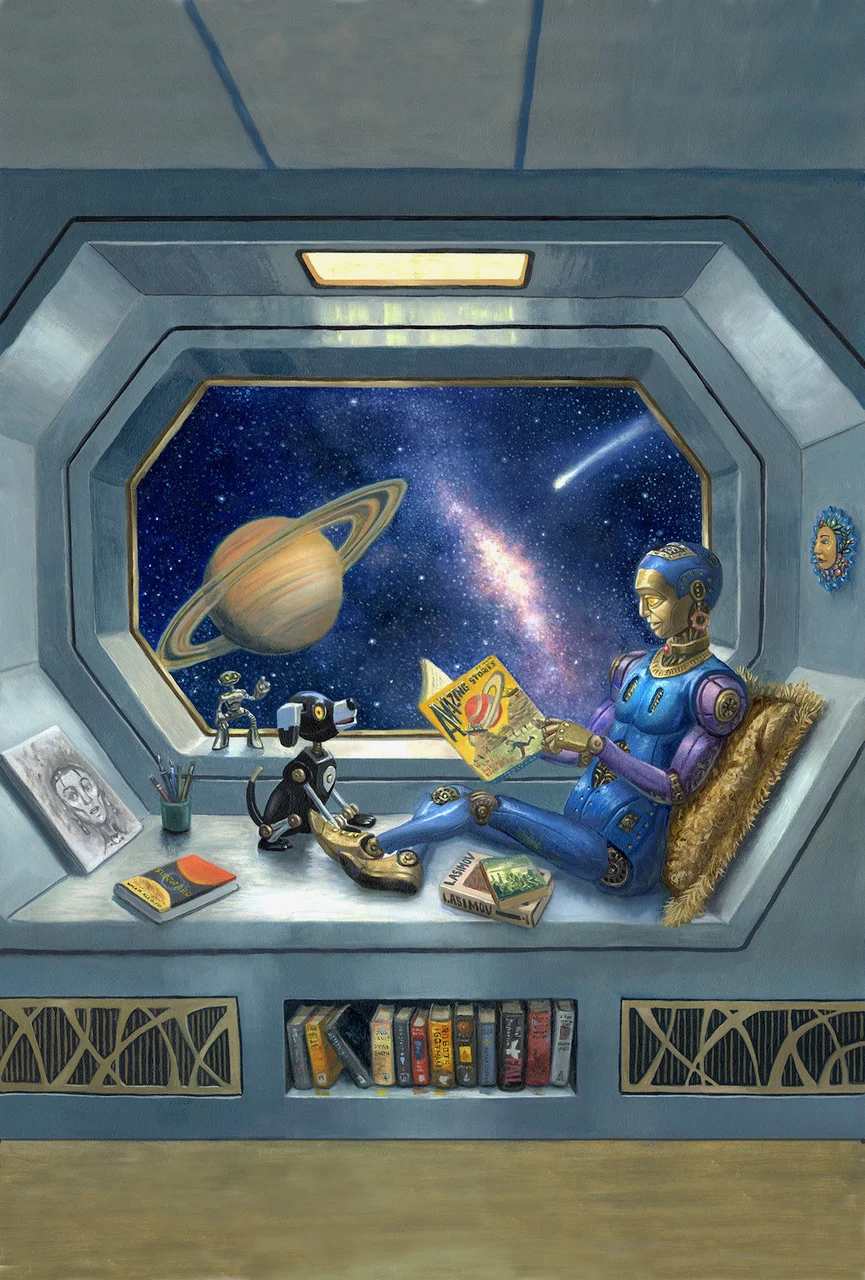 Its by award winning artist Ruth Sanderson and is titled “Future Fan”
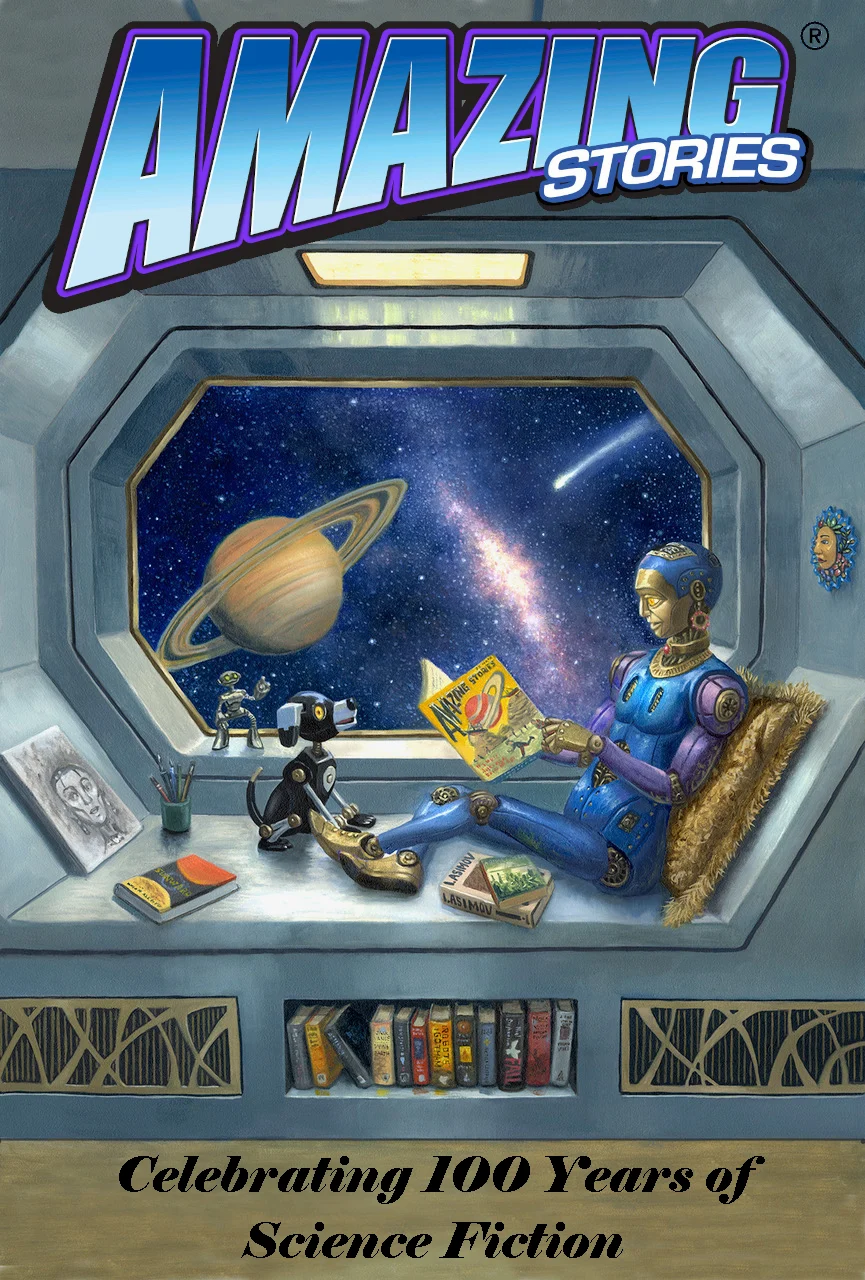
Here is a mockup of what the final cover might look like:
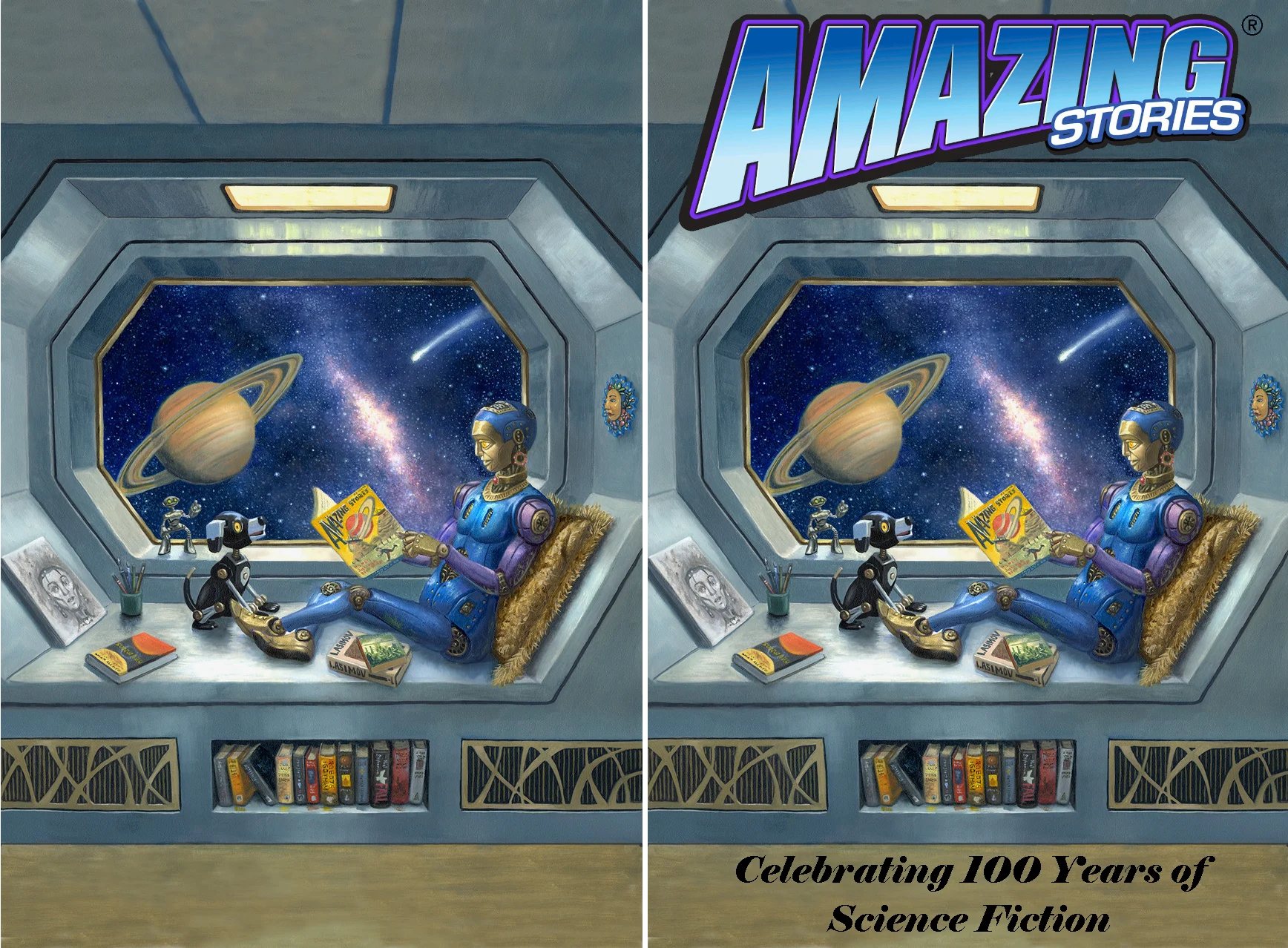
and here are versions that you can view without having to scroll:
Of course our esteemed Creative Director will do a much better job than I, but this ought to give you a fairly good idea of what you’ll be looking at.
Covers are one thing (and wonderful things at that), but they don’t tell the whole story. Once you manage to tear yourself away from staring at the cover, what will you find?
We’re preparing three distinct sets of content for your entertainment and your education –
There will be a fine selection of essays that examine the past and peer into the future of a number of SFnal subjects by practitioners of the field. All of the contributors were asked to examine their subject’s past treatment and then speculate on where it might be going in the future. A partial list of those subjects are:
Joe Siclari on Fandom, Chris Barkley on Black SF, Lisa Yaszek on women in SF, David Gerrold on LGBTQI in SF, David Brin on the genre itself, John Coker on First Fandom, Chris McKitrick on academia, Rachel Cordasco on SF in translation, F.J. Bergman on Poetry, Jean-Marie Stine on Publishing, Rich Horton on critique and review, Tanya Tynjala on Spanish language SF…and more.
There will be a retrospective section on 100 years of the fiction in the genre, showcasing one story from each decade of the magazine’s existence, curated and edited by Jean-Marie Stine – ten (perhaps 12) short fiction pieces drawn from within the pages of this magazine that will offer readers not only fiction from some of the best in the field, but also a road-trip through the development of that fiction over the course of a century.
Finally, there will be a selection of new fiction by contemporary authors, as well as the usual kinds of editorial matter associated with publications like this, as well as a rather extensive dedication page that will thank all of the many and varied people who have brought Amazing Stories to where it is today.
***
Ted White has now, sadly, passed. His daughter is seeking assistance with funeral and memorial costs. Amazing Stories has contributed support and has also made arrangements to reprint the full 50th Anniversary editorial, which you will find below. Ad Astra!, Ted. Hope to see you on the Riverworld!
Welcome to our 50th Anniversary issue. This issue marks not ony a milestone in the history of this magazine, but a milestone in the history of science fiction.
Before 1926 there was no science fiction.
There were occasional “scientific romances”, the works of authors who, like Verne, were as likely to follow up a novel like 20,000 Leagues Under the Sea (science fiction by today’s definition) with a sequel like Mysterious Island (largely an adventure storv). But the genre of science fiction did not then exist. When an author wrote a novel in which a hidden land of dinosaurs was discovered (as Arthur Conan Doyle did) he did not immediately categorize it in his mind as a genre work. It was a novel, no more and no less.
Amazing Stories changed all that. When the magazine’s founder, Hugo Gernsback, launched it he did not have the phrase, “science fiction,” with which to dub its contents but he did call the fiction he published “scientifiction,” a close cousin indeed. (As Isaac Asimov notes in his story herein, Gernsback originally wanted to call his magazine Scientifiction-, it was apparently an unpopular choice and he abandoned it as a title.)
Gernsback saw Amazing as a place in which to gather together stories of miraculous inventions and the frontiers of science. He wanted to give his readers the same sense of wonder he I himself experienced fi-om the explorations of science and invention (by no coincidence an earlier, non-fiction Gernsback magazine was called Science h- Invention -, it was the Mechanix Illustrated of its day). By sugarcoating the pill of science with fiction he hoped to excite an interest in science among his younger readers. His motives were at least in part evangelical.
His actual accomplishment was not the one he intended — at least not in a primary sense, although many scientists have noted that sf was an early stimulus toward a career in science — but it was far greater and more sweeping: Gernsnack accidentally created a new branch of literature, giving it both name and identity.
Proto-sf had existed for years, of course, as noted. Indeed, scholars in the field like to trace the antecedents of science fiction back to the ancient Romans at the very least; But proto-sf was not science fiction for the simple reason that neither its authors nor its readers recognized it as such.
When Gernsback founded Amazing he created a place in which science fiction could exist and grow and develop traditions. When other magazines subsequently appeared which also published science fiction fonder. Astounding) they legitimized science fiction as a genre.
The importance of this move is two-fold.
On the one hand, as modern authors within the field are proud of complaining, science fiction was’ “ghettoized. It became a distinguishable sub-branch of literature and as such became a focus for scorn and ridicule, much of which survives even today. (A recent issue of Newsweek once again, raked sf condescendingly over the coals; the author of the piece was Peter S. Prescott, a man whose low opinion of science fiction was already on record and was surely known to Newsweek’s editors. But that is a subject for another editorial.) Modern authors of science fiction thirst for literary acceptance and have called for an end to sfs “ghettoization,” under the mistaken illusion that this will benefit their own careers. As we shall see shortly, this is happening, and it does not bode well for any of us.
The contempt in which science fiction is held by those outside the field is due not to the fact that the field) genre/ghetto exists, but has been, from the first, caused by the closed minds and shuttered imaginations of those who feel this contempt. There have always been those who scorned visionaries and mocked them, and these people see in science fiction a vision which they cannot accept. In the twenties they mocked not only science fiction as it existed then, but rocketry pioneers like Goddard — with questions like, “Once your rocket goes above the atmosphere, what will it push against?” Their “common sense” told them that interplanetary travel (a theme long identified with sf) was an impossibility and those who believed in it were fools. That attitude, as such, is rare now, but how often have we seen in the news media in reports of manned landings on the moon, probes to Mars and Venus and Jupiter, etc., phrases like “this isn’t some sci-fi-fanatic’s dream — this is real”? I really can’t see much point in arguing with such; their minds are closed and, like those who’ve fettered their imaginations, they are best pitied.
An allied branch of contempt for science fiction associates it with pulp magazines and argues a sleeziness by-association which is both historically untrue and unfair to pulp writing in general. (Pulps gave us two of the 20tii Century’s best American authors, Dashiell Hammett and Raymond Chandler.)
In fact, science fiction magazines were not “pulp” magazines in any sense for the first four years of their existence — Amazing and the Wonder family of magazines (started by Gernsback after he left Amazing) were not published in the pulp format, did not use either the same type of paper or the same size (pulps were smaller) and were not priced as pulps (sf magazines cost more — until the Depression forced cheaper prices and pulp-production methods). It was in 1930 that a pulp publisher launched the first pulp science fiction magazine — Astounding Stories of Super Science — a magazine with a much stronger emphasis on actionadventure than upon scientific marvels. It is ironic that, under a later publisher and under the gifted editorship of John W. Campbell, Astounding evolved into Analog, the least “pulp”ish sf magazine of mem all.
During the 1930s the sf magazines fell upon hard times and were eventually surrendered to pulp-chain publishers, but it is significant that even then it was recognized that their readership was not the typical pulp magazine readership, nor were their authors, with a few exceptions, pulp-magazine writers. Ultimately — -in the early 1950s — pulp magazines, as a publishing phenomenon, died and disappeared from the newsstands. But science fiction magazines continued, virtually alone — the last surviving type of magazines still devoted primarily to fiction.
I said that the importance of the creation of science fiction as a genre in magazine form was two-fold. The second: aspect of that importance was positive. Even as sf became a literary ‘ghetto” within the confines of the science fiction magazines, it developed traditions and began to mow.
When proto-sf was published, before the inception of Amazing, it had few if any traditions upon which to build. The author might not have even read anything similar to what he proposed to write, and he certainly could not expect his readers to be familiar with the concepts he chose to use. Thus, .most — if not all — proto-sf was grounded in mundane reality. The Story began in a contemporary setting. If it was a story of the future, it began with a contemporary protagonist who had to be transported to the future (the most common device was to fall asleep, as Rip van Winkle did, for hundreds of years). If the story was set on another planet, the protagonist had to be transported there — as John Carter was, for example, by “astral projection.” Each story had to start with the familiar before it progressed to the unfamiliar.
Once Amazing appeared, this became less and less necessary. Here, in a magazine devoted to science fiction, where the readers expected the unfamiliar, traditions began to develop. Authors could easily see what their peers were writing, and when one author came up with a new idea another could elaborate on that idea in a subsequent story. Thus, certain devices and traditions came into existence. It was no longer necessary to invent spaceflight each time an author wanted to write an interplanetary story. In time he could take for granted certain conventions pertaining to spaceflight. When interstellar stories began appearing, authors began cooking up means of travelling fester than light. Today one has only to murmur, ‘ftl,” or “hyperspace. ’ The reader understands. Similarly, authors explored the paradoxes of ‘ time travel, each building more I sophisticated concepts upon the foundations laid down earlier.
Make no mistake: this did increase , the “ghettoizatiqn” of sf. To follow the stories you had to be increasingly familiar with the concepts employed — you had to know the shorthand. But the benefits were enormous. Nearly every important work of science fiction produced between the years of 1930 and 1960 owes its existence to the previous body of science fiction already in print. And the increasing development of sophisticated skills in the field — the increasing emphasis on style and characterization — were made possible only because there existed a body of literature upon which to build and better. Without Sturgeon, could there have been Zelazny?
If we were to view this process topographically, we might say that proto-sf was a horizontal process, each work existing independently and on the same plane with every other work. With the founding of Amazing and magazine-sf, science fiction became a vertical process, each work built on top of previous works, all science fiction being funnelled into one vertical area — the medium of sf magazines.
The death of the pulp magazines signalled a profound change in the publishing industry. In 1949 Street & Smith, the pioneer publisher of pulp magazines (the company got its start with dime novels), folded its entire pulp line, saving from extinction only one fiction magazine — Astounding. Within five years most of the other pulp publishers had followed suit. The reasons were not hard to find: languishing sales, usually blamed on television siphoning off the pulp audience.
The death of the pulps hurt sf magazines incalculably, although few realized it at the time.
There were several factors at work. To begin with, when sf magazines were published by pulp publishers, they fell under the economic umbrella of the entire; pulp chain. Advertising, for instance, was sold for the whole chain, the rates based upon the total circulation of a the magazines within the chain — and not by -the individual title. (Comics still do this today.) Printing contracts, etc., were negotiated by the chain. When sf magazines were part of large publishing chains their per Unit costs were significantly lower.
Likewise, sf magazines were distributed as part of the pulp chain as a whole. A pulp chain had considerable clout with distributors on both the national and local levels. Most newsstands devoted considerable space to the display of pulps, and readers browsing the newsstands had no difficulty finding them.
When the pulp publishers went under, many (but far from all) sf magazines survived. But most of these were either the products of small independent publishers, or orphans (like Astounding) in companies no longer geared toward the production of fiction magazines. The sf magazines survived primarily because their audience had never been the regular pulp audience, and consequently were not lured away by television. But sf magazines by the same token had never had large audiences — 100,000 was the maximum in most cases, and a number of early-1950’s sf magazines sold from 15,000 to 35,000 copies an issue. This was never a viable circulation; it guarantees breaking even at best and leaves little room for growth. Under the umbrella of a pulp chain such a low circulation was acceptable. Without that umbrella, it was marginal.
This fact became obvious not only to the publishers, but also to the distributors, many of whom declared themselves unwilling to handle such low-profit items. The 1950’s witnessed the collapse of the sf magazine field from a high point of over forty titles in 1952 to less than a dozen by 1960. The 1959 World Science Fiction Convention became a wake for the field.
What science fiction appeared in book form during the thirties and forties was, with few exceptions, reprinted from the pages of the sf magazines. In most cases these books were published by small houses run by fans or ex-fans — enthusiasts who wanted their favorite stories collected in more permanent form and knew that a small market (a few thousand at best) existed for such books.
In the early 1950’s larger publishers joined in. Doubleday began a regular sf program and also launched the Science Fiction Book Club. Soon the specialty houses were out of business. By the late 1950’s paperback houses were not only reprinting hardcover sf books — they were publishing original works as well. Ace Books, under Don Wollheim’s editorial hand, published three sf novels (two as halves of an Ace Double) every month, many originals. In the early 1960’s other publishers — Berkley, Pyramid, Lancer — were following suit.
And at this point the shift in emphasis from magazine sf to book sf began to become apparent. Samuel Delany was discovered not by a magazine editor but by Don Wollheim at Ace. Ursula Le Guin, although first published in Amazing and Fantastic, developed as a novelist at Ace. When I began writing sf, although I made my first sales to this magazine and to If, I quickly discovered that it was not only more profitable to write books for Ace, Lancer and Pyramid — it was easier to sell them there (I tried for magazine serialization on all my early novels, without success). Subsequently the appearance of anthology series like Damon Knight’s Orbit and Terry Carr’s Universe — as well as the blockbuster Dangerous Visions anthologies — underscored the shift away from sf magazines and into books. Most of the Nebula and Hugo award winners of recent times did not appear first in the sf magazines, and a scan of the credits in any recent Best of the Year science fiction collection will reveal that much if not most of the material has come from anthologies rather than magazines.
The science fiction magazine has been a marginal operation for the past fifteen to twenty-five years. Today there are only five left. How long three of those will survive is anyone’s guess. The sales figures continue to drop. The shift of original material away from the magazines has been brought ‘about primarily by this economic shift, which favors books over magazines. But what this bodes for science fiction is not good.
To put it plainly, we’re leaving the “ghetto” at last.
I can hear the authors cheering. Their cheers are not appropriate.
The death of the science fiction magazine, as an institution, is upon us. In practical terms, it has already occurred; the survivors are anachronisms.
Once more science fiction has become a book phenomenon. To return to our topographical view once more, the vertical column is spreading out horizontally again.
No, well never go back to the pre-1926 days in terms of content. Science fiction’s vocabulary has entered the mainstream of our culture, via comics and Star Trek; everyone knows about hyperspace these days. But the fragmentation which once existed is returning. No longer does sf appear within a limited marketplace; no longer can it. be easily followed by either its readers or its authors. There are literally hundreds of science fiction books in print these days — all at prices at or over 950 a copy — and no one person could hope to keep up with them all. Today sf in book form covers the entire spectrum — from Perry Rhodan to The Dispossessed, from the most juvenile to the most adult . But it’s a fragmented spectrum, and those who haven’t access to sf specialty bookstores are unlikely to even be aware of all the current releases.
Once again authors are writing in a vacuum. Unaware of what their peers are writing (except for the most notable among Uiem), and unsure of who their readers are. Books don’t publish letter columns. The feedback is minimal.
And the New York Review of Books is no more likely now to give an sf writer a thoughtful review than it ever was. Newsweek still sneers. The walls of the ghetto are crumbling, but the results are not the desired ones.
What’s to be done? Unless an angel appears and lavishes great amounts of money upon the sf magazines — an uncertain proposition at best — I don’t expect a reversal of the present trend. Science fiction as we’ve known it is going to change. It’s going to become broader-based, require a less sophisticated readership, and become diluted. The traditions may die; they will certainly not be built upon. The best of the new authors will still become known to the inner circle of readers who communicate among themselves — the fans — but the wider audience will find them on a hit-or miss basis.
Well, it was a great fifty years. Exciting, exhilarating, and something I’m glad I had the chance to participate in. That’s history for you.
Poscript: The body of the above editorial formed a speech which I gave in January at ConFusion, the annual Ann Arbor sf convention. I’d like to take this opportunity to thank Ro Nagy, Jim Martin and all the rest of Ann Arbor fandom for one of the most enjoyable conventions I’ve attended in many years. Their thoughtfulness exceeded that of any previous, committee with whom I’ve had dealings; their philosophy of conventioneering seems to me exemplary. Thanks, people.
—Ted White”

Steve Davidson is the publisher of Amazing Stories.
Steve has been a passionate fan of science fiction since the mid-60s, before he even knew what it was called.