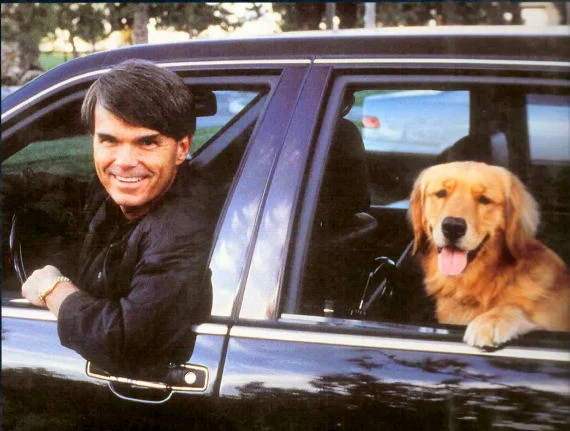
Dean R. Koontz is only two years older than I am; I always figured him for much older because of when I started reading hose books. Many people consider him a horror genre writer, but in my opinion, horror is a fairly small part of his output; I call him a “thriller” writer. Except for his books about golden retrievers, that is. Because of his late dog Trixie (Figure 2), he’s hooked on golden retrievers. Dean’s thrillers often fall into the sfnal realm, including such sfnal tropes as telephathy, aliens and nanobots, or nanites. Even his “Frankenstein” series is more or less SFnal, in my opinion. Most of his actual horror books were written under the pseudonym Leigh Nichols. A large number of movies and TV shows have been made from his writings. He’s probably one of the most popular American thriller writers.
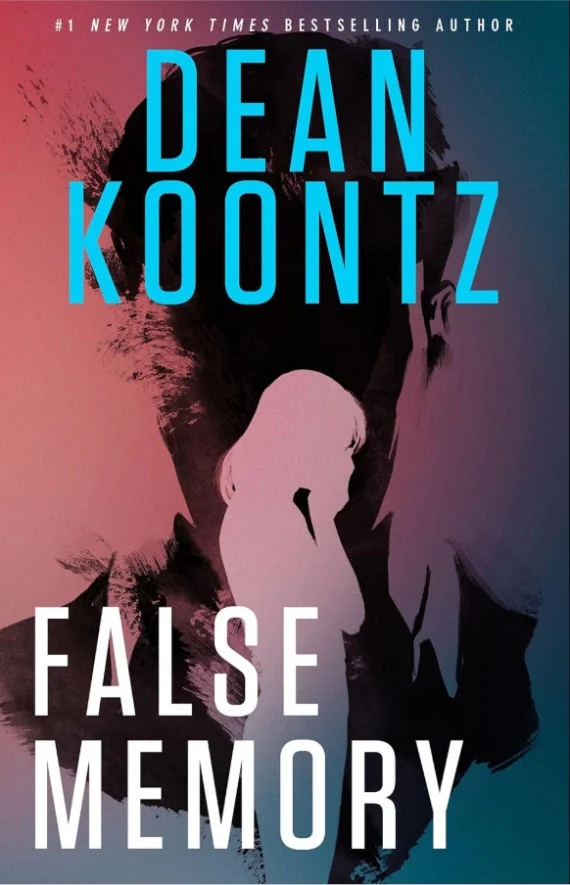
At the SF convention I attended in Seattle over Easter (Norwescon 48—this may be the longest-running fan-run convention in the U.S.), I got a couple of hardcover Koontz novels off the “free book” table, one being a first of By the Light of the Moon (2002) with dust jacket in really good shape; the other being a non-dust-jacketed False Memory (1999). I read a lot, despite my eye problems, and dove into the two books happily. I’ve found that I enjoy his writing, even when the book itself isn’t one of his best. He’s got a good turn of phrase, and sometimes I’ll force my wife (the Beautiful and Talented Lynne Taylor Fahnestalk) to listen while I read her a short passage. The other thing about his writings is that like Stephen King’s books, you never quite know—no matter how the book begins—where you’ll end up going.
At the front of this book (as is usual with Koontz’s writings) we start with a quotation from “The Book of Counted Sorrows” (Dean’s own writings), and a couple of haiku, which is not the usual, but is entirely appropriate for this book. (In case you’re unfamiliar with haiku, they are Japanese and Japanese-influenced 17-syllable poems with three lines each—5 syllables, 7 syllables, and again 5. A big name in haiku is the late Japanese poet Ōkyo (1733-1795), quoted in this book). The story begins in Corona del Mar, Southern California, where Martine (Martie) Rhodes is taking her golden retriever, Valet, for his daily walk. She carries the standard blue bag for his leavings. She’s young, married three years to “Dusty,” although her mother Sabrina harbours a deep wish that the marriage should fail—no housepainter can be good enough a husband for her daughter.
Martine’s father was the late “Smilin’ Bob” Woodhouse, an often-awarded firefighter; she inherited her good nature from him, rather than from her mother. Martie’s currently earning her living as a home-based programmer writing game software; she’s recently contracted to produce a new RPG (Role-Playing Game) based on J.R.R. Tolkien’s Lord of the Rings. Martie is quite happy with her life; the only shadow on her horizon is her best friend, Susan, who is suffering from an extreme case of agoraphobia (fear of the outside [world]). Susan is being treaded by a psychiatrist, Dr. Ahriman, who assures her that Susan is getting better, though Martie doesn’t really see signs of that.
Dustin (“Dusty”) Rhodes has a few problems of his own; as a painting contractor, he’s pretty successful. He has a crew of three besides himself: his half-brother, “Skeet” Caulfield, ex-druggie; Foster “Fig” Newton; and Ned Motherwell, member of a group that doesn’t believe in drugs. Today Dusty finds he has a problem: Skeet is perched on the ridgeline of the house they’re painting, preparing to jump. He’s been “clean,” but it sounds like he’s back on drugs—and Dusty will have to check him back into the clinic where Dr. Ahriman practices, because Skeet seems to be convinced that the Angel of Death has told him to jump.
Moving through the psyches of Martie, and Susan, Dusty and Skeet, the reader finds that each of them seems to be affected in one way or another by some psychological problem—and for Susan and Martie especially, it’s getting worse—Martie’s afraid—deathly afraid—that she might injure not herself, but Dusty; Susan, though she keeps her doors and windows securely locked, is afraid that while she’s sleeping, her ex-husband is visiting her in the night and sexually assaulting her. Skeet, though his toxicology reads clean, is acting as if he’s on drugs.
The effects on all of them—with the exception of Dusty—seem to be getting worse and more horrific. The link appears to be Dr. Ahriman: rich, cool, well-dressed and a best-selling author of pop psychology books. Despite his protests that the affected are getting better, everyone he’s treated seems to be getting worse and worse. The name Ahriman is taken from a Zoroastrian bad god—the equivalent of the Christian devil, if I remember correctly. This “doctor” uses several aliases, and every one is evil.
Doctor Ahriman is behind everything bad that happens to Dusty, Martie, and Susan—he is the kind of person who gets his kicks (sexual and otherwise) from hurting other people. I can’t go into more detail without spoilers, which I’m loath to do. It’s such a good, intense thriller that will, I feel, affect most readers and leave them somewhat breathless. I highly recommend this one for those who can appreciate a good, scary thriller.
NOTE: This column is in no way written, edited, proofed or composed by AI, though some of my photo editing software uses it in some capacity. This is a human column and will remain so.
I’d like to hear what you think about this column. I’m on Facebook, or you could email me (stevefah at hotmail dot com). If you liked it, let me know; if you didn’t, let me know as well. My opinion is, as always, my own, and doesn’t necessarily reflect the views of Amazing Stories or its owner, editor, publisher or other columnists. See you next time!

Steve has been an active fan since the 1970s, when he founded the Palouse Empire Science Fiction Association (PESFA) and the more-or-less late MosCon in Pullman, WA and Moscow, ID, though he started reading SF/F in the early-to-mid 1950s, when he was just a sprat. He moved to Canada in 1985 and quickly became involved with chairing or helping run Canadian cons, including ConText (’89 and ’81) and VCON. As a fan, he’s published a Hugo-nominated (one nomination) fanzine, New Venture, and he’s founded two writing groups (Writers’ Bloc and Writers of the Lost, Ink). He’s emceed and auctioned art at many West Coast and Northwest conventions including one Westercon. As a writer, he’s published a couple of books and a number of short stories (including one in Compostella [Tesseracts 20], and has collaborated with his two-time Aurora-winning wife Lynne Taylor Fahnestalk on a number of art projects. As of this writing he’s the proofreader for R. Graeme Cameron’s Polar Borealis and Rhea Rose’s Polar Starlight publications. He’s been writing for Amazing Stories off and on since the early 1980s. His column can be found on Amazing Stories most Fridays.