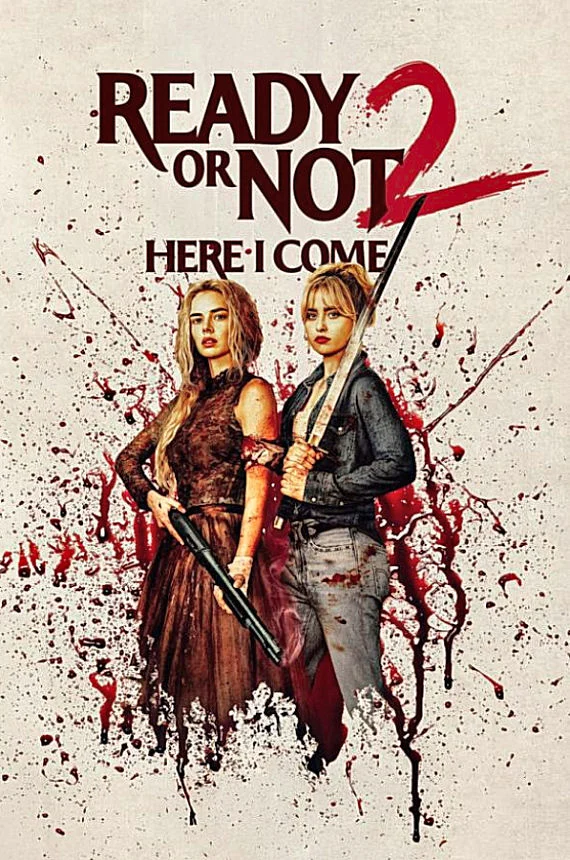
The first movie in this sequence, Ready or Not (2019), was a pleasant surprise; it was orignal, blackly humourous, well enough acted (for a movie of its type) and featured a strong female lead, leaving viewers with a yen to see a sequel, which was announced fairly quickly. For those of you who didn’t see the first movie, a quick recap. Grace MacCaullay (Samara Weaving), who was supposed to have no family, married Alex Le Domas but discovered on her wedding night that all new brides in that family had to play a game. Drawing a card, Grace discovered that her game was “Hide and Seek,” which she learned meant that she had to survive an all-out attack by her new family—if she lived until dawn, she would be a full-fledged member of the family. Even her new husband was out to kill her. Why? The family was—every member—pledged to Satan, and this was a) why they were so successful; and b) a requirement going back to the original pact with the devil. Silly as it sounds, every member of the family tried to kill her, but she made it to dawn, burning down the family home and killing every member of that family. Figure 2 shows her in her wedding dress, having a cigarette as the family home burns down behind her.

I won’t spoil everything in the movie, in case you decide to watch it, but since I’ll say right now that it’s not as funny or as clever as the first movie, I have to give you some spoilers to show why it’s a disappointment. So be warned. The sequel opens with Grace coming down the steps (as in the end of the first movie), then sitting and lighting a cigarette, but she almost immediately collapses and wakes up in the hospital with her left hand bandaged and handcuffed to the bed. Almost as soon as she awakens, a police officer tells her she’s under arrest for suspicion of murder and arson, as several bodies were found in the wreckage of the building.
She’sl also told that her emergency contact—Faith, her younger sister (Kathryn Newton)—is on her way. She’s had no contact with her sister for seven years and had forgotten that she’d listed her sister as such. The detective leaves them alone for a few and there’s an awkward reuinion, as the two sisters are obviously not happy with each other. Grace tells Faith that she (Faith) won’t believe her, then details what happened after the wedding.

At the same time, we cut to a room where an older man, Chester Danforth (David Cronenberg—yes, that Cronenberg) is watching a TV where a newscast is saying that there’s no end in sight in a continuing war being shown onscreen; on the phone, he says “Approve the cease fire”; immediately, a news bulletin appears onscreen, saying “Breaking news: cease fire approved!” A lawyer (Elijah Wood) appears, telling him that the Le Doma family is done, prompting him to tell the lawyer to contact his children, and to send out a message to China, to Spain, to India or Pakistan saying “The ball is in play.” This prompts a lot of reaction, including to Bill Wilkinson (Kevin Durand), who, after sniffing a giant whack of what looks like cocaine, yells to someone, “F*** the rulles! Bring me my knives!” All over the world, people appear to be getting the same message and prepping for something to happen.
At the hospital, the detective is wheeling Grace out in a wheelchair, accompanied by Faith, to take her to the station to give a statement, when—out of nowhere—he collapses with a knife in the throat. Bill Wilkinson, wild white hair standing on end, inflamed with coke, is here to “F” the rules and “get” Grace! The two attempt to run (Figure 3), but Bill gets them both down on the floor and is just about to kill Grace when something happens. (I won’t tell you what it is, but it’s justified by the rules of the game.) At the same time, in the Danforth household, the Danforth children, Titus (Shawn Hatosi) and Ursula (Sarah Michelle Gellar) are about to meet their father for the last time (Figure 4).

The movie from this point on, is very similar to the first movie—it’s nearly all action with the exception of the reunion and interaction of the two MacCaullay women. The younger, Faith (Newton) blames the older Grace (Weaving) for leaving her alone—they are, apparently orphans who were being fostered. Grace had run off to New York City at age 18, leaving her 13-year-old sister in foster care; the younger blames her for abandonment. A lot of interaction, blame, etc., occurs while the two are being chased as in the first movie—but the stakes are higher in this one. It appears the world is ruled by a council of five families, and Grace has killed one of those families, so the head seat of the council will be determined by who kills Grace. It’s all tied up with Satanism and Satanic pacts made by all members of the five families. (Personally, I found that part silly, but suspended my disbelief for the sake of the show.) The acting is okay, but there are no standouts, really. Even Elijah Wood, the lawyer, has little to do in this film. Much of the humour seems forced, and there are few surprises. Having the heroine (and in this one, her sister) covered in blood is a trope that became somewhat wearying after a while. I found the movie watchable, but not in the same class as its predecessor.
NOTE: This column is in no way written, edited, proofed or composed by AI, though some of my photo editing software uses it in some capacity. This is a human column and will remain so.
What did you think of this column? Would you please let me know whether you liked it, were lukewarm, or disliked it–and why. I’m on Facebook, or you could email me (stevefah at hotmail dot com). If you liked it, let me know—if you hated it, let me know so I can do better! My opinion is, as always, my own, and doesn’t necessarily reflect the views of Amazing Stories or its owner, editor, publisher or other columnists. See you next time!

Steve has been an active fan since the 1970s, when he founded the Palouse Empire Science Fiction Association (PESFA) and the more-or-less late MosCon in Pullman, WA and Moscow, ID, though he started reading SF/F in the early-to-mid 1950s, when he was just a sprat. He moved to Canada in 1985 and quickly became involved with chairing or helping run Canadian cons, including ConText (’89 and ’81) and VCON. As a fan, he’s published a Hugo-nominated (one nomination) fanzine, New Venture, and he’s founded two writing groups (Writers’ Bloc and Writers of the Lost, Ink). He’s emceed and auctioned art at many West Coast and Northwest conventions including one Westercon. As a writer, he’s published a couple of books and a number of short stories (including one in Compostella [Tesseracts 20], and has collaborated with his two-time Aurora-winning wife Lynne Taylor Fahnestalk on a number of art projects. As of this writing he’s the proofreader for R. Graeme Cameron’s Polar Borealis and Rhea Rose’s Polar Starlight publications. He’s been writing for Amazing Stories off and on since the early 1980s. His column can be found on Amazing Stories most Fridays.