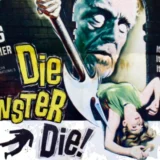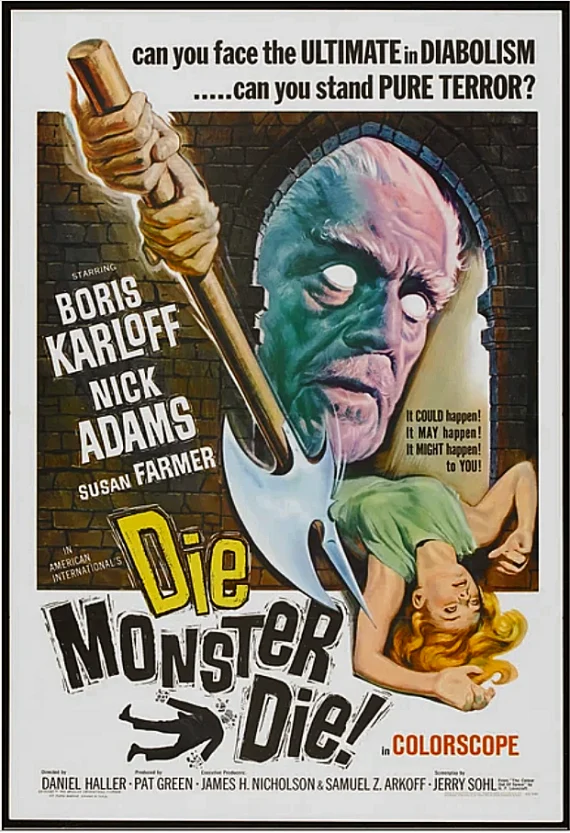
If there was ever a science fiction movie masquerading as a horror movie—with Boris Karloff, even—Die, Monster, Die, is definitely it. Extremely loosely based on H.P. Lovecraft’s “The Colour Out of Space,” and written by science-fiction and screenwriter Jerry Sohl, it’s marketed as something like a Hammer film (Figure 1). And the screenplay, though it never dips into standard horror/Hammer tropes like witchcraft, vampires, demons or monsters, certainly tries to give that sort of impression, even while it hewed to the science-fictional line of the original story. (The Hammer horror films from England were very popular in North America; there were 15 of them, ranging from Dracula movies, through werewolf, Frankenstein, Phantom of the Opera, to The Mummy and The Gorgon, from 1960 through 1965.)
The original Lovecraft story is set as usual near the fictional town of Arkham in New England. It doesn’t fall into his well-known Cthulhu Mythos, but is more a stand-alone piece about a blighted area where few people go by choice; blighted because of a meteorite that had landed there fifty years previous. Published in Amazing Stories—the only story Lovecraft sold to Amazing, because Hugo Gernsback was very late, as was his habit, in paying for the story, which made Lovecraft very angry—in September 1927, it quickly became one of Lovecraft’s most popular stories. Unfortunately for me, although I briefly discussed the movie with its writer, Jerry Sohl, who was a friend, I missed the opportunity to find out why the setting was changed to England, where it was filmed.
Because it’s so well known, I’ll run through the story (as opposed to the movie) quickly: A surveyor comes to a valley where, in the late 1880s, a meteorite hit the ground, which began to show strange effects: the ground and vegetation would show strange glowing colours at night, and soon the trees and bushes began to show signs of movement—people and animals start developing oddly. The farmer on whose property the meteor fell, one Nahum Gardner, discovers that although the vegetables he’s raising look big and lush, they have a bitter taste and are basically inedible. His farm animals exhibit odd behaviour, and even his family becomes affected. The area earns the name “the blasted heath” and everything gets grey and brittle. Gardner’s family turns physically ugly and twisted and dies one by one, and even Gardner himself dies—the surveyor witnesses the colour, which is pervasive in the area—disappearing into the sky.

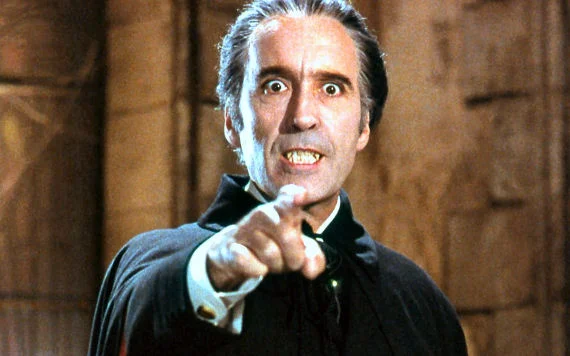
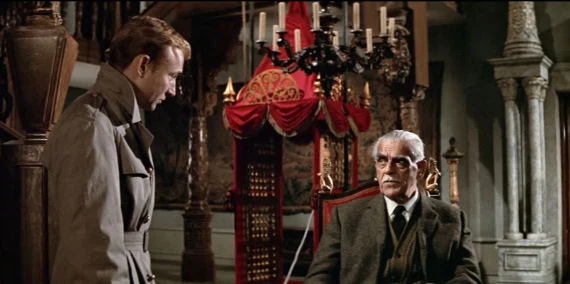
The movie changes all that—Nick Adams stars as American scientist Stephen Reinhart, who goes to England to meet his fiancée Susan Witley (Suzan Farmer, introduced in this film), whom he’d met while she was studying in the U.S. He goes to the village of Arkham, to get directions to the Witley estate—but nobody in the village will tell him anything, or rent him a taxi or bicycle to go to the estate. He walks, noting a grey area on the way—the “blasted heath”—where all the trees and bushes, even the grass—are grey and brittle. Arriving at the gates, which have large “No Trespassing” signs, he finds them locked, but he finds another way in. When he knocks on the front door, it is opened by Nahum Witley (Boris Karloff in a wheelchair (Figure 3); the chair was added because Karloff had a bad back and couldn’t stand for long), who tries to get rid of him, but his daughter Susan (Suzan Farmer) appears and invites him in. The house is old but richly furnished, but not well kept up, and which appears to have no electricity. The people living there number only four—Nahum, his wife Letitia (Freda Jackson), Susan, and the aged and infirm butler Merwin (Terence De Marney); Nahum explains that his wife (Figure 4) is too ill to be seen, though he doesn’t say how she is ill.Figure 5 – Lush, giant flowers and vegetables CENTERNahum grudgingly allows Reinhart to stay at Susan’s urging. Later, Reinhart follows Nahum and Merwin, the butler, surreptitiously into the basement, where Nahum appears to be performing experiments with something glowing in a hole in the basement covered with a large metal grid they swing up and down over it. Stephen accidentally makes a sound, but manages to beat Nahum upstairs and fakes being asleep in bed. The next day or so, Nahum informs them that Merwin has died; Reinhart follows him that evening and sees him digging a hole to bury the butler. Letitia, Nahum’s wife, asks Stephen to come see her, and gives him an earring from her maid, Helga, whom she says has disappeared. Stephen is attacked in the woods by a mysterious hooded person wielding a knife, but manages to escape. As you have probably guessed by now, the mysterious figure is Helga (Figure 4), who dies, glowing…. Stephen checks with the village doctor, played by Patrick Magee (Clockwork Orange), but gets little information.
You might want to figure out the ending yourself—or you may want to watch this on one of the streaming services; it seems to be available on Amazon Prime, Tubi TV, Plex, and others, so I’ll let it go there.
Nick Adams was never an A-list actor; his main claims to fame were a) that he was a friend of James Dean before Dean died, as well as a friend of Elvis Presley; b) that he had a one-season TV Western series called The Rebel (I remember the theme song, or at least the fist line: “Johnny Yuma was a Rebel; he rode through the West….”) which was episodic, like other Westerns of the time, and somewhat similar to Steve McQueen’s Wanted, Dead or Alive, though McQueen was a much more convincing actor. This was apparently Suzan Farmer’s (spelled “Susan” in the movie’s titles) first film, though she went on to be in a number of actual Hammer films. This was one of the last few films that Karloff made; he was, as they say, “getting on” in age and was increasingly infirm, though he did a marvelous job with what even Jerry Sohl told me wasn’t his best script. I gather there were more than a few fingers in that pot; I’m sure he could have written a better script had they given him free rein. At one point in the early ‘80s, Jerry sent me a big box of original TV scripts he’d written (though, to my disappointment, it was only a loan and I had to return it); I read scripts from TV series like GE Theatre, hosted by Ronald Reagan (Jerry joked that everyone called him “Two-take Ronnie,” make of that what you will), as well as Twilight Zone (Jerry had written three of Charles Beaumont’s when Beaumont became too ill to write.) Oddly and coincidentally enough, Beaumont and I went to the same high school (Everett High) in Everett, Washington, and shared the same favourite teachers; he gave them an autographed paperback, which I now have. And as far as I can remember, those scripts were pretty well written; I also read the script for Jerry’s original Movie of the Week, called Night Slaves, an interesting science fiction TV movie, as well as a Star Trek episode under the name Nathan Butler.
So what did I think of the movie? Well, compared with the original story, I found it a bit less than convincing, though to be fair, I haven’t read the original for years, and maybe I’d find Lovecraft’s prose to be a bit “purplish” today. Little things like despite having no electric lights in the house, Nahum nonetheless had an elevator to go from basement to upper floor; also, if nobody in the village wanted anything to do with the Witleys, where did they get their food and clothing? (Not to mention candles—they must have used a million of ‘em.) The experiments that Nahum was doing in the greenhouse to make those giant vegetables (Figure 5), what were the results? Where was the documentation? (If you’re doing scientific experiments, it’s absolutely necessary to keep track of how you’re doing it and what are the results, or it’s a pure waste of time.)
Of course, the actors—even Nick Adams—did their jobs more or less convincingly with what they were given. One of the better actors, with a bit part, was Patrick Magee. Why was it moved to England? Was it to appeal to Hammer fans? Why was Nahum’s name changed from Gardner to Witley? How much direction was Jerry Sohl given when writing (and/or amending) the script? Was there a better, earlier draft? I wish I’d known I was going to be writing this review, or I would have asked more questions about the movie. But then, that was fifty years ago, and I would probably have forgotten much of it by now.
There have been other, but no necessarily better, versions of the Lovecraft story, like the Nic Cage version of 2019; although I’m a fan of his over-the-top scenery chewing, the script wasn’t much better than this one and also made unnecessary changes (IMO) to the storyline.
If you have anything at all to say about this column, please let me know. I’m on Facebook, or you could email me (stevefah at hotmail dot com). Did you liked i? Did you hate it? Did it leave you cold? Please tell me. My opinion is, as always, my own, and doesn’t necessarily reflect the views of Amazing Stories or its owner, editor, publisher or other columnists. See you next time!

Steve has been an active fan since the 1970s, when he founded the Palouse Empire Science Fiction Association and the more-or-less late MosCon in Pullman, WA and Moscow, ID, though he started reading SF/F in the early-to-mid 1950s, when he was just a sprat. He moved to Canada in 1985 and quickly became involved with Canadian cons, including ConText (’89 and ’81) and VCON. He’s published a couple of books and a number of short stories, and has collaborated with his two-time Aurora-winning wife Lynne Taylor Fahnestalk on a number of art projects. As of this writing he’s the proofreader for R. Graeme Cameron’s Polar Borealis and Polar Starlight publications. He’s been writing for Amazing Stories off and on since the early 1980s. His column can be found on Amazing Stories most Fridays.