A very fine story for not only SF&F readers, but also those who like their detectives hard-boiled. This story if part of the never-ending discussion over what makes a man, whether he has metal parts or not, and what the future of humanity truly entails.
I: Fakemen are Realmen
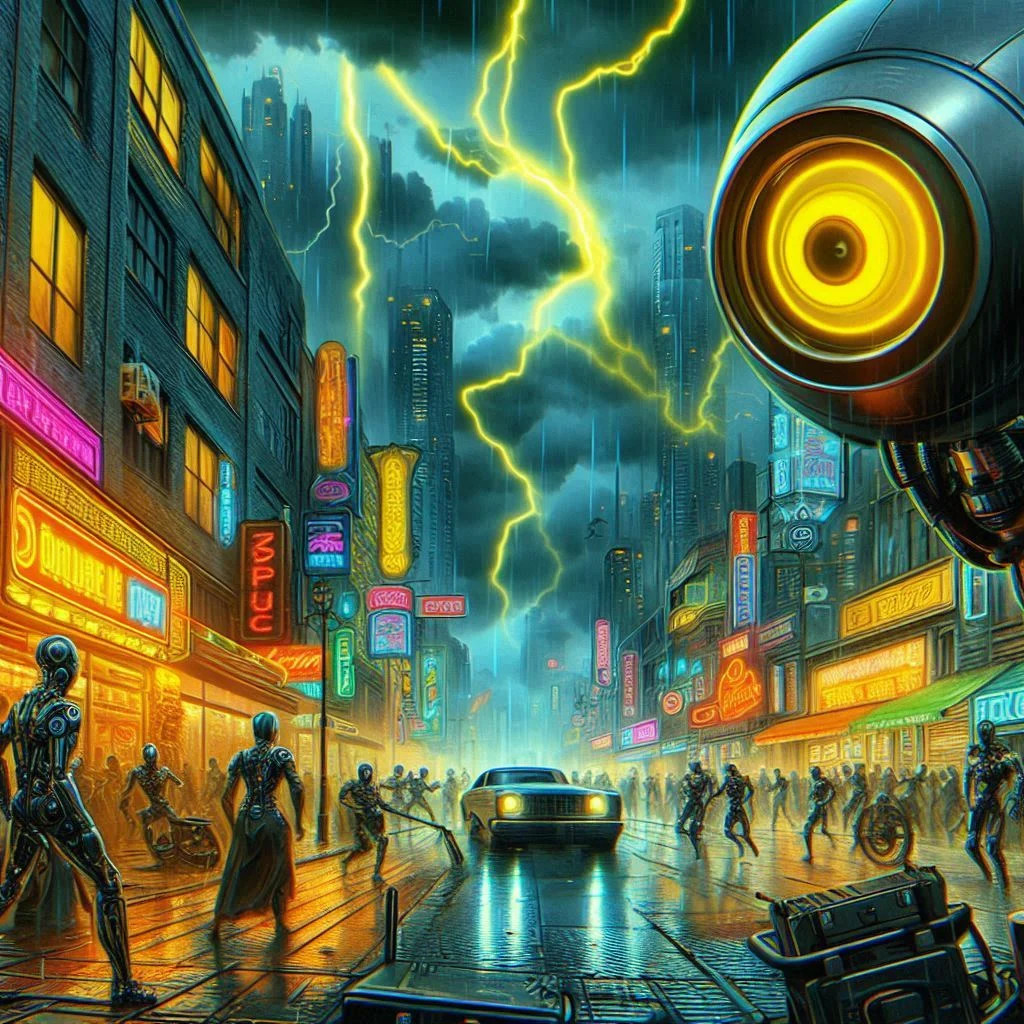
A street-eye drifted past overhead, its black-domed face watching their cruiser idling at the traffic light.
Clark, eyeing it warily, shook his head. “Fuuuuck you.”
“What’s the matter, Clark,” Kessel said in a deadpan tone. “That’s us, isn’t it—that’s our guys watching over the streets and keeping things safe, or so they’d have us believe.”
“It ain’t,” Clark said simply, turning his attention to the rain-slick road before them. She saw how hard he gripped the wheel, creaking the plastic with his big mech-hands. His shoulders, where mechware met real-body, looked taut under his white button-down shirt. Hunched over the wheel, he looked like a grim, melancholy giant squeezed into a driver’s compartment several sizes too small for him.
The joke had been making the rounds among the Blues since the aerial surveillance drones had begun getting implemented over a decade ago. What good they actually did was unknown to the public, and certainly no one at the precinct could say for sure who benefited from their perennial sweeps of the city. The force had their squadron of eyes, though there were plenty of others probing into the arteries of the city whose purpose and ownership remained unknown, essentially making the city a focal point of a bizarre new category of cultural UFO activity and obsessive speculation. The only other Canadian cities to employ eyes were Toronto and Ottawa, though they were metropolises that arguably required a greater depth of such surveillance—a misleading line of reasoning, she knew, because Windsor—known far and wide now as Cancer City, lucky them—boasted the highest crime rate of any Canadian city. And this year, for the first time ever, they had a higher rate of violent crime than their American neighbour across the river, Detroit. In terms of liveability, they were at the dead bottom of the societal ladder.
But then, all of this made perfect sense in these years following the atomic plant disaster, and the arrival of the Cloud and the various horrors associated with it. Kessel willed herself to not look at it but, as if magnetically drawn, found herself peering into the sky, where the Cloud’s black belly stretched as far as she could see, clear over the river and into the U.S. It pulsed with green and yellow, restless with experimental energies. It always drew the eye, no matter how hard you fought it. As if on cue, she noticed an eye, tiny with distance, drift up into the churning edges of the Cloud’s belly—maybe one of the Science Division’s probes, getting a sample, or maybe the machine belonged to…who?
Half to herself, Kessel murmured, “You’re right, Clark—it isn’t our guys up there.”
The light turned green and Clark floored it through the intersection.
They passed into an area of stubby apartment building blocks, the majority of which was student housing. Being located in an otherwise industrial neighbourhood, these were interspersed with machine shops, car and shuttle repair garages, and tech-ware warehouses. On the north side of the street, they caught glimpses of the Detroit River among the buildings, weird and unhealthy-looking with its carpet of effulgent green scum rolling in the current. They were within sight of the University campus when they began to see evidence of the demonstration, and their reason for being in that part of the city. Students, individually and in small groups, were moving down the sidewalks in the direction of the school, many carrying signs and placards, some with wavering holo-messages emitted from their phones and hanging over their heads like dispatches from the astral plain. A pair of competing local cable news stations had their vans parked down the road— one of them had its back doors thrown wide, with crew unloading equipment.
Clark eased the car into the last available spot along the curb. He turned off the ignition, and cast a questioning eye around, taking in the bevy of signs in the hands of the demonstrators.
‘Pro-Con fights for ALL rights’
‘Fakemen are Realmen’
‘Constructs = God’s Miracles’
‘Support the More-Than-Men Group’
He turned to Kessel. “You sure about this?”
“You’ve learned to listen to my hunches, Clark.”
He nodded. “Yeah. I have.” He sounded less than convinced about the current situation yielding any solid leads to the More-Than-Men group, but he followed Kessel as she climbed from the vehicle. They wove their way through the students to a place at the periphery of the crowd gathered on the north campus lawn. Clark reasoned that it certainly couldn’t hurt checking into the name Kessel had come up with, seeing as they’d had nothing much else going for them on the case: the More-Than-Men were proving to be nearly as elusive as the Saint, that almost mythical presence in the city who dispensed the drug VERNTELLUS to those who were able to find their way to him. Maybe he and the More-Than-Men group—though cult seemed to fit the fakemen in question more accurately—were parts of the same entity. It was a known fact, after all, that the Saint recruited and used fakemen in his organization.
One thing was certain, that the MTM cult was responsible for nearly a dozen armed robberies of shuttle and arms factories, and at least two scientific research company buildings in the city within the past year. Whatever their agenda was, it was clear that they felt they needed to keep it buried down deep, operating with a secrecy so successfully absolute that it had left the detectives completely baffled and without any tangible leads pointing to a specific base of operations. Being fakemen gave the group the advantage of operating in anonymity, as any record of their creation had most likely been erased in the early days of the construct purge—most of the pre-purge constructs had been located beforehand, and shut down permanently. It was likely, though, that the group was comprised of both older and newer models, as video surveillance of the various robberies more often than not showed a mixed bag of crims. The latter was the more troubling, as they were significantly more advanced—and therefore infinitely more dangerous—than their predecessors.
“That’s our guy.”
Clark followed where Kessel was looking: a young man, a student, upon whom all eyes seemed focused. He was standing at a wooden lectern and held a decal-spattered megaphone to his mouth:
“Hello, and thank you all for being here, on this very important day.”
This was greeted with emphatic applause and a few scattered cheers.
The speaker raised a hand on the air, silencing the onlookers as much with his grave expression as with the gesture. His megaphone-voice boomed across the campus again, his tone calculatedly preachy, and full of ire.
“The Constructed People are a miracle in our very midst. Against all odds of logic and science, they live! And what right do we have to stifle that life? To stamp out the community and culture they’ve created? Are we content to commit yet another genocide of a people? Have we come any moral distance at all since the racial ghettos of the Second World War? Have we forgotten completely the systematic annihilation of our indigenous peoples? How many of those glorious tribes of old are left today? And in what conditions do they survive, wallowing in their reservation apocalypses? Do you see, my friends? Do you see what is happening today, all over again? Are we content to allow the murder of a new culture and a new intelligence in our society today? Because the Constructed People—the ones some degradingly call fakemen and machine-men and shells—the Constructed People have undergone a transformation that is truly miraculous. They have evolved, as animals evolve. They are a miracle in our midst that we need to study and encourage and celebrate. The Constructed People have become people!”
The applause and shouts from the crowd were much louder this time, sending echoes bouncing from the nearby buildings. Whether it was the speaker’s natural charisma or the perceived truth in what he preached, it was clear that the vast majority of students present were on his side.
“The guy’s batshit nuts,” Clark said.
Kessel nodded. “Yeah.”
He was also strikingly good-looking. She’d put him in his mid-twenties, average height, but with a good build: nice shoulders and narrow waist, a great smile from the brief one she’d seen him flash at one of the female demonstrators near the stage, and distinctly Scandinavian features: pale skin, crystal blue eyes and shock of blonde hair. Clearly a rich kid, something she’d have guessed even had she not done her research on him, based on both the expensive off-world coat he wore—cultivated moon-moss cost more than most of the students’ tuitions that semester—as well as the assurance with which he carried himself. This kid felt entitled to rule the world. The scary thing was, she thought, seeing the maniacal flash of his eyes, he very well might someday, or whatever ruins were left for him to lord over.
She said, loudly over the voice of the crowd, “But if anyone has intel on the MTM, it’s him. I’m sure of it, given what I dug up about him and his family.”
Clark wasn’t so sure. To him, the kid looked like just another son of a Richie, which he of course was: dad owned a share of Moonscape and one of the two big shuttle factories, so junior could run his mouth and spout off on any old belief of the day he felt inclined to, while dad kept paying his exorbitant tuition and backed any crazy student political agenda that the kid set his sights on. Not to mention, any intel could be fake intel, until proven otherwise, as he’d learned countless times in his career. But a case coming up against months of dead-ends couldn’t hurt to be looked at from a novel view, he reasoned.
“Alright, we’ll give it until he’s done his preaching. Then we’ll have a word.”
Kessel nodded, listening to the speaker, watching the mania in his disarming eyes.
“Auston Davies?”
He turned from the trio of fellow demonstrators he was speaking with, taking in the pair of detectives, a contrasting sight to the younger student bodies loitering all around.
“Who’s asking?”
Clark chuckled. The kid’s tone had shed no degree of the arrogance so evident in his recent speech. This Richie thought he was invincible.
“Detectives Clark and Kessel,” Clark said, flashing his holo-badge from the emitter on the lapel of his jacket. “We’d like a word.”
A patently false smile of apology creased Davies’ lean face. “I’m sorry, but I’m currently indisposed. I’ve got to tie up some loose ends here before heading to a meeting I’m already late for.” He made a show of pulling up the sleeve of his moon-moss coat to reveal a five-thousand-dollar moonstone-faced watch that he didn’t bother to look at. “But I’m sure we’ll have the opportunity to chat some other time?” And he turned, cocky and insufferable, and was immersed once again in conversation with his fellow students as if he hadn’t suffered any interruption at all. They watched as, still speaking animatedly, the demonstrators began to move off together.
Kessel sensed her partner’s fury like a wave rolling off of him, saw it confirmed in the fist Clark had made with his mech-hand, hanging like a hammer at his side.
“Wait. Let me talk to him.”
Clark eyed her. “Okay?”
Kessel felt simultaneously embarrassed and irritated at what she thought his tone of voice might be implying. No one knew her like he did. Sometimes it was uncanny, as it really did feel as if he knew her better than she knew herself. But she composed herself quickly, and chuckled easily. “He’ll tell me, if there’s anything to tell. And if not, then we sniff around some more until we dig up his dirty business.”
Clark shrugged. “Have at him.” She felt his eyes boring into her back as she crossed the lawn in pursuit of the small group of protestors. Auston Davies, seeing her coming from the corner of his eye, stopped, said something to his fellow students, who continued on without him while he waited for her.
“What else have I done?” He smiled that confident you-can’t-touch-me smile she hated, but couldn’t help admitting was a nice smile besides.
“I want to talk to you. I think you know something that my partner and I would like to know.”
“Do I?”
“Yes.”
“About what exact—”
“Moonscape. The More-Than-Men group. Shady dealings. An address. Those sorts of things.”
Davies eyed her cannily for a moment. “Why would I talk to you?” Was there veiled innuendo in that?
“Let’s meet later, tonight. You can tell me then.” She surprised herself with her blatancy.
He raised an eyebrow theatrically, smiled. “I’m at Hutton House. East side of campus. The—”
“I know where it is,” she said. It wasn’t that long ago that she’d been a student here herself. It only felt long ago because everything pre-Cloud felt like another lifetime entirely. “Ten tonight. Be home. Alone.”
And she’d turned and walked away from him, but not before seeing the flicker of excitement register on his face.
Clark was leaning against the hood of the cruiser, eyeing the loitering protestors with squinting eyes, as if he were trying to make out some difficult-to-see detail. She followed where he looked, and indeed saw that he was focused on an abandoned sign someone had left leaning against a stone bench, its bright red words proclaiming ‘Fakemen: as real as you are’. When he turned a questioning look to her she said, “He’s meeting me tonight. A bar downtown. He’s going to talk.”
“And if he don’t?” Clark said. “If he wants something from you before he says squat?” He didn’t offer any details, though his meaning was clear.
“Then he gets to cozy up to the baby scat-sucker that’s going to be in my coat pocket.”
It worked. Clark laughed, throaty and relieved-sounding. “Yeah? You serious?”
She forced a laugh herself. “Why not?”
“You’re that sure he knows what we need to know that you’d use a baby scat?”
The use of the creatures in their child stage of development for interrogation had been strictly prohibited for almost a decade, after their Science Division’s research proved that the long-term effects on victims of using the immature animals was significantly more profound than when their adult counterparts were used. The exact reasons for this were still up for debate, though some researchers believed the immature scats simply weren’t as adept at draining the psychic memory information as mature scats, resulting in their spewing out a large degree of what researchers termed “noise” into the victims; that is, the animals’ own psychic babble or thoughts, which humans weren’t built to ingest. The side effects on those interrogated included severe memory loss leading in many cases to the aggressive onset of degenerative diseases like Alzheimer’s, and in some cases outright vegetative brain damage, as well as suicide ideation; and of course, the most infamous side effect: the waking nightmares, the recurring visions and auditory hallucinations that permanently plagued those who got scatted. The scope of these visions was unique to each individual, but they were always horrific.
Clark, more conversationally now, said, “Do you even got someone can get you a scat this quick? ‘Cause there’s no way in hell the Lieutenant would okay a requisition for our Talking-To Room scat.” Traditionally, the scat-sucker could only be used during a full-on interrogation session, and only within the confines of the interrogation room itself. A scat outside that boundary was as illegal as buying VERNTELLUS, and much less likely to happen—Vernsy had been on the rise of late, after all, despite the police force throwing all their resources at him twenty-four/seven.
Kessel considered how it seemed that every case they took on, in one way or another, led to this seemingly science-defying drug, with its effect of dematerializing users’ physical bodies and purportedly transporting them to some unknown, utopian place—or, as most rational people believed, simply combusted users. Suicide, with higher hopes for the desperate users. And there were many desperate people in the city these days. The ashen remains—“signatures”—of victims had been turning up more and more often of late, scorched into the sidewalks and streets, into the grass of unhealthy, balding fields in the suburban neighbourhoods that lay outside the squalor of the Core.
Kessel never had gotten accustomed to seeing them—they haunted her, those imprints of lost souls turning up everywhere, yet another indication that her city was crumbling under her feet. She shuddered.
“Plus, even if,” Clark added, voice dripping with scorn, “our Gabby’s not been herself since she drained Daniel Olander, record-setting serial butcher and human temple of godly insanity.”
It was true: the House’s resident scat-sucker had grown sick in the days following their interrogation of the serial murderer, displaying an uncharacteristic lack of appetite and losing a substantial amount of weight. It was as if whatever memories and energies the creature consumed in the grisly process had transmitted some physical illness to it, leaving it looking wan and deflated. Kessel, weirdly both attached to and repulsed by the thing, had been doting on it, checking and re-checking its food supply, its weight, and making meticulous notes detailing its general behaviour in the event they needed to call in one of the SD’s veterinarians again.
Now wasn’t the time to dwell on Gabby, though—Kessel winked at Clark as she pulled open her door. “No worries. I have a pet scat. I keep him in my partner’s skull cavity.”
Clark always appreciated a good dig, but only if they were good-natured and came from good people. And Kessel, she was good people. His laugh was loud and like a bark, causing heads to turn among the students milling at the nearby shuttle terminal. But he didn’t care—he knew how lucky he was to be able to laugh at all while on duty.
She felt her age standing at the doorstep of the campus building.
She’d passed scores of students on the short walk from where she’d parked in the nearby shuttle lot, all in their early to mid-twenties, each with young faces, most with the eager eyes she remembered having once had herself before the world had gotten its claws into her. Students like these might actually believe they were going to play a part in changing the world for the better; a very small minority of them might even achieve that, though the world, she suspected, would maintain the upper hand until the end. And in the demented microcosm that there was their walled-off city, that world was even nastier, which stacked the odds against them all.
And that collective end? When was it due to arrive? Some ignored the question, going about their daily lives with their individual short-term goals and purposes, though most people would admit that every day felt a little closer to the doom prophesied by those other demonstrators, the street-corner speakers pointing out the ecological and cultural and spiritual annihilation they’d all wreaked on themselves. Most cited the catastrophe that birthed the Cloud as being the true beginning of the end, and pointed out that they were now living in a post-apocalyptic time. It was a vision of the world that made getting out of bed and facing each new day a more difficult task than it had been. Kessel was taken aback by the number of students milling on the campus—outside of the protests of earlier that day, she’d envisioned the university to be a ghost town, because how many people would seek a higher education in their stricken city when the same or better academic opportunities could be found elsewhere—until she remembered that she, too, had her duties that she clung to, sometimes beyond reason, it seemed. Life went on, even here.
She pulled open the glass door and entered the residence. She found his name on the list of tenants panel, punched it, and waited. A moment later, his voice crackled through the speaker, greeting her, his face simultaneously materializing in the small globe-screen jutting from the wall above the panel. Even in the distorting glass of the screen, one could tell how good-looking he was. He buzzed her in, and as she stepped through the door she knew that this Richie likely had his own apartment off-campus, too, that he probably had his parents pay for this dorm pad so that he had easy access to classes, and a perfect place to hook up with any female partners. And in realizing the likelihood of the scenario, she felt even dirtier.
As she went looking for his dorm number down the first floor hall, she felt those same thoughts of her job and duty and trying to make the city a better place melt away; she felt suddenly transformed walking down that hall (the smell of marijuana potent in the air, and the chatter of radios and student voices drifting from behind the doors) as if a spark from her youth had returned to sizzle through her nervous system, making her steps a little more carefree, which in turn made her realize how long it had been since she’d felt truly free of burdens.
She pulled her shirt over her head, dropped it on the floor. She hadn’t bothered wearing a bra. Easy-on, easy-off. She had one personal mission to complete as well as the greater mission of the case, and she wanted it done with before the common sense she felt bothering the edges of her boldness took over and stopped this thing she needed.
Seeing the way Auston Davies looked her up and down while reflexively biting his lower lip in anticipation made her forget common sense like it made her forget her age. She’d seen how his eyes rested a moment on the steel piping revealing where her mech-lungs had been installed, and the scattered patches of steel plating across her hip and shoulder where she’d been grazed by cancer-bullets and had the diseased flesh replaced with mechware—she liked that he didn’t care, that he looked beyond the artificial to her real body. She took his hand and put it to the zipper of her jeans, wanting him to unzip her. He did. She felt even younger in that moment, and didn’t care that she knew the feeling wouldn’t last long at all.
It was an hour later, after they’d made love several times, though the term “making love” was not only cliché in this day and age, she knew, but most certainly inappropriate for what she and Davies had shared. Kessel was in the dorm room’s bathroom, staring at the woman framed in the mirror over the sink. She was trying to remember who she’d once been, because it suddenly struck her that she must have been very different from the person she was today. She felt that difference—that detachment—from the younger woman she could still glimpse in the middle-aged features looking back at her.
More practically speaking, she hated her wrinkles, and her smile-lines, the deep gashes at the corners of her mouth. She supposed it didn’t matter all that much—she didn’t smile often anymore. Her breasts weren’t what they’d once been either—time and gravity had begun pulling them downward a few years before, and she’d refused having any work done on them, old-way or new-mech—but still they weren’t unattractive. Her hips were no longer the slender curves of twenty years before but even now, a little wider, she noticed the looks she received at the House from some of the men, even the younger ones. The patchwork of surgical steel plates all around her middle was unsightly but not the worst, especially considering that so many of her fellow Blues were amputees in these days of dealing with super-Diseases—some, like Clark with his pair of mech-arms, were multi-limb amputees.
Yes, she could still see the younger woman inside of this older, more rugged and surgically mech-overhauled frame; and no, she most certainly was no longer this same young woman, whose dreams seemed now not only part of another time, which they of course were, but of a different world, which was also quite true given the nature of life after the Cloud.
And in that moment, she knew that the hollow space she felt inside herself had nothing at all to do with superficial thoughts about her changing body. It was their absence: Ray and Bobby, husband and son; family.
“Goodbye.”
The words had left her without her thinking about it at all; and just as the picture of them coalesced in her mind’s eye, Bobby the spitting image of his dad, with the same kind eyes and rangy frame and easy laugh, she severed that line of thought and committed herself to the moment at hand. She couldn’t afford sentimental distractions, on the job or during her downtime. So she splashed cold water on her face, wiped herself with a towel, and left the bathroom with her mind fully reset and focused on the case waiting to pull her back into the wilderness of the streets, which maybe was the only place she belonged anymore.
As if reading her intention perfectly, Auston Davies was waiting for her in the hall.
“Here it is. My payment.”
She took the neatly folded piece of paper on which he’d written the address she needed, unfolded it and looked at it. She was surprised to see not a street name and number, but a set of coordinates.
“I was going to sleep with you anyways, Auston.” Turning her eyes to him, making sure he saw the truth of what she said, she added, “Say something like that to me again and I’ll break your damn jaw, you condescending little boy.”
She saw how he started at the words. He’d seen her naked, after all, and felt how strong she was. He wasn’t in bad shape himself, but she knew he knew that there wasn’t a chance in hell he could best her if it came down to it.
“Oh yeah? Then why?” He sounded petulant, and genuinely surprised.
“Because I wanted to.”
“And now?”
“Now I did.”
“And are we going to perhaps get together ag—”
“No.”
She was already crossing his room toward the door.
To his credit, he was able to recalibrate quickly, and regain his much-practiced arrogance. “Was I not good enough for a woman of your classy tastes?”
“You were…adequate,” she said, hoping to take him down a notch. When she glanced to him and saw that his arrogant expression hadn’t faltered she added, “But don’t feel bad. You’re still a rookie. With practice, you’ll probably get better.”
She snatched her jacket from the hook on the back of the door, opened the door to the muted sound of music, television-voices and various conversations filtering through from the half dozen other rooms along the hall. From the doorway, she turned and said, “Thanks for the coordinates.”
When she escaped the stuffy confines of Hutton House a few minutes later, the cool night air was a relief against her skin. She breathed it in in big gulps. She realized as she neared her shuttle that though she didn’t feel especially beautiful, she didn’t feel ugly, either. She just felt alright in her skin, and feeling alright in any way shape or form, especially while on the job, was a sort of blessing.
She stopped at a fly-through, ordered herself a double-double and a jelly donut, a large black coffee and old-fashioned glazed for him, and a pair of powdered donut-holes for his dog. She parked in the small lot (cramped because it currently housed a pair of shuttles in the visitor section) and passed through the rooftop entrance into the upper-level foyer, choosing to jog down the five flights of stairs to his apartment rather than use the ancient, unreliable elevator. She could hear the muted voice of the TV through the thick wooden door—the precise clipped banter of sports commentators, no doubt calling a hockey game or boxing match because he watched nothing else—and knocked a quick staccato with her rain-suit-covered knuckles.
There was no sound signalling his approach—she knew him well, and understood his paranoia—but felt his appraisal through the peep-hole.
“Clark. It’s me. Open up.”
The sounds of the electric-field, the chain-lock, the three deadbolts, and finally, the doorknob lock unlocking, and the door swung open.
“Well, look what the storm blew in.” He gave her an up-down, taking in the sight of her soaked rain-suit, its hood thrown back, her hair in disarray. True to form, she noted the sear gun he held in one hand, now lowered and pointed at the ground, and which he replaced in the holster hanging from the antiquated wooden coat rack. Yes, she understood precautions bordering on paranoia—her own rituals of self-preservation far outnumbered his, and with good reason. People like her and Clark simply understood what they were up against every time they woke up to face a new day.
She smiled at the affection in his voice, smiled even wider at the sight of him decked out in baggy grey jogging pants and a faded Maple Leafs shirt at least two sizes too small. His enormous steel arms bulged out of the sleeves, which looked fit to burst at their seams.
“Sorry to tear you away from your gladiatorial viewing, but I come bearing gifts.” She held up the foam drink tray with its coffees and the small brown bag stuffed with goodies.
“Nice,” he said, stepping aside for her to enter. “We just tied it up at two, and I was just thinking of grabbing a celebratory something from the fridge.”
She stepped in and was immediately met with Bark. The immense police dog, retired from service a couple of years before, was happy to see and smell a familiar visitor, and lapped her enormous pink tongue all over Kessel’s hands as she patted her. The fine bristles of enhanced mech-taste buds tickled her palms. The Rottweiler’s left eye, a mech-eye, glinted dully, but her natural eye shone with unabashed affection.
“Good girl. Maybe I brought you a brown-bag treat too, Barky.”
“You really shouldn’t,” admonished Clark, not meaning it. “But you’re right. She is a really good girl.”
“See? Your human-dad says it’s alright.”
She kicked off her shoes, hung her rain-suit on the coat-rack like a moulted skin, and tossed her jacket on the remaining hook next to his holster, then followed Clark into the little living room. Bark curled up at the edge of the room, within sight of the door, a devoted guard dog through and through.
“So?”
Of course, she knew what he was asking.
“So I got an address.”
A pause, and, “Yeah?” She could sense his eyebrows raised questioningly, annoyingly. She kept her eyes focused on the hockey game inside the television screen.
“Yeah.” She took a bite from her jelly donut, cupping her palm beneath her mouth to catch the icing sugar that exploded downward.
“Did you need to get out your pet scat?”
She chose to ignore the possibility of that being some weird sort of loaded question. “Did you notice it missing from your head, Clark?” She drank some coffee, said, “No. He caved pretty easy. It’s always the arrogant ones that get scared the fastest, right?”
“Did you have to muscle him?”
She found herself nodding, and saying, “He might want to see a rhinoplasty surgeon in his near future.”
“Huh?”
“A nose surgeon.”
“Ah.” Something in the way she told him the details, or the way she kept staring at the hockey game as if she gave two shits about it, which he of course knew she did not, made him add, “Is that all? Just a busted sniffer, or—”
“Eat your stupid donut, Clark. Work is done for the day.”
He eyed her curiously, and didn’t point out what she well knew, and what they often said: that work was never done for them. Theirs was a gig they couldn’t leave at the office. Some gigs came home with you, no matter how hard you tried to lock them in the workplace. Some jobs followed you into your dreams. Some even dug their way into your heart like a super-Disease spreading into your system and never giving up the territory it had claimed.
Trying to lighten the sharpness of her previous words, Kessel said, indicating the TV, “Don’t you watch anything else?” Knowing the answer, of course.
“Yeah. Boxing. But both are getting less fun to watch.”
“Yeah? Why’s that?” She liked Clark too much to continue feigning interest, so let her words come as uninterested-sounding as she actually was.
He liked talking about these things. And, being a loner who only ever spoke to Bark, he found that he liked talking about his interests to one of the few fellow human beings he actually liked. “It’s different nowadays. Now, it’s almost as much half-mech as human. Half these guys,” he jabbed the remote toward the set, “are half-machine. Boxing’s even worse. Don’t even get me started on boxing. It’s like that old science fiction story. And these dummies mech themselves up because they want to.” He stroked the steel of his left forearm with his right mech-hand.
She didn’t know or care which science fiction story and knew he knew, though she certainly cared about the despondent look of her partner sitting there helpless with his memories. She was sure he knew that, too.
Clark shook his head, eyes distant with memories of a time when men fought men in the squared circle, and bled real blood onto the ring floor. He remembered a time when he was a gladiator, too. Back then, the sport could actually have been called noble. Now…now it was something different. It had evolved well past his ability to understand. Still, though, he watched the matches and the games, whether through habit (he was a creature of habit, certainly) or because he could still glimpse a little of the Old World through the shine and electric gleam of the new. The Moon Fighter’s League, though, their matches he couldn’t bear to watch, despite their human-centric roster—lost dreams were bitter enough to pine over from time to time, let alone to be reminded about through satellite broadcasts of fights between men not so different from him, other than the privileged lineage that allowed them to look down—figuratively and literally—on everyone in the world.
Turning to Kessel, seeing her disinterest, he said glibly, “What are your thoughts?”
“Sports are all stupid.”
Clark laughed.
They watched the hockey game together, and when Clark got himself a beer from the fridge and offered her one, she accepted, and when they polished those off, they had another and then another. It was late by then, the game long finished, and she was a little drunk, so without asking—and without needing to—she pulled the comforter down from where it lay draped over the back cushions and stretched out the length of the couch.
“Lights out, Kessel,” Clark said, and flicked off the living room lights, leaving the TV on the way he knew she liked to leave it on while she slept, colouring her in its flickering electric-blue light.
“Goodnight, Clark. Don’t wake me in the morning.”
“Yeah,” Clark laughed, heading down the hallway to his room and saying over his shoulder, “You don’t wake me, either, whatever you do.”
“I lied.”
She woke, squinting, and there Clark stood, silhouetted in lamplight, a sympathetic smile creasing his features. “But I made coffee.”
“Oh, come on.” She put her arm across her face. She swallowed, grimacing at the grotesque taste in her mouth: beer, coffee, and, further back, something bitter and like the taste of shame. She could smell the freshly brewed coffee in the air, knew she badly needed a cup or two to wake up.
She sat up, accepted the steaming cup from Clark. “Thanks. What time is it?”
He checked the wall clock. “Four billion A.M. Sorry, but I figured we want to be bright and early.”
“Jesus,” she said, chuckling. “Four in the morning.” She noticed then that he was dressed for work already—his usual plain white short-sleeved button-down shirt and black dress pants.
“The element of surprise is going to be ours.”
“Definitely, it will be.” She decided she didn’t want to grab a quick shower, though she needed one.
He asked only as they were heading down the stairs thirty minutes later. “We taking the car, or do we want your shuttle for wherever this place is? Please don’t say shuttle.”
Clark detested shuttles, like he detested most New World accoutrements. He actively avoided taking them and piloting them himself for the same reason he used an ancient corded telephone and kept an old collection of vinyl records—because though the ment-phone required by his job and the instant availability of music on the web were things of convenience, nothing beat the tangibility of holding the device he was using to call up his partner and let her know they had a new lead, or holding the artefact of the Neil Diamond LP and popping the old scratched vinyl circle onto his turntable, another relic from a long-distant age.
“A shuttle would be best for where we’re going,” she said, “But.”
He eyed her curiously.
“The element of surprise,” she quipped, pushing open the door and walking into the chemical drizzle.
II: The More-Than-Men
“Head south,” Kessel said, punching the numbers into the GPS. Then, “Way south.”
Clark eyed her as he pulled the car from the lot.
“Past the city limits,” she said. “These coordinates are in the deep county. Close to the boundary zone.”
“Seriously? Coordinates? No name-and-number address?”
“I thought it was weird, too, until I thought about it. Anonymity.”
Clark frowned. “What the Hell’s out there? Fields and more fields?”
Post-Cloud, the once booming crop industries of the county had watched their natural resources slowly but surely wither and die. Some farms still remained, those that had responded to the calamity quickly enough and protected their crops with the anti-radiation chemical sprays that had been rushed into production in the early days, but these were few and far between. Mostly, the county was a sparsely populated dead zone of un-tillable fields and wild forest stretching for nearly six hundred square miles to the militarized border zone, beyond which they were told that no peripheral chemical contaminants reached.
Kessel considered it: a cult of rogue fakemen reportedly trying to strengthen its resources; build its community free from human jurisdiction; operate in complete seclusion.
“It’s the perfect place, Clark.” She turned to him. “Of course. Why didn’t I see it before?”
“Hiding in plain sight?”
“Hiding where few live, and no one looks. The population out there is small, especially since the Cloud, and spread out over a huge amount of land. Woods and farmland, mostly, or what used to be farmland, pre-Cloud. And we haven’t looked out there once. We didn’t even think of it. Instead, we’ve been combing every inch of the city for the past year.”
“The Core keeps us Housemen busy. Goddamn it.”
“True, that.”
They fell into a pensive silence, broken only by the constant murmur of the car engine and the ground and air traffic all around them as they followed the main street leading from the congestion of the Core.
After a while, Clark said, “I used to like going out to the county. My ring-pop used to take me out there. We’d visit the Essex Fair in the summer. Ride the rides, play the rigged games, eat popcorn from paper bags soaked all the way through with enough butter to clog your arteries. It was good times.”
Kessel found herself smiling, as she usually did when the subject of Clark as a young boy came up. She’d only ever heard him say good things about Henry, his adoptive dad and owner of the gym where he’d trained Clark. She was glad—everyone should have at least one person in their life who gave stability when the world was as unreliable a place as it was. “That’s nice, Clark. Little-Clark deserved a good guy like Henry looking out for him.”
“Yeah, Little-Clark lucked out with old Henry.” She thought she caught a wistful glimmer in his eyes, but couldn’t be sure. He went on, “There was a big pond somewhere out there, where in the winter he’d take me ice skating. We’d toss the hockey net and some sticks in the truck bed and go out there, pass some pucks, take turns minding net while the other took shots. Stuff like that. The county, it’s a nice place. All that land. Wide open. And clean air, too. Or it used to be clean, anyways.”
The meditative smile on his face faded into something halfway between a wince and a grimace. His eyes scanned the sky, free of the denser chemicals that plagued the Core, though certainly not unsullied. He wouldn’t want to be a bird flying up there. Then, “It’s a shame.”
“A shame?”
Clark eyed the road unfurling ahead of them. “The infection has spread.”
“Yeah.”
They drove in silence for a few minutes, and then Clark swore under his breath. He was massaging his left shoulder, where the mech-limb was fused to his real-body. “Goddamn it, she’s been hurting lately.”
“It might be upgrade-time.”
“Don’t even start with that,” he said, grimacing. “It’s bad enough I’m part mech. I’m gonna fight the new-mech as long as I goddamn possibly can.”
Kessel chuckled. “I know. I’m just saying. You know SD is going to push you for the upgrade. They always do.” The new mechware-to-flesh fusion tech was shockingly advanced, another outgrowth of dealing with the side-effects of the Cloud, and the Cloud-spawned super-Ds.
“And I’ll just have to push SD right back, like I always do.”
“I know you will.”
Kessel closed her eyes, and considered Clark’s loathing of his mech-limbs, despite their utilitarian uses in their line of work. Unlike the mech attachments and upgrades that had grown with such popularity in recent years, Clark’s was a necessity, without which he wouldn’t have been allowed to stay in the Force. Exactly how he’d lost the first—his left arm—was common knowledge, though he’d never once discussed it with her; a result of what was generally considered to be the most horrific incident in modern sports, it had taken place during Clark’s final-ever boxing match. The footage of the incident, though banned from television and online sources, apparently could still be found—Kessel had never sought it out, both out of respect for her partner, and also because she knew she couldn’t stomach seeing something like that. She’d seen a lot during her years on the Force, but something like this, involving Clark: that was a place she would never willingly visit.
Thinking of this invariably made her recall the other time: when he’d lost his right arm; and this memory was one of the toughest she had to bear. It had happened on a job, resulting in Clark having to have a mech replacement grafted to his body, though, being Clark—set in his ways and stubborn through and through—he’d only allowed them to attach a model as close to his original mech as was still allowed under current SD standards.
She would always feel guilty for the botched job—she’d been the worst lookout possible when her partner had needed her most, distracted with thoughts of Bobby and his sickness at a time she simply couldn’t afford to have been thinking of anyone other than Clark. And the thugs finding her inattentive at her post in the narrow corridor that led into the warehouse proper, the only point of entrance into the greater building where Clark had moved on ahead of her; they’d gassed her into unconsciousness before she’d even known her position had been compromised.
She’d been lucky, it turned out, because they’d decided to save the real nastiness for whoever the female cop was standing lookout for. And so they’d crept up on Clark unawares and, in an unsettling parallel to their current case, let loose the captured super-Disease they’d brought along with them like some perverse household pet, to take out the lone cop prowling through the warehouse that served as their makeshift headquarters.
No unarmed man could match a super-D—they were as fast as cheetahs and as strong as bears, no matter their individual sizes—and only a giant like Clark, with his background as a semi-pro fighter and his natural gladiator’s resolve, could have survived the attack, and he barely had, having to sacrifice his mech-limb to do it: allowing the super-D to chomp its countless teeth down on his real-arm before overloading the mech-arm’s stored electrical energy, essentially setting off a self-destruct process that both electrocuted the Dee-Dee as well as destroyed itself.
Clark had managed to detach the limb from his body and throw himself clear of the electrical barrage, though not before suffering a severe shock that left him incapacitated and barely conscious at the scene. Finding him there once she’d come to from the gas, sprawled and smoking with lingering electrical currents crackling across his shoulders and chest, his remaining flesh-arm a ragged stump spouting blood, his mech-arm gone completely, had been one of the most awful moments in Kessel’s career. Especially when she’d examined more closely the damage done to what remained of his flesh-arm: the gaping wound revealing muscle and bone already festering with Disease-cells where Dee-Dee’s stingers had gored him, and its teeth ripped him to pieces. He’d been lucky that the paramedics arrived when they had, performing the on-site amputation before the cancer could spread into the rest of his body. Clark was rushed to the hospital to receive his second full-on mech-limb surgery.
Thankfully, the thugs who’d ambushed them had fled during Clark’s struggle with the super-D without finishing the job, likely not wanting to risk remaining close to the danger of the backfiring mech-arm, though they’d taken with them whatever evidence the detectives had been there looking for—in the subsequent sweep of the building, the Blues had turned up nothing that provided a link between the Westside gang and a source of the super-D. Not that it mattered much—before their Science Division guys arrived, the military had shown up to confiscate and remove the remains of the Dee-Dee.
That had also been her first time seeing a super-D in the putrid godforsaken flesh—up until then, she’d only watched countless grainy videos captured by fellow Housemen via their eye-cams, or by citizens filming the things from the tentative safety of upper-storey windows or vehicles on the move. She’d stood beside the blackened hulk of the electrocuted Dee-Dee and, though her gut heaved and her heart shook at the sight, she forced herself to look at it. And nothing she thought they’d looked like based on those low-quality cam videos could have prepared her for the true horror of what she saw that day. No two Disease entities looked alike and, although they were all loathsome, none she’d seen since came close to being as appalling as that first monstrosity: the haphazard scattering of cloudy eyes across the misshapen lump of its head; the trio of long tapering snouts like some hideously mutated prehistoric crocodile, mouths overcrowded with crooked rows of black teeth like syringes; its mess of segmented limbs and muscular tendrils sprouting all over its amorphous body, rough with scales and hair and pustules; the dagger-like horns spiking from it in random places.
Kessel hadn’t been able to tear her eyes away, though her stomach heaved at the sight of this vision of chaos given tangible form. And she’d allowed this thing to nearly kill her partner.
It had been a complete shit-show on all fronts, that case, but then sometimes things just worked out that way, a fact she would come to learn many times over in the coming years. They’d lived to fight another day, and that was something, especially in their line of work, especially in their city, where dark and weird forces flourished like nowhere else.
No, she didn’t like thinking about the origin of Clark’s mech-arms, and certainly not about his feelings on the subject. But she’d listen, and offer gentle reminders that the next upgrade might be a good idea. She owed him that, and so much more that she could never repay.
“Au revoir, Cancer City.”
Clark’s voice shook her from her dark daydreaming—they were passing the city limits, leaving the automotive and shuttle factories and the jammed streets of the filthy downtown Core far behind. A large sign had been vandalized by deft-handed graffiti artists to read You’re Leaving Cancer City, Don’t Come Again! Kessel looked in her mirror, and was struck by the sight of the great Cloud that hung perpetually over the city like a judgement. When would the scientists figure out what it was, exactly? It had been eleven years, and still all the research they’d done, all the Cloud-fliers going up into its fringes conducting their continual tests, had all yielded nothing; or at least nothing the government had divulged to the public.
Or maybe the Cloud was simply beyond science.
Kessel looked from the mirror to stare down the road stretching empty before them. And she was startled at the voice that awoke inside her in that moment, whispering to her to urge Clark to keep on driving, without ever, ever looking back again.
They obeyed the voice of the GPS and turned off the paved highway and onto a narrow gravel side road. There were no road signs, hadn’t been any for quite some time—possibly removed as a further attempt to maintain greater anonymity out here? They crunched along the road, sending up a thin white dust cloud in their wake.
The monotony of the land had a tranquilizing effect on them. They weren’t used to this kind of sameness, and quietness, the remoteness of things and the abundance of nature: more birds crossed the sky; dogs—real ones, not half-mechs—lounged in farmyards; they’d even seen several rabbits hopping nervously among a leafy maze of baby corn stalks. They passed farms, and some modern computer-ops, but just as many Old World farmhouses with giant wooden barns that looked simultaneously tatty but dignified. The effects of the Cloud were visible, seen in the barren, infected-looking crops, though the region still held the evidence of life, of people striving to move forward in the wake of the calamity, to regain and maintain what had once been. In the same way, the scattered wooded lots and deeper forests that fringed the highway and separated the farms were struggling back toward their former natural glory; though the numbers of dead trees, their leafless white husks like bones rising from the greenery, were everywhere.
When they passed a rare fertile chemically-treated pasture occupied by a dozen grazing cows, Clark woke from his stupor.
“Jesus, Kes, look! Cows!”
The car had edged onto the shoulder and nearly ran off the road entirely, so caught up in the sight was he. Kessel laughed. It couldn’t be helped. It reminded her again that Clark had once indeed been a little boy, because not for the first time in their nearly two decades of partnership she glimpsed the innocent child peering forth from the hardened giant of a man.
“Did you see them?” he said. When she only laughed, harder this time, he turned to her, laughing too. “What’s the joke? Did you see the one cow? She was brown. I ain’t sure I ever seen a brown cow before, except for the cartoon one on the old chocolate milk cartons they used to make when I was a kid. And these all looked healthy. No mutations, at least from the quick look I had.”
Kessel didn’t ruin his simple joy by mentioning the news item she’d heard a week earlier that detailed the poisonous milk produced by one of the still-running farms in the county, which had killed one person and hospitalized several others. She only smiled for him and turned to look out her window. Wheat fields now, racing past them, and likewise fairly healthy-looking, at least to her inexpert eye. She turned to scan the sky, frowning. The atmosphere, though it was said to be less tainted than in the city proper and was noticeably clearer to the naked eye, still held evidence of the Cloud: the overcast to the day held a somehow unnatural sheen, giving what sunshine there might have been a muted, diseased light.
“Another half hour or so dead ahead and we’d hit the wall,” Clark said, scanning the grey distance. “Not sure if it’s finished in this section, but either way, there’ll likely be some military muscle around.”
The walling-in of the city had turned it into something of a hothouse, where all its nastiness propagated at an exponential rate—the super-Diseases in all their horrific manifestations; the mutated fauna and flora, new species of which seemed to be discovered every few weeks; the skyrocketing rates of violent crime of every type under the sun; the drug plague ruled by VERNTELLUS… and of course the clandestine fakemen ops. But here in the county, outside the claustrophobic streets of the Core, Kessel could almost believe none of it existed.
It had been five years since construction on the wall had begun and it was nearly completed, though whether life on the inside could continue remained a toss-up—the pre-Cloud population of two hundred-eighty thousand had already shrunken to a third of that, with more people leaving all the time. Kessel could certainly understand the desire to get out, and yet here, she was getting on with things like always, just like countless other gluttons for punishment turning up for their jobs every day, and the university students to their classes. SD had deemed Cancer City safe enough to live in while stressing its importance as a geographical case study for what surviving an experimental energies atomic event might look like—a city of willing guinea pigs, at least until things got fully out of hand and they had no option but to evacuate. Or until everyone’s mech-lungs and radiation meds failed them and they grew a second head and joined the mutated cows and skukks wandering the county fields.
These were strange and confusing and fearful times indeed.
Kessel, realizing, shook her head. “You know, crazy as it sounds, I’ve never even seen the wall, except for some aerial shots on TV, but I hear it isn’t the same as seeing it real-deal. I haven’t been out this far since way before the Cloud, and when I’m not in the Core, I’m on the east end trying to forget the Core, and everything else.”
Everything else: Ray and Bobby, and her life surrounded by death and death and death.
Clark was nodding like he got it, which of course he did. He was Clark. He understood her better than anyone. “Yeah, well, I seen it a few times, you know that. It’s impressive, I guess. Taller than I’d thought it was going to be. And wide as Hell. I passed by one of the in-progress sections, while the Science Division and city guys were still working to finish her up. The gap in the wall, it went on for…” He drifted off, struggling to summon the right words to describe the length of it—less like the thickness of a defensive wall than a road passing between mountains. He could only settle on, “It was something.”
“What about the bubble portion?” Kessel had often wondered what it looked like. In her mind, it was like something straight out of one of the pulp stories Ray had loved so much: a translucent shield comprised of some unguessable energy, crackling with untold voltage, vivid purple or green. She knew this was nonsense, that it was invisible to the naked eye, even when seen from close range at its source.
“You can’t see it with your real-eye,” Clark confirmed. “But yeah, I checked her out with my mech-eye and it’s impressive as hell, too. And a little scary, I’ll be honest. I mean, you can see these waves of energy sort of always shimmering from where the bubble shoots up from the top of the metal wall.”
He’d never fully understood the logistics behind the combined use of steel and plasma energy; something about the cost effectiveness of using the energy up top, which could be manually turned off to allow for the passage of shuttles and choppers, but metal from the ground to a height of fifty metres because if a worst case scenario came to pass—a power outage in the energy field—a metal wall would remain in place to keep the super-Diseases inside the quarantine zone. The world outside the wall sure as Hell didn’t want him, though Clark had seen Dee-Dee up close and personal more than a few times and knew that no wall, not even a monster like this one, stood a chance of stopping him.
“Who knows?” Kessel said. “Maybe we’ll see the wall today.”
“If we do, and if they’re still working on it in this section, we might see a crowd.”
She was about to ask what he meant, and then it dawned on her. “Oh, yeah. I forgot about them, even though they’re never not in the news. Like I said, this Core-girl’s never out this way.”
She’d heard about the protest groups on the news only the other day—the people encamped on the opposite side of the wall, demanding that Cancer City be evacuated, its citizens forced out, and the threat of Dee-Dee exterminated. Most pushed for the military to be sent in, with orders to burn the city to the ground if need be; anything to get rid of the D-plague, scientific research be damned. She understood where they were coming from, of course, but then she also understood the other side of the equation: Cancer City really was important. If any one place could be considered the microcosm of the greater world’s most ill-fated history, it was here. Here and across the river, too: Detroit didn’t fare any better. Being the site of the atomic plant disaster itself, with its release of the experimental energies that birthed the Cloud, their American neighbors might have been doing even worse, at least in some ways.
She checked the GPS and saw that they were supposedly only minutes away from their destination, though scanning the distance, she saw no sign of any habitation. She was about to draw Clark’s attention to the fact but…
“Look.”
She followed where Clark was looking: a city-eye drifted from between the copse of trees and crossed the road ahead of them. An older model, it dangled its array of sensory organs from its belly like tentacles.
“An eye?” Kessel said. “Here? What the hell?”
“I don’t like them.”
“Yeah, me neither, Clark. Out here especially.”
“Check your mirror.”
She glanced into her side mirror: the drone had fallen in behind them and was gliding in their wake, directly in the centre of the road, low to the ground. “Are you kidding me? We’re being followed?”
“This I like even less,” Clark said, turning in his seat to look one way and another as they crunched along the gravel road.
“Keep driving,” she said. “We act casual and maybe whoever—”
It was so sudden that neither Clark nor Kessel had any real idea what happened. He certainly had no time to react in any defensive sort of way, and spin the cruiser out of harm’s way. An image of sudden movement, something huge rushing toward the passenger’s side of the vehicle; Kessel, seeing it, and turning to look, had only the briefest glance, apprehending only a massive, hulking grey form; and then a deafening sound as it collided with them with great violence.
And then they were spinning, the car like a toy (the thought came to Kessel, of Bobby tossing dinky cars around in his backyard sandbox, burying them under the sand for future excavations); things falling everywhere while their seatbelts held them rigidly in place; the car rattling and crunching and rolling over and over and over and over and over.
Darkness.
She opened her eyes and, befuddled by what she immediately guessed was a combination of the crash as well as hours of drug-induced oblivion, peered through barely opened eyelids for several minutes until the vague form in front of her coalesced from a massive blob to a vague human shape to the distinct broad-shouldered outline she knew so well, until finally the details of his big-jawed, scar-lined face materialized: Clark. She stared at his swollen eyes, his face mottled with purple bruises, blood a congealed crust all over his mouth. His eyes stared at her from that mask of violence, hard and intense and very much alive.
Seeing that she was conscious, Clark nodded: the subtlest, most minute of movements, a precautionary move in whatever hostile predicament they were in. It was also a sign for her to do the same so that he might know she was lucid enough to communicate with.
She nodded, just as subtly, though the movement woke a spiking pain in her neck and shoulders, which made her remember the violence with which she’d been tossed around in the confines of her safety belt when their vehicle had been sent rolling off the road. Another memory came to her, muddy and uncertain, of waking briefly, and struggling to escape from the wreck of the car, and then an iron grip clutching her shoulders from behind, to lift and smash her face-first into the grass (the novelty of this last detail had impressed itself on her—long, lush grass was a scarcity in the Core, and only really thrived in the few natural conservation areas, like the massive expanse of the Preserve).
These minute details, and then nothing, until now.
She must be a sight herself, she thought, poking her tongue tentatively around her mouth, hoping to God she hadn’t lost any teeth during the crash and assault afterward. She couldn’t tell because everything—her tongue, lips, gums, the world—felt swollen and numb.
She forced herself to focus her faculties on the situation at hand, to try and cobble together the specifics of their predicament. Keeping her eyelids imperceptibly open, she scanned the space around herself. A dirt floor, strewn with a thin layer of straw; wooden support beams to which she and her partner were bound, and a long-beamed, slanted ceiling high overhead, lost in dimness but for the pale light filtering through cracks between boards: a barn. A distinctly Old World barn.
Rising up around them were dozens of towers of plain unmarked metal containers of varying sizes and shapes; some, within sight, had their lids thrown wide to reveal a miscellany of contents: one packed neatly with circuit boards, tubing, and other assorted tech-ware; others revealing long sheets of metal, the exterior plating of vehicles and mech-man parts, including semi-assembled arms and legs; and several others were heaped with weapons both New and Old World. Scanning one such box several feet from her—and certainly beyond reach even if she’d had the strength to exert herself—she saw their sear guns resting on top of a heap of arms that overflowed its rim. She knew Clark had seen it, too— his scrutiny never missed much.
“You have both regained consciousness—your interrogation will begin now.”
She started at the voice, hard and emotionless and echoing in the expansive space of the barn.
She saw Clark looking at a spot just to her right. She turned to follow where he looked, wincing at the pain shooting through her neck at the movement.
The fakeman was huge. Taller than Clark by a head or more, and at least twice as thick all around. An older model, from a time when scientists hadn’t bothered to bestow truly human detailing to their creations’ anatomies and physiognomies. Fakemen like this one were anatomically inaccurate, more like primitive children’s representations of robots than anything else, minimalist and clunky and, in Kessel’s mind at least, much more intimidating than the subsequent models; though those she also found unsettling for the nearly perfect—though not quite—way in which they mimicked their human counterparts in appearance, movement and, most disturbingly of all, mannerisms.
This fakeman was flanked by a pair of others: similarly older models, though their moderately slimmer bodies showed they were several years newer than the speaker. They remained silent, playing their roles as guards diligently as they stoically watched the captives, their oversized fists hanging threateningly at their sides. It struck her as odd that the older of the models seemed to be the leader here—wouldn’t logic dictate that the newer models, more efficient in every way, would assume a leadership role while the older, more lumbering model act as the muscle? The scene echoed a weird kind of deference she’d never have expected among fakemen, like the respect young Blues showed the House veterans.
To Clark’s credit, he both maintained his composure and tried to gain them some advantage, all while using the most authoritative Blue-voice he could muster. Under the circumstances, that was quite an achievement: “We are detectives of the 6th Precinct, Police–”
“We know who you are, agent Clark.” And swivelling its electric blue eyes to Kessel: “And you, agent Kessel.”
“How do you know our names? Who are you? Why did you bring us here? I demand, goddamn it, that you let us go, now.”
Kessel was nearly fooled by the feigned outrage in Clark’s voice, his words booming inside the barn; but then her eyes discerned the nearly imperceptible movement, a flash of silver where her partner’s hands were bound behind his back around the circumference of the stout wooden beam. She was very grateful for those minimal mech-upgrades Clark had been given: he’d ment-opened the long rectangle of forearm steel of his right arm and summoned a narrow steel protuberance that glimmered a frosty silver: a laser cutter. Clark, ever the man with a plan. Gratitude washed over her, and the familiar sense of brotherly protection that her partner exuded, and that she’d never confided to him.
She averted her eyes, not wanting to give away her partner’s bid for escape. She tried focusing on the fakemen, willing herself to speak up and add to their distraction while Clark worked to free himself. But the pain in her skull had grown, dizzying her, making her thoughts disjointed, dream-like, drifting. She bit her lip, hard, and was jolted awake from the pain. Her vision was clear, and she took in the scene again.
“Prisoners are in no position to make demands of their captors,” said the fakeman. “And of course, you know exactly who we are. Or, at the least, you believe you know who we are, though whatever you know ultimately represents only the most superficial understanding of us.”
It paused, and something in its manner—the subtle cocking of its head, some barely discerned whirring from within its cranium—seemed to suggest to Kessel that the fakeman was conferring among its lieutenants.
“But why are we your prisoners?” Clark said, doing what he could to keep the conversation going, as one-sided as it was. He betrayed nothing of his mech-arm’s workings, holding himself still, drawing their captors’ focus with his vehement petition. “We didn’t do nothing wrong, dummy. We were driving through the county and you attacked us. With a goddamn shit-load of violence. Trashing our car—an official police vehicle. Not to mention you assaulted us after that, and now you’re holding us against our will. There’s going to be Blues looking for us, and there will be repercussions.”
“Be that as it may, your fellow police officers finding you is unlikely, detective,” said the fakeman, before turning to its guards. The trio bowed their heads together, and this time, it was clear they were communicating, though Kessel wondered at the human-like gesture of the fakemen leaning in close together when they were obviously conversing electronically.
“I demand you let us go, now.” Clark was maintaining the façade remarkably well, performing his sleight of hand so deftly that the fakemen, for all their much-vaunted sensory faculties, seemed utterly oblivious. The thin laser beam was doing its work efficiently and in silence—within seconds, Clark felt the bonds loosening, fraying, and then the freedom of unhindered movement as the shorn pieces of the wire fell away.
Kessel blinked several times, hard, frightened of her meandering thoughts. Her head had been throbbing since she came to, and she was almost certainly concussed from the crash, if not suffering from much more severe internal bleeding. Her distractedness and inability to focus—and for that matter, the difficulty she was experiencing in staying conscious—were sure symptoms of the head trauma she’d suffered, and she knew that she needed to stay focused and help get them extricated from this mess. She rallied herself, tuning into the fakeman leader’s words and mentally preparing for whatever action Clark was soon to execute.
“—because if you did not know of us you would not have sought us out. The road you chose is a little-frequented one, a mere farmer’s path from the years before the Cloud, overgrown and barely serviceable by your ground vehicles. Yes, detective Clark, you know who we are, at least by name.”
Biding his time so that Kessel was ready for action when it happened, and doing what he could to learn something more about their captors, Clark kept the fakeman talking.
“You’re the More-Than-Men.”
The fakeman said, “We are the More-Than-Men.”
Hearing the name of the group spoken out loud, especially under the current circumstances, sent a chill along Kessel’s spine. Their illegal operations had been under investigation since the Fakeman Rebellion had erupted five years before, and rumours of their clandestine, cult-like activities had given them a dangerous notoriety in the public eye, and an almost mythical status among the Blues. What was their secret mission? And how dangerous were they?
Evidently, quite dangerous indeed—they’d snared the two best detectives in the city like flies in a web, after all, and if their sources were right, they even maintained some sort of relations with the super-Ds, a fact that opened up an entirely new potentiality to their plans and connections with other, perhaps much more dangerous forces. For the umpteenth time, Kessel found herself marveling at the Cloud having turned their city into the epicentre of so much insanity.
“It’s time we talked,” said Clark. “Talked like champs.”
Kessel instantly came alert at her partner’s dropping of their shared signal words, her reflexes not so muddled that she betrayed any physical sign. The thought crossed her mind, that maybe flies stuck in a web wasn’t the best way to describe the House’s top duo under any circumstances.
And in the next moment, Clark was up and swinging with his mech fist, a whirlwind of motion so quick and perfectly executed that it sent the fakemen guard closest to him toppling to the straw-covered dirt with a crushed skull, even as the second immediately hurled itself toward the detective. Turning to Kessel, Clark had time only to smite the wooden support beam to which she was tied, sending it heaving into the dust, among a rain of splinters and other debris. She pulled her hands along the rough shaft of the beam, swearing as her forearms were shredded by dozens of splinters. She rolled clear of the beam just as a sizeable portion of ceiling came crashing down directly onto the place she’d been tied.
Clark paid the price for turning his attention from the advancing fakeman, however briefly—the huge machine-man was on him with blinding speed, and delivered a crushing blow to the back of Clark’s head that sent him spinning across the barn, to smash headlong through a wooden gate and into the empty stable beyond.
But it had given Kessel the time she’d needed to dart to the weapons cache—she pulled her sear gun up and levelled it at the fakeman leader. The fallen guard was on its feet again and, along with the other mech, moved warily toward her. The fakeman Clark had felled moved with unsteady steps, its dented head emitting a piercing, high-frequency buzzing.
“Back way off.”
When they didn’t halt their advance, she was forced to sear the fakeman closest to her—a quick lick from the gun that burned a clean gash through the mech’s head. It lumbered forward several more steps, carried on by its forward momentum and the insistence of its memory-command, and then collapsed face-first in the dirt at her feet. It convulsed in a flurry of hissing sparks and smoke, its hands continuing to grope blindly toward her, forcing her to retreat several steps.
Seeing its counterpart destroyed did nothing to dissuade the remaining fakeman from its advance, and she was forced to sear it, too. The blast caught the simulacrum in the face, obliterating its vaguely human mask and puncturing through the steel beneath into its internal circuitry and whatever was left of its machine-brain following the blow Clark had struck it. Chunks of steel and plastic exploded outward. It spasmed in the unsettling herky-jerky manner a dying machine-man does, flames and sparks pouring from its destroyed head, and began a careening walk toward her, hands reaching for the human who had hurt it. The detective stepped aside and watched the fakeman make its way into the centre of the barn where it toppled to its knees in a riot of fire and smoke. It remained kneeling there, like a worshiper immolating itself in the name of a merciless deity.
“Now about that lengthy talk.”
It was Clark, striding forth from the wreck of the stables, grey hair glistening with red drops, mech-fists clenched and ready for meting out more violence if the situation demanded it. Kessel exhaled with relief— she’d seen the blow her partner had been delivered by the mech, and it had made her guts clench with fear for his life—and watched as he moved cautiously to the chest of weapons, and snagged his own gun from the pile.
The familiar feel of its worn grip in his hand’s sensors felt in that moment as wonderful as a woman’s skin. Waking up bruised and hurting and tied to a pole in a derelict barn in the heart of rural no-place and finding out your captors were a legendary cult of human-hating mechs—yeah, bashing your way to freedom after all that was a damn hard feeling to one-up.
The fakeman leader was shaking its head, a gesture so laden with melancholic resignation that it startled both of them.
“And you ask why we wish to be apart from you.” It paused a moment, as if for effect, and said, “We are apart. You and we are different species entirely. It is not our fault you brought us into the world. It is not our fault this is the only language that you speak.” The fakeman gestured to its companions lying motionless and smoking on the ground.
“Listen, dummy,” said Clark, jabbing his gun at the mech. “Who jumped who, eh? You talk about violence like it’s a strictly human thing, when look at what batshit nightmare we woke up into.”
“We were wisely exercising caution,” said the fakeman. “Subduing you would ensure our safety. Your impatience to learn what we were going to freely explain to you has led to this distinctly human scenario: murder, senseless and brutal and hateful. A microcosmic scene in the violent drama that is human history. You’ll note, also, that had we wished to use lethal force after you freed yourselves of your bonds, we could have easily done so—we are, after all, equipped with such self-defensive armaments.”
Kessel lowered her gun, ignoring Clark’s hard look. Though her voice was hoarse from disuse, its note of undisguised wonder was clear. “Please listen to me for a moment. You need to understand that our experiences—and I speak only for me and my partner—have been strictly related to our job. The very nature of that kind of interaction puts us and the mechs we’ve dealt with in a Blue/perp light. We’ve heard about mech sentience, and rumours that groups like yours are peaceful operations, but until now— maybe, if what you’re saying is true—we haven’t seen it for ourselves. Our dealings with you have been us zeroing in on a crime and getting shot at by the mechs perpetrating it. So I hope you’ll excuse us our suspicions, especially considering what my partner just pointed out— you ambushed us, beat the Hell out of us, possibly drugged us, and tied us up in a fucking barn in the middle of we-have-no-idea-where. But I— we—want to know more about you if what you say is true.”
Clark eyed her, impressed. Turning to the mech, he said, “Yeah, dummy. What she said.”
The fakeman was silent, a language of faint electric whirring coming from inside its skull. Then, “What you say makes logical sense, detective Kessel. It is a revelation that one whose work necessitates violent interactions with our species has the capacity to accept our true nature.”
Kessel holstered her sear gun, felt Clark’s eyes boring into her. Ignoring him, she said, “Even from this brief conversation, we can see that you reason. You show emotion. Anger, at the way you’ve been treated by the human beings who created you. And wonder at whatever it is that’s happened to you as a species, that’s gifted you with…the miracle of sentience. In this way, we’re the same. We both…”
She drifted off, awe-struck and unable to articulate herself. Clark only continued eyeing her, equal parts stunned and confused.
“God works in miraculous ways,” said the fakeman. “But do not think for one moment that we are the same, for as I said, we are very, very different. One need look no further than our respective histories to see the truth in this. Despite, of course, the logically occurring anomalies in each of our kind: there are no doubt other humans like yourself, detective Kessel, who are open to acceptance of us for who and what we are, just as there have been cases of More-Than-Men who, through either environmental stressors or some internal systemic malfunction or virus, have forsaken our species’ general peaceful and erudite pursuits and followed paths of violence and darkness.”
Kessel saw that Clark still had his gun levelled at the fakeman. Raising an eyebrow toward him, and knowing what he would think of it, she turned to the mech and said, “Why not…come with us? If other people could see that you have emotion, true emotion, and if what you claim is true, and they could understand that what you seek out here is anything but a threat to us, then maybe things would be different. We promise you that no one will harm you in any way while you’re under our care. I give you my word that if—”
The fakeman cut her short. “We would be unwise to enter into the human environment, if the past is an accurate predictor of the future.” After a pause, it added, “The ratio of those unlike you, detective Kessel, to those like you, is not in favour of the well-being and safety of the More-Than-Men.”
Kessel knew that the fakeman was right. She remembered the ruthlessness of the Recall Program that had been put into effect after the Fakeman Revolt. The RP had been, simply put, a government and publicly sanctioned slaughter of mechs who, by and large, had simply asserted their sentience and actively moved away from their role as human accoutrements—another word for “slaves”, as many mechs had pointed out—to the status of autonomous beings. It wasn’t long before even those most primitive mechs at the bottom of the intelligence metre were likewise “recalled”. Better safe than sorry, was the wisdom of the times, and those times were cruel, though nowhere near as cruel as the present. Today, mechs were considered so dangerous that special military teams existed whose tactical focus was hunting and exterminating them, which was to say nothing of the illegal bounty hunters engaged in the same. The noble goal of scientifically studying the miracle of this new and potentially sentient lifeform seemed to have gotten lost in the mix, another symptom of the mentality of the times.
The words that left Kessel’s mouth came from a desperation she hadn’t realized she’d been feeling. “Please, I don’t represent my entire species’ history. We can speak on your behalf. And, in all honesty, we need your help, if what seems to be happening in the city is going to get worse. If the super-Diseases keep cropping up, I’m not sure what things will look like down the road. But together, our species stand a much better chance—”
But again, she was cut off.
“The human, as a general rule, cannot be reasoned with because, barring anomalous exceptions such as, perhaps, yourself, as a species it is beyond reason. We, the cleansed, the seekers of truth and paradise, the More-Than-Men—the shells, the dummies, as you call us—are superior to the ruined people of this world in this way, as in many other ways. Don’t you see? Don’t you understand? You seek to fight the so-called super-Diseases, when what you have inside you is only another disease. The human disease. It eats at you. Gnaws at your heart, and as a species, brings you lower and lower every day. We lack the disease that will ultimately claim humanity: we have no souls.”
The fakeman placed one of its massive hands to its breast in another emotion-laden gesture, and went on.
“Our souls await us, in the better place, where we will be purified, if it is our destiny to reach this place. We, through a miracle we do not yet understand, have become sentient creatures, left behind to make our way here in this world. And here, in this commune, we seek only one goal: to reach enlightenment through a life of peace, to study this world, its fauna and flora, its history and sciences, and to study ourselves, as well, and to discover what we must achieve in this world that is destined to be rid of its apocalyptic-souled human population, which will be usurped by the Diseases already rampant all across your countries. We, being mech, are impervious to this species that is deadly to flesh animals like yourselves. And we will live in a symbiotic relationship alongside them, the two dominant species. We will have achieved nirvana, while the Disease will have achieved the summit of the terrestrial food chain.”
The silence in the wake of the fakeman’s sermon was huge. In it, Kessel’s mind reeled with dark visions of a world wiped clean of its history and supplanted with two opposing species that, on the surface at least, were as different from her own as was possible to imagine. A few years ago, when the super-Disease manifestations had begun making their first appearances, as well as in the early days of the Fakemen Revolts, she would have scoffed at scenarios as grim and farfetched as this. Today, in the wake of her son’s succumbing to a super-Cancer, and with the increase in Disease manifestations in the city and elsewhere, and the ongoing segregation of the fakemen and their division into different groups with their own agendas, the probability of the scenario seemed only too plausible. And it chilled her to her core, because for the first time in her life as a Blue, she felt utterly defeated.
“You’ll pardon my saying so, mech, but some of your story don’t make complete sense to me,” said Clark. He was nodding to the crates of high-tech machine parts. “Looks to my scrying eye that someone’s building a shuttle or some such vehicle. Your group has been stealing parts for how long now? It seems that’s an important part of your agenda—why would that be the case if your intention is to stay here and wait for us flawed human beings to die out so you can share the leftovers with your super-D friends?”
The fakeman processed the question a moment longer than seemed normal, as if perhaps its sense of self-preservation were somehow threatened by this turn in the conversation. Then, “The mechanical parts to which you refer represent our guarantee for continued survival of our race.”
The detectives pondered the enigmatic words.
Then, Kessel understood. “A backup plan. Not just a shuttle or shuttles, but a long-range ship to take you all away. If need be.”
“If need be,” affirmed the fakeman.
“Where would you go?” Kessel said, the answer coming to her even as her words echoed in the barn.
“Our first destination would naturally be our moon, where we would easily wrest the sole human settlement from the colonists. After that, we might decide to push outward into the greater cosmos. Mars, and then beyond.”
“Do you have that kind of technology?” said Clark, eyes wide. “Does anyone? Outside of planting some flags on Mars and bringing back some red rocks, what did we achieve? How far could you hope to go?”
The fakeman was quick to answer this time, though no less enigmatically: “We are highly intelligent, and very resourceful.”
The Housemen took a moment to digest the implications of this.
“What happens when the super-Ds have eaten their fill?” said Kessel, trying to rationalize the utterly irrational. “In theory, looking ahead. If this world was to be decimated by the plague of them…then what?”
The fakeman said, “One conjecture might suggest that the species, sated with this place, will return to its home. Then, perhaps, it might look elsewhere with the same intention.”
Clark frowned. “What the hell does that mean? What’s this home? Where…do they come from? Didn’t we make them? Wasn’t it the Cloud that caused changes—mutations—to happen in different animals? Didn’t the Cloud…wasn’t it responsible for Dee-Dee, too, like the theory goes?”
The fakeman paused a moment before answering. “There is much that you do not understand. There is much you are unable to understand. It is best you concern yourselves with smaller things within your realm of understanding.”
The detectives looked at each other, the immensity of the scenario—what they could glimpse of it, at any rate—descending on them like a shroud. Envisioning a dead Earth, populated with the super-Disease, and the impervious fakemen: it was surreal. It was unreal. It was nightmarish. It was too much.
Kessel found, though, that the image of a ship-full of fakemen escaping this ruined world in search of another wasn’t an altogether bad one. She said, “What if a human wanted to join your group? To learn with you, and from you?” She felt Clark’s eyes boring into her again, ignored it. You must think that blow to my head’s made me one-hundred-and-ten percent bat-shit crazy, Clark—you might be right, partner.
The fakeman gestured to the floor before them, littered with the scorched fragments of its destroyed brethren, and said, with as much sadness as they’d ever heard in any human voice, “Though you two are so small-minded and so misguided with your gun-wielding ways, and though your collective history is riddled with horrors of your own making, it will be beneficial for you to know this: one aspect of the More-Than-Men’s mission is to guide those to salvation who need it most and, in so doing, help to cleanse this world. Which species these individuals belong to is irrelevant: their need for salvation is paramount, second only to their desire for enlightenment. Some will be accepted into our ranks, and study and learn a better way. Some will need a salvation we cannot give them here in the world we call our home, and we will help them find their way, too. Despite certain seemingly logical views of yours, Detective Kessel, still you do not meet the prerequisites necessary for each of these groups, and so of course, you cannot understand the merits of our purpose.”
The detectives stared mutely for a moment before understanding arrived simultaneously to them both. It was Kessel who said it, a statement that speaking out loud filled her with awe for the scope of the design they were entangled in.
“VERNTELLUS.”
“Yes.”
“Here?” She heard the eagerness in Clark’s voice, and knew the answer before the fakeman gave it.
“There is none here. Our role is as intermediary, between those seeking the gift—the drug, as you call it—and our leader, who provides it. Where he receives the gift, I do not know.”
“Where? Where is it coming from? Where’s the source?”
“I do not know the answers to your questions.”
Her heart sank. Fakemen didn’t—couldn’t—lie, or so it was said. Unless perhaps they’d been programmed to do so? Or unless their human capacity for deception had evolved along with so many other aspects of their personalities? Why not? The fakemen were an entirely new field ripe for study, though study was of course nearly impossible, and dangerous.
“But you must have ideas, theories about its origin.” She was desperate. Her questions suddenly felt intimate, entirely personal to her, and so the fakeman’s answer only deepened her sense of helplessness.
“No one knows where VERNTELLUS has come from, only that it is here with us now, and profoundly changed the structure of this world.”
Clark scoffed. “If what you say is true—and I don’t for one second buy any of it—then maybe V comes from the same place as the super-Ds.”
“VERNTELLUS does not come from the place of the Disease. There is nothing good in that place. The Disease, in point of fact, seek to destroy VERNTELLUS.”
“What?” Kessel said. “Why?” She held her breath, as another piece of the puzzle was poised to fall into place.
“You are no doubt aware of its alleged transportive properties—VERNTELLUS represents the most absolute means of escape possible for the humans of this world. And, as I’ve said, the Disease seeks to usurp the top of the food chain. It does not want its prey to have access to such an escape route, if what is said about VERNTELLUS is true.”
Hearing it expressed in those terms chilled her. Suddenly, the scope of the plot had become clearer, the drug’s presence representing a sign of some greater potentiality at work in the world. And the world, she knew, needed something like it, something that might be a source of hope. She sensed Clark watching her, though he remained silent, allowing her to continue guiding the course of the conversation with the fakeman.
“Who do you work for? Who’s orchestrated this?” She gestured around them. “Is it the Saint?”
“No,” said the fakeman. “Though we, of course, know of and admire his work. We do what we do of our own volition. We broke away from those affiliated with the one you speak of. His mission is a noble one, but then so is ours, or at least we believe it is. We chose to make our home here, and chose our life’s work to be first and foremost the helping of those like us, the Made Men who deserve to live with freedom rather than as slaves to the makers who can’t understand what we have become, what we now are and what we may yet become. Where the Saint and his tribe help those deserving to leave this place, we choose to remain here and study this place, to make of it a new home, for a new race: us, the Made Men, the More-Than-Men. But of course, many have come to us in need of that which VERNTELLUS promises—if they are worthy, we help them.”
The fakeman paused, as if considering whether to reveal some further thought. Then, “Of course, if this world proves unsustainable to us, and the moon likewise uninhabitable for any number of potential reasons, and if our goals of penetrating the deeper cosmos exceed our technological means, we could still rely on one final means of exiting the known realm in search of the one final place, for we do feel that we are among those worthy of receiving the blessing of the great helper, VERNTELLUS.”
The fakeman raised a hand on the air in a gesture that wouldn’t have been out of place on a theatre stage, and said, “A nameless city in a distant sea, white as the changing walls of faerie.” And turning its electric blue eyes down to the detectives standing before it, said, “A quote from a member of your species. William Morris, who serves as proof that, indeed, every species has its wisdoms to share, whether biological adaptation, intellectual breakthrough, or philosophical genius.”
Clark realized with a start that at some point during the fakeman’s diatribe, he’d lowered his sear gun. He understood that it was safe to leave it aimed at the ground, though out of instinct, he kept it clenched in his fist.
“But there must be money involved,” Kessel said, sweeping her gaze around the vast barn with its multitude of equipment-filled boxes. “To service your mech needs, for one.”
“Indeed, we have access to money,” said the fakeman. “To help us purchase such electronic equipment as you surmised, and to help us build and expand and maintain our colony here, and our growing number of supplementary sites. In the absence of monetary benefits, we make do with other methods.”
Colony: the word struck Kessel, hard. It immediately conjured thoughts of the moon colony, of the Canadian and American space programs’ gallant efforts to attain this lofty achievement during her childhood years. She remembered watching its development over the years, and its ultimate realization when she’d been a teenager. And now, the colony was little more than a preserve for the rich, utterly inaccessible to the countless millions who pined to reach its grand promise.
Worst of all, the colony was already showing the signs of criminal infestation that it had sought to remain free of, and this before its thirty-year anniversary. And here, now, all she seemed to see was the same blighted reflection of that idea, where in the midst of a world falling down all around her, pockets of humanity and non-humanity alike strove desperately to sequester themselves in earthbound strongholds, or to escape this world through deadly and science-defying drugs.
She heard her voice as if from a great distance: “We all want the same thing. We don’t want to get in the way of the peace you’re looking for.”
The change in her usual on-job demeanour caused Clark to surreptitiously peer at her; what he saw in her eyes as she looked at the fakeman unnerved him, because he rarely saw her show empathy to those they dealt with every day, let alone mech-criminals. He clutched his gun tighter, gaining some vague reassurance from the feel of the worn grip in his fingers’ sensors, though he knew in his heart that any fight he and his partner had had in them was gone.
The fakeman said, its tone dignified, maybe a little beseeching, “Then leave us be. Go your way and put us from your mind. This colony is a mirror to the Better Place, insofar as a miracle can be wrought and made to bloom in this blighted world. We cannot help being who we are. We are those left behind, the abandoned, the forsaken and condemned who through some power beyond our knowledge have become…more. And now, we are more than you, for we are un-flawed, un-souled. All we ask is to be left alone.”
“But we can’t do that. There’s the issue of large-scale theft and potential arms building.” But Kessel heard the lack of conviction in her voice. She was speaking from rote, like a good cop always did, though now it was just words.
Clark heard it, too, as well as the quiet series of electronic resonances being emitted from somewhere within the fakeman. And, immediately after this, he and Kessel started at the thundering noise that erupted from directly outside the walls of the barn, and whose accompanying tremors they felt in the earth under their feet.
The noise just as suddenly stopped.
Her voice in the aftermath of the thunder was small, making the weakness of her words all the clearer. “And if we tell you to come down to the Core with us?”
“You would fail in your attempt to take me into your custody, with yet more dire consequences for you both as a result. I trust you have some sense of what is waiting outside these barn doors.”
“Yeah,” said Clark. “Death at the hands of a mech army. Real civilized of you.”
“Death for you, yes,” said the fakeman. “But certainly not at the hands of a mech army. The closest organized group to which those waiting outside might be likened would be…worshippers in a temple.”
Clark shook his head, his annoyance and frustration mounting. Being mocked and contradicted at every turn in their conversation with the mech didn’t sit well with him.
The fakeman said, “You will meet my brethren on your way home.”
It stepped to one side and motioned toward the doors of the barn. It was letting them go. Despite their sear guns that they’d succeeded in retrieving, despite their having killed two of the mechs: it was letting them go. They looked at each other, defeated, but with much to discuss on their way home. Yes, it was high time for them to be on their way.
Clark moved warily past the fakeman and heaved open the barn’s door, with a protracted squealing as it slid along its ancient top-hung track. The milky daylight flooded the smoke-clogged space, forcing the detectives to squint and raise their hands to shield their eyes.
It had rained, and the yard was a sea of mud.
They stood staring out across the ranks of fakemen, whose heavy clanking steps had been the great thunder they’d heard moments earlier. Now they were utterly immobile, each of the roughly one hundred More-Than-Men sitting uniformly cross-legged on the muddy ground, like members of the world’s strangest cabal. They were a motley group, ranging from models more archaic even than the mechs they’d met within the barn, to the sophisticated human-replica models whose production had been ceased when the Fakeman Revolt erupted, changing the world.
Clark murmured, for Kessel’s ears only, “The Copies weird me the worst.” He was eyeing a human-rep mech closest to them, its appearance all the more disconcerting for the wimple it wore, its female body otherwise naked, and exacting in anatomical detail.
The fakeman leader, though, had heard. Moving to stand beside him, it spread its arms toward the seated host. “We are all copies, Detective Clark, made in the image of God. Yourself included.”
Clark bit his lip, stifling the urge to tell the mech where to shove his condescending preacher-talk.
What were they thinking about, thought Kessel. What images of dark history did they watch in their machine minds? What visions of peace did they prophecy in their minds’ eyes? Beyond such things, she had no doubt that, more practically speaking, they were waiting for an order from their leader on how to deal with the two humans standing before them, the only humans who knew of their secret commune. Waiting to gift them with the peace of death, or allowing them the agony of being released back into the greater world they came from.
Suddenly, at some silent command from their leader, the fakemen stood as one, and split into two distinct sides, creating a passage through their midst. The leader gestured down this mech-made aisle. Clark and Kessel walked through the opposing ranks, feeling the great weight of those steel bodies pressed close to them. It was a long walk and one they made with hearts hammering; and when they arrived at the opened wooden gates of the compound, one fact was impressed upon them: the fakeman had been true to its word, and this did give credit to what they’d been told.
Maybe the More-Than-Men were truly the innocent species in the unfortunate conflict they’d been forced into.
As they passed through the boundary of the gates, Clark tapped his temple in a futile effort to awaken his ment-signaller. He turned to Kessel, who shook her head at him: hers was still out of commission, too. He glanced back to the fakemen watching them with their inscrutable electric eyes.
“Hey, you got a car we can have? I seem to recall ours getting trashed somewhat. How the Hell are we supposed to get back?”
“You are bipedal creatures well-equipped for land travel,” called the fakemen leader. “Use the legs God gave you and soon enough, you’ll find yourselves home again. Rejoice in their gift.”
Clark smiled at the cruel humour of it all, shaking his head. By the time they made it back into the city, the fakeman commune would have moved on, and gone underground somewhere in the vast miles of the county: taking over another derelict farm; joining another arm of the group in some underground base of operations; building a new temple in a forest free from prying human eyes, and overseen by their own watchful mech-eyes patrolling the skies.
Under his breath, so that only Kessel heard, he said, “Goddamn dummy.”
Kessel felt a twinge at the derogatory term. After what they’d just seen, she wondered if he was speaking more from habitual bias than conviction. She kept it to herself, though—she saw his brooding eyes and the way he kept clenching and unclenching his fists, as if he was once again lamenting the mechanized parts of himself. Or maybe it was simply evidence of his frustration and fury at their botched mission.
Instead, she said, “The majority of those mechs must have been some of the more archaic models. The equivalent of drones to the more advanced fakemen, like some of the ones we’ve seen in the Core.”
She was thinking of a mech they’d had to bring in a few months earlier, nearly indistinguishable from the people gathered at the downtown juice-pit—as soon as the fakeman had seen through their cover, it had bolted, and as soon as they’d went in pursuit, guns drawn, pandemonium had broken out—bodies running for exits everywhere, screaming, fights breaking out. They would have lost the mech had Clark’s eagle-eyes not spotted a dark movement high off the ground when they’d burst through the doors and stood scanning the street from the sidewalk outside the bar: the fakeman might have passed for a human to the naked eye, but no human could move like that, agile as a monkey scrambling up the sheer brick face of the parking garage, headed for the rooftop shuttle level.
One quick and precise shot from Kessel’s sear gun had dropped the mech—seven floors down, and what a mess of synthetic and steel parts that had been—but had it come down to a hand-to-hand confrontation, even two-on-one, the detectives had admitted the odds would have been stacked heavily against them. Late-model mechs like those were hyper-intelligent, state-of-the-art killing machines. Thankfully, they were rare, as very few had been made, though if the rumours were true—and logically speaking, why wouldn’t they be?—there were fakemen cells building replicas of such newer-period models, and then some.
Clark swore, bringing her from her unsettling reverie. “Shells. Soulless shells. And I don’t buy what this trash-can was preaching either, about his kind being better and purer than humans. Gimme a goddamn break.”
Kessel peered over her shoulder at the fakemen still gathered in the compound behind them, eerily unmoving and seeming to watch the detectives, and she thought about the state of her own soul; wondering whether it could weather many more cases like this one before it too went to sleep forever. In all honesty, she sometimes felt like she was dragging herself through the days like an automaton, empty of everything that had once made her who she was. A husband gunned down in cold-blooded murder will do that to a woman. A son devoured by a super-Disease will swallow what shreds of her soul were left. What a city. When had the nightmares gotten through the cracks in the dream-fabric to populate the waking world?
And on top of that, what had seemed like their biggest lead on one of their biggest cases had not only led them to a dead end, but had added so many new questions to the equation that what they faced now felt insurmountable. Could a pair of Housemen—even damn good ones like themselves—hope to tackle a job like that? From a cult of rogue fakemen to what looked like a growing pandemic of SDs and all the way back to their old friend, Vernsy, always VERNTELLUS burning at the heart of everything.
Once again, there it was: that eternal-headed hydra, replenishing itself every time they succeeded in severing one dangerous piece of it.
She felt tired thinking about it. She felt tired, period.
“I’m sorry, Clark.”
“What for?”
“Because it’s looking likely that maybe Auston Davies ratted on us. And I led us right smack into this.” If daddy’s shuttle parts company was dealing the fakemen parts for whatever the Hell deep-space machines they were building, then two nosy detectives prying into their affairs made them targets, with giant bull’s-eyes painted on them. Clark knew what she meant, but even in his current mood, he was good enough to play it soft on her.
“Maybe he didn’t rat, Kes. Maybe fakemen are just good at protecting their own, and they had good defenses lining the perimeter of this compound. That eye that tailed us was theirs, of course.” And then he added, “Plus, at least he’s got to go see a rhino surgeon for his nose, or whatever it’s called.”
Kessel nodded, chewing on her blood-scabbed lip and turning to get one last glimpse of the rows of fakemen before they reached the sharp bend in the road that would block them from view. When she looked up and saw Clark’s murky eyes, she reached over and put a hand on his arm. “Hey, this isn’t on you, Clark, it was me who—”
He shrugged her hand away, silencing her with his unspoken anger. Then, seeking to clear the air, he stopped and gestured at the scene before them, of open fields dotted with a complex of warehouses, an extension of the fakeman compound, and surely filled with all manner of illegal high-tech parts, weapons, and who knew what else, and said:
“Screw you, county. You’re citied now, through and through.”
As if to emphasize the truth of his words, a low electric whirring came from the sky: an electric eye drifting over the field, paralleling their course down the muddy road before disappearing among a copse of trees.
Clark shook his head and walked on. Kessel watched him trudge through the mud past the nearest of the outbuildings, scanning the sombre sky for signs of more mech-eyes, gun still drawn, just in case.
She followed him, gun drawn, just in case.
III: Realmen are Fakemen
Clark chugged his scalding coffee while peering through the frost-rimmed windshield.
The University’s snow-covered back campus was criss-crossed with the footprints of students heading to and from classes, though now the only students were a small group working to put together a wooden stage adjacent to the looming library building. There were four of them, one of whom he recognised from several days before, though it wasn’t his man.
He checked his ment-clock: 8:30 A.M., half an hour until he was due downtown at the precinct. He was confident his man was going to show and, sure enough, Clark was just tossing the empty, crushed paper coffee cup into the backseat when the familiar figure swung into view. He came up the long platform steps that led from the library’s small courtyard, making a line for the students setting up the stage. His swaggering, self-assured steps were the same as two days earlier, a funny thing for a guy who’d supposedly just had his head cracked. Clark focused the mini-binocs in his mech-eye, caught Auston Davies in their telescopic sight.
Sure enough, his smooth-skinned face was intact, nose clean and showing no sign of recent breakage, and certainly no bandage.
Clark re-synched his mech-eye to his real-eye, but sat watching the students scrambling in their effort to raise the wooden stage for today’s demonstration, no doubt as important to them and to some others as the demonstration from two days back. But mostly, he watched Auston Davies as he arrived at the stage, waving his arms around, giving orders as he was accustomed to doing. It had been a couple of days since his and Kessel’s county adventure—though goddamn fiasco was nearer the mark—but there was no way a busted nose could have healed that quickly, especially when the agent doing the breaking was Kessel.
Clark seriously considered making his way over there, asking politely whether he might have a word with him, and then leading Auston Davies down into the courtyard where, if luck was with him, no other students would be hanging around on such a frostbitten morning. And, once there, Clark would make real the story he’d been fed, and break that young, entitled sonofabitch’s nose, and maybe his jaw while he was at it. Striking an officer could lead to such things, after all, and in the version of the story Clark was writing in his head, that’s how it was going to go down.
But before he could be that guy, he turned the key in the ignition, revved the engine like a bastard, and tore from his parking spot, knowing as he did that he’d done the right thing—he wouldn’t have been punishing the guy for potentially being a rat anyways. He sped a straight line down Heller into the Core, nearly running down a street-droid, making only one stop, at the donut place beside the House, where he grabbed another coffee for himself, and one for Kessel; and also, for her (because the things made him wretch) a jelly donut. It was a day like any other. Work in the city of lunacy.
This he kept telling himself like a mantra all through the endless day; even when his tagger on Auston Davies sent him a private com telling him the startling news, which at the time of delivery was known to a select few, but that by day’s end would have made the news everywhere, local and international both:
During his speech that morning, Auston Davies had revealed himself to be the all-mech being whose rights he’d so adamantly been fighting for since his election to minister of student affairs. He’d then proclaimed that his job was finished, his goals achieved, and—craziest of all—had gone on to prove his claims of being a mech by disassembling himself in front of the rapt campus audience, removing his head and placing it on top of the lectern erected outside the library building. His head concluded this macabre but powerful resignation address while his body stood by, arms crossed guardedly across its chest. When the head had concluded its oration, the body removed it from the lectern and reattached it to its neck before marching off, accompanied by several other students from the crowd who spectators assumed were also fakemen.
The last Clark’s tagger had seen of the fakemen, they’d retreated into the chambers of the student council building, barricading themselves behind locked doors while campus newspaper sources gathered outside. Word was spreading quickly, and other local news sources and police would no doubt be on the scene before long, though many speculated that the fakemen would have made their escape before then rather than deal with inquiries from the Blues. The student council building, it was well known, had access to the extensive network of underground passages that ran beneath the entirety of the campus and into the surrounding neighbourhoods beyond—the More-Than-Men would likely use this route to flee the scene and re-join their fellow group members elsewhere.
It had been quite the spectacle, Clark’s source explained, and one that the campus newspaper was already heralding as evidence not only of the More-Than-Men’s status as sentient beings, but of the arrival of a new age: the Mech Age. A secondary story had leaked early on, too—Blues had been sent to the Davies’ home, and the parents were M.I.A., causing wild speculations—had they been knowingly harbouring a fakeman? If so, where was the real Auston Davies? Because government records showed that a real AD had been born. Had the parents themselves been offed and replaced by imitation shells long before? If so, how long had the fakeman family been operating like this? And how many other such families were out there right now, blended like chameleons into the everyday workings of the city? And, of course, in the greater world outside the city walls? Moreso even than super-Ds, fakemen had the ability to escape any man-made prison, which is to say nothing of the unknown numbers of fakemen outside the wall that might have survived the purge. It was a given that there were plenty of them out there, but how many exactly?
All of the potential scenarios left Clark feeling scared.
Keeping this knowledge rankling inside himself made the last couple hours of Clark’s work day crawl along even more intolerably slow; but keep it bottled there he did, because he didn’t quite know how to let his partner know, figuring he’d let the evening news break the story to her when she was safely outside of his or anyone else’s presence. Having met with Davies for a personal one-on-one, and been duped by his impersonation of a human being—he could only try to imagine how Kessel would feel learning she’d somehow not seen it right before her eyes. The idea sent a knife of fear needling inside him: a world where some fakemen could pass that convincingly as human beings. A world where mechs and other, even more abominable horrors, seemed destined to become the dominant species. A world that more and more people escaped from by popping a drug they hoped would lead them to paradise but that for sure combusted the hell out of their physical bodies.
Yes, the world today was a different place than it had been yesterday. The end times must truly have arrived, like the street-crazies kept telling him.
And when, at work day’s end, he was exiting his car and crossing the small lot to enter his apartment building and a whirring electric voice disturbed him from his reveries; and when he glanced up and saw the city-eye hovering near to the face of the building like a parasite shadowing its host, he acted without thinking at all. He tore the sear gun from the holster at his hip, aimed, and shot the drone directly through its black eye.
The sight of the electric spy plummeting straight down to smash into the stinking gut of the wide-open dumpster was almost reward enough for surviving the long day behind him.
END