
Space Shuttle First Flights: John Aaron (Error-Free Code?)
NASA required IBM’s Space Shuttle software to be delivered “error-free”. It doesn’t take a rocket scientist to understand the likelihood of that was extremely low.

NASA required IBM’s Space Shuttle software to be delivered “error-free”. It doesn’t take a rocket scientist to understand the likelihood of that was extremely low.

During the Apollo Program, NASA’s Phil Shaffer had subjected me to what I’d describe today as a version of “Shark Tank”. I wasn’t looking forward to presenting to him again on Shuttle.

An eyewitness account of the explosion of the Antares rocket: it looks very bad on TV. Close up it was horrific.
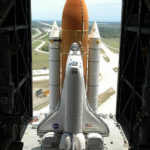
The first version of the Shuttle flight software had two serious problems: it couldn’t fit in the computer, and it ran way too slow. IBM was two years into the contract and basically nothing worked. All hell broke loose.

Science fiction and fantasy have a comprehensive and highly visible presence at the annual Baltimore Book Festival. In fact, SFWA is a programming partner and their tent is like a mini-Con. I’ve lived in the region since 1992, yet somehow managed to overlook this event. I won’t make that mistake again, it was terrific.

Hearing about the near-legendary competence of NASA astronauts was one thing, seeing it in action was humbling. Bob Crippen and Dick Truly, the two I got to work with on Space Shuttle, were the most impressive professionals I’ve met.

By comparison to the Space Shuttle, Apollo was a Model-T Ford – no set of computer-controlled spaceship operations like this had ever been attempted. Nothing that got us to the Moon could be reused here, and so it was discarded.
During high speed atmospheric flight, the extreme forces buffeting the Space Shuttle produced abrupt, violent oscillations that, left unattended, would cause it to spiral out of control. No human was capable of flying the Shuttle unassisted.

The Space Shuttle’s onboard computer system alone weighed more than the entire Apollo Command Module.
An Air Force requirement demanded wings for the Space Shuttle, and that drove everything else about its design. Yet they were never used for that purpose.
In spite of having four separate sets of rocket engines, for the entire flight through the atmosphere and landing, the Shuttle Orbiter was simply an unpowered glider.
The Space Shuttle was immensely different and more complex, in both concept and design, from anything attempted on Apollo.
In 1959, U.S. astronauts piloted an airplane-shaped rocket ship into space, and then flew nearly 200 missions, twenty years before the first Space Shuttle ever left the ground.

The Space Shuttle launch site could have been Cape Hatteras, North Carolina
Now that the era of Space Shuttle has passed, was it all worth it? While the Apollo Program was the great adventure of our age, what exactly did this stepchild do to earn its keep?

The event that most dramatically highlighted the end of my time on Program Apollo was to be present at the launch of Apollo 16.

Phil Shaffer, an Apollo Flight Director and Assistant Chief of the NASA Houston Flight Dynamics Branch, was yet another extraordinary NASA veteran.
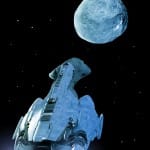
Wildcatter dropped onto Hawking a month ahead of perihelion. We slammed in after losing a brutal tug of war with the singularity that started when we closed to 60 klicks. I was in the cockpit […]

Five of the six American flags placed on the Moon by the Apollo astronauts are still standing today.
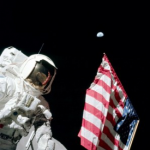
Apollo 17 was the last Apollo Moon Landing, the last crewed space flight beyond Earth orbit, and the last time human beings have set foot on the Moon.

On Apollo 16, Astronaut John Young performed Neil Armstrong’s “giant leap for mankind” to salute the flag.

NASA faked the Apollo Moon landings? No dogma is more unyielding than one founded on ignorance and arrogance
There were several notable achievements of the Apollo 14 Moon Mission. One that was abetted by the free time gained using the new flag design was that Alan Shepard became the first golfer on the Moon.
Apollo 12, the second lunar landing mission, was snakebit from the outset. The crew’s problems continued with their attempt to raise the American flag on the Moon.

Apollo 11 was the first of six Apollo spacecraft to land on the Moon. A total of twelve men walked on her surface, and every crew planted an American flag at their landing site. Each flag has a story to tell.
Today, if they think about it at all, most Americans take for granted that the Apollo astronauts planted American flags on the Moon. That wasn’t always the plan.
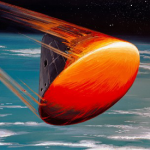
A complex system like Apollo or Space Shuttle is impersonal, amoral. It is indifferent to human objectives, human aspirations, or human lives. Like reality itself, it moves only to its internal agenda.
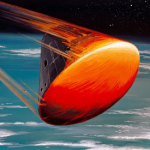
If you know your history, or if you’ve watched the movie Apollo 13, you have an advantage those of us working on that mission didn’t. You know how it came out.

I was young and hadn’t experienced a crushing reversal at the hands of an impersonal universe. More were to come my way, but on that day, Apollo 13 was enough.

The Space Shuttle Columbia disaster demonstrated the hazard of reentering the atmosphere with a damaged heat shield. During my support of Apollo 13, that was the goblin hiding under my bed.






Recent Comments