
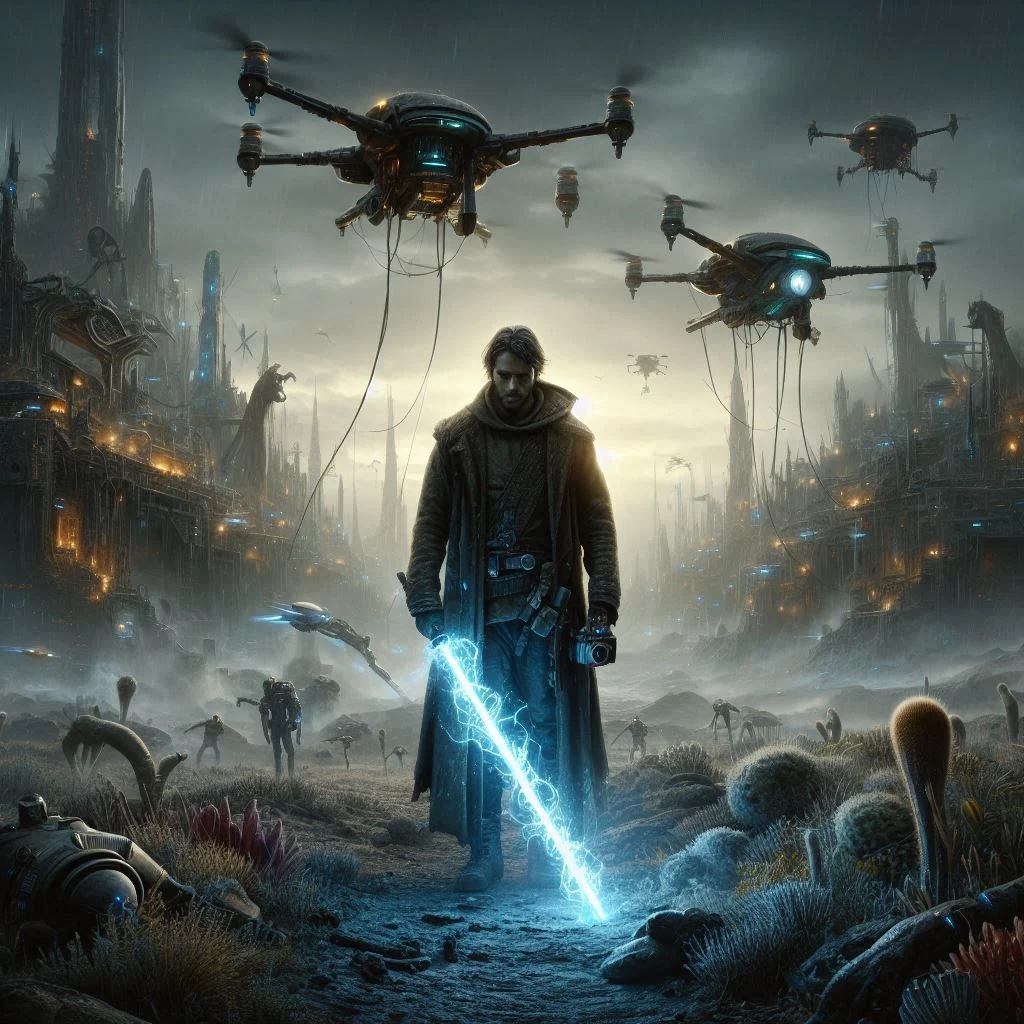
War heroes are brave and daring, and admired by the masses. Yet, these people do have consciences. Here’s a war hero with a conscience, and a good story, just right for a sterling journalist to uncover.
“The war is over,” I told the ten holo cameras, knowing history would record my every word. “We have peace.”
I heard the rumble of approval immediately from the ten million people on the colony world of Mindeira through my neural link to the Net.
Waiting until the celebration had eased, I continued my announcement to the entire Confederation as Fleet Admiral of the Confederation Navy.
I knew everyone on Mindeira would watch through their links. And listen, of course. Every colony in the Confederation, as well as Earth itself, would receive neural streamings of my speech. My words would be remembered, for they marked the unofficial end to humanity’s first war with an alien civilization. Of course, the official termination of hostilities would have to be announced by Earth Command, but that was a mere formality.
I heard myself speak, in a voice distant from my thoughts. “Citizens of Mindeira and the Confederation, my message today is short. At 18.187, March 10, 2356, the Third Fleet of the Confederation Navy unleashed upon Srajer, the homeworld of the Yruwan Empire, a new weapon, which destroyed the planet in its entirety. During the subsequent month, every colony of the Yruwan Empire suffered a similar attack, with the following result: the Yruwan Empire was obliterated. The war is over.”
They expected more, but I didn’t give it to them. They expected me to laud the glories of the Confederation, but I didn’t. They expected me to tell them about The Confederation’s new weapon, but I didn’t. However, they finally realized I was finished and erupted into jubilation.
Though most Madeirans observed my words from their homes, a few thousand were gathered in the square below the President’s Palace, so I used my link to visualize them. They were bouncing around and cheering in celebration of the news.
I have to believe they didn’t know why they were cheering, that they were caught up in the spirit of the moment, that they would feel differently when they had time to process the information. I did not, could not, believe that fellow human beings would feel happiness at the thought of having extinguished an entire race of intelligent creatures, with a civilization as advanced as ours in some ways, even if that race had one or two biological quirks that made humans shudder. Humans could now genetically modify their bodies, but the Yruwans were not that advanced yet in genetics. They had to stick with the traits that evolution had given them.
As a noemo, an ambi in the popular slang of our day, I was the perfect example of genetic modification. I was designed to be a neutral human, genetically neither male nor female, having some characteristics of both. I had the aggressiveness and strength of a male, but the intuition, extraversion, and better ability to multitask of females.
My appearance was more like a male, tall and muscular, though I had no facial hair. Nor any sexual organs; thus, no sexuality, so I could not easily visualize myself as a father or a mother since I could never have children. And since I was designed to feel few emotions, I should feel no sorrow if an enemy ceased to exist, making me an ideal admiral, like most of the officers in the Terran Space fleet. But despite my genetics, the very thought of that concept bothered me immensely, and I could also understand the horror unleashed upon their mothers by pubertal Yruwans. I had sympathy, though I lacked empathy.
The cheers went on and on, swelling and fading like the praise of a giant, mindless animal, until I could stand it no more. But still I stayed. It was part of my job.
#
The first human-Yruwan interactions were peaceful. After we encountered one of their ships in orbit around Mindeira in 2232, embassies were established on Earth and Srajer, the Yruwan home world. They seemed a gentle and peaceful people, artists and mathematicians at heart.
And dancing. They loved to dance.
#
One hundred years of war is a long time. Few people now alive remember the taste of peace, but everyone wanted it. Enough to rationalize what we had done to achieve it? We’d invented an invincible weapon, and Earth Command had ordered me to use it, even though we were winning already. The Yruwans were almost our technological equal until we developed our new weapon, but as a people, far less aggressive than humanity.
What would historians say about me? History is sometimes, though not always, written by people with a conscience, though I wondered if humanity had lost its racial conscience.
Below me, the citizens of Mindeira still cheered. They waved banners. They danced in the streets. I wondered if any Yruwans were down there dancing.
I turned and retreated through the archway to the palace proper. The Presidential residence had a pre-twentieth-century Spanish appearance, with balconies and high colonnades. I wouldn’t have been surprised to find an old priest waiting for me in the preparation room. To absolve me? I needed it, but not for the obvious reasons.
Instead of the priest, my twelve-person honor guard greeted me, clicking to attention as I entered. I waved them brusquely aside.
The President of Mindeira scurried after me, a worried look on his face. “Where are you going?” he said, still puffing.
“To my quarters.”
“Why? The hour is yours, enjoy it.”
“You must be proud to be in the presence of such a hero,” I said.
“Admiral—”
“Never mind, I don’t expect you to understand.”
He shrunk away from me, realizing that I had insulted him, but only vaguely aware how. This obsequious little man controlled an entire planet. Lord help the colony of Mindeira. But he was probably no worse than most politicians.
“Go talk to your people,” I told him. “My speech wasn’t long enough to satisfy them. They want more blood and guts.”
He bowed and returned to the balcony, glad to be done with his duty of accompanying me. I signaled for my top aide.
He arrived quickly, followed by a tall spider of a man, all elbows and knees, with a thin smoket dangling from his lips, its tip smoldering. It was interesting that centuries after cigarettes fell out of favor, a new equivalent had arisen, very popular in the colonies. Smokets were safe, according to the manufacturers. But didn’t everyone say a similar thing about cigarettes at first?
“This is Dalemon Strong,” my aide explained defensively, catching my look of annoyance. “He’s with Colony Press.”
The newsman slowly crushed his smoket between his fingers and threw the remains on the floor, though I doubt my frown had anything to do with his actions. There was a click, a rush of air, and the ashes were sucked into the nearest wall. At least there was a little civilization out here on Mindeira, far from the mainstream of Earth and the Confederation.
“You promised me an interview,” he said, the words sloppily pronounced, as if he wasn’t concentrating. But I knew it was a ruse.
“I see.”
“You remember, of course.”
I scowled. If he noticed my scowl, he didn’t react to it. I didn’t remember, but I couldn’t admit that. After all, he might be right. In the confusion that occurred after I landed on Mindeira, there was no way of knowing what I had promised. Still, I would have expected to remember the name Dalemon Strong. He was the most well-known and popular newsman in the outer worlds of the Confederation, largely because of his instinct for uncovering stories that no one else even suspected. He had a reputation for being clever and persistent when he went after a story. Also, a reputation for being one hundred percent against the war. Now that the war was over, I wondered how he would react to its ending. Why would I ever grant him an interview? Maybe I didn’t; I was beginning to believe that my aide had set this up.
“Okay,” I said. “You get your interview. But no holo or other electronics. Just a pad and pen. And you must promise to let me edit the final draft.”
“No good,” he replied. “I’m not your PR man.”
“Fine. Then no interview.”
Strong found another thin smoket in his pocket, waited for it to light itself, then stuck it between his lips. “All right, I’ll accept your terms.” We both knew he didn’t mean it.
I nodded, but I had little hope that I would ever see the final draft before it was streamed. I would just have to be careful with my choice of words.
Strong put down the holocorder he had in his hands. As he did so, I noticed the large silver-colored ring on his right index finger.
“Your fingercorder,” I said. “You forgot to take it off.”
He glanced at me, then put the ring in the case with the holo camera. I wasn’t worried that he might be linked to the Net; Strong had the reputation of being extraordinarily paranoid. If he were linked to the Net, any information he might obtain might be found by other newsmen as unscrupulous as he was, so that was a technique he avoided.
“That’s better,” I told him. I turned to my aide. “I want to go to a club. What’s the best one nearby?”
“The Silent Mission,” he said.
“Then I want to go there,” I said. “Please get me some civilian clothes.”
“Yes, Admiral Shrander.” He disappeared.
“We can talk at the club,” I told Strong.
#
The Yruwans were very humanoid in appearance; with makeup and the right clothes, it was difficult to tell the two races apart. There was no accepted explanation for this, though there were many theories. But we made a mistake when we didn’t foresee that there would be some major biological differences. Humanity wasn’t ready for some of them. They went against our concepts of God, motherhood, and apple pie.
Particularly motherhood.
#
“I’m a little surprised, though,” Strong went on, as we waited for my aide to complete his tasks. “You should be out on the balcony still, wallowing in your glory.”
“I made my speech—I have nothing further to say.”
“You can’t just wash your hands clean of the entire business—not after what you’ve done.”
“I did what I had to do,” I replied. “I was ordered to win the war.”
“So now you have an iron conscience, huh? People sure change. It’s strange that you turned out to be the one to destroy the Yruwan civilization. You, the Peacesinger at the Academy. Don’t act surprised. I’ve done a bit of research on you. You weren’t too popular at the Academy, even though you were first in your class. You had what many people considered un-Academy ideas. Imagine, an Academy graduate who didn’t believe in killing. Particularly an ambi, a person genetically designed to be neutral, ambivalent, neither male nor female, but somewhere in between, a person who possessed few emotions, a noemo.”
“Genetics are not always completely predictable,” I said.
“Of course, they hoped you would change, or that your militaristic qualities would overcome your humanistic ones. I guess they were right. They must be proud of you today.”
“Not today,” I pointed out, part of me wanting to tell him where his conclusions were wrong. “No one on Earth will know about the end of the war for another three months.”
“Just a figure of speech,” Strong muttered. “Don’t get too excited.” He shook his head. “I’m trying, but I can’t understand. I’ve followed your career for a few years, and over that time, I’ve talked to some of your classmates from the Academy….” He shook his head again, more slowly this time. “You know what they said? They told me you wouldn’t even fire a blaster at the target of a man. Furthermore, in war games, you were never credited with a personal kill—you couldn’t stand the thought of even pretending to kill a man. But you could always design a hypothetical strategy that could wipe out millions!”
“I am designed to be a good theoretical tactician.”
“Then it’s okay if someone else pushes the button?”
“Killing of any kind is wrong.”
“You expect me to believe that?”
“I don’t really care,” I replied, growing weary of his questions. I might have actually killed him right then if I had the chance, even if it went against almost everything I believed in. Right where he stood. Every rule or belief had exceptions.
“You exist because of all the wars in the past fought by our race secondary to hatred,” he pointed out. “The Germans hated the Jews, thought they were inferior. As did some Muslim countries in the past, as well as many other countries, and not just against the Jews. Humans are the only Earth species to deliberately organize to hate others of their own kind and systemically kill each other. So, to downplay this chance, military and political leaders are now created genetically with a lack of ability to let emotions interfere with their decisions.”
“That’s why we’re genetically designed the way we are,” I replied.
“But aliens are different, aren’t they?” he said. “I guess you somehow enjoyed killing the Yruwans. It’s the only logical answer. You changed from a Peacesinger to a murderer of twenty billion intelligent beings on twelve planets. What reason can there be except that you don’t regard the Yruwans as equal to humans? They’re definitely hard to love, and easier to hate, aren’t they?”
“I don’t enjoy killing anything.”
“Sure, sure, try to convince me. I suppose since you’re an ambi, you can’t truly sympathize with Yruwan mothers. What happens to them doesn’t bother you.”
Emotionally, it didn’t bother me, but logic was one of my strongest qualities, so logically it did. “I suppose you’re planning to print all of this,” I snapped, changing the subject. Inside, I shuddered. I knew exactly what he meant. And it was true. Part of me was repulsed.
“It’s my obligation.”
“In-depth character assassinations are your trademark, aren’t they?” I asked, trying to stay in control of my temper, one I wasn’t supposed to have.
His lips came close to forming a sneer, but quickly relaxed. He grinned coldly. “I report only the truth.”
“At any cost?”
“There is no price too high to pay for the truth.”
“That’s where we disagree,” I said.
“That’s not the only place,” he replied sharply, and I could see the scorn in his eyes. Murderer! they said.
“You don’t think much of me, do you?” I asked.
“Don’t take it personally,” Strong remarked, calmly. “I’d despise anyone who killed twenty billion intelligent beings.”
#
The problem with Yruwans is that they are born missing a few important genes, primarily those responsible for initiating their equivalent of puberty. These genes have to be exogenously supplied, and they are then incorporated into every cell of the body, except the germ cells.
These genes are obtained from their mother by ingesting her cells. And they celebrate the event!
When humanity discovered this, it was horrified. A race whose children ate their mother, even if biologically necessary, did not deserve to live.
And eventually, the war began.
#
The street cringed with the clamor of victory. People jostled along, stumbling into one another, shouting, “The war is over! Have you heard?”
All the while, I had the impression that no one knew quite how to act, but everyone was sure that it was time for a celebration, so they snapped on their brightest smiles and wandered into the streets.
I bumped into at least fifty people as we walked, but even when I answered their greetings with a glare, no one recognized me, for in their minds my uniform was the outer layer of my skin, and Admiral Shrander could not exist in a blue cotton swirl. It felt good not being known, not being called Admiral, not being called “sir”, “mam”, or “ambi,” and not being followed by an armed platoon of guards wherever I went. It felt good just being another human being. Under different circumstances, I would have been happy here in this crowd. Now I was not.
But I had done what needed to be done.
“I understand that there are a few remaining Yruwans on planets in the Confederation. Are we going to hunt them down and exterminate them like the vermin they are?” His voice reeked of sarcasm.
“You’ll have to ask that question of Earth Command,” I replied tersely.
“I heard rumors that a few are even on Mindeira,” he went on, ignoring my comment. “Will we be able to find them?”
“I told you—I’m not the one to ask.” Why won’t he leave me alone?
“I’ve heard that they’re hard to distinguish from us in the dark, particularly with cosmetic surgery.”
“In some ways.”
“A very graceful and poetic people, aren’t they?”
“So, I’m told.”
“You must be sorry not to receive the assignment to exterminate the remaining few.”
I said nothing, trying to control my anger, an anger I was not supposed to feel. I had an irrational urge to admit to this jerk that no one had any intention of killing the few Yruwan agents left in the Confederation. But that would give him information I didn’t want him to have.
The Silent Mission was even more crowded than the streets, but only half as noisy. For a moment after we entered and waited for a table, I watched the dancers on the main stage, flying to the music. One in particular caught my attention. The dance was Birth and Death by Rubilino, and it was the lead dancer playing the part of the star who impressed me. The dance was almost over, the star was going supernova, and he was the star. I did not see a man on the stage any longer, I saw a star, hurling out its insides in one cataclysmic burst of energy as it died. He spun and the stage was too small for him. He flung his arms apart, and I flinched. And then he was spinning rapidly in place, a pulsar, the burned-out remnant of what had once been a bright and mighty sun.
Then I noticed another much smaller dancer who was circling around the primary one. When the star exploded, the secondary dancer wilted to the floor, quivering on the stage like the remnant of a vanquished sea creature. Or a planet destroyed by the supernova.
The dance was over. The principal dancer snapped erect and glided off the stage without a bow, as did the smaller one. The audience in the spread yelled in appreciation, but the dancers did not return.
A brown-suited gentleman approached as we waited and when the roar diminished, addressed my still-uniformed aide. “I’m sorry, sir, but as you can see, we are full.”
My aide mumbled something I didn’t care to hear, something I was very used to in such situations, and the waiter turned to me and bowed so low he almost rubbed his head against the floor.
“A room will be found for you, Admiral Shrander,” the waiter purred. He stuttered away, the three of us behind him. He led us to the periphery of the spread where approximately ten private rooms were reserved for the rich or the owner’s favorites. Or those with too much power, I thought, like me, and all the foolish dreams of my adolescence came rushing back at me. I had wanted freedom and peace, but I possessed only power, and the peace I had brought to the Confederation did not extend to include me. I felt imprisoned by my actions. But I could not blame anyone else. The bars of my mental prison cell were of my choosing. I had created peace, but not in the way I desired.
We stood while the waiter chased out another party, three men who stalked angrily by us, glaring at me as they passed. We sat down and the waiter took our orders. I snapped on the holo sphere in the middle of the table, but the dance stage was empty. I turned off the sound.
“Few people make admiral at thirty-eight,” Strong offered. “Especially a person like you.”
“What is that supposed to mean?” I asked him irritably. But I knew what he meant.
Strong grinned coldly. “Oh…nothing at all. Why don’t you just tell me how you accomplished such a high rank at your age,” he urged as the waiter returned with our drinks. I had a Silk Sour, full of alcohol with a little mindspin thrown in—something I needed, though I rarely drank. Strong ordered something even worse: Deathwish, two parts Mindeiran whiskey to one-part mindspin. My aide evidently felt that he was still on duty and had to protect me, because he ordered a glass of juice. I didn’t try to persuade him to change his mind.
“I was a captain in the Right Wing of the Third Fleet,” I began, “when the flagship of the Wing Commander was destroyed in battle, and he was killed. I inherited his position by default. Up to that moment, the strategy of the Confederation had been to start at the outskirts of the Yruwan Empire and slowly move inward, capturing planet by planet, all the while maintaining our supply lines to the rear. It sounded good on Earth, but it wasn’t working. Mindeira is the nearest Confederation supply base to the Yruwan Empire, but it’s still three parsecs away from Yruwan space. The Yruwans never had more than a light-year to bring their supplies. We had a lot further. It was too difficult to keep our supply lines intact—after each skirmish, they could repair twice as fast as we were—and they could therefore neutralize us for a hundred years.”
“But you changed that strategy?”
“Yes. Before anyone outside my wing was aware of the Command change, I decided it was time to surprise the enemy. I jumped my entire wing to Jrew, the primary supply base in the Yruwan home system, and attacked. As I suspected, it was almost unprotected—the Yruwan fleet being completely occupied by the fighting along their border. Two things happened: first, with the loss of only a few Yruwan lives, I was able to inflict upon Jrew damage from which the Yruwans could never recover. No longer were they able to repair their damage faster than we were, because they were suddenly short of supplies and the factories necessary to make those supplies. Second, the diversion caused the Yruwans to pull three of their fleets back from the border in a desperate attempt to protect themselves from what they thought was about to be a direct attack on Srajer, the home world. As a result, four border colonies of theirs were taken.”
The difference between a hero and a goat is less than the instant between the present and future. Had I failed, I would have served out my Navy years as a lowly lieutenant, perhaps again receiving a small freighter to command at the end of my career, but only if I preserved an unblemished record. At the time, I was brash and conceited and eager to end the war, and such an unpleasant fate never even occurred to me. As it turned out, I was an immediate hero, quickly promoted to Fleet Admiral of Confederation forces and allowed to run things with little interference from Earth. Such were the frustrations caused by a century of war. Earth and the Confederation were willing to try just about anything.
“That was the turning point in the war?”
“Yes, though the warp-fields ended it.”
“Oh, yes—the warp-fields. They are the new secret weapon, aren’t they?”
“Yes.”
“What can you tell me about them?”
“Nothing.”
“They destroy entire planets by transporting a portion of the planet into warpspace, don’t they?”
“I can’t comment on that.” I was just being contrary now; the statement was accurate, and every citizen was aware of it.
“I thought not.” He paused. “They say that before you destroyed Srajer, you met with the Yruwan leaders and offered them peace.”
“That’s true.”
“And they apparently turned you down.”
“They would not surrender.” A convenient answer that hid the truth.
“How hard did you persuade them to accept peace?”
“I gave it my best.”
“Did you now? I doubt that somehow. They should have been easy to convince. After all, the end was inevitable.”
“You’re saying that if I had tried harder, the Yruwans would be alive today. Isn’t that right?”
Strong shrugged. “Draw your own conclusions. All I know is that I would hate to have on my conscience what you have on yours.”
Back on the stage, the dancers had returned, and in silence, we watched. All were good, but I couldn’t help watching the lead dancer to the exclusion of the rest. Everything else—the stage, the audience, the other dancers—no longer existed. He moved like gossamer in the wind, water evaporating to form a cloud, then a raindrop falling slowly, gently, splattering on the stage….
“You’ve come a long way, Admiral Shrander,” Strong said. “But I still think there’s something missing. I just can’t figure you out. I guess that as an ambi, unable to remotely comprehend the feeling of a mother towards her children, the fate of a Yruwan mother doesn’t bother you.”
I glanced at the lead dancer on the stage, who was now standing erect. I knew that Strong was still staring at me, so he must have noticed the fleeting burst of suspicion that flickered through my eyes.
Strong frowned, looked at me, then back to the dancer on the stage, as his mind digested the new information. “Dances like a Yruwan?” he said.
“Maybe, a little similarity, but he’s perfectly human,” I replied.
“Are you sure?”
“Positive.” After all, I knew where all the Yruwan agents were on Mindeira, though I couldn’t tell him that.
“You looked uncertain a minute ago.”
“I’m sorry, but this interview is over. I have another appointment.” I knew I had to end it quickly.
“I’m not finished.”
That, of course, was what I was afraid of.
“Why would you change from a Peacesinger to a murderer who would wipe out an entire civilization?” he asked.
“We have peace, don’t we?”
“But at such a price.” He shook his head. “Not until I’m certain how a mind like yours works will this interview be over.”
“If you will excuse me,” I said, and turned to leave.
Strong grabbed my arm, fire in his eyes. He continued to stare at the dancer, then evidently the last vestiges of confusion fled from his face, and I knew that even the slightest suspicion I had shown that the dancer might be a Yruwan had come back to haunt me.
“You didn’t change!” he whispered. “Now, I understand. You didn’t change.”
I made the order. I had no choice—he would have published the truth. But at least he would get the story of his life.
Eventually.
#
Two years later, I sat on the bridge of a small cruiser as it pulled adjacent to Ceres. We had dodged and deflected a thousand small rocks to reach this destination, an isolated prison world deep in the asteroid belt. Here were the prisoners who could not be allowed to escape, the traitors, the irredeemable terrorists and mass murderers…and a single unlucky, too-smart journalist. This prison world only existed on a handful of databases and was only described thoroughly on mine.
As we moved closer, I continued to read the preliminary reports from the colony world of Mindeira, knowing that what I read occurred almost three months ago.
The reports stated a ship had come to Mindeira from the direction of Srajer. An unarmed ship, with a crew that should not exist, a crew of Yruwans. My opinion was wanted, since the President of Mindeira was confused by the development, as would be Earth Command, very soon, when the news reached them.
My opinion would not be wanted for long, for in a few days I would no longer be Commandant of the Confederation Navy. More reports would soon follow the one I was reading now, and they would tell a story that Earth Command would not believe…at first.
My aide and I followed a stout lieutenant down the corridor to the prison, where the warden in charge met me in a small lobby filled with stiff metal chairs and blood-red carpeting.
“Commandant Shrander, how wonderful to meet you. How can I help?”
“I need to talk with one of your prisoners.”
“But I received no orders, no warning.”
“Would you prefer my aide here to go back to our ship and send you my written orders? Won’t my spoken orders do? How hard is it for you to fetch a prisoner from his cell?”
The ruddy-faced warden turned even redder. “I can do that.”
“Actually, I’ve changed my mind. Take me to him.”
We walked through six steel doors, each at least six centimeters thick, into a series of cells on the first floor. I thought he was going to stop, but we found an elevator and dropped four floors to a cell block straight out of a luxury hotel, one I had designed, except for the bars. In the middle of the room working at a large desk was Dalemon Strong, looking worn, tired and thinner, with even more elbows and knees than I remembered. I was a little surprised given the weak gravity here, but psychological stress can be very damaging.
“You,” he hissed.
“Yes, me,” I told him. “Stand up, it’s time to write that story you were working on two years ago.”
The prison warden looked puzzled.
“What?” Strong said. But he staggered to his feet, and I thought he was going to take a swing at me, but he lost his balance and tumbled back to the floor. I helped him up, and now his anger was gone.
“What happens to me now?”
“You are free. I’m sorry that I had to do to you what I did. I hope part of you understands. I felt I had no alternative.”
He was silent, but I knew that part of him did understand, though I doubted that he would ever forgive me.
“I’ve received no orders about this,” the warden said, frowning. “I need to check with my superiors,” he added, disappearing back into the special elevator.
The barrier of time melted away in my mind. I remembered Strong’s fierce look of anger and disbelief as he stood before me in The Silent Mission after I ordered his arrest. I remembered the search for him when it was discovered that he had disappeared. And the curiosity when time passed, and he was not found. I was safe only because no one other than Earth Command had the authority to investigate me, even though I was one of the last people to see him alive, right before I returned to Earth. And everyone was so happy the war was over that Earth Command was unwilling to challenge my orders.
“There’s nothing to write,” he said. “My day is gone.”
“Your day is just beginning. You will write one of the greatest stories in humanity’s history, one with a surprise ending. Your thoughts were correct, that night in The Silent Mission. And now the truth has come home.”
“Then the Yruwans….?”
“Are indeed alive and well.”
I remembered other things as well. Soon after my return to Mindeira, the mood of the press and public began to change. The meaning of destroying an entire civilization became all too clear. The sword of guilt began to pierce many hearts, and I was, of course, condemned by many as the agent of the destruction. Four times, the radical arm of the Peacesingers tried to assassinate me.
But through it all, Earth Command supported me, and eventually promoted me to the position I hold now, Commandant of the Confederation Navy and Coordinator of the Joint Council. There will be inquiries and firings when the truth is finally told. My friends will become enemies—I can only hope that some of my enemies will become friends.
“How did you do it?”
“It really was not so hard to pull off,” I told him. “The warp-field generators required only three ships to destroy an entire planet. I was the only one with the coordinates on my flagship, so after giving them to my navigator, she performed all the course calculations and fed them into the computers of the other two ships. We popped out of warp space in exact position, destroyed the planet, then were gone in fifteen minutes. It wasn’t hard to find uninhabited planets to obliterate. Only my navigator and I knew that we never came within half a parsec of Srajer or any Yruwan colony world after I met with the Yruwan leaders. I didn’t have much trouble convincing them to accept the peace when I showed them what our weapons could do.”
“But why did you do it? You couldn’t easily sympathize with Yruwan mothers.”
“No. I wasn’t designed to feel sympathy. But I was designed to be more logical than emotional, so while I couldn’t imagine what it felt like to be eaten by my own children, since I couldn’t imagine what it was like to be a mother, I could understand the genetic necessity of it. At the present time, it was the only way for the Yruwans to survive.”
“So, I was right. You didn’t change! You couldn’t accept killing twenty billion intelligent beings. And as Commandant of the Confederation Navy, you were able to prevent further missions into Yruwan space?”
“Yes. I created a blockade beyond Mindeira. But now, the Yruwans have come back to human space, and the truth is out. It is your job to explain that truth.”
As we turned to leave, the warden returned.
He was not alone. At least a dozen armed guards accompanied him.
“I thought you said I was free to go,” Strong said.
“You are,” the warden said. “It is Private Shrander who cannot leave. At least not until his court-martial, though I doubt that he will win that. Treason often carries the death penalty.”
“But he saved an entire civilization!” Strong said.
“Maybe you can defend him at the court-martial,” the warden responded, then led Strong and the bevy of guards out, coming over to remove all my Commandant badges as he left.
#
Now I was alone in my elegant cell. Elegant and spacious, yes—after all, I designed it—but it was still a cell, a prison cell. Would I be here for the rest of my life? Would that be short?
The death penalty was essentially never used anymore, but it was still in the books as a potential punishment for treason. I didn’t consider what I had done as treason, but Earth Command might feel differently.
I walked over and sat down in front of a giant screen. I used my connection to the neural Net to turn it on.
I was surprised that my connection to the Net still worked. I was sure that soon it would be disconnected. And I would be alone, truly alone, for the first time in my life.
Leaning back in the chair, I reached my mind out and visualized the bridge of one of the many ships I had commanded. My memory surveyed the sweep of stars through the bridge canopy. Bright and glorious suns filled space, dark and dusky nebulae, the violent burst of light and darkness that was the distant galactic center…it was far more than one person could ever possess, but vicariously, I had possessed them through the fleets of Confederation starships that were loosely under my control. How could I regret my actions? I played a part in changes I never believed possible.
I didn’t know what would happen to me. Obviously, my career as Commandant was already over, and I had no idea about my future. But at least I felt free, no longer in the prison of my actions and the necessary secrecy. Strong was out of his prison, and I was out of the prison of my own mind, though my body was behind bars.
After ending the war with the Yruwans, humanity concentrated its explorations in the opposite direction, at my suggestion, of course, and one year ago encountered the Distrix Domain. There was no suggestion that humanity fight for the right to settle planets within this region. War was never considered by the Joint Council, and I have little doubt that the guilt I brought back from Srajer was primarily responsible. Peaceful trading with the Distrix has begun, though there are aspects of their culture and biology that we have trouble accepting as well. Believing that we had wiped out an entire alien civilization had matured us—we were more tolerant now.
I am convinced that this tolerance will extend to the Yruwans…this time.
I sat back down, staring into my own thoughts. The Yruwans had returned and Strong was now free, free to publish what is possibly the most exclusive story in the history of humanity, of the hundred-year war with the Yruwan Empire, and the ultimate battle that never was.
Far away, twenty billion Yruwans still lived because I disobeyed my orders. Maybe, at some point, they will read Dalemon Strong’s article about the true ending of the war, and what might have happened, what might have been if I had not intervened. Maybe, ironically, Strong would now try to defend me.
The pathway to peace is not always a straight road.
In my cell, when I sometimes hear the screams of many other prisoners, I often dream about a wide and turbulent river. The Yruwans live on the far side, with gleaming cities and vibrant plazas on which to dance.
On my side are many beasts, all determined to shred me, but for some reason, they have no success. Maybe my dreams shield me.
The Yruwans constantly signal me to come over. They would welcome me as their friend.
But the river is too treacherous. I cannot go. I must live out the rest of my life among the beasts.
And the most terrifying thing is that the beasts are all human.
END





Recent Comments