
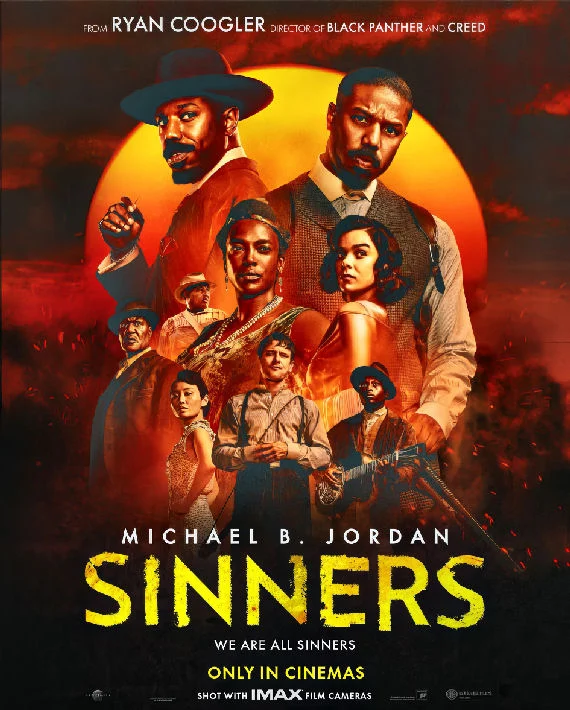
**SPOILER ALERT!* I will be talking about all sorts of things that happen in this film; some of it might be a fairly major spoiler. If you can’t stand spoilers, I urge you to see the movie before reading this review.**
I didn’t pay any attention to Sinners before it became the most-nominated film in the history of the Oscars—the previous highest number was 14, shared by such films as All About Eve, Titanic, and La La Land. The plot description I read was something like “Trying to leave their troubled past behind, twin brothers return to their hometown to start again, only to find an even greater evil is waiting to welcome them back.” It sounded like a period piece about African-American gangsters, probably during Prohibition, coming into conflict with a bigger organization. A little later I heard it was a horror film, which piqued my interest a bit. But then came the 16 Oscar nominations, including Best Picture, Best Screenplay, Best Director, Best Actor, Best Supporting Actor and Actress, Best Original Song, and so on. What is going on? So I had to see it. Here’s a bit of a spoiler: it is, I believe, the world’s first-ever All-Black (almost) musical horror vampire movie!
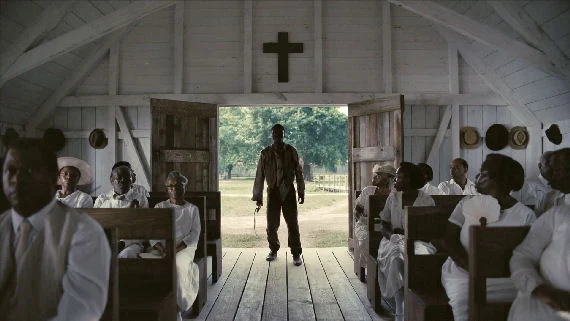
There are only a few white actors (and two Asians (playing ethnic Chinese), with most of the major award nominees being African-Americans. So if this first spoiler sounds good to you, read on (otherwise, I will have other spoilers in this review, so beware). Two of my favourite actors, Delroy Lindo (who has been woefully underutilized in most of the movies I’ve seen him in) and Michael B. Jordan, who’s recently played Apollo Creed’s son in the Rocky Balboa spinoffs, as well as many other roles. (Fun fact: he is exactly 40 years younger than I, since we were both born on January 9; he in 1987, me in 1947.) Also, Chicago Blues legend Buddy Guy also has a small role in the film.
But although the description tells you it’s a vampire movie, it’s a lot more than that—because it’s also an examination of what the American Dream meant to poor Black folks in the Deep South in 1936. (Hint—not a whole bunch.) But it is innovative, in that it’s also a musical unlike any other musical you’ve probably ever seen; the storyline touches on many things that are in some ways still germane to 2026. The movie’s also notable for being R-rated for its language (typical of the time), somewhat graphic sexual situations, and major bloody scenes of violence.
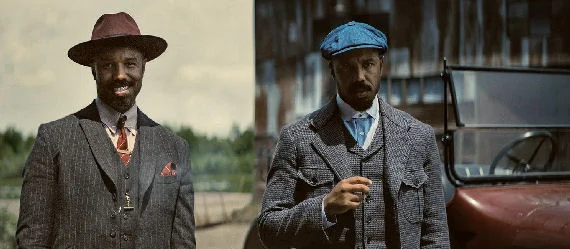
Mind you, I was mighty confused as to whether it was really worth all the hype (and nominations) the first time I saw it. Because it’s just a vampire movie, right? Well, after I saw it once, I started thinking about it and had to see it again; it kind of grew on me. The plotline described above puts the Moore twins as protagonists, but I think that cuts out a third protagonist, Sammie Moore (nephew of the twins), played by 20-year-old actor and singer Miles Caton, who learned to play guitar for his role in this movie. (In fact, a lot of the cast performed their songs live for the film, according to IMDB.) The title, Sinners, is supposed to be a description of evil according to Sammie’s father, a preacher, who rails against Sammie’s desire to leave Mississippi and go to Chicago to play guitar. His father says he’ll be playing for people who abandon families, jobs, and God in order to drink, gamble, listen to blues, and consort with loose women, and urges him to abandon his sinful ways (and, one assumes, his music.)
The sound of a guitar being tuned up occurs over the WB logo, then the movie begins with a black-and-white drawing and a female voice narration telling us that some musicians have music “so true” that it can bridge the past and the future; these people are called “fili” in Ireland; the Choctaw (Native Americans) call them “firekeepers,” and in West Africa they’re called “griots.” Their music can heal, or it can attract evil. Then the film begins in a place called Clarksdale, Mississippi, on Oct. 6, 1932. A word about Clarksdale—if it’s at all similar to where I lived in Florida in the late 1950s, there were two Clarksdales: one for the White folks, and one for the non-whites (which could include Asians). In the city in the northern part of Florida (where I lived in the late 1950s), the non-White area was called “Shinetown,” (or a much nastier “N-word…town,”); and the Whites generally stayed out if the others stayed in their own area. I apologize if this offends anyone, but I’m just reporting what I personally witnessed.
Here’s the basic plot: the Moore twins (I think their names are Elijah and Elias), called “Smoke” and “Stack,” left Clarksdale some years before to go to Chicago and reputedly work for Al Capone, possibly as bootleggers. They have left Chicago with a truckload of “Irish beer” (possibly Guinness Ale), French wine, and a roulette wheel in order to establish a “juke joint” (an illegal, unlicensed place for Black folks to go and have fun (drink, music, gambling and whatever) without the dubious company of white folks. They arrive in town one day earlier than October 6th, ready to buy an old, disused mill and open “Club Juke.” They deal with a very stereotyped “good old boy” named Hogwood, then go into town to get food and a sign for their Grand Opening that night at the local Chinese-owned grocery cum General Store, Chow’s.
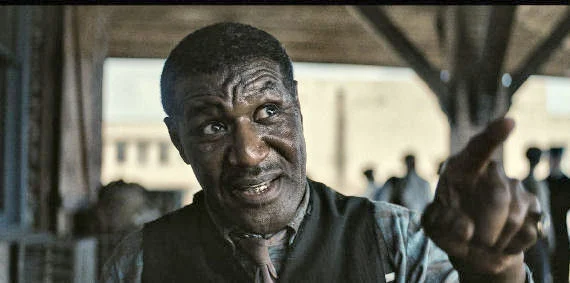
They hire Mrs. Grace Chow (Li Jun Li) to make a sign; they hire local folks to fetch and carry and set up; they hire “Cornbread” (Omar Miller) out of the fields (most of the locals are sharecroppers) for a doorman cum guard; and they hire Sammie to play guitar and sing as well as local legend Bluesman Delta Slim (Delroy Lindo) to play piano and harmonica. Stack reacquaints himself with his ex-lover and mother of their dead child, Annie (Wunmi Mosaku). Sammie and Stack also interact with another of Stack’s exes, Mary (Hailee Steinfeld), who looks White, but has a father or grandfather who was part Black (she has married a White guy and is “passing” as White—that was something that could cause severe consequences to a person who was passing but had “even one drop of Black blood,” as they said in those days.)
As the day wears on toward sunset, we see a white man running toward a rough cabin. He’s wearing dirty clothes, and is either smoking a bit or is covered with dust, as we see something rising from his shoulders as he bangs on the door of the cabin, shouting to be let in. The door opens, and the people inside (a White man, Bert, and a White woman, Joan) aim a rifle at him; he says he’s being chased by some Choctaw Indians and pleads to come in. They relent and let him enter. A car and a horse and rider then come to the cabin and knock—the woman opens the door, aiming a rifle at the Choctaw rider, who removes his hat and asks her if anyone’s come by; they’re trying to find a very bad and dangerous man who might have come this way. She sends them off and goes back into the cabin. The Choctaw men have to rush off before it gets dark. This point comes about 40 minutes into the film; here’s where we find out he is a vampire (Figure 5).
From here we go to the Grand Opening of the “Club Juke,” and begin to know some of the players better; we meet Pearline (Jayme Lawson) who, though married, is obviously intrigued by Sammie (who has earlier in the day gotten some instruction from Stack on how to please a woman); and after a quick dalliance with her, Sammie begins to play and sing—and as advertised at the beginning of the film, his music is so true it begins to merge present, past, and future. By the time he’s done with the song, the dance floor is crowded with persons from all eras, from ancient Africans to funky electric guitarists and rappers. Mary shows up at the door and Cornbread tries to turn her away because she looks White, but she speaks to him and he recognizes her and lets her in.
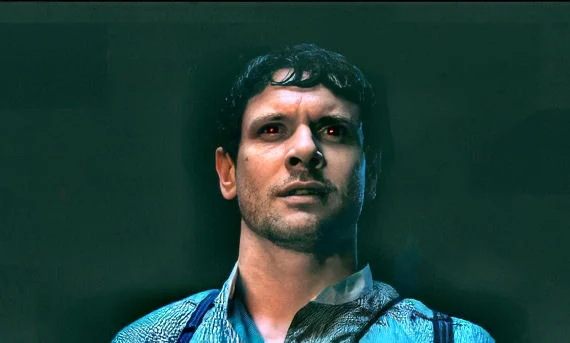
Remmick the vampire (Figure 5) comes to the door with the two people from the cabin, but all are very clean and carrying instruments; they tell Cornbread they’re just here because they heard tell of a party. Smoke and Stack, with several other people come to the door and the trio (Remmick on banjo, Joan on fiddle, and Bert on guitar) begin to sing “Pick Poor Robin Clean” (a 1930 tune by Geeshie Wiley and Elvie Thomas based on an old African tune) to demonstrate that they’re just musicians who believe in equality and just want to join the party, eat and drink and play music—but the twins aren’t having any of it (the three are White, after all) and turns them away. They say they’ll hang around outside in case the twins change their minds. (Later, the vampires sing “Wild Mountain Thyme” and other songs; again, in perfect unison and harmony. There is other really well-done music in this film—one of its attractions.)
Okay, well here I’m gonna have to quit describing the action (after all, I don’t want to spoil the whole thing) and go into what I think makes this a good movie. First, as part of their technique to talk people into inviting them in (legend has it that a vampire can’t enter a dwelling—here, it’s loosely translated to “enter any building” without a specific invitation); next, they talk up big time that they believe in equality—once it’s known by the crowd that they are vampires (Annie says, “They ain’t haints, they’s worse—they’s vampires!”), they try to convince the people inside that being a part of the vampire family is the greatest thing since sliced bread. There’s no colour bar; and nobody is lonely—it’s all about love and togetherness forever. Plus, what one vampire knows is known by all; to demonstrate this, they all sing and dance together. At one point Remmick tells Sammie that it was his music that drew him, which harkens back to the drawing and narration at the beginning.
The new things about these vamps, not seen before in a genre movie that I’m aware of, are first, they can kill in a matter of minutes; secondly, that within a few more minutes the victim becomes a vampire with the same bloody desires; also, that they seem to share a common mind and/or memory. What the leader (Remmick, in this case) wants, thinks, and knows—they all know. To demonstrate this, all the vamps sing, dance and play in absolute unison and in harmony. My guess is that Remmick is a very old Irish vampire, and he wants to absorb Sammie’s musical knowledge and talent. Some other common things of legend appear to be true: the vamps are allergic to garlic; they can’t be injured by bullets; they can fly; and, finally, they are killed by sunlight. But if this movie is typical of those vampires, it wouldn’t be long until they had killed and converted every human for miles around.
As I said in the beginning, I didn’t know anything about this movie—I hadn’t even heard hype about it—but after viewing it twice, I have to say I’m impressed; writer/director Ryan Coogler has come up with a few new things to add to the vampire lore. And the music was certainly impressive. I can recommend this to any adult—it might be too intense for younger viewers—who’s not afraid of a genre movie that thinks about racial relationships. (Though there’s still that elephant in the room with vampires—what happens when they run out of humans?)
I must also mention that Chicago Blues legend Buddy Guy here plays the older Sammie many years after the events in 1932; however, his screen time, sadly, is limited—but do stick around for a short post-credits scene.
NOTE: This column is in no way written, edited, proofed or composed by AI, though some of my photo editing software uses it in some capacity. This is a human column and will remain so.
I’d like to hear what you think about this column. I’m on Facebook, or you could email me (stevefah at hotmail dot com). If you liked it, let me know—if you hated it, let me know so I can do better! My opinion is, as always, my own, and doesn’t necessarily reflect the views of Amazing Stories or its owner, editor, publisher or other columnists. See you next time!

Steve has been an active fan since the 1970s, when he founded the Palouse Empire Science Fiction Association (PESFA) and the more-or-less late MosCon in Pullman, WA and Moscow, ID, though he started reading SF/F in the early-to-mid 1950s, when he was just a sprat. He moved to Canada in 1985 and quickly became involved with chairing or helping run Canadian cons, including ConText (’89 and ’81) and VCON. As a fan, he’s published a Hugo-nominated (one nomination) fanzine, New Venture, and he’s founded two writing groups (Writers’ Bloc and Writers of the Lost, Ink). He’s emceed and auctioned art at many West Coast and Northwest conventions including one Westercon. As a writer, he’s published a couple of books and a number of short stories (including one in Compostella [Tesseracts 20], and has collaborated with his two-time Aurora-winning wife Lynne Taylor Fahnestalk on a number of art projects. As of this writing he’s the proofreader for R. Graeme Cameron’s Polar Borealis and Rhea Rose’s Polar Starlight publications. He’s been writing for Amazing Stories off and on since the early 1980s. His column can be found on Amazing Stories most Fridays.






Recent Comments