
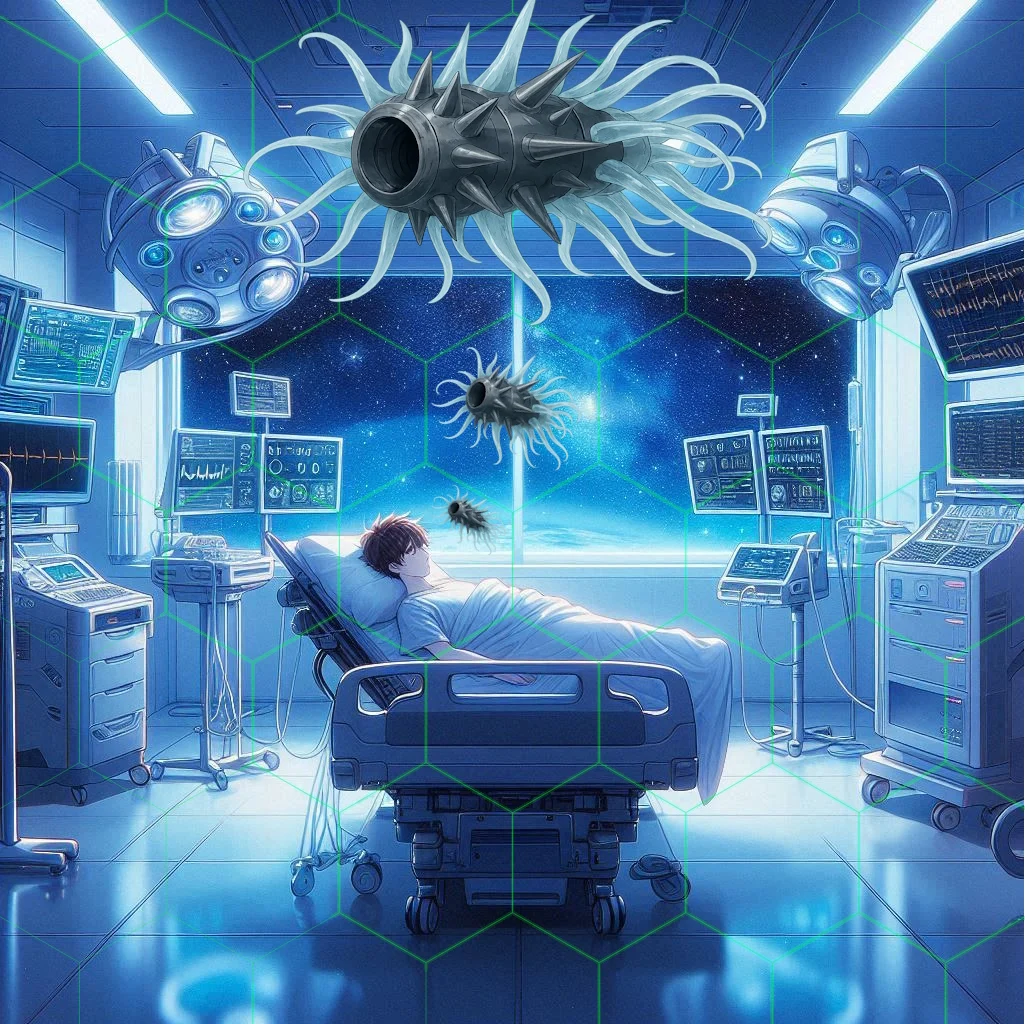
A tale on the distant future, almost post-civilization, about the state of a human mind, the near-immortal capacity of humans, and the tolerance of death. Can it be avoided? Yes, but it’s not how you think…
Bacterial colonies bloomed like a field of peonies. Spiky spheres and jagged clusters floated in the reddish murk. Tadpole-like shapes butted against the barricades of cellular debris.
“Everything’s fine,” the doctor said cheerfully. “Good for five hundred years!”
It was an exaggeration, of course. Fifty was more like it.
Staring at the screen, Anton felt a surge of strange pride at the complexity inside his own body. He was just an ordinary, boring guy, he often told Ava. You want to be boring; she would fire back. You are special! We all are! He never believed it. But now, observing the alien ecosystem swarming in his blood, he suddenly decided that perhaps she was right.
“What is this?” he asked the doctor, pointing at a creature that resembled a spiky rotating cylinder with a bouquet of transparent tentacles surrounding each hollow end. The doctor responded with a Latin name that barely registered as Anton tried to follow the progress of the creature through a cloud of swollen red zeppelins. One of them unfolded like a flower and enveloped the cylinder that butted against the walls of its translucent prison.
“Is it supposed to be that way?” he asked anxiously. Somehow, the creature had become special to him and he did not want it to be devoured by the cellular jungle in his arteries. He tried to stop the assault. Of course, nothing happened. His mind was barred from the microworld inside by the unbreakable barrier of scale.
I am paralyzed, he thought. I can’t control my body.
Paralyzed? That was an old word. He tried to remember whether he had ever known somebody with such a condition.
He thanked the doctor and walked outside. It was already dark, the sky, freed of the light pollution of previous ages, was sown with stars. Anton looked up, a shadow of unease hovering at the edges of his mind.
He had wanted to be an astronaut once, hadn’t he? He could not quite remember after the treatment, but it felt right.
There were no more astronauts. Space exploration had ceased long ago, after the Crash that had reduced the population to millions instead of billions. People of the Age of Waste had tried to escape the scene of their crime as the planet burned. Life had been cheaper than plastic. Now it was different. He had been given the gift of life. What did he care about the yawning emptiness among the stars?
But even though the rejuvenation treatment had been, according to the doctor, successful, Anton felt bloated and shivery. It was as if something had taken root inside him that both was, and was not, himself. He could almost trace the sinuous paths of tailored phages and bacteria in his body that were delivering packets of DNA to his cells, preventing the deterioration of his cellular chemistry, and gluing back the snipped-off telomerase ends. Could he really? The sensation was vaguely familiar. It was not the first time…it was…never mind.
His comm bracelet trilled, and Ava’s face floated before him. He sighed, ready for another onslaught of worn-out emotions. He still loved her, he supposed. It was just that after many decades of a dying marriage, each contour and wrinkle of this relationship was as familiar to him as a pair of worn-out slippers, ready to be tossed out.
Her chestnut-colored eyes glistened with tears. When he concentrated, he could see how beautiful she was. She must be the same as the day they had been married. He wished he could remember their wedding.
“Davis is gone,” she said.
“Gone where?”
Davis was their son. Anton did not remember when he had seen him last, but that was not unusual after a treatment.
“Gone,” she repeated. “As in dead.”
The image blinked out and Anton was left gaping as the ancient word, resurrected from the Age of Waste, suddenly claimed relevance to his own life. People did not just die! Euthanasia was a long process, prepared in advance, so the client had the time to put their affairs in order, say goodbyes… Surely, Davis would not be so inconsiderate as not to inform his own father!
As he was trying to wrap his head around it, it suddenly came back to him where the familiar/unfamiliar sensation of being inhabited came from.
This was how Ava had described her pregnancy in that long-ago misty age when she carried her only child.
During his train ride, Anton stared into the rain-slicked window and tried to muster some regret for the passing of Davis. He could not. Death just did not seem real. It felt rather as if Davis had embarked on some prolonged journey. It was a strange thought because Anton did not believe in an afterlife. Nobody did. People who had clung to their religion and refused the rejuvenation treatments were long gone. Euthanasia was for those whose treatments had failed and who would be now subjected to the ravages of aging that society had neither the means nor the inclination of coping with. Had it happened to Davis? But how? He was younger than Anton and must have had fewer treatments. The rumor was that their efficacy petered out after the fifth cycle, but nobody knew for sure. The medical guild was tight-lipped about it and nobody remembered how many treatments they had had.
Ava was waiting for him by the decrepit station building, her black-clad figure lost in the lush vegetation that was encroaching upon the empty platform. Few people traveled today. Tourism was a horror story from the Age of Waste.
Ava looked different; grief obscuring her face like a veil, making her mysterious and suddenly desirable. Something dark brushed the edges of his mind: not a memory, but an empty aching presence where a memory had been. He reached for her, but she turned away and slipped down the platform onto the overgrown path, the shaggy tresses of kudzu vines falling onto the splintered pavement. Spindly wind towers rose above the trees, but it was quiet, butterflies flitting in the drowsy sunshine. The address was in a wind-and-solar commune called Windstar, but when he checked it on the map, he was surprised to see it was on the outskirts of an abandoned Age-of-Waste city called Atlanta. Most cities had been reclaimed by now, but there were still fields of concrete shards and forests of steel skeletons hidden among natural ecosystems.
“How is it legal?” he asked when they were wending their way among heaps of broken stone and glass. A flock of birds shot out of the empty shell of a building on their right, their wings whirring in the blue sky.
“I don’t know,” she said flatly.
Anton frowned. Legal issues were negotiated among different communes, though there were basic guidelines for all. Most people navigated their lives by deeply ingrained, though shadowy, memories: faded maps of permitted and forbidden. But for some reason, Anton’s map felt useless now.
“Perhaps we should not…” Anton started to say, but Ava went on and he followed, resigned. Now the trees fell away, and Anton was surprised to find himself among intact buildings constructed in accordance with the universal architectural guidelines – one story, wood-cladding, solar roofs. He could be in any commune, including his own, except that the buildings were surrounded by unkempt patches of tough grass instead of vegetable gardens. Ava dove into a doorway without consulting her bracelet map, which indicated to Anton she had been here before.
The man who met them inside was slight, with a honey complexion and opaque eyes. He and Ava exchanged familiar nods that made Anton feel excluded and resentful. So, he attacked.
“What did you do to my son?”
“Nothing he did not want us to do,” the man said smoothly, while Ava lashed out at Anton:
“It’s not like you had much use for our son when he was alive!”
“You can’t be a hovering parent for…for…all these years,” Anton stuttered. The man smiled:
“I am Sanjay,” he said. “And your son is not dead. Please follow me.”
Inside the building, there were more people: men and women sitting at old-fashioned terminals. Anton looked at them curiously.
“What’s your energy?” he asked. “Hydro, solar, or wind?”
“Wind mostly. But we have salvaged some pretty effective batteries from the city. We need a constant power supply. Life support.”
That was an oxymoron: life supported itself. But before Anton could point it out, Sanjay led them into another room. It was windowless, but a screen wall filled the space with a crimson glow.
Anton started at the familiar sight. He recognized the darting tadpole bacteria, the lumbering spiky colonies, the luminescent phages shaped like a space vehicle with an octagonal head and strut-like legs. The same alien zoo that swarmed in his own blood.
“This is your son,” Sanjay said.
They were silent as they sat in the dining room of the Windstar commune, reluctantly sharing late dinner. Few people were around, and Anton was glad; he was still reeling from what Sanjay had told him.
“Even if it’s true,” he finally said, “the process is irreversible, so Davis is…dead. Maybe…maybe we can apply for a new child?”
Ava glanced at him; her eyes darkened almost to black by candlelight.
“You said our marriage was over. Done.”
“Yes, but…”
“Davis was my baby. I want no other.”
Baby.
He tried to picture himself holding a tiny wet package of new life. The mind obeyed, as it always did, producing a happy image that Anton knew he had seen it in some vid-drama.
“It must be illegal,” he insisted. “The authorities will be after us. They’ll think we allowed it.”
“What authorities?”
“The commune council,” Anton said feebly. Ava scoffed.
What was wrong with him? Even if Windstar outlawed what Sanjay was doing – and Anton had no idea whether that was the case – there surely would be another commune where it was legal. But there was inchoate fear in his mind, collecting in the empty spaces of lost memories like stagnant water in the cellar.
Fear of…he did not know. He stooped over the dark water in the cellar and saw it illuminated with lurid flashes.
“Ava,” he asked, “how did we meet?”
“There was a fair,” she said listlessly. “I was wearing a white dress. There were flowers, and candles, and wine.”
He remembered it. A white swirling dress, a red stain of wine he had inadvertently spilled, his mortified apologies, her laughter…
His brain was obligingly creating moving pictures out of her words. Confabulations. Simulacra. He knew they were not true. But the more he strove to brush them aside, the more annoyingly real they became.
It was not a secret that rejuvenation treatments played havoc with your memory. People were warned to write down important events and connections in their lives. Total amnesia was rare, but gaps were common. Anton used to be mildly miffed about it. He felt that something was being taken away from him with each rejuvenation, and even though he still retained the basic coherence of his personality, he wanted to have his past back – useless and inconsequential perhaps, but his.
But now, he suddenly realized the past did not matter. There was something else hiding in the occlusion of his memory, some lost intensity, as elusive as it was compelling. A fire that cast the shadow.
Had Davis felt the same? Was that what it was all about?
He could not sleep. The conversation with Sanjay kept replaying itself in his head.
“We developed the technology to encode personal information on strands of bacterial DNA. A personality transfer. The information that was your son is here, in his own blood culture.”
“Are you saying my son is a bacterium now?”
“A swarm of them. The information is distributed among multiples. They communicate by tailored RNA packages. In effect, your son’s brain is a tank of colloidal liquid. His character traits are bacterial strains that interact, reproduce and mutate to create the dynamic gestalt of his personality. He is a microcosm. A world.”
A world.
“Why?” Ava had asked. Sanjay had glanced at her.
“I told you.”
“I know. But I still am not sure I understand. And Davis’ father is here. Tell him.”
“This is an extension of the rejuvenation technology,” Sanjay had said. “But rejuvenation fails after five cycles. This won’t. Bacteria are immortal.”
“Is it still Davis there?” Anton had asked, pointing at the busy swarms of petaled hydras and multi-tentacled blobs. Sanjay had smiled.
“It’s a philosophical question. We don’t know what it is like to be a swarm of submicroscopic creatures living in your own blood. But this is what your son wanted. Not knowing.”
He had been calling Ava for days with no answer.
After they came back from Windstar, she declared she was moving to a hydro commune a hundred miles away. Her guild had approved the move, and since she and Anton had not been living together for several years, he hardly had any reason to object. At least she left him a message.
But now, this message became a source of frustration as he replayed it again and again, Ava’s face hovering over his bracelet like a wisp of smoke.
“We shouldn’t be alive. None of us. Davis knew.”
And that was that.
Davis knew what? That there should be no rejuvenation treatments? There had been some opposition at the beginning, Anton believed, but it petered out. There was no rational basis for it. The planet was still empty, the Crash having disposed of billions, so it was not like longevity threatened to bring back overpopulation and all its ills.
War. Famine. Plague.
He should remember the Crash. He had lived through it, as had Ava. Anton dug into the shadows in his mind, but all he could bring up were cartoon figures, as flat and uninspiring as cutouts at a commune fair: War with a big rifle; Famine with a scythe; Plague with a test tube. Symbols of the events too terrible to remember in all their gory details: a painted veil over PTSD.
He could not understand why Ava said they should not be alive. He knew about survivors’ guilt. But Davis was not even born until after the Crash. Surely, life was the ultimate value!
He went back to Windstar, using all of his social credits for the second train ride in as many months. The train was as empty as before, and when he disembarked, he almost expected to see Ava’s silhouette in the shadow of the trees. But she was not there. He followed the familiar path through the woods, glancing at the wind towers as if people in the commune might see him and suddenly jump out of the undergrowth, barring his way. But he met nobody, and all was normal.
Until he came to Sanjay’s lab complex and stood there, gaping at the blackened ruins.
He poked through the charred remains with a stick. But there was nothing: not even the melted computer modules or remnants of glass tanks he had expected to find. The site had been swept clean. It looked like Age-of-Waste ruins rather than something that had been a functioning facility only a month ago.
Anton turned away, disappointed, but vaguely relieved as well. His old life beckoned him back: the comfortable twilight life in which he had almost forgotten he had a son.
A figure stepped out from behind a tree.
Anton started until he recognized Sanjay. The man’s olive skin was stippled with crisscrossed ridges of darkness and his eyes were bloodshot. Anton backed off, looking for a sturdy branch.
“It’s not a disease,” Sanjay rasped. “Just an allergic reaction. It will go away.”
The man’s self-absorption in believing that his altered appearance would be the first thing on Anton’s mind made him angry.
“Where are my wife and son?” he barked at Sanjay, forgetting the social rules of harmonious interaction.
“Here,” Sanjay jabbed at his dappled forearm. “Your son, that is. Your wife…I don’t know. The security guild torched my place. They are not supposed to arrest citizens, but they may have taken her. When the truth is out, rules don’t apply.”
The world tilted and whirled around Anton, so much so that he had to grasp a blackened beam to steady himself. It left an ashy imprint on his palm. He looked at it.
It had been there before. His hands, dappled by soot, scorched by fire, smelling of the acridity of embers and the metallic stench of blood. He did not remember it, but his body did.
He lifted his eyes and met Sanjay’s. They were glazed with fear and exhilaration.
“Your son is here,” he repeated, padding his swollen flesh. “The rest are…gone.”
“Here?”
“I injected myself with your son’s colloidal suspension,” Sanjay said.
Sanjay led him to his hideout in the city ruins. Anton shuddered as he gingerly stepped onto the dead pavement. Heaps of broken glass and eroded metal were covered by the lush exuberance of vines, but here and there man-made objects bloomed among the undergrowth like strange orchids: a holed pot embedded in moss and a plastic handle poking from an anthill. Anton tugged at it, but it was buried too deep.
“I tried to scavenge,” Sanjay remarked. “It’s too old. Useless.”
Did his intonations sound familiar, Sanjay’s liquid vowels overlaid with Davis’ brusqueness?
“So, are you Davis now?” Anton asked.
Sanjay shook his head.
“Not yet. The brain-blood barrier still holds. But not for long. Yes, eventually I will be Davis. And Sanjay. And others. All those whose memories had been stolen.”
“What do you mean?”
“Do you remember the Crash?” Sanjay asked.
“I was a soldier,” Anton said grimly.
“We all were. All who survived. Because we were the only ones to have been vaccinated. The universal vaccine – developed to protect against all bioweapons. It worked too well. It’s still working, keeping the bacteria and phages in our blood in check, allowing them to keep us young and healthy, but no more than that.”
“What do you mean, ‘no more than that?’”
Sanjay squeezed through a narrow doorway into a large space inside that was lit with fluorescent glare and contained a couple of terminals and some electronic equipment. Anton realized Sanjay must be stealing power from Windstar. Frustrated, he grasped the other man’s shoulder, jerked him around. His own aggression shocked him.
“Talk to me!”
Sanjay sighed.
“The last plague they released in the last war was meant to wipe memories clean. To reset the brain. But it did the opposite. It encoded people’s memories, identities, and desires in bacterial swarms. For everybody except us. The soldiers, the vaccinated ones. We were affected too – this is why our memories are so faulty. But the phages could not kill our enhanced bodies, only reset them. And here we are – stuck in-between, dragging out our leftover lives. Going through cycles of rejuvenation that only bring us back to what we are.”
“So, the rest are dead?” Anton whispered, awed and sickened in equal measure.
Sanjay shrugged.
“What is death? Now, help me move this box.”
Anton drank the salty liquid that tasted of seawater and bleach. Sanjay was monitoring his vital signs on the jury-rigged monitor.
Working together for the last couple of weeks, he and Sanjay had managed to reconstruct the lab by stealing batteries and supplies first from Windstar, and then from other communes around. Stealing felt like a physical violation to Anton; he had to force himself to do it. The post-Crash years must have changed him from the mercenary he used to be. He asked Sanjay how long their society had existed, but Sanjay could only give an approximation: two hundred years, give or take.
And how long had it been for the others – those who swarmed in his blood, floated on motes of dust in the air, broke species barriers and colonized mice in their burrows, and butterflies dancing in the air? What was time in eternity?
At night, he would lie in his narrow bunk, close his eyes and imagine himself fighting the creatures in his own blood, targeting them through the laser scope on his microscopic rifle, creeping through the philia growth, hiding in the cytoplasmic trenches. Yes, he knew how to fight, and to kill, and to survive. Obsolete skills, useless where he was going. Or perhaps not.
He could not retrieve most of his memories, but some did come back in sharp fragments like a broken china set he had found in the forest. He remembered now how he had met Ava. No party, no sunny lawn and white dress. A ditch, a torn uniform, blood on her shoulder. He took her to his encampment, ripping off and tossing away the insignia of a forgotten enemy. Davis was conceived that night.
“There is still time to go back,” Sanjay said.
Anton shook his head.
“So, I will be…inside myself?”
“You will be in the microworld. Chasing your own memories. Fighting, perhaps, with others that are trying to take over. Or maybe merging with them. Exploring.”
Anton nodded. Yes, he had wanted to be an astronaut. Before he became a soldier. When civilization had tottered on the brink, choosing between transcendence and self-destruction.
“Transcendence,” Sanjay said, as if reading his thoughts (as perhaps he was, his son’s distributed consciousness reaching out to him across the barrier of the other man’s skin). “You can call it by any other name: curiosity, lure of the unknown, even death wish. But this is what it is.”
“I think you are making it too complicated,” Anton said. “I wanted to be an astronaut. But they took my dream away from me and made me a soldier. But even a soldier has choices. And then they took choice away from me too, and gave me safety instead. But I am a man. I want my decisions back, even if they are wrong. I want my memories back, even if they are painful. And I want my future back, even if it is dangerous.”
“Being just a man, is it enough?” Sanjay asked.
“Not anymore. But I am going to be something else now, won’t I?”
“’To see a world in a grain of sand’. William Blake.” Sanjay said.
“No,” Anton said. “To be all the grains of sand on all the beaches in the world.”
Anton’s head was pounding, the drug taking effect. His mind and body were slowly unraveling, falling into a heap of memories and sensations. Somewhere there, he knew, was a memory of his son as a baby, the memory of his love for Ava, the memory of himself in his mother’s arms. He tried to imagine each memory embodied in a separate microorganism, all swimming in the red universe, searching for missing pieces, coming together in the lost unity of what used to be Anton, and then separating again. Shards of himself, falling into an infinite constellation of possibilities, forever…
Sanjay was still saying something, but Anton was no longer listening. He was falling into the infinity of himself, straining to hear the faint voice of the submicroscopic gods, calling to him from the lengthening silence between his heartbeats.
END



Recent Comments