The Robot Wars Began As A Simple Rivalry Between Pulp Magazine Publishers
It is 1929 and Hugo Gernsback has lost his publishing empire to bankruptcy.
From the New York Times, February 21, 1929. (Underline added)
Later that same year he returns with competing magazines from a new publishing company. In one of many tactics used to market his new publications, Gernsback introduces the “Bedsheet-plus-pillowcase” magazine format. The size of the format causes it to display prominently on newsstands, towering over other titles and requiring nearly two spaces on the racks.
Not to be out-done, his rival (his own former publication) soon thereafter introduces the “Kingsize Bedsheet Format”, edging out Gernsback’s space dominance by a couple of inches in each dimension.
By 1932 the two competing publishers had reached the limits of possible expansion: distributors refused to deliver magazines in bulk that could not easily fit through standard doorways and that would have required them to nearly double their fleets of delivery trucks. (Besides, they were also running up against the limits of the presses themselves.)
Then readers complained. Initially, fans had reveled in the over-sized publications as offering them more content per issue, but this praise gave way to claims of hernias, cricked necks, broken coffee tables and a host of other issues.
Ever the technological optimist, Gernsback’s Stellar Publishing Company introduced the Robomag: a robotic assistant that would carry your magazines, hold them for reading and turn pages upon request.
Gernsback’s competitors were quick to respond. His rivals at Teck introduced “Newsboy”; it not only replicated Robomag’s capabilities but would also pick up your magazines at a designated newsstand, provided, of course, that you had trained it in the location and its money hopper was filled with the correct change.
This latter innovation soon proved to be a problem as street thieves quickly learned that they could get Newsboys to hand over their change by telling them that the newsstand’s location had changed, while holding up a bit of cardboard in front of its sensors on which “Newsstand” had been scrawled .
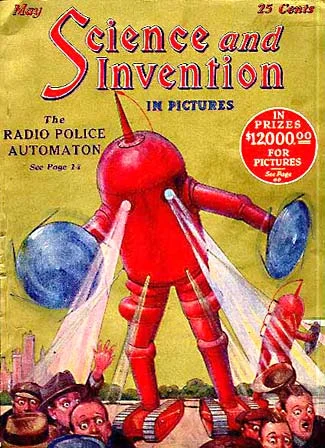
Naturally, Gernsback sought to take advantage of this situation and used it to cajole the New York City Police Department to place an order for a dozen of his Radio Police Automatons.
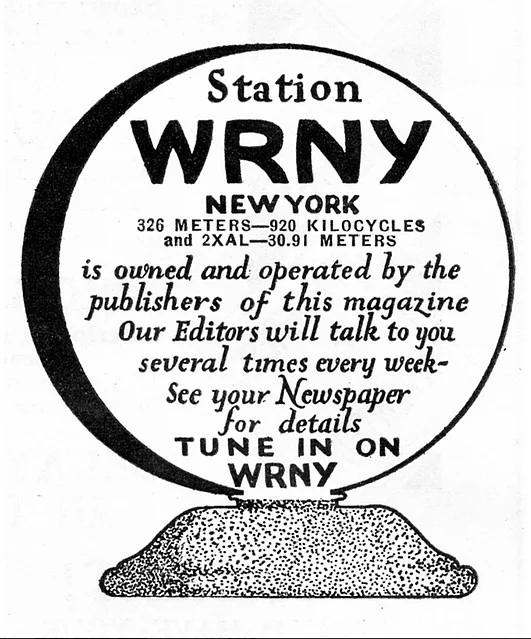
Unknown to anyone but Gernsback, his Radio Policeman’s controls could be over-ridden by instructions beamed from his radio station headquarters atop the Empire State building.
Although never proven, it has long been suspected that the Radio Police Automatons were responsible for attacks on rival publishing concerns, printers and distribution networks that serviced Gernsback’s competitors during this period.
And lets not forget the magazines themselves. By this time printing technologies were responding to the demand and constructing presses capable of processing jobs using platens up to thirty feet by fifty feet in size.
Of course this required that all manner of other technological innovations be introduced to support the creation, production and delivery of such over-sized publications. Gigantic scaffolds supporting multi-story sized canvases for cover illustrations were frequently seen in Central Park, one of the few areas large enough to support such things.
Things were going apace; giant airships now crossed the skies, slung below them a pallet capable of blotting out the sun.
Entrepreneurs shipped copies overseas, offering single leaves as temporary housing for refugees in war torn Europe. Communists protested their presence as blatant examples of capitalism’s excesses. Although representing the epitome of publishing technology, there were problems attendant as well, such as the city wide blackout that occurred when the cables of a delivery pallet broke from metal fatigue and the entirety of Manhattan was buried under the windblown pages of the New York Times.
And then Clayton Magazines introduced the positronic robot brain – a robot capable of learning and mastering new tasks without having to be programmed. A robot brain that could be placed into any number of different types of mechanisms, including the so-called “Watchdog”, or JWC-II model, designed specifically to locate and destroy Radio Police units.
Gernsback was quick to respond with a number of different innovations, each designed to counter the Watchdog units in one fashion or another.
Please take a moment to support Amazing Stories with a one-time or recurring donation via Patreon. We rely on donations to keep the site going, and we need your financial support to continue quality coverage of the science fiction, fantasy, and horror genres as well as supply free stories weekly for your reading pleasure.
https://www.patreon.com/amazingstoriesmag

Unknown to anyone but Gernsback, his Radio Policeman’s controls could be over-ridden by instructions beamed from his radio station headquarters atop the Empire State building.
Although never proven, it has long been suspected that the Radio Police Automatons were responsible for attacks on rival publishing concerns, printers and distribution networks that serviced Gernsback’s competitors during this period.And lets not forget the magazines themselves. By this time printing technologies were responding to the demand and constructing presses capable of processing jobs using platens up to thirty feet by fifty feet in size.Of course this required that all manner of other technological innovations be introduced to support the creation, production and delivery of such over-sized publications. Gigantic scaffolds supporting multi-story sized canvases for cover illustrations were frequently seen in Central Park, one of the few areas large enough to support such things.
Things were going apace; giant airships now crossed the skies, slung below them a pallet capable of blotting out the sun.Entrepreneurs shipped copies overseas, offering single leaves as temporary housing for refugees in war torn Europe. Communists protested their presence as blatant examples of capitalism’s excesses. Although representing the epitome of publishing technology, there were problems attendant as well, such as the city wide blackout that occurred when the cables of a delivery pallet broke from metal fatigue and the entirety of Manhattan was buried under the windblown pages of the New York Times.And then Clayton Magazines introduced the positronic robot brain – a robot capable of learning and mastering new tasks without having to be programmed. A robot brain that could be placed into any number of different types of mechanisms, including the so-called “Watchdog”, or JWC-II model, designed specifically to locate and destroy Radio Police units.Gernsback was quick to respond with a number of different innovations, each designed to counter the Watchdog units in one fashion or another.The robot wars had begun.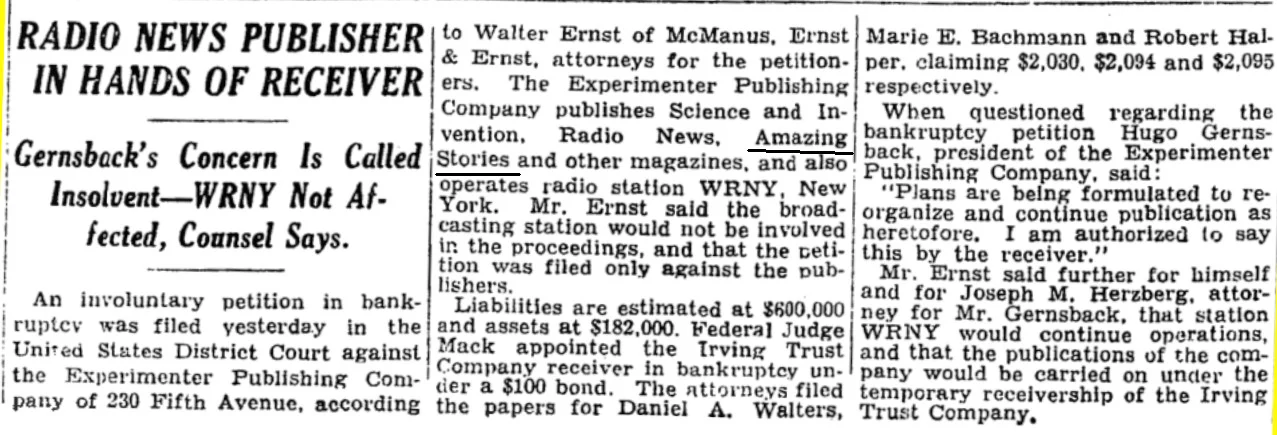
 Unknown to anyone but Gernsback, his Radio Policeman’s controls could be over-ridden by instructions beamed from his radio station headquarters atop the Empire State building.
 Of course this required that all manner of other technological innovations be introduced to support the creation, production and delivery of such over-sized publications. Gigantic scaffolds supporting multi-story sized canvases for cover illustrations were frequently seen in Central Park, one of the few areas large enough to support such things.