The title of this piece draws upon a quote from Chandler’s most storied character, Commodore John Grimes, former officer of the Interstellar Federation’s Survey Service (secretly still a reserve officer, intelligence branch), private (space) ship captain and more recently the Astronautical Superintendent of the Rim Worlds Confederacy Navy1.
The quote draws upon Grime’s early career, first as an ensign and later as a Captain in the Survey Service, and is his long-standing commentary on the inevitability of official orders. Fortunately for Grimes and Chandler’s readers, the going is fairly easily accomplished, as Chandler saw fit to populate his future with not one, not two, but three different Faster-Than-Light drives.
Grimes himself is even responsible for championing the development of one of those drives during his time as Astronautical Superintendent of Rim Runners, the merchant fleet of the Rim Worlds Confederacy, an independent group of worlds that have broken from the Federation.
 However, I think a brief review of the history of the Rim Worlds universe is in order first.
We’re not exactly sure when that fictional history departs from our own (though it is very clearly meant to depart from our own reality), as Grime’s own personal history relates “Unfortunately, it is impossible to paint a detailed picture of Grimes’ childhood, as many records were destroyed during the Central Australian Subsidence of 375 AG. It is known, however, that he was born in the city Alice Springs on Primus 28259.” (John Grimes Autobiographical Notes, Marcon XIII Program Book, 1978)
There are hints of some future apocalyptic event, which eventually gives rise to both Russian and Australian Empires and eventually some form of world government that goes on to establish interstellar travel and the founding of numerous colonies prior to the advent of faster than light technologies; sleeper ships are mentioned in passing, as is a “first expansion”. (Woomera is one of the Federation’s primary space ports and Federation bases. I therefore prefer to believe that the Australian Empire eventually came out on top…)
However, at some point the “Ehrenhaft Drive”, the “gausjammer” (windjammer is slang for wind-powered sailing ships) is developed and a Second Expansion begins, this time at FTL speeds.
Felix Ehrenhaft was an Austrian physicist (in our own timeline) of some note, contributing to atomic research into the measurement of electrical charges, which makes sense because the Ehrenhaft Drive is described as turning the ship into a magnetic particle that travels along the tramlines of magnetic force between the stars.
A physicist Chandler was not. (Though astronomers have fairly recently discovered that there is a “cosmic web” connecting stars in our galaxy.)
A Science Fiction author he was. (Though astronomers have fairly recently discovered that there is a “cosmic web” connecting stars in our galaxy.)
Chandler did what good SF authors do: came up with a concept that was somewhat scientifically plausible and then examined its implications. In the case of the Ehrenhaft drive:
“…a gausjammer runs into a magnetic storm and is flung away to hell and gone off trajectory, with as like as not a dead pile and no power for the flywheel and the Ehrenhaft jennies. Nobody has a clue as to where she is, but they start up the emergency diesels, get the Ehrenhaft drive working after a fashion and carry on until they stumble upon a habitable planet, if they’re lucky. If they aren’t…” – Rendezvous on a Lost World.
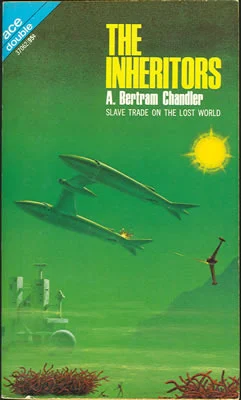 The same novel relates that “Lost Colony” stories are apparently very popular fare, featured in books and films. Research suggests that there are thirteen that are known of, many of them featuring in later Chandler tales, including Spartan Planet, The Inheritors, The Big Black Mark, The Far Traveler and the non-Grimes centered Rim Worlds novel, The Rim of Space* (Derek Calver), and, as one might expect, they afford the author an opportunity to explore how such isolated colonies can deviate from the human norm. As revealed by the titles listed, a fair number of those lost colonies are rediscovered by Grimes himself.
The “Gaussjammer” era of interstellar expansion lasts a sufficient time for the sector of the galaxy containing Sol system to be fairly well colonized, but at some point Chandler must have realized that such an FTL drive was pretty thin on the science and chose to invent another drive – The Mannschenn Drive.
It’s a pretty nifty concept and works by “Moving the ship ahead in space while moving backwards in time”. A “Time jammer”, if you will
Notably, Chandler may have been the first science fiction author to suggest this concept. Award winning author and physicist, Dr. Geoffrey Landis, who compiled a list of fictional FTL drives a number of years ago listed this particular type, but was unaware that Chandler had conceived of it decades earlier. (The “Landis List” can be found on the Project Rho website.)
The Mannschenn Drive is not without its own set of quirks. Playing with time can lead to playing with alternate realities. One character describes what it is like in Catch the Star Winds – “…for the benefit of those of you who have never experienced this latter, is that it is somewhat hard to carry out normal shipboard duties when you’re not certain if it’s high noon or last Thursday.” Getting caught within the drive’s field (described as being generated by three precessing Möbius loops arranged at right angles to each other) can cause a person’s body to invert; a skipping drive can lead to the repetition of events…can lead to the repetition of events…can lead to…and can strand a ship in the far future, the far past or “somewhere” else. A persistent sense of Deja Vu is a clear indication that the drive is malfunctioning.
The Mannschenn Drive is used in every John Grimes story that includes FTL travel, as Grimes was born following its advent, while the Ehrenhaft Drive is usually only a passing reference in a handful of stories, such as The Cage, The Left Hand Way, Sisters Under the Skin and one novel – Rendezvous on a Lost World (When the Dream Dies). In that story, both the Mannschennan and Ehrenhaft drives are contemporaneous, as an ED equipped ship from a lost colony finds its way to a Federation world decades, perhaps centuries after getting lost and is purchased and refurbished by a handful of daring adventurers. The “MD” is itself the cause of much Rim Worlds adventure as its malfunctions often send Grimes, crew and ship off into precarious situations.
It was also used by the author to provide a circular conclusion to the John Grimes stories. In The Way Back we learn that the history of our universe is cyclical. Having previously been flung into the far future by a malfunctioning drive, Grimes, with some help from the mystical saurian inhabitants of Stree (a Rim World), the Mannschenn Drive is used to advance the ship through the cycle until it rolls back around to Grimes’ own time.
Which brings us to Chandler’s third and final FTL creation, the Erikson Drive.
Admittedly, the Erikson Drive is the hokiest of all of Chandler’s drive concepts, as it involves accelerating a ship once it has reached 99 point 9 – unlimited decimals – percent the speed of light, initially achieved with solar sail acceleration.
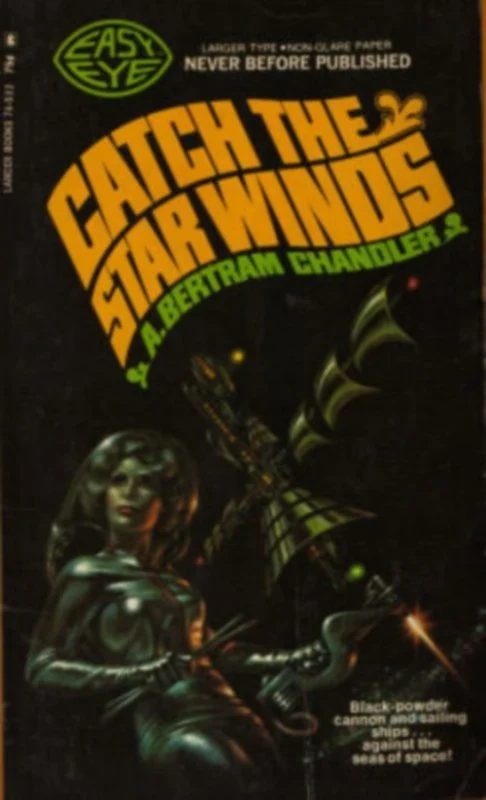 Chandler was really diving back into the days of wooden ships and iron men with this drive, as a cannon is used in one instance to provide that final push (The Winds of If, To Catch the Star Winds), and I suspect he knew he was a bit out on the edge, given the title he chose for the story. He also chose to name the first “Sunjammers” in the new fleet after historically significant sailing ships – Flying Cloud, Pamir, Cutty Sark, Herzogen Cecile, Sea Witch, Lord of the Isles.
Chandler wrote most of the Grimes stories that involve Grimes as Astronomical Superintendent of the Rim Worlds Confederacy Navy, the latter half of the character’s career, early in the author’s writing career and the ones featuring Grimes as a Federation Survey Service officer (early career) later in the author’s life (much like Forestor’s treatment of Horatio Hornblower, on which it is said much of Chandler’s work is modeled), so perhaps he can be forgiven this bit of fancy.
The development of a solar sail powered sailing ship of space was engendered by the discovery of the “anti-matter worlds to Galactic West” of the Rim Worlds Confederacy. Under Grime’s tutelage, the Rim Worlds Confederacy (which recently broke away from the Federation) is seeking to expand its trade. A cluster of worlds is discovered, but trade is impossible as they are all formed from anti-matter.
However, tests of the Erikson drive had revealed that when a ship employs the drive, its’ “polarity is reversed”.
Based on this happy discovery, Grimes champions the drive’s further development.
It is only discovered later that use of this drive can also shunt a ship and its contents off into alternate realities2, such as one in which mutated rats have taken over the Rim Worlds, or one in which Rim World’s society is a matriarchy (of the “we’re gonna do to men what men have been doing to women” variety).
Regardless, the Erikson drive offers the RWC an advantage over the Federation whose rule they were beginning to chafe under, and offered Chandler an opportunity to continue playing with the consequences and foibles of living on the edge of the galaxy, where reality grows thin.
***
Note:
*The chapters detailing a very unusual lost colony in The Rim of Space only appear in the Avalon Books edition; the Ace Double edition omitted a couple of chapters in the interest of length.
*The Bertam Chandler website has a “Before Operating the Mannschenn Drive” post, written by yours truly, that details these hiccups in a humorous manner.
1 In point of fact, John Grimes has had the following titles: Lt. Commander, FSS; Master, Private Yacht; Commodore, El Doradan Privateer Fleet; FSS Planetary Governor; Owner/Master, Far Traveler Couriers; (unwilling) Consort to Shaara Queen; Captain, FSS Naval Reserve; Commodore Rim Worlds Naval Reserve, Astronautical Superintendent Rim Runners Merchant Navy.
2 This shouldn’t be surprising as FTL drives and transposition to “alternate timelines/parallel universes” is a regular theme in Chandler’s fiction, although such travels are also mediated by drugs, mysticism and dreaming as well.

Steve Davidson is the publisher of Amazing Stories.
Steve has been a passionate fan of science fiction since the mid-60s, before he even knew what it was called.