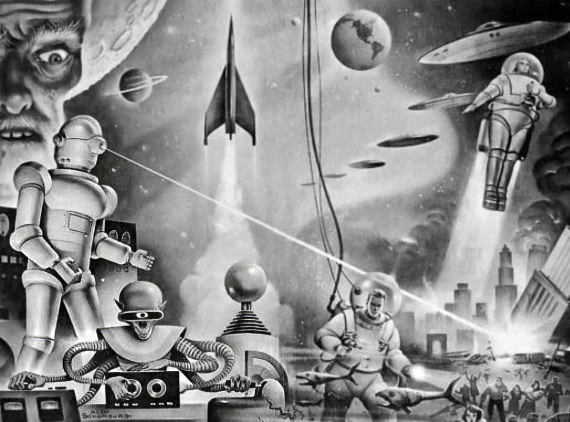
Back in 2014, I wrote a couple of columns about the John C. Winston company’s series of YA (then called “Juvenile”) science fiction novels. Although I touched on the covers, especially those by my late friend Alex Schomburg (and his marvelous endpapers, Figure 2), I’d like to show some more of the art that for me, and many youngsters like I was, symbolized the whole arena of science fiction and the possibilities of time- and space-travel, alien life, undersea living and mining, et cetera. Not only were the stories by some of the better SF writers (though, sadly, Scribners had all the Robert A. Heinlein juveniles), but Winston’s “stable” of artists included Virgil Finlay, Ed (EMSH) Emshwiller, Mel Hunter, and that master of the airbrush, Alex Schomburg. Because of time limitations, I won’t go very far into biographical information about these artists, though most of them actually deserve columns about them. The endpapers shown in Figure 2 were used in almost every Winston book, both at the front and the back of each book.
Though I’d been reading SF since I was about 7 years old, when I encountered the Winstons—that rocket on the spine (Figure 1) was one of the several things I always looked for in the library (there were several stock stickers that all libraries used for SF—one was a rocket similar to the Winston logo; another one was an atom); unfortunately, my best searches can’t find an example without going to an older library. So for this week’s column I thought I’d throw out a few examples of the covers with spines that I and thousands of young people read in the ‘50s and ‘60s, thanks to the John C. Winston company. Cover and spine scans courtesy of my late Everett (WA) High School friend, John H. Meeker, Jr. Since these are all scanned from John’s collection, they won’t all be pristine, so there will be varying qualities of covers. I will only show a few of the 37 covers, but a representative swath of them. I’ve done some minor cleaning up on most of the books.
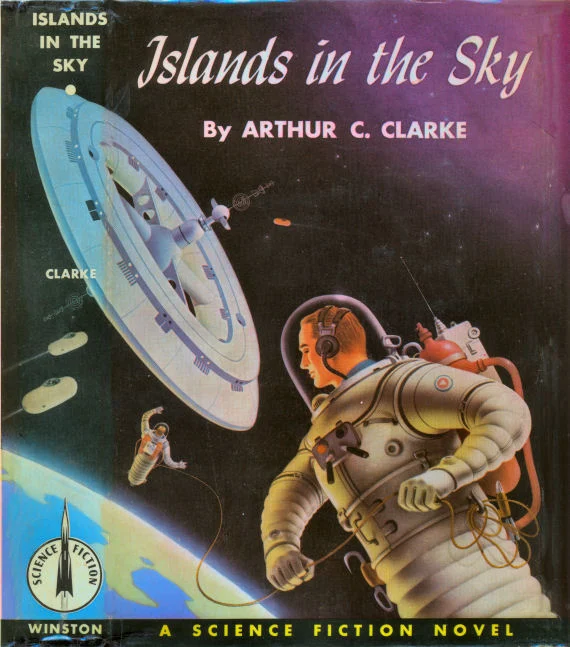
If you wish to know more about the books themselves, you can search the Amazing Stories site using the prompt “john c. winston”—the search isn’t case-sensitive—for those particular two columns I wrote in 2014. Figure 3 shows the cover for Arthur C. Clarke’s well-known book, Islands in the Sky; the cover is by Alex Schomburg. Alex was a comics artist in the 1940s (known for The Human Torch and Captain America, for two), who went into SF illustration when that became a big thing in the 1950s. I was fortunate enough to meet Alex when I spotted his name on a small poster for a comic convention in Portland; we became friends. Alex was, as I’ve said, a master of the airbrush. He was the most prolific of the Winston artists, doing about 20 of the covers. His smooth airbrush work and “flying saucer” illustrations are unmistakable.(If you wish to know more about Alex, look on Amazon for my late friend Jon Gustafson’s book Chroma: The Art of Alex Schomburg. It’s still available from third-party sellers.)
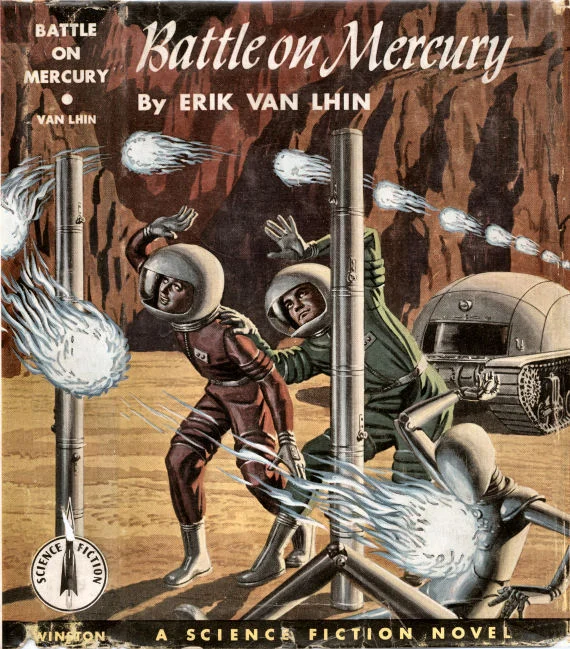
Kenneth Fagg did three covers for Winston, Figure 4 being the first (a pseudonymous st ory byLester del Rey). He was a well-known commercial artist who helped launch the nascent magazine IF in the 1950s; he was recruited by now well-known paperback cover artist Ed Valigursky, who was the art director for If at that time. You can see that the space suits and robot in this cover were typical of what people thought they would be; round helmets with a glassy port in the front and pressure relief joints at the elbows, shoulders, and knees. Fagg did a dozen covers for If, including several wraparounds that, in my opinion, are stellar (click link).
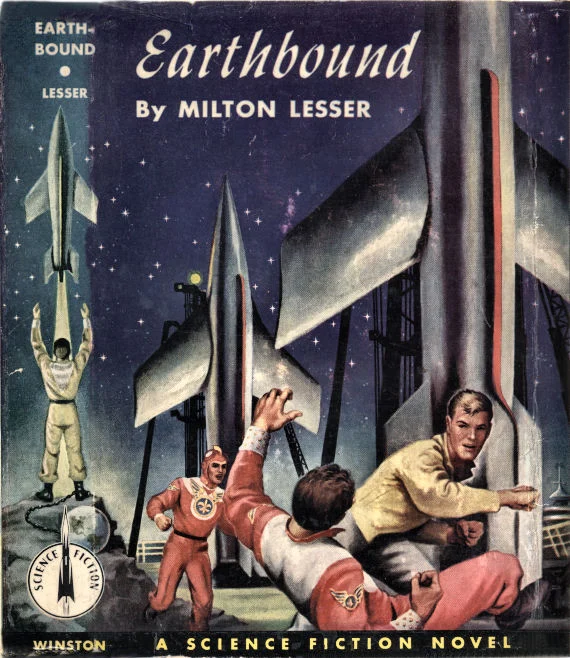
Another artist who did several covers for Winston was Peter Poulton. Little is known about Poulton besides the fact that he did many illustrations for “men’s” magazines. Unfortunately, I don’t have a copy of Jane Frank’s book about SF illustrators, so I don’t know much more. The original for this cover was sold in auction and can be viewed here. Other cover artists for Winston, who I will probably cover in a future column, were Paul Orban, James Heugh, Ed Emshwiller, and Mel Hunter (Figure 6).
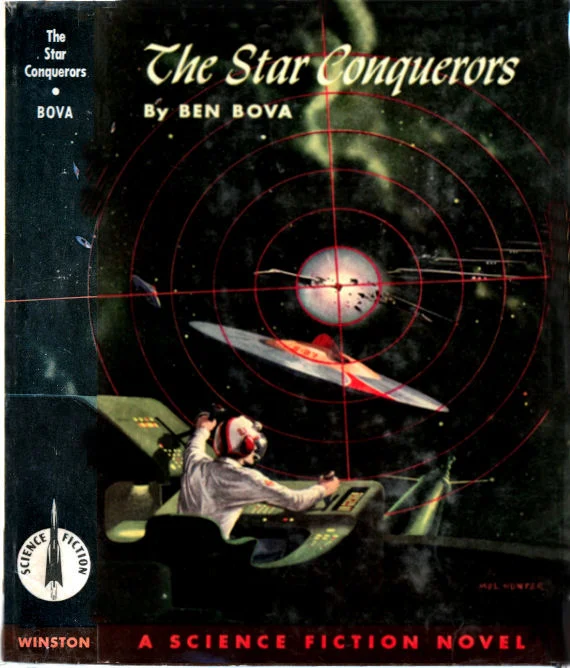
Mel Hunter was well known as a science fiction illustrator, though he only did two or three (I haven’t counted) Winston covers. Besides the one shown here, he also did Stadium Beyond the Stars by Milton Lesser (who also wrote as Stephen Marlowe in the mystery genre). I was fortunate enough to see the original of this on Dr. Alan E. Nourse’s (pronounced “nurse”!) wall during a visit to his North Bend, Washington home. (Coincidentally, Dr. Nourse was Avram Davidson’s physician, when Avram lived in North Bend. But I digress.) Hunter also did technical illustration for Northrup Aviation, among others; many will remember him for his many robot covers for The Magazine of Fantasy and Science Fiction, which he continued to do until the 1970s. Many of these involved a lone robot wandering the wasteland after a nuclear apocalypse. After his death, Hunter’s ashes were shot into space in 2012, according to his wishes.
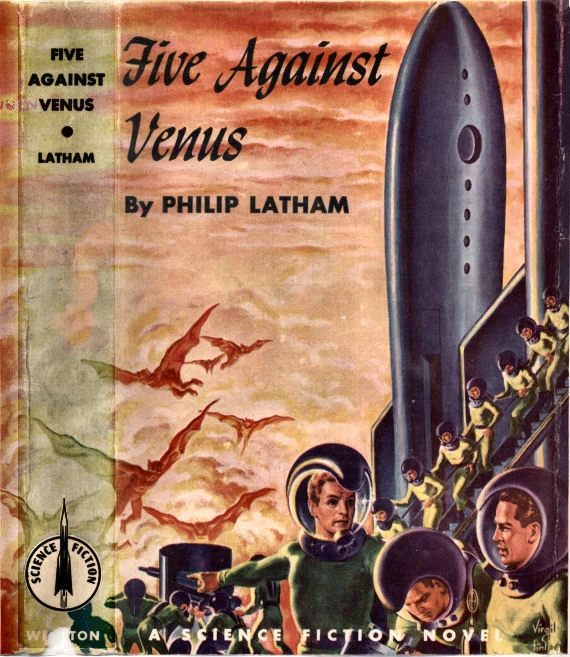
The cover in Figure 7 is notable for several reasons: first, because it’s a Virgil Finlay; he did comparatively few covers; secondly, it’s a colour cover—and Finlay worked mostly in black-and-white (a lot of scratchboard illustrations); and thirdly, because the “A Science Fiction Novel” tag was superimposed on the bottom of the illustration rather than being in a red ribbon at the bottom of the illo; even the art director of Winston (I’ve not been able to discover who that was) seemed not to want to cover any of Finlay’s art. This was the only cover Finlay did for Winston. The author of this book, “Philip Latham,” is a pseudonym of astronomer Robert S. Richardson, who also wrote Missing Men of Saturn (also a Winston). I assume he used a pseudonym to keep his SF writings separate from his astronomy career.
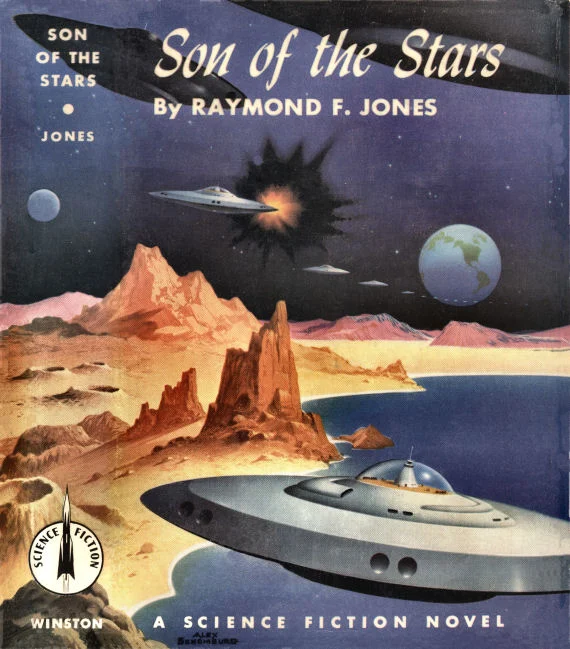
The last cover I’m going to show here is Raymond F. Jones’ Son of the Stars, another Schomburg creation. Here we can see Alex’s signature “flying saucer” spaceships and his smooth airbrush style. Some of Alex’s earliest SF work (as opposed to his comics work) was for Amazing Stories; and he continued doing covers for magazines, including Isaac Asimov’s Science Fiction magazine, until his death in 1998. He was an amazing person as well as artist.
NOTE: This column is in no way written, edited, proofed or composed by AI, though some of my photo editing software uses it in some capacity. This is a human column and will remain so.
I’d like to hear your opinion of this column. PM me, message me on Facebook, or email me (stevefah at hotmail dot com). If you liked it, let me know—if you hated it, let me know so I can do better! My opinion is, as always, my own, and doesn’t necessarily reflect the views of Amazing Stories or its owner, editor, publisher or other columnists. See you next time!

Steve has been an active fan since the 1970s, when he founded the Palouse Empire Science Fiction Association and the more-or-less late MosCon in Pullman, WA and Moscow, ID, though he started reading SF/F in the early-to-mid 1950s, when he was just a sprat. He moved to Canada in 1985 and quickly became involved with Canadian cons, including ConText (’89 and ’81) and VCON. He’s published a couple of books and a number of short stories, and has collaborated with his two-time Aurora-winning wife Lynne Taylor Fahnestalk on a number of art projects. As of this writing he’s the proofreader for R. Graeme Cameron’s Polar Borealis and Polar Starlight publications. He’s been writing for Amazing Stories off and on since the early 1980s. His column can be found on Amazing Stories most Fridays.