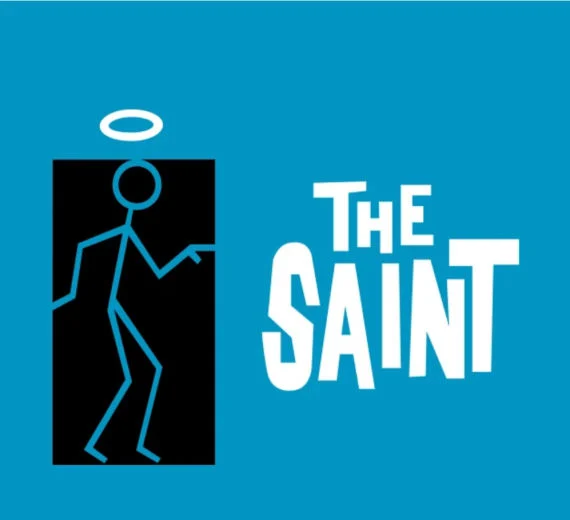
 Figure 1 – The Saint Logo
I hope eveyone had a great Christmas, if that’s what you celebrate, or Solstice or Hanukkah or Kwanzaa—or any other celebration, whether religious or secular. And I hope you are, as I am, looking forward to the year 2026, which has just begun—several people have already told me that 2025 was a terrible year and this one simply has to be better. I hope so.

Some years ago I wrote a column about Leslie Charteris’s famous hero Simon Templar, AKA The Saint. I regularly read all of the 52 or so Saint books I have, and it occurred to me recently that although Charteris wasn’t a genre author, he wrote a number of stories and one novel that could be characterized as genre, and today I propose to look into those. I’m not alone in this; in 1982, Doubleday & Company published a book containing six genre (a bit loosely attributed as genre, but let’s not be picky) stories. I don’t have that book, but I do have all the books the stories were taken from, as well as the only novel I can find that has the appearance of a genre book.
But at the same time, it also occurs to me that you may not know anything about The Saint outside of the Roger Moore British TV series. So I’ll give a quick rundown on the real (so to speak) Saint and his author. Born Leslie Charles Bowyer-Yin in Singapore, Leslie began to write at an early age; but when his British mother and Chinese father divorced, he moved to Britain with his mother. He had a hard time in school, both in Singapore and England, as he was characterized at the time as a “half-breed”; he became a somewhat solitary person who at one point studied law, but soon found school somewhat constrictive and left University without a degree. Finding “real” work somewhat constrictive as well (he reportedly worked as a tin miner, on a rubber plantation, as a gold prospector, as a bartender and as a professional bridge player before writing (information from The Saint Fandom Wiki). He apparently chose the last name “Charteris” from the phone book before legally changing his name (again, it was the tenor of the time; people regularly changed “foreign-sounding” names. As Issur Danielovitch became Kirk Douglas, so Leslie Charles Bowyer-Yin became Leslie Charteris) and taking up writing. He sold his first book at age 20, but his first Saint book, The Saint Meets The Tiger, was the third of five published in his first few forays into writing. It wasn’t an immediate hit, though he wrote enough Saint books that the character achieved traction; possibly because the books were a mix of action and humour with a lighthearted “buccaneer” protagonist who not only flouted the law, he also acted to, as they say, protect the innocent. In all, he wrote original Saint stories, books, comic strips, radio and screenplays, from 1928 to 1963 inclusive. (For about thirteen years, he wrote a daily comic strip for the New York Herald Tribune (1948-1961), also replacing Dashiell Hammet on writing Secret Agent X-9. His screenplays ncluded three Saint films (The Saint’s Vacation, The Saint’s Double Trouble and The Saint in Palm Springs) co-written by or based on a storyline by Charteris himself. So you can see that he was extremely prolific as a writer, also insisting on having his fingers in any Saint TV shows produced. (The films listed here don’t include TV movies based on or compiled from either the Roger Moore The Saint series or the Simon Dutton/Ian Ogilvy Return of The Saint series.)
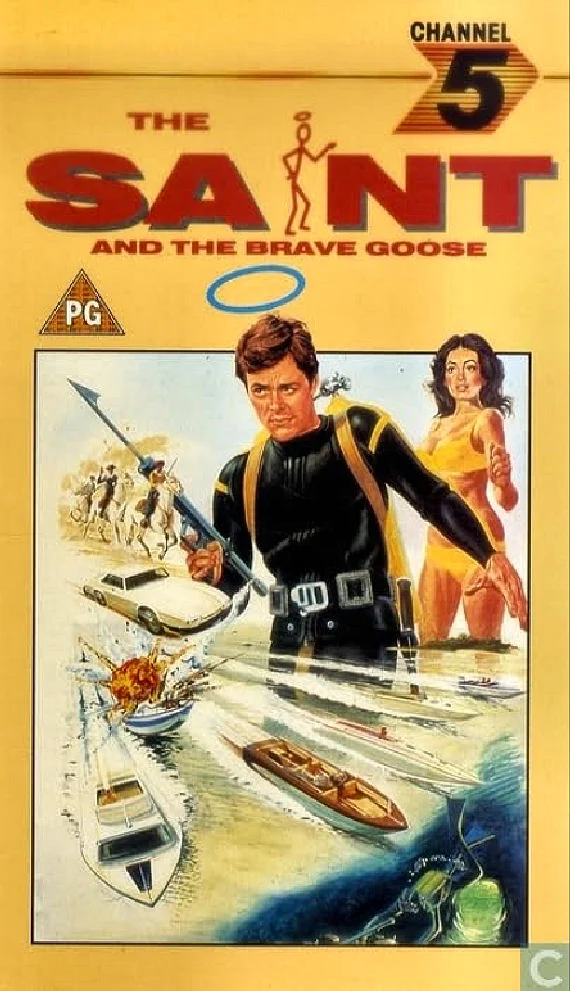
RSo who was Simon Templar, The Saint? Most people know him from the Roger Moore TV series; that Templar seemed to have nothing to do but solve mysteries, save people and take down bad guys. The “real” (i.e., from books) Saint was a bit different. He was a debonair, dashing self-proclaimed pirate or buccaneer who was sometimes described as the “modern Robin Hood.” When he wasn’t stealing—usually from people he felt were undeserving of their wealth—he was making himself rich by taking down crooks. Before World War II, the Saint lived in England; afterwards, he motly lived in the United States (like his creator). I believe he was described by Charteris as 6’2” tall, fair-haired and tanned, with the build of an athlete, though not obviously muscled. He had blue eyes and dressed in the finest Savile Row-type clothing. (As he debuted in 1928, you can be sure his hair was slicked back, unlike the ‘60s portrayal by Moore.) He felt that life was meant to be lived to the fullest, and built a reputation in London’s underworld with the stick-figure drawing (Figure 1) he left on people he robbed and/or killed—always people he felt deserved it; he had made himself rich and notorious (though never arrested; he skirted the law and sometimes aided the police) by delivering his own brand of “justice.

In the early days he had a gang consisting of Patricia Holm, a blonde femme fatale who somehow vanished in later books; also male chums like Monty Hayward in the first few books; later he had other associates, like his manservant Orace, who was apparently ex-military (British, it seems from his speech patters; one of his favourite sayings was “Brekfuss narf a minnit.”) From his days in New York, he also ganed a sidekick named “Hoppy” Uniatz, an ex-gangster who loved his “Betsy” (his gun) and was fond of bopping people on the head with it; Hoppy found thinking a chore and was happy to leave any of that stuff to the Saint. He could empty a bottle of whiskey in a matter of minutes when he had “a toist, Boss.” Simon drove, for many years, a very expensive cream and red-coloured “Hirondel,” (French for swallow) a fictional 8-cylinder sports car (Figure 5), as opposed to the Volvo P1800 he drove on TV. (Porsche had declined to supply a car for the series, but the Volvo company was happy to supply a white car, license “ST1.”
Simon Templar had an alias he used when “The Saint” became too well known; he called himself “Sebastian Tombs” when he was trying to go icognito (but later the Tombs alias was almost as well known as his own name). Because he skirted the law or operated in grey areas of it, he became well known to law enforcement on several continents—in Britain, his chief opponent was Claud Eustace Teal, a senior officer at New Scotland Yard; in New york, he was most often opposed by Lieutenant John Henry Fernack. I can’t remember any particular significant description of Fernack, but Teal was described as portly and always chewing Wrigley’s Spearmint gum. Fairly early in Simon’s career, he decided not only to take down major crooks and thereby increase his own wealth by redistributing theirs to his own pockets; but also decided to aid victims of such people by recovering their losses and giving it back to them less a 10% “tax.” Over the years, he not only had law enforcement, but also government as both allies and opponents.
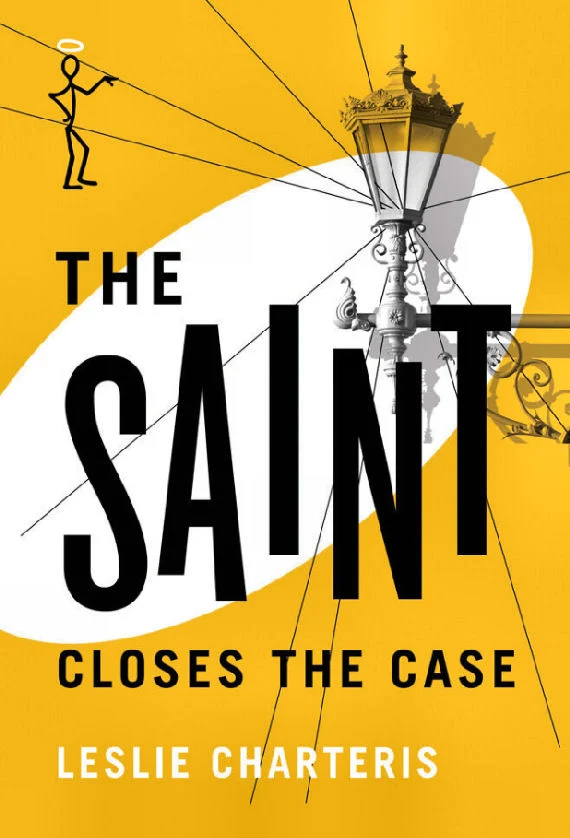
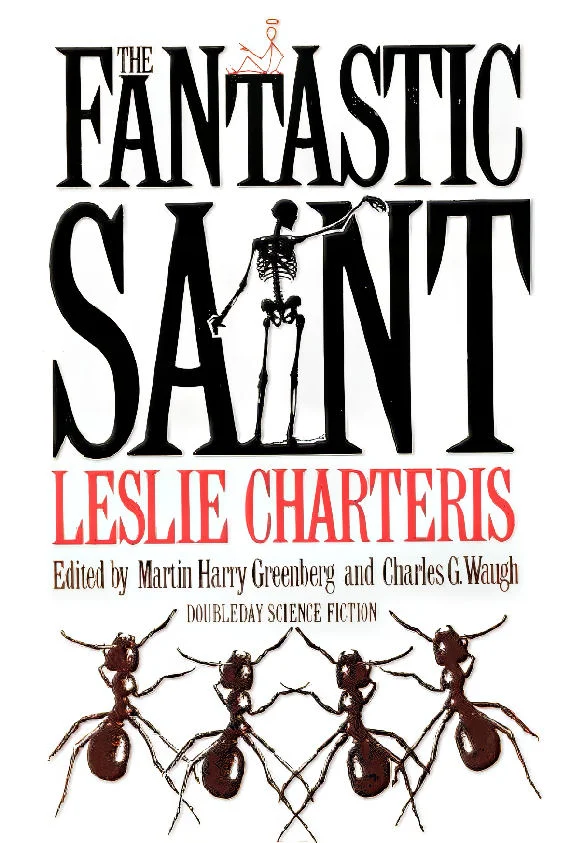
Back to the genre stories. There is one Saint novel (Figure 6) that could be said to be genre. Originally published in 1930, The Saint Closes the Case put Templar in opposition to Rayt Marius, who was a shadowy industrialist-type figure—who wanted to make lots of money selling arms to various countries—and who was trying to obtain a scientific invention which was described as a purple, electrified nebulous and gaseous something that, when it touched a living being (the first subject was a tethered goat), turned it into a shriveled, blackened corpse. Simon witnessed the secret test of this invention, and decided that not only the invention, but the inventor, if he refused to destroy it and any of the research that led to its invention, must be utterly eliminated for the sake of the world. (I’m sure Charteris was thinking of mustard gas, widely used in the first World War, was horrible enough, but the idea of something similar but nastier, should not be unleashed on the world. Little did he know, eh?) The novel itself is fairly typical for a Saint book, but is notable for the self-sacrifice of Norman Kent, one of the Saint’s gang, in order to prevent this calamitous invention coming to fruition. In The Fantastic Saint are 6 stories, all previously published: “The Newdick Helicopter”{from The Saint Intervenes); “The Gold Standard” (from Once More the Saint); “The Man Who Liked Ants” (AKA “The Man Who Loved Ants”, from The Happy Highwayman); “The Questing Tycoon” (from The Saint on the Spanish Main); “The Darker Drink” (from Saint Errant); and “The Convenient Monster” (from Trust the Saint).
The first story, “The Newdick Helicopter,” is genre in that Templar meets a con artist who is trying to sell a helicopter that can take off and land vertically. (When this story was written, there was no such helicopter—they used autogyros, which were like ariplanes with helicopter vanes on top; they needed wings and a front motor to take off and land; otherwise they behaved a lot like modern copters. Of course, it was a con; the man had a design that couldn’t possibly work. So it’s genre in terms of prediction, but I won’t tell you what happened…you’ll have to find the story, which is fairly clever. And we now have helicopters that can take off and land vertically.
The second story, “The Gold Standard,” is, like the first, a prediction story; a future that (at least in our corner of the multiverse) hasn’t happened. This one concerns a man who invents a process that can transmute something into gold. (Transmutation can happen, even transmutation into gold, but I believe it’s a) very energy-dependent; and b) involves a lot of radiation, so it’s not very efficient and costs more than it’s worth. But in this story, a scientist invents a cheap and efficient way of making gold; to keep him from breaking the world’s economy, he must be stopped. In his own way, Simon stops him as well as the crook who wants to profit from his discovery.
Story number three, called “The Man Who Liked Ants” (or perhaps “…Who Loved Ants,”) is about a literal mad scientist who believes that ants have a perfect society and if they were only bigger, they could rule the world (he was working on making them lots bigger). Unlike Clifford Simak’s ants (look it up, in City), these ants are inimical to humans. But Simon stops him. This one was made into a TV episode with Roger Moore.
The next one, “The Questing Tycoon,” is less SF and more fantasy; I think it might have stemmed from Charteris’s time visiting Haiti, because it’s about voodoo. There’s a lot of technical and accurate (AFAIK) stuff about houngans and veves, Erzuli, etc., in this story of a man who creates zombies out of living people—not the undead kind—to control them and to make them slaves. It’s well told, and is full of actual voodoo (or “vodou,” as it’s apparently called in Haiti) information.
The fifth story is listed as “The Darker Drink,” from Saint Errant, but in fact that book seems to have been revised since this book was issued, because I found it titled “Dawn,” from the same book. Again, it’s more fantasy than SF, but it’s definitely genre. I can’t really describe this story; all I can say is that it reminds me of the old saying about the Chinese emperor who dreamed he was a butterly, but when he awoke, wondered if he really was an emperor, or was he a butterfly dreaming he was an emperor? Great story.
The sixth, and last story is “The Convenient Monster,” and in it we find a murder mystery all tied up with a very popular legend about Scotland and one of the lochs therein. Yes, Nessie makes an appearance in this tale—or does it? Read the story and decide for yourself. This, too, was made into a TV Saint story with the aforementioned Mr. Moore.
So that’s it. So far as I can tell, and I’ve read pretty much all the Saint books and seen as many Saint videos as I can find—this is the extent of Charteris’s genre fiction. Except for one story I’ve been unable to find, which was published in the June 1954 Magazine of Fantasy and Science Fiction (or F&SF); and since I don’t have that issue I have no idea whether it’s a Saint story. I did a lot of research for this column, but certain things are still hidden from me.
Oh, and IMDB (the Internet Movie Database) seems to think that a new Saint film is in production, possibly to air in 2026. Regé-Jean Page appears to be set to star as Simon Templar, but further information isn’t forthcoming.
Let me wish you all a happy New Year, and my hopes for a wonderful year for all go out to you.
Note: The Saint Logo is copyrighted, and used under Creative Commons license for review purposes.
Note #2: Neither this post, nor any previous post, is written by, proofed or edited by, nor dependent on AI in any way. I’m a person, not a machine. No future posts will be written by or aided by AI. Just so you know.
I welcome all comments on my columns whether you agree with me or not. My opinion is, as always, my own, and doesn’t necessarily reflect the views of Amazing Stories or its owners, editors, publishers or other columnists. See you next time!

Steve has been an active fan since the 1970s, when he founded the Palouse Empire Science Fiction Association and the more-or-less late MosCon in Pullman, WA and Moscow, ID, though he started reading SF/F in the early-to-mid 1950s, when he was just a sprat. He moved to Canada in 1985 and quickly became involved with Canadian cons, including ConText (’89 and ’81) and VCON. He’s published a couple of books and a number of short stories, and has collaborated with his two-time Aurora-winning wife Lynne Taylor Fahnestalk on a number of art projects. As of this writing he’s the proofreader for R. Graeme Cameron’s Polar Borealis and Polar Starlight publications. He’s been writing for Amazing Stories off and on since the early 1980s. His column can be found on Amazing Stories most Fridays.