
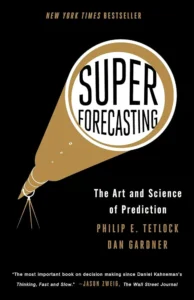
- Publisher : Crown
- Publication date : September 13, 2016
- Edition : Reprint
- Language : English
- Print length : 352 pages
- ISBN-10 : 9780804136716
- ISBN-13 : 978-0804136716
- Author: Philip E. Tetlock
- Author: Dan Gardner
Superforecasting: The Art And Science Of Prediction by Philip E. Tetlock and Dan Gardner came about partially as a result of work done for a Intelligence Advanced Research Projects Activity (IARPA) tournament to get better at predicting world events. Tetlock and team put together a crowd sourced group of volunteers who worked to predict answers to various questions with a degree of certainty (and uncertainty), then identified the best of those (super forecasters) and ran through more questions. They formed teams of forecasters and super forecasters and measured how they did.
- Some things are too far in the future or just to random to predict
- Take big unanswerable questions and problems and break them down into smaller sub-questions that you can address
- Make sure you are gathering a diverse set of data and weighing it appropriately. Question your own biases
- Take into account all the data. Don’t overreact to new info just because it’s new and fresh in your mind, but don’t under react because news disagrees with your internal biases
- Be open to new information. If you are working in a group, encourage others to challenge your assumptions and your data. Be open to contradictory evidence.
- Realize why you were right (or wrong) about a prediction. Sometimes you were lucky and guessed right for the wrong reasons. Sometimes an extraordinary event occurs that makes your prediction wrong even though it was based on sound evidence. Look back at what you have predicted and why and measure how you did and why.

Matt Truxaw’s newest book is Monster, which released on 1/12/2026. This urban fantasy, horror, thriller will keep you turning the pages.

He is also the author of the hard science fiction thrillers: “Plastiphobia/Plastivore” and “Anthrophobia: A Teacher’s Tale”

You can find them all on Amazon in Paperback, Hardback, Kindle and/or free to read with Kindle Unlimited.
When you read any of them, he would really appreciate a review/rating on Amazon or your favorite book seller/book reader site.
More about Matt:
He was born in Orange County California many years ago and he still lives there. He has been reading books for most of those years and writing up book reviews for the last few years. He gets MANY of his books out of the library/Libby so expect a lot of old science fiction classics book reviews and other science related reviews in addition to newer books he comes across.
If you want to be ‘in-the-loop’ on these and other works, you can follow his author’s page on Amazon or his Facebook page.
For more reviews and articles by Matt here on Amazing Stories (Click here).
Monster: A Novel by Matt Truxaw



Recent Comments