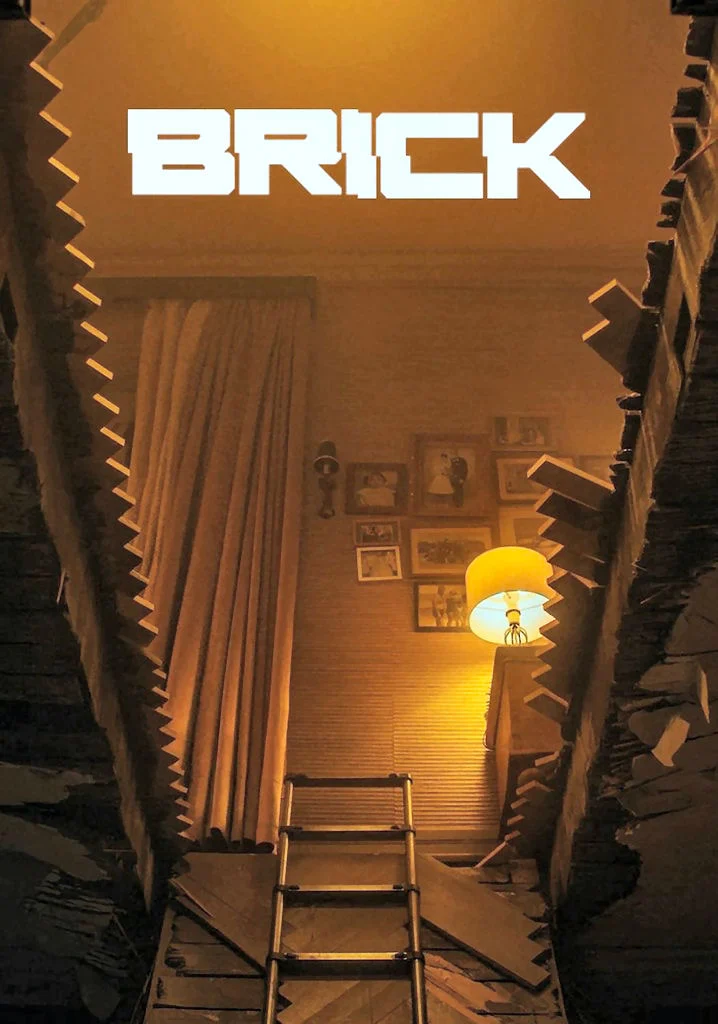
Somewhere in the last week or so, I read something that gave me the idea that the new movie Brick (Figure 1) was a good science fiction movie. So when we were looking for something to watch, I slipped over to Netflix and we watched it. It’s a German movie, dubbed in English, and it’s written and directed by Philip Koch, who I’m not familiar with. It stars Matthias Schweighöfer (Army of the Dead), Ruby O. Fee (Army of Thieves), and Frederick Lau (Victoria), among others.
Schweighöfer and Fee play a married couple whose relationship is just about over after a miscarriage; she wakes up one morning determined to leave him because he’s not able to talk or have a serious conversation with her for over a year. There’s one teeny-weeny problem, however: the door and all the windows to their apartment in Hamburg are blocked by black walls made of an unknown substance and composed of a large number of irregularly-shaped and sized “bricks.” There’s still electricity, but no water. They succeed in breaking through the wall to a neighbouring apartment, but that one is blocked as well; the couple there are apparently drug-obsessed types. Finally, the foursome succeed in breaking through the floor, only to find the same thing holds true throughout the whole building.
There are more people in the building, all accessed by breaking through floors, which means older buildings in Hamburg are constructed quite differently from ours—but they find no relief. They finally find out that the walls are ccomposed of nanites, similar to the nanodoor in the movie Doom with Dwayne Johnson. (If you remember the movie, one scene will not surprise you.) There’s a lot of tension in this movie, but surprisingly to me—since I’ve suffered from it off and on since childhood—noboy seems to get claustrophobic. Weird. But there’s plenty of other tension; for example, are they going to run out of air as well as water? There’s tension between characters—not just the first couple. I don’t want to give too much away, because I thought for a movie set mostly in one building it had some decent tension. I enjoyed it.
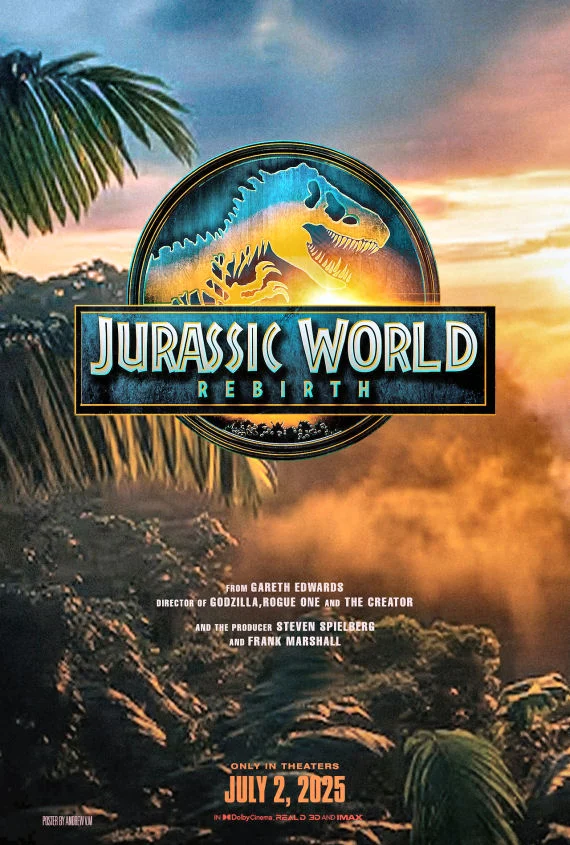
Since we’ve seen all 300-400 Jurassic Park/World movies and enjoyed them more or less, I figured we should see this one; besides, it’s a treat to see Scarlett Johansson as a character besides her Black Widow standby. (What? There weren’t that many? Funny, it feels like it.) Actually, this is the seventh film in 30 years in this franchise. But I have to say, before I dive into some of the film’s flaws, this is quite watchable and I liked it.
But, my gosh, there are so many things wrong with this film, despite its strong cast—Scarlett Johansson, Mahershala Ali, and Jonathan Bailey. It’s set five years after JW: Dominion; it’s been a tough half-decade for the dinos; nearly all of them have fallen prey to disease, inability to adjust to the modern world, probably predation by humans/other animals, etc. There are some islands in a narrow band in the equatorial region where some survive; the air is closer to what they’re used to, as well as the heat and humidity. Those islands are ruled off-limits by every country in the world. In the early part of the film, we see the death of the last dinosaur in North Ameria.
I think she (Scarlett) said she was a “security specialist”—basically, a mercenary who’ll do most anything—legal or not, and probably not necessarily moral either—for money. A company wishes to hire her to get DNA samples from 3 of the largest surviving dino species: the Mosasaurus in the ocean, the Titanosaurus on land, and Quetzalcoatlus the flying dinosaur; their DNA is needed because their hearts are so large. This DNA has to be extracted from a living dino because it breaks down almost immediately upon exposure to the air. With it, the company can make a medicine to cure thousands—if not millions—of heart patiens (and, coincidentally, make a bucketload of money).
So there’s your quest—sneak into the island area, use these high-tech hypodermics to get this dino DNA, and get a 10-figure reward; she’ll have to share it with the scientist who knows all about the dinos, and the crew she goes with—Mahershala Ali is the pilot of the small (30-foot[ish]) boat and his several redshirts. (Was that my outside voice? No matter; we all know a redshirt when we see one.) Their task is further complicated by a Spielbergian intervention—a small family of a father, two daughters, and the older daughter’s boyfriend has decided to sail(!) through that same tropic zone where the Mosasaurus, the biggest frickin sea dino that ever lived, is happily living and hunting. So—the Spielbergian touches: a ten-year-old (approx.) girl who will make friends with a small mutant dinosaur.
All of the expected adventures happen; there are hair-raising near-misses and a few fatalities; the “bad guy” gets it in the end (expected, right?), and they all sail off into the sunset (literally) in what appears to be a large Zodiac (inflatable). Predictable, scientifically improbable, many reused tropes, the several key people survive and, although there’s nothing really new in this, it keeps you—well, it kept me—watching.
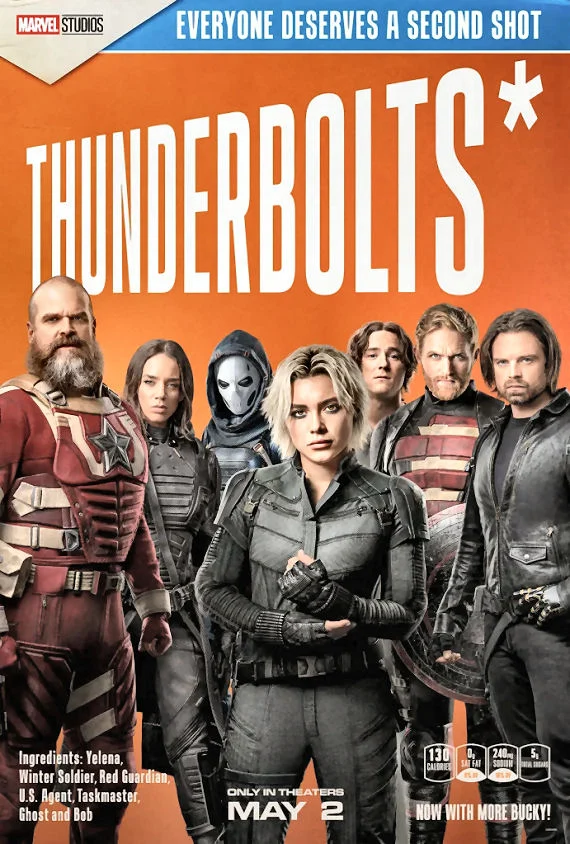
And now the one I was waiting for (Figure 3), The Thunderbolts*, AKA The New Avengers (wait, wasn’t that Joanna Lumley back in the day?)
All kidding aside, I have to say that I still have a thing for the MCU, even though they’ve killed off a lot of their stalwarts or sidelined them, and moved on to the lesser elements; instead of Captain America, we have David Harbour as The Red Guardian and Sebastian Stan as Bucky…er, James Buchanan Barnes, once the Winter Soldier; instead of the Black Widow we have her “sister” of the Red Room, Florence Pugh as Yelena Belova; plus a few I’m not really familiar with, like U.S. Agent, Taskmaster, Ghost (wasn’t she in Ant Man?) and Bob. This is definitely the “B” team, right?
Quick précis of the plot: Julia Louis-Dreyfus (Seinfeld, Veep) plays Contessa Valentina Allegra de Fontaine, who is one of those Agency people (CIA, natch) who pops up in various Marvel movies; I understand that she was—in the comics—once a S.H.I.E.L.D. agent and also a Hydra agent, but whenwe see her, she’s always someone you want to punch in the face. In this one she begins by sending all the above-named people to a building ostensibly to eliminate a traitor—but actually to eliminate each other. They find out (not before one of them gets dusted) and after much wrangling decide to stick together.
Bob, who seems to be an ordinary guy, turns out to be a problem. What kind of a problem I’ll let you find out for yourself—but he’s a BIG problem. So the Thunderbolts (Red Guardian’s favourite name for them; it was Yelena’s sixth-grade soccer team or something) have to deal not only with him, but with Valentina—in the process, becoming an actual group. Again, I don’t want to spoil it for you; approached in the right manner, you might really enjoy this.
This was where I learned that the Winter Soldier, the Red Guardian and at least one other of this group had been given a “super soldier” vaccine. What the…? I originally thought Captain America was the only Super Soldier,then they brought in the Red Guardian, Russia’s answer to Cap. Now we find out that they must have injected people like Covid antivaccine, ‘cos every other Marvel person’s a super!
Ah, well, I gripe too much. I haven’t even mentioned how much it ticks me off that the Marvel crowd ignores physics at whim. I still watch the darned movies, don’t I? I hope you too are watching and having fun. Till next time, okay?
You can comment here or on Facebook, or even by email (stevefah at hotmail dot com). All comments are welcome! (Just be polite, please.) My opinion is, as always, my own, and doesn’t necessarily reflect the views of Amazing Stories or its owner, editor, publisher or other columnists. See you next time!

Steve has been an active fan since the 1970s, when he founded the Palouse Empire Science Fiction Association and the more-or-less late MosCon in Pullman, WA and Moscow, ID, though he started reading SF/F in the early-to-mid 1950s, when he was just a sprat. He moved to Canada in 1985 and quickly became involved with Canadian cons, including ConText (’89 and ’81) and VCON. He’s published a couple of books and a number of short stories, and has collaborated with his two-time Aurora-winning wife Lynne Taylor Fahnestalk on a number of art projects. As of this writing he’s the proofreader for R. Graeme Cameron’s Polar Borealis and Polar Starlight publications. He’s been writing for Amazing Stories off and on since the early 1980s. His column can be found on Amazing Stories most Fridays.