Earlier this year I introduced a promotional tool I created for Ravencon, to some minor success.
I’m now going to share two such projects I’ve created in pursuit of an impossible task: giving everyone what they are asking for.
It is no secret that magazine publishing and distribution is increasingly expensive – becoming prohibitively so, especially for niche markets.
It’s also well known that most genre readers and collectors would prefer to receive physical issues, as opposed to electronic files. Especially for those who “collect”, having an object that they can shelve, hold, page through, smell, alongside the rest of their collection, is a must.
Finally, we would all, I am sure, much rather be spending 50 cents for a book or magazine (or LP for that matter) than ten or more dollars. This last desire is of course long gone, but it may be possible to reduce the expense, and therefore the cover price, a bit.
(Note, please, that compensation for content is not addressed here. Some work would be required in this area, but for self-promotion purposes, this is not really a consideration.)
I’d long had the concept of creating a “hybrid” version of the magazine that sought to take advantage of the relatively inexpensive publishing of electronic publications and the desire of many readers (like myself) who want a physical copy in their hands.
A first attempt (not by me) at merging the two was introduced a number of years ago with the Espresso Book Machine, capable of printing and binding a 300 page book in about five minutes.
Imagine if everyone had one of these at home, sitting next to their printer. (Over the decades, a fair number of SF authors hinted at such things.)
They’re too expensive for that and not enough demand, apparently to build a market, so the company that made them is gone,. though according to a search a few are still out there operating in the wild.
Not having the resources to manufacture and distribute millions of such machines, I had to go in a different direction.
Suppose that you could meet the “shelving” requirement for collectors and serious physical publication lovers while drastically reducing printing and shipping/distribution costs.
Well, you can, with something like this:

Printed on card stock in a digest magazine sized format, there is a pocket on the inside for holding a thumb drive.
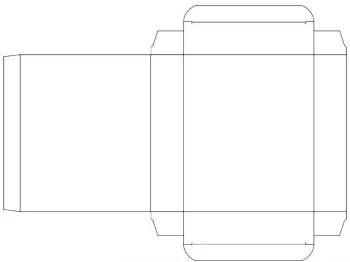 When properly folded, it has a spine that can be outward facing on your shelves. Thumb drives can be acquired in bulk for about a dollar each. For greater sturdiness, the art could be printed on a flattened box, with or without tabs. The thumb drive can be affixed with that rubberized “glue”, allowing it to be removed and replaced at will.
Production (mass copying of thumb drives) would require an investment of a couple of hundred dollars for a USB thumb drive “cloner”. “Custom” thumb drives (with logo and issue indicia) can also be purchased, but printing up some good foil stickers would be less expensive.
What you end up with is (presumably) exciting cover art that can be displayed in its natural habitat, a titled place holder for the shelves, a great reduction in shipping costs and in printing costs. Such a thing might come to be acceptable to readers, especially if it is the only distributed version. (Or this could become another, low cost edition alongside more traditional ones.)
You could of course just hand out cloned thumb drives as a promotional vehicle (here, read an issue on me! Bonus – don’t like it? Well, now you’ve got a free thumb drive!)
This concept has not yet been put into production, but it has been shared around a bit, to mixed reviews.
(Note that the copy printed on the cover has some basis in reality, but is really only filler.)
Which brings us to the second concept, which I believe holds out some promise for actual utility – especially among the small imprint and indie publishers out there.
Hauling your physical books from convention table to convention table is an onerous task that introduces a number of potential issues, not the least of which is the physical effort required. Books are heavy. If you are mixing hardbacks, paperbacks and magazines, it’s awkward as well, as that mix does not “box” well.
There’s the potential for damage and loss. There’s ALWAYS the question of what, and how many of each, to bring along. Suppose you’ve got a series going and have just released the latest number. Do you bring more of the latest, an equal number of each, do a percentage based on current sales? Honestly, in the long run, you’ve got no idea of what is going to be a sales leader at any given event. And you absolutely don’t want to go home thinking “If only I’d brought 1,000 copies of that title, I’d have sold them all, instead of having to haul all of these back home again!”
There’s also this to consider: You really don’t want anyone visiting your table walking away empty handed. You want them leaving with something, even if they haven’t bought a book. Folks put freebie book marks out, they put candy out, they put out postcards printed with book/author info and business cards. All of these promotional tools are designed to either keep someone at your table until they give in and buy something, or, they should be something designed to encourage your customer to make a future purchase. (What was the name of that author I met? Oh, right, I got a book mark from their table….) Not to mention that the wider the distribution of your materials, the more exposure you get. Appealing to 1 percent of 1 person doesn’t get you a sale. 1 percent of ten thousand people might get you a handful.
So what if you could accomplish all of that, while at the same time really upping the ante, possibly increase traffic to your website, giving your potential customer something that has real (perceived) value – for free?
Suppose, for the sake of argument, you could give your future fan a sample of your work, at virtually no cost to yourself? Suppose that you could distribute an entire magazine’s content on a single sheet of paper, folded so that it was a small, four page pamphlet.
That sure would seriously reduce production and distribution costs now, wouldn’t it? More importantly, it would do the one thing that every author needs their future readers to do: READING SOMETHING. Let your words do the selling.
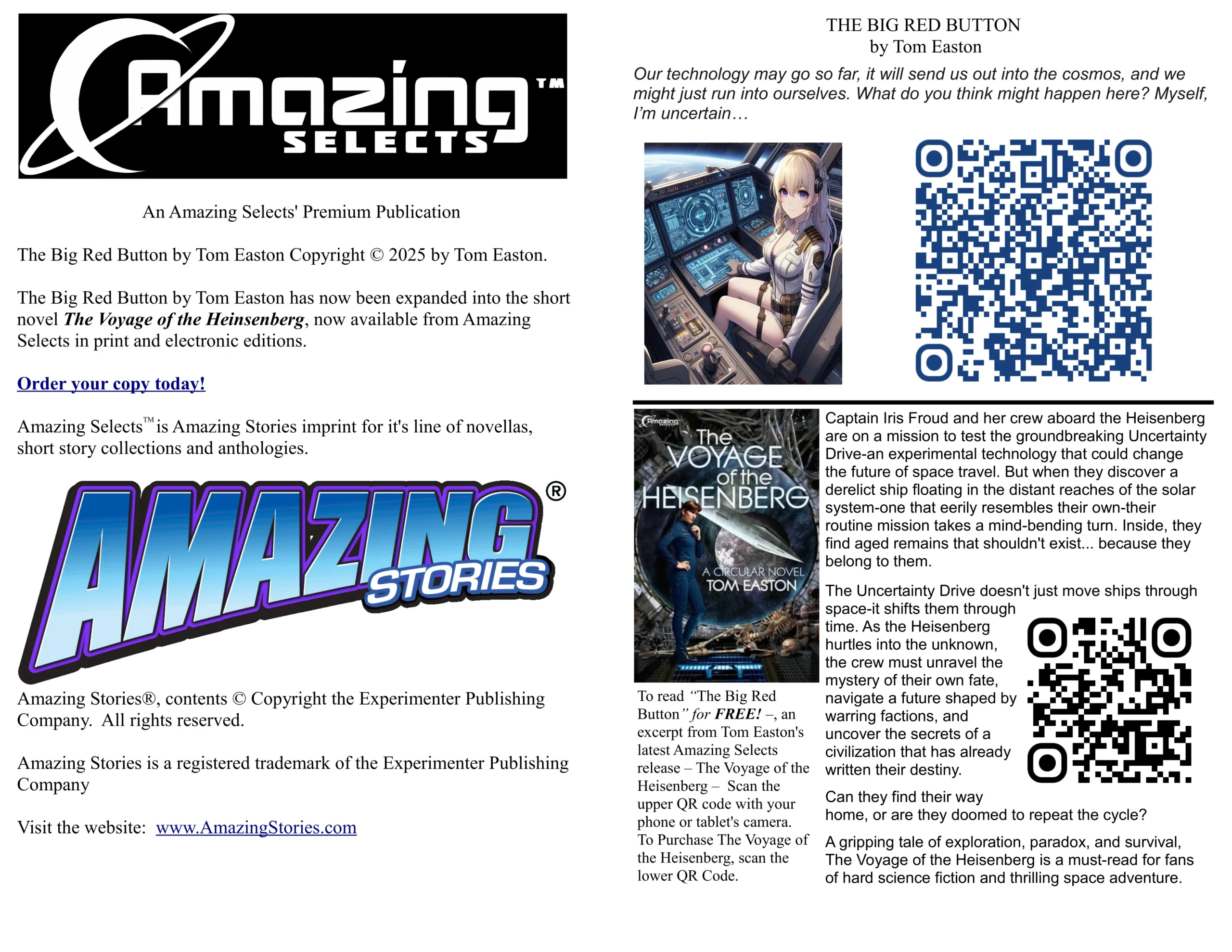
Well, here it is: a four-pager that contains cover art, back cover promotional materials, a teaser to whet the reader’s appetite and a direct link to our website (several, in fact), where, if you want to, you can capture some of their data, like an email address.
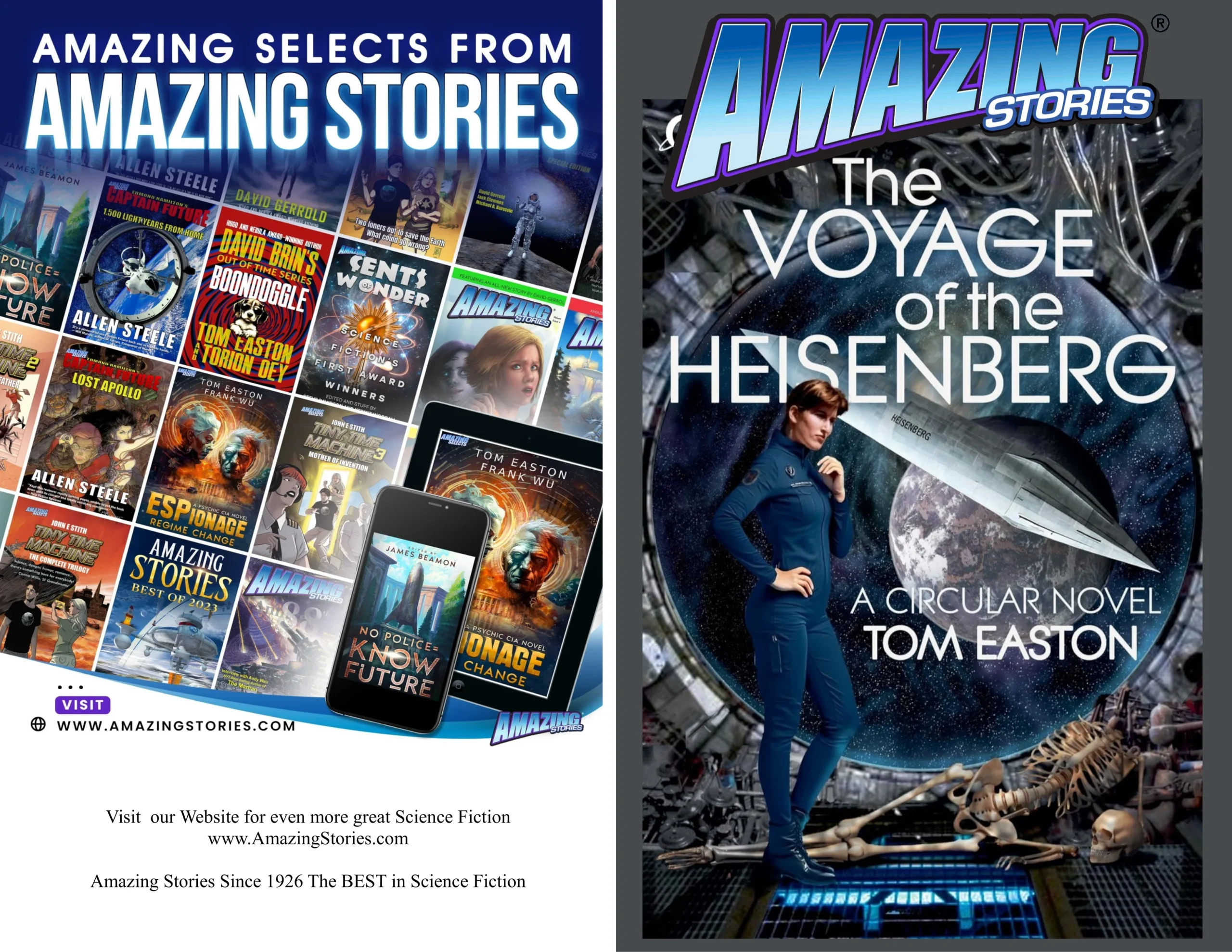
 What we wanted to do was eliminate any “barriers to entry” for a new reader of a recently introduced title, in this particular case Tom Eastman’s The Voyage of the Heisenberg.
The pitch is pretty straight forward: in any case where your customer is walking away without making a purchase, you offer them the opportunity to read one of your titles FOR FREE. Or an excerpt from one anyways.
In the Heisenberg example, we reproduced the book’s cover, featuring the cover art and a promotional image with link address for the Amazing Selects imprint line of books.
On the inside, we placed promotional copy for the excerpt – actually a short story that was expanded for the novel – explaining what it was, along with the story’s artwork from the website, the teaser for the story and a QR code that links directly to the story: scan it and you’re now on the Amazing Stories website, ready to read the excerpt.
Below that, a blurb for the novel, instructions on how to use the pamphlet and a QR code that links to the book in our online store.
The content can, of course, be heavily customized for your own needs. You could use your cover, promote other books in a series, print a longer teaser or excerpt for the work(s) in question, add additional artwork. In fact, you could do an online issue of a magazine, printing a QR code linking to each story, along with artwork for each one.
Customers are increasingly tied to their phones. With one of these stuffed into a pocket, they don’t even need to remember the name of the book or your company. All they have to do is scan.
 Of course, where and how they land would be entirely up to you, as would what they can do when they get there. You could give them a teaser and then offer them the opportunity to read more – by registering their email address (We’ll keep you informed of our latest releases. You’ve now signed up to receive our monthly newsletter. Visit our store and take advantage of a special discount.)
Keep in mind that the QR code does not have to link to your publicly-facing online presence. You could create a page that is inaccessible unless the QR code is used. Any content you are sharing promotionally does not also have to be shared broadly. (EXCLUSIVE! This story is only available to those who visited our table at Genericon! Be the FIRST to read the latest story in the Humdrum Universe Series!)
And, once again – you can do this for pennies. There are a ton of free QR code generators online. Most home printers can print double-sided and in color. “Xeroxing” at Staples or Office Depot is pretty cheap too. If you are already publishing books – print or electronic – your artwork and text are already available for use.
Didn’t bring enough copies of that book you thought would never sell? “No, I’m sorry, I’m all out. But here’s a flyer with an excerpt in it and a link to buy the book.”
Chances are, even if a customer never purchases the book, they’ve probably helped to increase your website traffic.
When you realize that readers, like most people, are out and about during the day, and that most of them (especially younger generations) are pretty much engaged with their phones all day. In Japan, they’ve even given a name to the popular habit of reading novels on phones – keitai shousetsu (cell phone novels).
Here’s a look at a draft version for an entire magazine issue done with QR codes, featuring stories published on our website as entries in Free Fiction Mondays.

I’m not happy with the crowding and scanning with the QR code so small can be an issue sometimes (especially with older phones or tablets).
On the other hand: a reduction in printing and mailing costs by probably close to 99% offers a lot of incentive all by itself.
If you were really going to try something like this, you’d probably need to increase perceived value as much as possible: print it on the heaviest GLOSSY card stock you can manage. Make up some custom envelopes to mail it in. Maybe figure out a good use for a gold sticker to stick on it (EXCLUSIVE CONTENT!)
The point here, I think, is that your promotional options – especially for events – does not have to be an “either/or” proposition – you either haul your entire inventory or make your best guess and prepare for disappointment. Nope. Now you’ve got what might be a middle ground.

Steve Davidson is the publisher of Amazing Stories.
Steve has been a passionate fan of science fiction since the mid-60s, before he even knew what it was called.