It’s tough to make your garden successful; seems sometimes you’ve got to use supernatural ways to do it. Well, sometimes, it might be more supernatural than natural, and sometimes, not so super…
I didn’t realize that Springfield, Oregon was the slug capital of the world until I moved here for a job at my cousin’s bicycle repair shop. It should have tipped me off early on that the local baseball team’s mascot is Sluggo, and there is an anti-beauty pageant in the town next door called the “Slug Queen Pageant.” As soon as I planted a garden behind the house I rented, glittering trails of slime attested to the culprits behind the devastation—even if I didn’t witness any of the sneaky miscreants myself.
First, I tried diatomaceous earth, because it is supposed to cut up the soft bellies of pests naturally. That didn’t stop my butter lettuce and tomato starts from being eaten.
“I read a trick on the Internet for that, April,” my mother rumbled from my cell phone. The effect of smoking for over forty years made her voice a gravelly purr. “Place beer in empty hummus containers. Slugs love beer. They’ll crawl in to drink it and drown.”
I doubted slugs were that fond of alcohol, but I was willing to give it a try. I purchased Pabst Blue Ribbon from the store, filled shallow plastic containers, and dug little wells around the garden so it would be easier for slugs to fall into the dishes. The next morning, I found two slugs in one dish and one in another. I couldn’t tell if my organic garden was less chomped up, but this was promising. I scrounged for more plastic refuse, strategically placing ten shallow dishes around the garden.
I set out more containers that day. The next morning, I checked on them. There were slugs in some of them—a good sign. But some of the dishes were completely empty, all beer completely gone. I eyed the neighbor’s cat, sprawled in my thyme under the apple tree. Cats were the other pest of my garden, always digging up the beds for me to find little nuggets later.
I shooed the cat away, noticing it wove drunkenly out of the yard.
Longingly, I gazed at Richard’s yard over the white picket fence. His heirloom tomatoes were ripening into plump artistic masterpieces. Stalks of corn grew perfectly straight and strong. His mint was hearty. I squinted. No, that was cannabis that was hearty.
He didn’t have slugs plaguing his garden.
Over the following days, the chewed-on greenery declined. The corpses of drowned slugs kept filling the dishes, but new trails of slime continued to show up. Drunken cats—and there were quite a few because Wendy, my next-door neighbor, had twenty-one cats—were constantly trampling over my plants to get to the beer, squashing the produce, and digging up the beds. I didn’t even know cats could hiccup until I heard them in the bushes. Several times, I heard feline yowls in the yard at night, probably as they fought over the beer.
Cats loved inexpensive beer as much as slugs and college students, it seemed. I tried cheap wine and found the cups overturned in the morning. Apparently, the miscreants in my garden were alcohol snobs. I went back to using beer.
One night, I lay in bed, trying to ignore the rustles, grunts, and what I would have sworn was laughter outside my window from the garden, when I decided I could not stand the noise anymore. Nor was I going to have a garden left if the cats kept invading.
I wrapped a housecoat around my nightgown, slipped my feet into my garden clogs, and went outside. I had brought the army surplus flashlight that weighed about five pounds and was half the length of a baseball bat. I doubted throwing it at drunk cats was going to do much good, but I had it in case any of them leapt at me.
Stealthily, I slipped outside and flicked on the flashlight, aiming the beam at the rustling corn. Lying on the ground with their faces dipped toward the stale beer was . . . my eyes couldn’t be right. It wasn’t felines—or any other kind of animal.
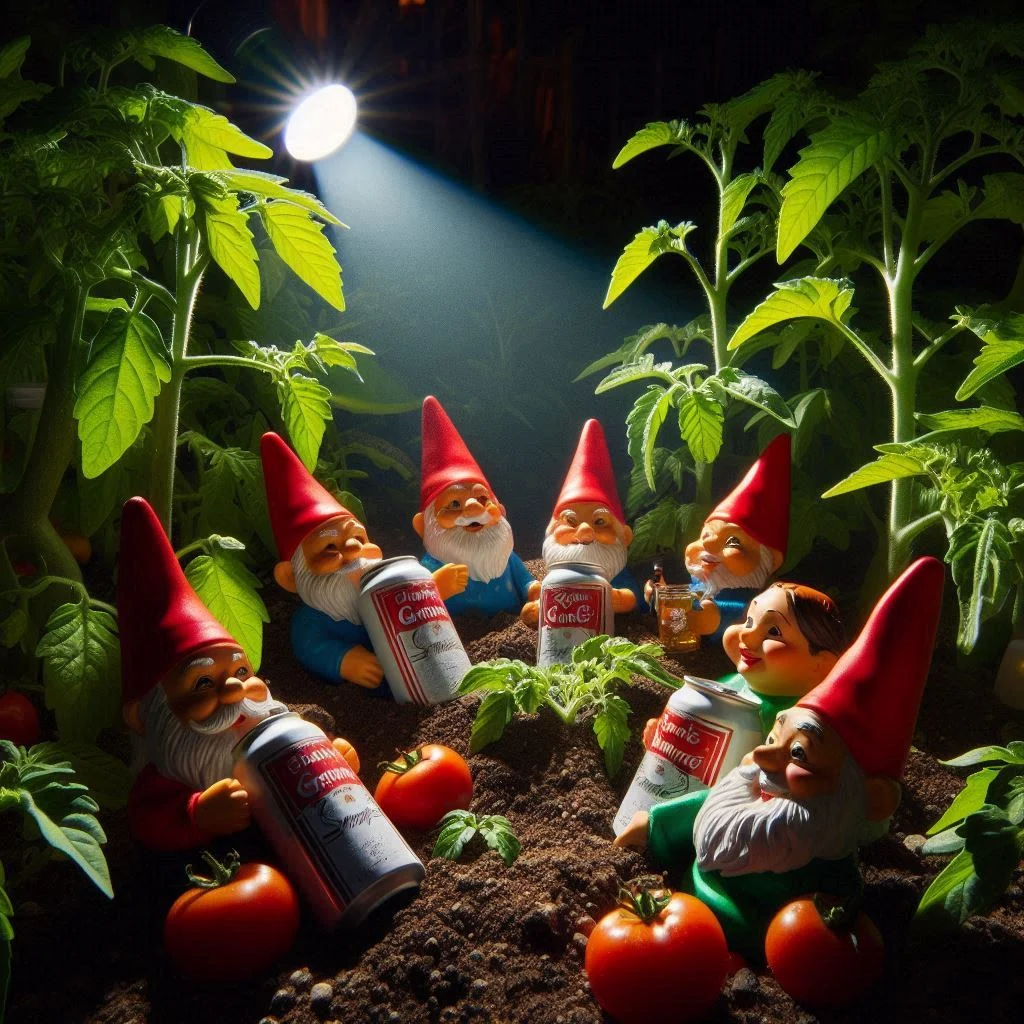
I found little men with red conical hats—though some of them had tossed their hats aside. They lapped at the beer like cats lapping up milk. One of them slurped up a slug from a bowl like it was a tasty treat. As my flashlight paused on a red hat, a man lifted his head from a bowl, beer dripping from his silver beard. He squinted into the light and grunted. Several ceased to throw cherry tomatoes at each other. They froze as they stared into the glare of my flashlight, horror painted across their faces.
Another man scampered back from the nearest bowl. Without their hats, the men were about the height of Barbie dolls, but stockier. And hairier.
“Um,” I said. Maybe I was dreaming.
Or my eyes were just tired, and what I was really seeing were my neighbor’s twenty-one cats getting drunk off my homemade slug bait.
A splatter caught my attention. A tipsy gnome stepped on a plump heirloom tomato. The gnome tried to shake it loose from his foot. Anger annihilated my momentary awe.
“That’s my prize tomato!” I said. “You ruined it!”
One of the diminutive men opened his mouth, his eyes wide with surprise as he took me in. I thought he meant to say something—to apologize. Instead, he belched loudly.
“Out!” I yelled in fury.
They scrambled back, leaving glittering trails of dust that settled onto the ground in their wake that resembled trails of snail slime.
The following morning, I found a red conical hat that was made of wool poking out from underneath the bell pepper plant. My momentary wonder at the realization that I hadn’t been dreaming melted as I saw my trampled produce.
I stared at the scarred terrain of my garden. The soil was turned up, like a battle had taken place, large hairballs of cat fur left in the wake.
Suddenly, I realized why the cats had been yowling. The gnomes had driven them off, not wanting to share the beer with them.
It looked like their party had thrown my cherry tomatoes like paintball bombs. Split and smashed tomatoes littered the entire garden. Someone had used my kale as a bed, or perhaps one of them had just drunkenly rolled over it. The ultimate prize was the turd planted in my artichoke.
I now wondered how many times I had been cleaning up cat excrement and it had actually been gnomes soiling my garden.
Did gnome feces carry E. coli? That would explain some things about mysterious contamination of romaine lettuce and spinach at the store.
Out of all the pests I was battling with, the garden gnomes were the worst! I had to find a way, not just to get rid of the slugs, but also the cats and gnomes. The beer had seemed like such a promising solution to the slugs, too.
I went back to research. Websites mostly talked about how to attract “good” fairies by leaving milk, butter, or cake outside as gifts. I could see how I might have drawn gnomes without realizing I had given them “an offering.”
To keep away Fay or Fae, the Internet suggested iron nails, planting herbs like boxwood, and creating barriers made from rowan and blackberry stems around the perimeter. I hung horseshoes, bells, and chimes.
I stopped setting out beer since I didn’t want cats or gnomes. Instead, I tried citrus and coffee grounds because cats supposedly didn’t like those smells, but the citrus attracted more slugs and snails. The coffee didn’t thwart either. To deter the slugs, I used eggshells around my most promising plants—or what was left of them—and made fences out of copper wire. The cats buried the copper and eggshells as they used my garden for a litter box. I used homemade cornmeal traps to lure the slugs, which would kill them as it expanded inside them, but I witnessed the cats eating it instead.
My neighbor caught me using salt next.
Richard leaned against his hoe, pausing in his weeding as he watched me from his side of the fence. He might have resembled an oversized garden gnome himself with his white facial hair and portly frame, only he sported a Grateful Dead T-shirt. The ancient fabric was threadbare, and the once bright tie-dye faded.
“Is that salt part of a protective spell you’re casting to rid your garden of the good neighbors?” He laughed.
I couldn’t tell if that was a joke. Richard was an old hippie, but I hadn’t guessed him to be superstitious. Then again, I wasn’t superstitious. I had caught those gnomes red-handed. Maybe he knew about my pests. They certainly hadn’t been quiet.
“Will it work?” I paused in the sprinkling of salt. It was supposed to cut up slug bellies and dehydrate them.
“It might keep your garden free of hexes, but you’ve got a bigger problem than that.” He eyed my stalks of leafless arugula and Swiss chard holeyer than his shirt.
Envy filled me as I took in all of his healthy produce.
“If it isn’t the slugs, it’s the cats. And if it isn’t the cats, it’s the . . . well, never mind.” I didn’t dare say the word “gnomes” out loud.
According to crazy-cat-lady Wendy, Richard was supposed to be the crackpot of the neighborhood—not me.
He winked at me as he pruned his marijuana plants. “It’s better if you can get the good neighbors to work for you instead of against you.”
Right. Like I was going to be able to employ a bunch of skittish mythological men to guard my garden in exchange for an all-you-can-drink beer fest. On the other hand, I remembered the days I had been in college, and what I had been willing to do for an invite to a party with free booze.
Gnomes might be the same way.
#
In stories, fairies could be tricksters, but many were also protectors. They were more likely to do good deeds of you left them gifts. Perhaps Richard was right, and I had to allow the gnomes to protect—and give them an incentive to do so. Possibly, he didn’t just grow that cannabis for his own use, but he used it to bribe his “good neighbors” as well.
I removed the nails, horseshoes, and barriers made of materials that fairy creatures didn’t like. I set out the beer in cups that evening.
I kept the window open that night so I could hear whether my gnome bait had worked. The rustle in the bushes told me it was either cats creeping through the garden or gnomes. I listened at the window, certain it was the latter when I heard the voices whispering to each other. I waited until the moon was high in the night sky before venturing out so that I would be able to see.
Clusters of little men sat around bowls of beer, some with their red caps on, others with them off. They weren’t so inebriated that they had destroyed anything yet. That was a good sign.
“Excuse me,” I said, rushing on before they scrambled away. “I would like to propose we make a bargain.”
The beer-drinking gnomes turned toward me. A few already started edging back from bowls.
“You obviously like beer,” I said. “I don’t mind providing it—if you don’t destroy my garden. And if you’re willing to keep other unwanted pests away.”
The gnomes clustered together, whispering too quietly for me to hear. Some had already slipped off into the shadows.
One of the little men with a snowy white beard stepped forward. “If you set out the good stuff, we’ve got a deal.”
“What do you mean by ‘good stuff?’” I asked. I hoped they weren’t referring to mead or expensive wine.
“No more of this Budweiser, Coors, or PBR drivel.” He crossed his arms. “This is Oregon, land of the microbreweries. We like local and organic. It’s good for the local economy and helps promote sustainability.”
Of course they wanted expensive beer. It turned out my pests were hippies. Or maybe hipsters. I should have known gnomes would be like this.
“So if I purchase local craft beer and set it out, you’ll keep away the slugs and cats?” I asked, wanting a confirmation. “Without causing harm to my produce? And you aren’t going to have drunken parties that keep me up all night?”
The gnomes exchanged chagrinned glances.
One of the gnomes elbowed a friend. “See, I told you we were being too loud.”
“We will do our best to avoid disturbing you or your produce,” one of the gnomes said.
That was the beginning of a mutually beneficial relationship. As Richard had said, it was better to work with the gnomes than against them.
Now I just have to get rid of the mice in the garage . . . assuming those little turds I’ve been finding belong to rodents and not some other magical creature.
The End