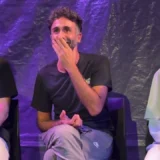
Abby Goldsmith – “Abby Goldsmith is the author of the Torth series, which starts with MAJORITY. Published by Podium and performed by George Newbern, the epic sci-fi series was originally serialized on Wattpad and Royal Road with over 750,000 views.
Abby is a SFWA member with short works sold to Escape Pod and Writer’s Digest Books. A former animator and game content writer, she is credited on more than a dozen Nintendo games for Nickelodeon and Disney. She has lived on all three coasts of the United States and is married to her favorite reader.”
Posted the following video to Youtube titled “Networking at Major Conventions: What I Wish I’d Known Earlier“, below. My commentary, republished from comments on Youtube, follow the video.
I have not read any of Abby’s published works and will therefore not offer any comment on them; from her bio and webpage, it appears that she is successful and has an audience. However, I do want to push back a little, gently, on some of her commentary, as I do believe that there is a different side to her own experiences.”
Here’s the video:
And here’s my commentary:
But first: Note that while Abby’s commentary is essentially negative on the awards and community(s) discussed, her video IS contributory to community and therefore “Fannish” in nature.
To vote for the Nebula Awards, you must be a member of the Science Fiction and Fantasy Writers of America (SFWA). That’s because the award is given out by the organization (of writers, editors, artists, publishers in the field).
To vote for the Hugo Awards, you only have to be a SUPPORTING MEMBER of Worldcon. If you were a Member of Worldcon the previous year, you are also eligible to nominate for the Hugo Awards in the current year. Member includes both SUPPORTING and ATTENDING and VIRTUAL MEMBERSHIPS. (2:17) *
I feel that any member of Worldcon is my Peer.
My personal experiences with Worldcon from 1977 till the present, ranging from when I was a lowly Fan attending his first local conventions to years as a small press and magazine publisher, that has not changed. Fans are approachable – and everyone attending Worldcon is a Fan.
However, and I think this crucial, there is a learning and acceptance phase that every neofan goes through. And here’s the REALLY crucial part: the neofan has to persist. The test is “do you really want to be a fan”?
You demonstrate this by attending AND finding ways to contribute. NOT by arriving and looking for business connections. If you approach Fandom as an individual looking to join a new community with its own customs and traditions, you do not enter it seeking to take advantage. You enter it looking to learn.
* Science Fiction – good science fiction – is not just “action adventure”. There’s plenty of room for that, but the consistent trend for both SF and Fantasy works that win the major awards are works that “entertain”, but that also explore aspects of the human condition. We can all get behind action and adventure as good entertainment (when well-written), but if a work is to step up to award level, it needs to have something more.
* “Might even be industry inside jokes”. “Dropping you into a world” without handholding are opportunities for learning. You learn about a world by living in it as you read about it, not by getting info-dumps.
* “The Public” is not Fandom.
* You were at the San Antonio Worldcon. Did you stop by the Amazing Stories booth for a free copy of our introductory issue of the magazine? You may have – I don’t remember meeting you if I did (though I was not the only one working the booth). I would have loved to have discussed these issues with you.
First, I’ll not deny that your experiences and your take are valid ones, at least so far as your reception and perception go. They do not align with my own experiences. And, while it is VERY true that we engaged with Fandom/Worldcon/etc., in different eras and much HAS changed over the years, I still believe that it is a welcoming, accessible community – if it is approached with the community’s traditions in mind.
It may seem “closed”, but that is only a thin protective crust. A crust developed in the early years owing to Fandom being founded largely by outcasts of mainstream society. That should change – soften, if you will, but some relatively recent attacks on the field seem to have hardened it so some degree. “Fandom” (the collective) wants to learn whether or not you really want to be a “FAN”.
One of the Fannish “values” is that Fandom is NOT about money, earnings, copies sold, who can I find that will help me with my career? It is about meeting other people who share the same values of openness, acceptance, contribution and support. All the rest – finding mentors and peers, resources and access, that comes after. Fandom is not a quick-fix literary smorgasbord. It’s a family.
***
Who can vote for the Hugo Awards?
1. The Nominating Phase
- Members of the current year’s Worldcon.
- Members of the previous year’s Worldcon.
- Note: To be eligible to nominate, memberships typically must be purchased before a specific early-year deadline (usually January 31st of the voting year).
- Only members of the current year’s Worldcon can cast a final vote.
- Members of the previous year’s convention cannot vote on the final ballot unless they also buy a membership for the current year.
- Attending Membership: A full-price ticket to attend the physical convention events in person.
- Online / Virtual / Supporting Membership: A significantly cheaper, non-attending tier designed specifically for fans who only want to participate in the voting process and support the society.
For example, voting for the 2026 Hugo Awards is administered by LAcon V (the 2026 Worldcon), and only registered members of LAcon V can vote on this year’s final ballot.
www.WSFS.org (World Science Fiction Society)
Who can vote for the Nebula Awards
- Full Members: Published authors, creators, or game writers who have met professional sales and credentials thresholds.
- Associate Members: Emerging writers and professionals who have a documented commercial sale but have not yet hit full membership requirements.
- Senior Members: Long-standing or lifetime professional members of the organization.
- Note: Standard “Affiliate” and “Friend of SFWA” members do not have voting or nominating rights.
For the record: I am a Affiliate Member of SFWA (Publisher).
Steve Davidson is the publisher of Amazing Stories.
Steve has been a passionate fan of science fiction since the mid-60s, before he even knew what it was called.