

This is a redo/rewrite of a column I wrote ten years ago, when books were still king in the world of SF/F. When I was growing up, there were very few SF/F movies; there was no CGI, and only a few SF movies were made that got much notice by the general public. Hardcovers were still affordable, but paperbacks were everywhere. And cheap, too. In the 1970s, when I got into active fandom, a man started dominating the anthology market; wherever you looked, there was an SF anthology edited by Roger Elwood (Figure 1).
I attended my first convention in 1975, and Elwood (1943-2007) had already begun to make a splash in science fiction; by 1974 (inclusive), according to Jonathan Strahan—figures supplied by Bill Contento, compiler of the Locus database—he’d already published some 55 anthologies in that field over the previous ten years, with the bulk being published in 1973 and 1974 (19 and 23 respectively)! Regardless of the quality of the anthologies, that’s an impressive number of anthologies for such a short period, comprising about 25% of the published SF anthologies for those two years. At that time I was receiving a lot of SF review books, and I had quite a number of Elwood anthologies in my collection—mostly hardcover.
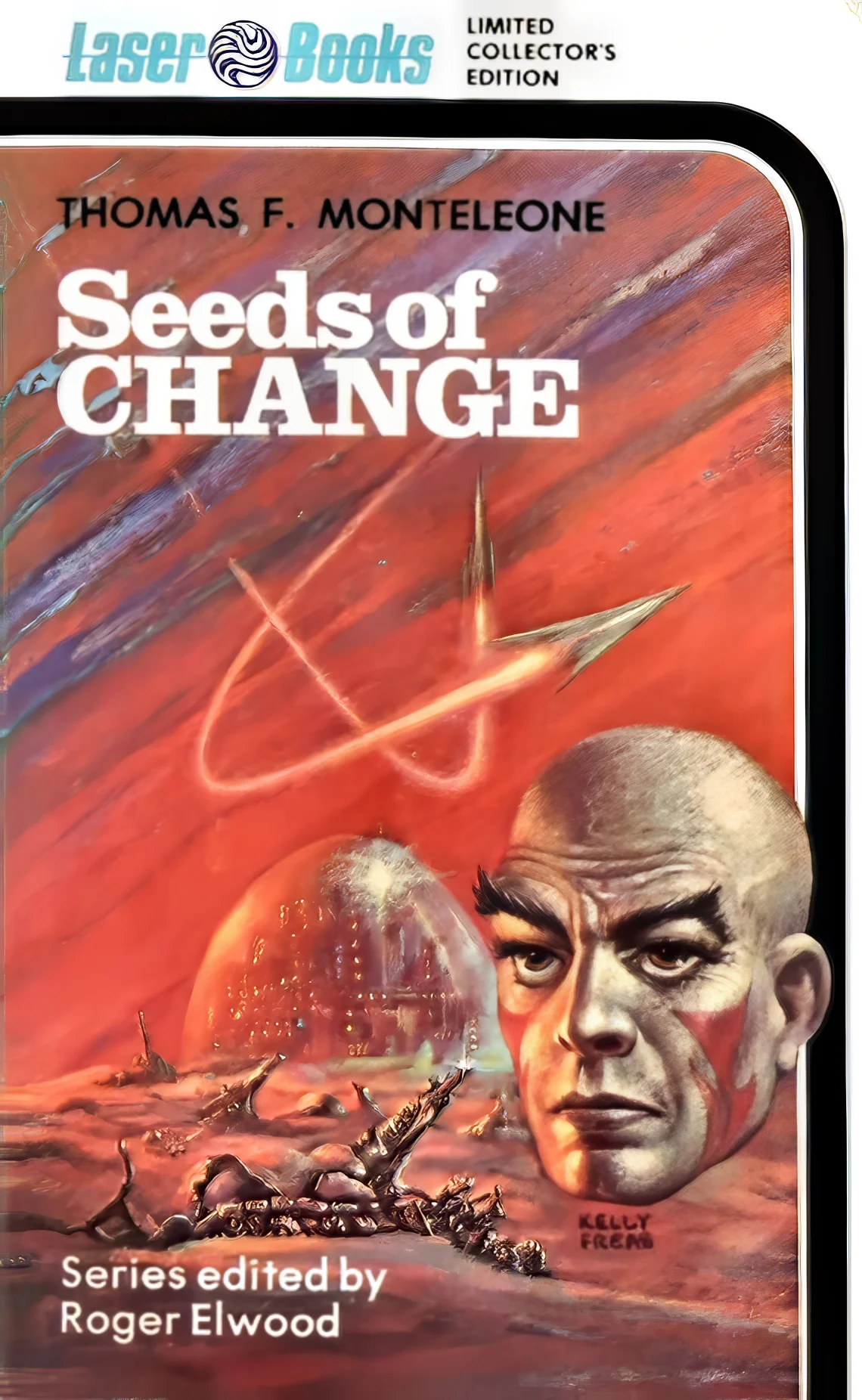
Back then I was in my late 20s and had been reading SF for most of that time, although it wasn’t my sole reading matter, but it formed the bulk of my reading matter. At that age I was still assimilating material, and hadn’t really formed any critical opinions other than “I like this but I don’t like that”; certainly not enough opinion to say definitively “this is good SF” or “this is bad SF.” So aside from providing lots of reading material, I was aware of Elwood’s compiling prowess, but hadn’t really thought much about the quality. At my first convention (Westercon 28 in Oakland, CA)—which is also the first time I met Elwood—part of the attendees’ packet was a paperback book, the so-called “Number zero” of Laser Books’ coming SF series, edited by this same Roger Elwood. This book was Seeds of Change by Thomas F. Monteleone. I understand it was also given away at some bookstores. Up until #37, when you subscribed or filled out a survey in the back of a Laser book, you also got a free copy.
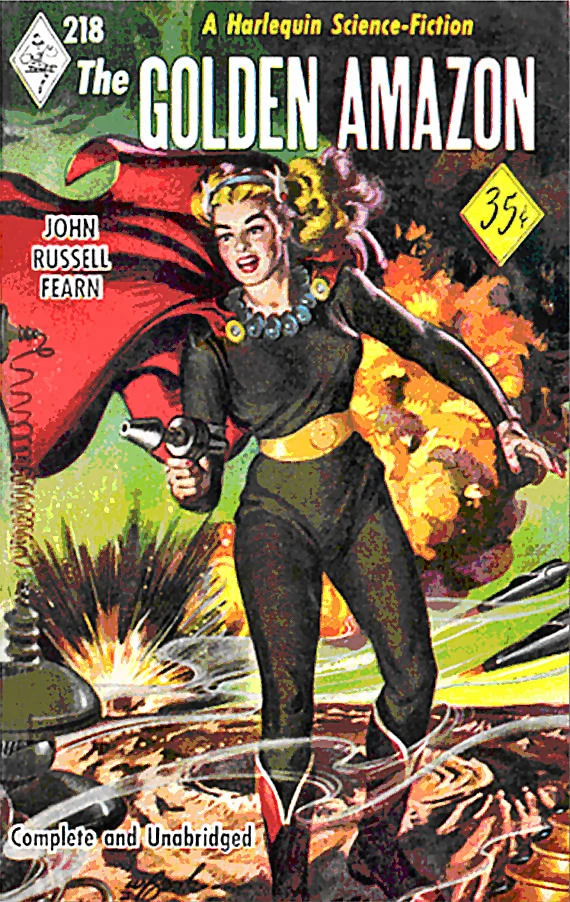
Unless you’re a book collector, you may not be familiar with Harlequin. Harlequin Books, in Don Mills, Ontario (Canada), was not known at this time for publishing anything except romance books, including the well-known “Gothic romance,” featuring cover images of women in whispy white negligees standing in front of ruined castles with one lighted window; sometimes a horse and carriage would also feature in the picture. (I can’t say for sure what was inside; the images never intrigued me enough to make me want to read one.) By the mid-1970s, Harlequin had published hundreds; possibly tens of thousands—my landlady in 1973 had a giant collection that she kept in boxes out in the barn. Oddly enough, some of the most collectible early Harlequins were SF/F, but I was only able to find one: Figure 3, which was a reprint of John Russell Fearn’s The Golden Amazon (1958). In the 1950s, however, Harlequin published lots of mysteries and hard-boiled detective novels, by such writers as Edgar Wallace and Agatha Christie.
But apparently, in 1975, Roger Elwood talked Harlequin into a science fiction line; and Laser Books was born. In all, Laser published 58 books—for a couple of years at the rate of 3 a month!—including the first, unnumbered giveaway. By the time the series ended, readers were beginning to think that perhaps Elwood’s name on a book was not a guarantee of quality. (On Wikipedia, Teresa Nielsen-Hayden is quoted as having more than a few things to say, not necessarily complimentary, about Elwood’s influence on SF anthologies, and the quality of those he edited. On the other hand, some bloggers, like Senski, have defended Elwood.) If you look at the list, many of his anthologies contained stories that later ended up on “best of” lists.
Was Laser’s quality high? On average, the books were at least average, in my opinion. There were no real low spots, but there were a few quite high spots, including Ray F. Nelson’s Blake’s Progress (also now known as Tyger! Tyger!), Tim Powers’s The Skies Discrowned, and Dean R. Koontz’s, writing as Aaron Wolfe, Invasion. There were other good and well-known writers, like Jerry Pournelle, J. F. Bone, J.T. McIntosh (no offense to any writers I’ve left off the list; I’m not going into a giant amount of detail on this). Many people who read Lasers were unaware that they were heavily edited—Bowdlerized to some extent—to conform to Harlequin’s general policies. Tim Powers—according to Wikipedia—was highly put out by the changes to his manuscript. (And there’s also a possibility that Elwood withheld money owed to some authors; here we will adhere to De mortuis nil nisi bonum—of the dead say nothing but good). It would be safe to say that the majority of Laser titles would not give offense to most readers.
Back ten years ago or so, there was a movement by some “puppies” to bring back the “good old stuff”—that is, stuff that’s not too “literary,” stuff that would be at home in the 1950s, before there was all this Politically Correct writing going around (that’s sarcasm, folks). (As far as “politically correct,” I should also point out that a number of Lasers were written by women—Juanita Coulson, Kathleen Sky and Joan Hunter Holly, for example, as was a lot of the authentic Good Old Stuff. Who could deny that women like Leigh Brackett and Andre Norton (born Alice Mary Norton) wrote Good Old Stuff back in the day?) Well, if “message fiction” and “literary fiction” are the bad categories, then for the most point, Laser books would have been lauded by the small dogs. I, personally, would call most of them “a fun read” and leave it at that.

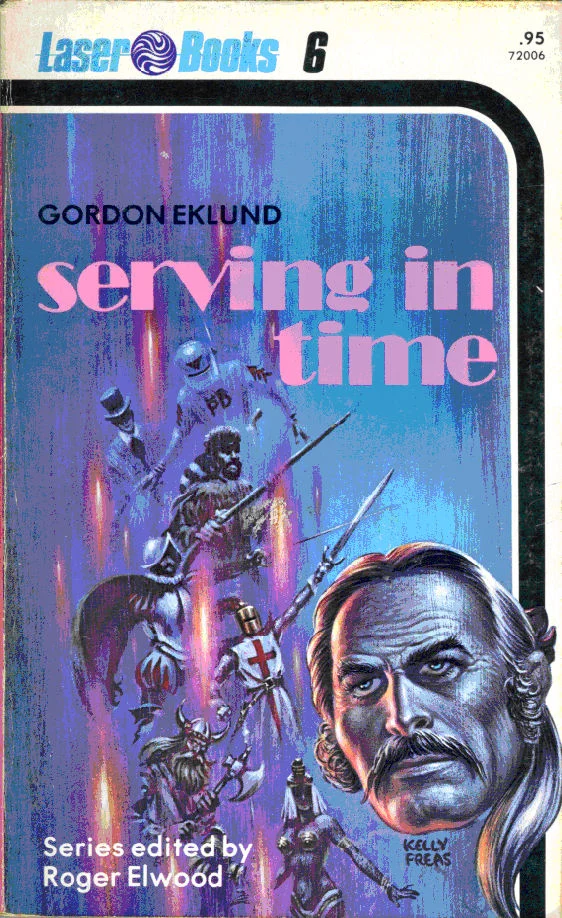
A good buy for under a buck—at least at the beginning; by #37, The Meddlers, by Jesse F. Bone, the price had gone up to $1.25, where it stuck until the end of Laser Books. Interestingly enough, the whole series underwent a redesign, as shown in Figure 4. The black curved “frame” for the Kelly Freas cover—all covers for the Laser series were painted by the late Frank Kelly Freas—expanded to just under the logo, and the title was dropped out of the black, with the author’s name moving down into the actual graphic, which was now smaller on the cover. The Roger Elwood attribution, which had varied from “Series edited by Roger Elwood” to “General Editor Roger Elwood” was moved to the back cover—possibly because Harlequin was realizing that at that point, Elwood’s name might not be a draw for SF/F fans any longer. (In checking my collection and looking at the titles, I now realize that there was little or no fantasy in the series at all.)
Up to #37, The Freas covers (all of them at least workmanlike, although there were a few that stood out; for example, the Gene DeWeese title shown in Figure 4 was quite striking)—had been confined to the frame on the cover, then repeated—vignetted—on the back cover. But starting with #37, Kelly began doing wraparound covers. (At the worldcon MidAmericon (Kansas City, Kansas—in 1976), Laser held a draw for attendees, and the prize was to have Kelly paint your portrait and put it on the cover of a Laser book. I don’t know who won; or indeed whether the winner got on a Laser cover, but I have a vague memory of Kelly telling me who did, some years later. My guess is that the winner also received the portrait of themselves—a rare treat indeed!)
I doubt that Kelly did a wraparound for the same money he did a vignette cover; if nothing else, his then wife Polly Freas, who was vigilant both on Kelly’s physical and financial health, would have seen to it that he got more money for the wraparounds. Polly was a diminutive woman with a will of iron; I met her on more than one occasion and liked her immensely.
(After Polly’s death from cancer, Kelly married Dr. Laura Brodian Freas; they remained married until Kelly himself died in 2005. Kelly himself was a gentleman of the old school, gracious to a fault. I was lucky to have him do an oil portrait of me—and signed with his old KF “bug” that he used to use on Astounding covers; said portrait paid for by E.E. “Doc” Smith’s daughter, Verna Smith Trestrail, another good friend until her death. Kelly was a consummate illustrator, known as the “Dean of Science Fiction Illustration.” As my wife, the Beautiful and Talented Lynne Taylor Fahnestalk said, after we spent some time in Kelly and Laura’s room, talking art and other things, at the Winnipeg Worldcon (“ConAdian”), “I learned more in that time with Kelly than I did in four years of art school.”
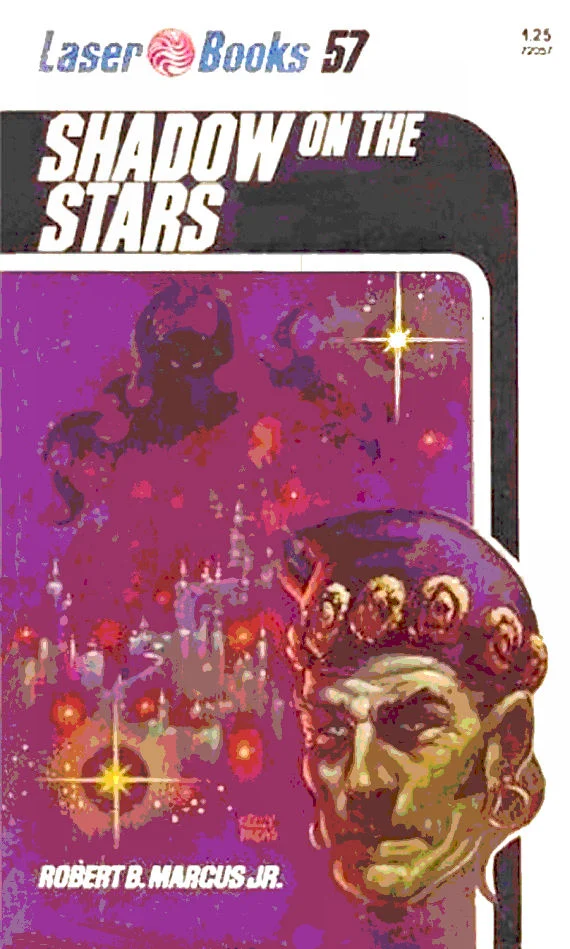
But back to the books. Because of limited time—it takes a while to read 57 books—and space, I’m not going to attempt to review any of the Lasers here. Just note that if you’re at all intrigued, many of them are available on eBay or Amazon.com for reasonable amounts. (#57, Shadow on the Stars, by Robert B. Marcus Jr. was never distributed to bookstores; it was available to subscribers only. Some Lasers are going for as little as $8 US; some as high as $80.) My purpose here is to bring some SF/F and SF/F-related stuff to readers who might otherwise not be aware.
Note: Figure 1 is taken off teh interwebz; since this photo doesn’t match the Roger Elwood of my memories (well, it has been 50 years!), and I can’t remember if I took a photo of him in the late ‘70s, this will have to do. If it isn’t Roger, my apologies to whomever it really is.
If you have anything to say about this column, good or bad, please post your comment here—or on Facebook; or even by email: stevefah at hotmail dot com. My opinion is, as always, my own, and doesn’t necessarily reflect the views of Amazing Stories or its owners, editors, publishers or other bloggers. Until next time, then.

Steve has been an active fan since the 1970s, when he founded the Palouse Empire Science Fiction Association and the more-or-less late MosCon in Pullman, WA and Moscow, ID, though he started reading SF/F in the early-to-mid 1950s, when he was just a sprat. He moved to Canada in 1985 and quickly became involved with Canadian cons, including ConText (’89 and ’81) and VCON. He’s published a couple of books and a number of short stories, and has collaborated with his two-time Aurora-winning wife Lynne Taylor Fahnestalk on a number of art projects. As of this writing he’s the proofreader for R. Graeme Cameron’s Polar Borealis and Polar Starlight publications. He’s been writing for Amazing Stories off and on since the early 1980s. His column can be found on Amazing Stories most Fridays.






Recent Comments