In response to this article, I offer the following summary of that piece, and then a longer exposition on the topic:
The article appears to argue that since visual media presentations of science fiction and fantasy can literarily show us anything, there’s no longer any need for speculative fiction writers to bother their heads with “world building”, thus freeing authors up to more fully engage with literary experimentation and style (you know – giving them the space to “write good”); the disruption this is causing within genre fields is compared to the earlier, turn of the century objections made by fascists to the negative effects that the new technology of photography would have on art (“The pseudo-intellectual works of such critics were often used by fascist movements to justify their cultural conservatism.”).
The authors declare, upfront that their piece is “a deliberately provocative heterodox opinion article that seems intended to attract detractors and invite debate.” All righty then!
First – a nice job conflating any potential criticism of this piece with Fascism, even if that connection does have some historical roots in a similar, turn of the last century debate. Disagree – you’re aligning yourself with fascists. Yeah, no.
“There was — of course — a backlash against these more abstract and expressive forms of art…The pseudo-intellectual works of such critics were often used by fascist movements…”
Then, after admitting that the comparison they draw between the present and that earlier event is not entirely accurate – “The comparison between the effect of photography on painting and the impact of special-effects laden movies on prose speculative fiction is an imprecise one.”, they dive right back in to warding off objections with “It is also worth talking about similarities between the Sad Puppies and the turn-of-the-century fascist artists…”
Why not just save a bunch of words and imprecise historical referents and just state outright: anyone inclined to disagree is a potentially dangerous doody-head?
Fine. I’ve been considered potentially dangerous before, even if for reasons unconnected to Fascism or Puppies. I’m still going to critique.
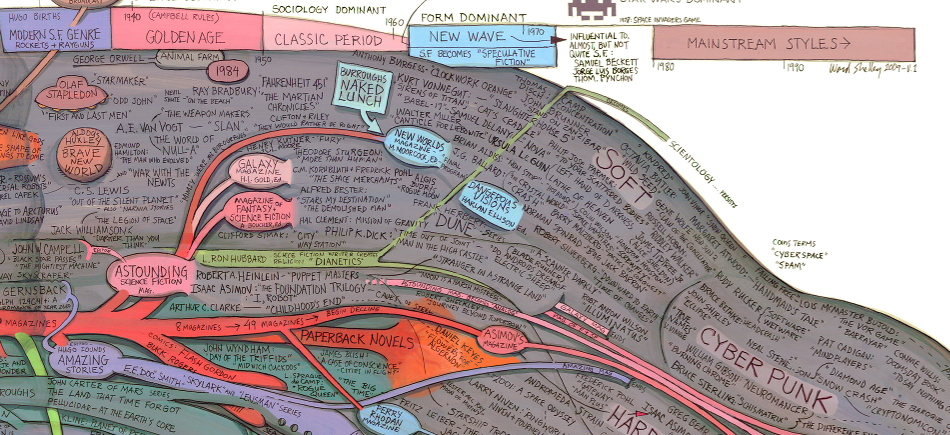
The gist of this piece seems to be that film has supplanted the need for world building in science fiction and, therefore, literary science fiction is turning to more literary expression and away from boring plot driven, world-building encumbered, need-a-physics-degree-specialized-audience-requiring works that used to be called Scientifiction.
As proof, a blunt comparison between the estimated 40 million copies of The Fellowship of the Ring that have been sold (“with a readership of likely triple that number”) and the 200 million “documented” viewers of the Jackson film of the same name, which they seem to suggest indicates some kind of dominance, if not complete replacement of one by the other.
Well, sure, if you put it that way. But how about if you stated that Tolkein’s first third of his original novel has had approximately 120 million readers to date (what about the rest of that doorstop novel?), while the film version has had an estimated 200 million viewers and that dominance fades a bit, doesn’t it?
They underscore this with the following:
“It has often been observed that speculative fiction won the culture war, becoming the ascendant genre and providing most of the popular culture touchpoints in current society, but what’s left unsaid is that it is filmic speculative fiction and fantasy that was the victor, not works of prose.”
Totally agree. The “filmic” version of speculative fiction has become somewhat dominant – except: the content that they are likely referring to is primarily dominated by Superhero films, which, while they push many of the buttons that SF does, do not usually observe the full set of rules required to meet the definition of the genre. They can, for the most part, be considered strongly adjacent to science fiction, but where’s the “dominance” if you pull the more than 100 MCU offerings out of the picture – SF film’s not looking so “dominant”. Add the DCCU and the indies and offshoots into the mix, pull them out too and you’re looking at a small handful of studio-funded, big-budget properties that can arguably be referred to as “Science Fiction”. You’ll get double to triple that number if you add in the films that are touted as SF, but really aren’t. (Films like “Planet of the Apes” or “Lucy”, two examples that use some of the tropes and scenery from science fiction, but are, if anything, more akin to science fantasy). It’s not movies about the impact of language on perceptions of the universe that the kids are flocking too, it’s movies about guys and gals who beat up other guys and gals in interesting gymnastical ways, and all over a bunch of jewels that simply can’t exist.
Regardless, when compared to the superhero numbers, SF film is about as “dominant” as that earlier 120 to 200 millions comparison, meaning, if not less so.
Beyond that, stating that “speculative fiction won the culture war” begs an awful lot of questions.
Seeing as how they listed both speculative fiction and fantasy as separate entities (“it is filmic speculative fiction and fantasy that was the victor”), we could start with a debate all about whether that’s justifiable categorization or not (even though they sort of had to include fantasy seeing as how their initial example was fantasy, and without it the “dominance thing gets diminished), but even if we concede that the two are lumped together in “genre” – fantasy is called fantasy because it is not science fiction, nor is it even speculative fiction.
Not to mention that “winning the culture war” would seem to suggest that one set of values has replaced another and while I will concede that there is definitely a replacement of one set of values by another currently going on in our culture, it sure as heck ain’t science fiction’s. (Maybe that’s where the fascist stuff crept in from.)
Which kind of gets to the heart of my criticism here. Which I’ll expose by tearing my shirt open superman-style, but not yet.
They go on to state: “Much of the heft of worldbuilding was suddenly provided to the consumer, in a more passive visual format. We would posit that this shift provided authors with the freedom to delve deeper into complex ideas, philosophical questions, and experimental narratives.”
But never question whether this is a good thing or not. Well, I guess they do suggest its a good thing, because they also write “…this shift provided authors with the freedom to delve deeper into complex ideas, philosophical questions, and experimental narratives.” As if such things were never present in the dark ages. As if the New Wave never sputtered. As if no one ever really read Brunner’s Club of Rome Quartet, as if Dhalgren never came to Bellona, or Joan never went to Whileaway. As if there’s no philosophy, however violent, to be found in A Clockwork Orange.
My dudes, “the heft of worldbuilding” IS what the genre is all about (the Science Fiction genre). Was the “heft of worldbuilding” removed from N.K. Jemisin’s Broken Earth trilogy? From Leckie’s Ancillary Justice? You can probably argue the “hardness” of those works, but not the worldbuilding. Which, I’d humbly argue, is at the heart of all four of those novels, if not the very exercise that brought them into being.
You do not get Science Fiction without worldbuilding. You get something like the bedtime stories my mother made up, where astronauts land on the sun and, because it’s so hot, they remove all of their clothes as a means for solving that problem. You get Atlanta Nights. (And now you also know why I am the way I am.)
Then – this: “Public appeals for a return to traditional “pulp” aesthetics, and “Campbellian” science fiction could be understood as being essentially similar in nature to the calls from the 1930s-era German Reichskulturkammer for visual arts.”
Which I’ll also get to in a bit.
And, finally, this: “We think its impacts have brought a broader public under the wing of fandom, prompting inevitable and uncomfortable splits within the subculture.”
I think they have entirely missed the point, across the board. But first –
The Puppies are an aberrant outgrowth of mainstream culture, not of Fandom, a pseudopod extended from that slime mold and, having found little to no nourishment within Fandom, has largely withdrawn to its own tiny, moistly dark corner. Fandom thoroughly rejected it, evidenced at least by the nearly complete sweep of No Award at the 2015 Hugo Awards. Fandom rejected it because Fandom’s cultural values do not include Fascism, whether they be from this year or from earlier in the previous century.
The call for a return to “nuggety nuggets” in Science Fiction was misunderstood and perverted by the Puppies, and is also misunderstood here. That call for a “return to Golden Age science fiction” (which is also misused as it refers to the age of a reader experiencing the literary genre for the first time, not an era in time) is a call not to regurgitate pulp. It is a call to remember that the genre, when maturely expressed, is supposed to be scientifically grounded extrapolations of as-yet unrealized science and/or technology, and its interplay with human people and/or their societies.
Whether that fiction is expressed as “commentary on our times” placed in unfamiliar settings in order to gain acceptance and remove potential pushback or expressed as prognostication regarding futures aspired to or warned about, the central concept is that it should draw its starting point from the here-and-now, known and verified, and rigorously hypothesize from there.
Anything less largely defeats its purpose – if its purpose is anything other than entertainment. I think it has one. I think there’s a direct connection between SF disparagingly referred to as “Campbellian” (a better descriptor might be “Clarkeian”) and the advances in science and technology our society experienced from the 1950s on – space programs, computers, material sciences. And I think that if our contemporary science fiction doesn’t include that, we’ll see a diminishment of such advances moving into our future. Remove the inspiration and you lose the innovation.
And as for “passive visual formats”: Think about this: READING Science Fiction requires that the reader actively engages their own powers of imagination to visualize and understand the story that was imagined inside the head of an author.
This is ACTIVE engagement. What’s a Stobor, why is it dangerous? How can I protect myself from it if I don’t even know what it looks like? The author will give you some hints, prompts and suggestions, sometimes detailed, sometimes not (Trantor was a planet made into a city, the Mesklinites resembled centipedes), but it requires the readers own thought processes to visualize and inform the story with those visualizations.
If, speculatively, we imagine a future in which all potential readers are passively receiving the visions of speculative fiction that are created by others, AIs, most likely – what will it matter whether an author creates a pulp-laden adventure tale full of cardboard characters, time-worn plots and silly make-believe or a high-falutin, deeply layered study of character full of philosophical insight, Joycian use of language and emotion-triggering content? NO ONE WILL BE READING, and if anyone does, they will lack the mental training required to give them the ability to mentally travel along with the author.
You’ll get the same reaction we currently get from the younger generations who have grown up on high-definition color televisions and wide screen, technicolor movies when exposed to truly classic Black and White Films: “It’s in black and white. That’s boring!” Dismissed. Why is it boring? It’s not their fault, because they’ve never learned how to receive and understand visual metaphor. They never had to imagine what colors the different shades of grey might be. They don’t know what it means when a character’s face is shown half in light and half in shadow. They don’t know that the actions of a character while expressing dialogue are a part of the dialogue.
Just as those only exposed to visual media will lack the mental skills required to read a book, starting with an understanding that “that’s a lot of pages” is not a detriment but a potential bonus.
Yes, Fandom has split. Perhaps even Balkanized. But the lesson that should be taken from that split is that our definitions and understanding of what the genre is and is about have gotten very confused over the past several decades and that if we want to see the literature preserved, strengthened and improved we need to remember that there are definitions.
NOT exclusionary guardrails. Definitions. Someone wants to write a science fantasy, doesn’t want to be concerned with having to calculate orbital mechanics or remember there’s such a thing as thermal dynamics, fine! Write a good story and I’ll enjoy it because you’ve written a good story AND I know what I’m getting into. If you wrapped a romance novel’s covers around a Stephen King story, you can bet I’ll be both confused and disappointed. But if we remember that we have definitions and we use them, we can all avoid such disconnects and disappointments.
(There was a time when publishers used to list other titles they published at the back of their books, if they had the spare pages. They’d usually go one of two routes, either “other titles by” the author you were reading, or “other science fiction titles”. You knew what you were getting – other science fiction. Maybe it wasn’t to your taste (which, fortunately for authors meant they still got their royalties), but it was science fiction. Those works had already been judged to fit by other readers, reviews and critique.)
Write something that’s on the borderlines? Great! Because definitions themselves are defined by critique and consensus.
THIS is Science Fiction.
I don’t like where you’re pointing.
OK, here’s why I’m pointing at it….
That’s dialogue. Sharing values.
The breakdown of our Fannish culture, the very thing that will allow other values to supplant them, comes from a loss of shared values, and values get lost when people don’t know or understand them. Have whatever values you want (well, not you, puppies), but know what they are. If they’re unfit for our times, they’ll change. If they work, we should keep them, and modify them accorordingly, but with care, with discussion and thoughtfulness.
It’s not even really a question about right or wrong. It’s a question of having some kind of agreed upon language that we use to exchange and discuss those values. How can you agree or disagree with something if you don’t know what the thing someone else is talking about actually means? “I hate framistams. We need to get rid of them all or society is going to fall apart! You agree with me, right?”
The correct response is “I don’t know what a framistam is, please enlighten me”.
I’d like to see a lot more “nuggety nuggets” being published in the science fiction genre, but by that I mean what I’ve just written about, not the unintelligible yippings of a puppy.

Steve Davidson is the publisher of Amazing Stories.
Steve has been a passionate fan of science fiction since the mid-60s, before he even knew what it was called.