
Regular readers of Amazing Stories will undoubtedly recall the reviews I completed on Brandon Sanderson’s Mistborn Series, a high-fantasy adventure spanning more than 300 years of history set within the fictional world of Scadrial, where the exploits of Allomancers are detailed.
If you recall, Allomancers are individuals endowed with the capacity to gain enhanced speed, strength, and other abilities after ingesting certain metals. Powers they can access, thanks to the safeguards set in place by the two opposing gods of that world, Preservation and Ruin, who strive to counter each other in a never-ending struggle for dominance.
As I mentioned before, that series also reveals Preservation and Ruin are, in fact, 2 of 16 opposing creational forces or intents – Shards – which came into existence with the shattering of Adonalsium, the original Supreme Being. Those Shards are bound in pairs, and though they bear an aspect of Adonalsium’s original nature, each pair stands divorced from their opposite number while vying for control within the greater Cosmere.
Having enjoyed how that universal model was addressed in the Mistborn Series, my last article began to explore how Sanderson expanded on his concept when I delved into the first three of ten proposed books – The Way of Kings; Words of Radiance, and a short novella, Edgedancer – in what has become the Stormlight Archive. A series that introduced us to the world of Roshar, along with another pair of opposing Shards: Odium and Honor.
To briefly recap, Roshar is divided by religious and political unrest, and the various kingdoms of that world all vie for control, many of them employing a magic system – based on Stormlight trapped in gems that are replenished during each highstorm – to try and get one over on their opponents. Their best warriors also use shardblades and shardplate, (mystically enhanced armor and weapons), to maintain their dominance, while ignoring the ethereal spirits of the higher and lower planes – spren – who seem drawn to the emotions given off by people as they contend with the ups and downs of their daily lives.
The first three novels follow the lives of several main players: Kaladin, Shallan, Dalinar, Adolin, and Lift, as their talents emerge amid the onset of change in this politically and religiously charged drama, while hinting that the reclusive tribespeople who have live for millennia in the shattered hills, the Parshendi, might have a deeper, more ominous history than was first imagined.
As events moved forward, certain individuals began regaining abilities of old, while, in tandem, the Parshendi dabbled with the potential for Armageddon by accessing the realm of the spren – Shadesmar – to trigger the Everstorm. An act that paved the way for them to reacquire the most powerful of their long-forgotten forms. That of the voidbringer, minions of the dark and hateful Shard, Odium.
It was as our main protagonists responded to those revelations that another blast from the past was rediscovered. Urithiru, the fabled city of the Heralds and Radiants, who also exercised uncanny abilities thousands of years ago in order to fight off Odium and those very same voidbringers. And just as well, because when the Everstorm struck, it brought ancient spren along with it, creatures who transform the Parshendi into beings of incredible power.
A point to remember is that as the story-arc unfolded, we were given hints of the existence of another set of players. The Ghostbloods. A secret society that has been keeping an eye on Roshar and its citizens for a very, very long time. Buuut, just who they are and where they’re from wasn’t revealed.
That recap brings us very nicely to the next two books in the series: Oathbringer and Rhythm of War.
Oathbringer.
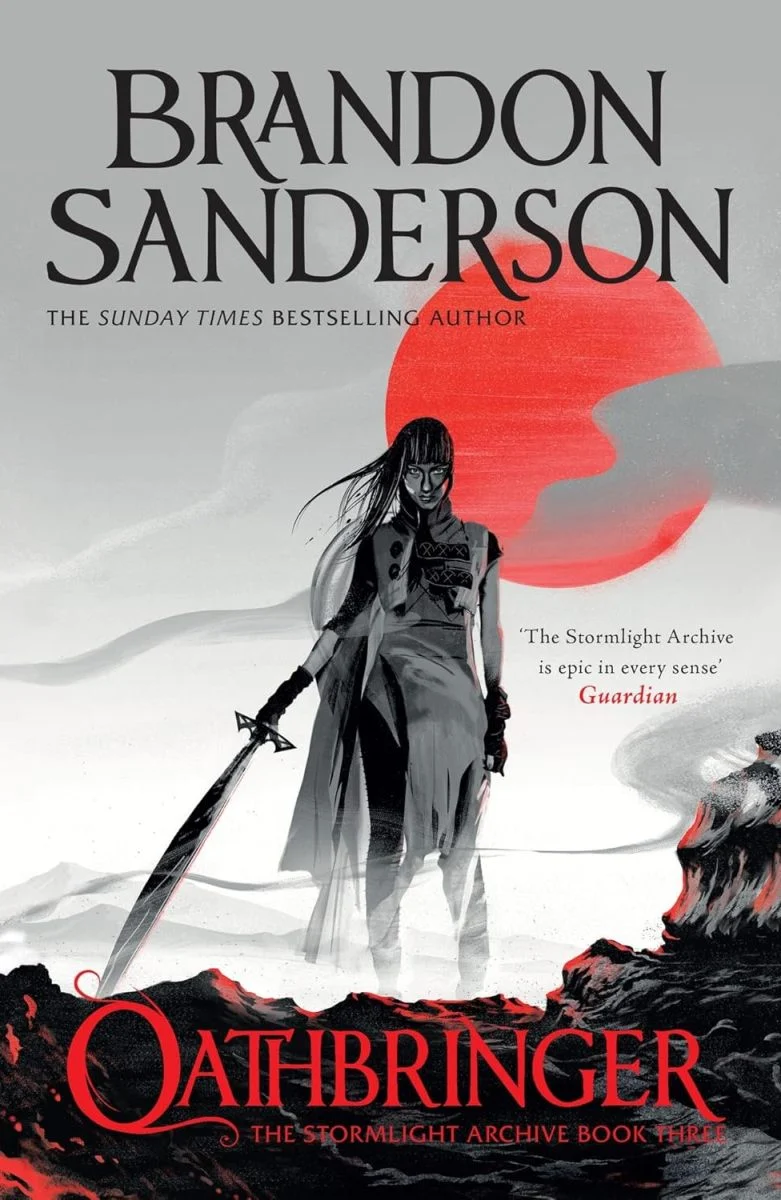
This book helps us uncover much more about the ancient Heralds and Radiants, along with their involvement in the ending of the last age, (termed, the Recreance). The world of the spren – Shadesmar – also gets examined in much more detail, as does the society of the spren themselves. In particular, it focuses on the results of the Parshendi’s decision to welcome the return of the ancestral spren, and the repeated battles that follow. (Don’t forget, the spren of Shadesmar are thousands of years old, experienced in battle, and harbor a deep animosity toward anyone who opposes them.)
It is as we start to understand the relationship between spren and those they bond with – human and Parshendi alike – that we also begin to comprehend the pitfalls of their magic system. How the spren actually manifest within the ‘real’ world, for example, is an absolute doozy.
We also get to see just how many types of spren there are and how that creates a clear distinction between the two camps. For example, the spren who decide to bond with humans often study their prospective partners for many years. Decades, even. While a certain faction of those who bond with the Parshendi are much more mercenary, especially if they’re of the primeval faction who fought against the Heralds and Radiants before. They become ‘Fused’ and lose all vestiges of their identity, their minds being overwritten by the persona of the immortal spren, many of whom teeter on the edge of insanity.
This also highlights the fact that each enhanced individual – Radiant or Fused – is endowed with their own particular blend of ethereal energy (surges): Stormlight or Voidlight. And get this. The two don’t mix. (Think of matter/antimatter and you’ll be on the right track).
The Kholin family turns to scientific development and the creation of artifacts to negate the abilities of the fused. But in this the ancient Fused have an edge. They’ve fought Heralds and Radiants before, don’t forget, and are already in possession of a limited number of weapons that can strip Stormlight from their opponents.
Little wonder, then, that as things kick off, the Parshendi/Fused open their campaign by targeting Kholinar, the capital of the strongest army on Roshar, and home to the royal family. A canny move, as Kholinar falls, and King Elhohar along with it as he tries desperately to rescue his family, leaving Dalinar the de facto regent in a time of escalating crisis. No easy task, for he has to navigate the stormy seas of politics while trying to unite the besieged nations of Roshar to fight against a common enemy. The strategic location of Urithiru and the Oathgates seem to help in this regard, though not as much as he would have liked.
Yet hope remains. Something about the abilities of the emerging Radiants worries Odium, forcing him to intervene, personally, in an attempt to derail both Dalinar and Kaladin. (A particularly absorbing thread, leading you to wonder . . . what is Odium’s weakness?) And can it be exploited, especially as it becomes apparent that there’s a third Shard of Adonalsium hiding on Roshar. But how? Isn’t each world only supposed to have two?
And if there is a third Shard, then who is the interloper?
In an even bigger twist, we discover Roshar was actually the ancestral home of the Parshendi, not humans . . . so WHO are the real voidbringers?
(A factor that just might have influenced the Radiants of old into abandoning the fight and walking away).
What this means, long-term, I’m intrigued to discover, for some among the Parshendi are willing to share and live in peace, while many of the Fused want to get rid of anybody who isn’t like them. Human and normal Parshendi – who they now refer to as Singers – alike.
Along the way, we take a closer look at Shallan, who, appearing to suffer from a strange personality disorder, increasingly resorts to dividing her talents between three distinctive personas: herself, as a highborn woman, and academic; Radiant as the gifted protector of the weak; and the ever shifty Veil, who walks a narrow line between espionage and murderous assassination. Doing so seems to allow her to cope with an unstable situation while drawing ever nearer to determining the identity of the Ghostbloods. Something that consumes her every waking moment, for the Ghostbloods know things they simply shouldn’t. . .
There are a few other nifty twists and turns along the way, which I won’t divulge here. Nonetheless, what you get is an intriguing, action-packed extravaganza that sweeps you through more than 1300 pages in much less time than you might imagine, and sets you up, ready to go with. . .
Rhythm of War
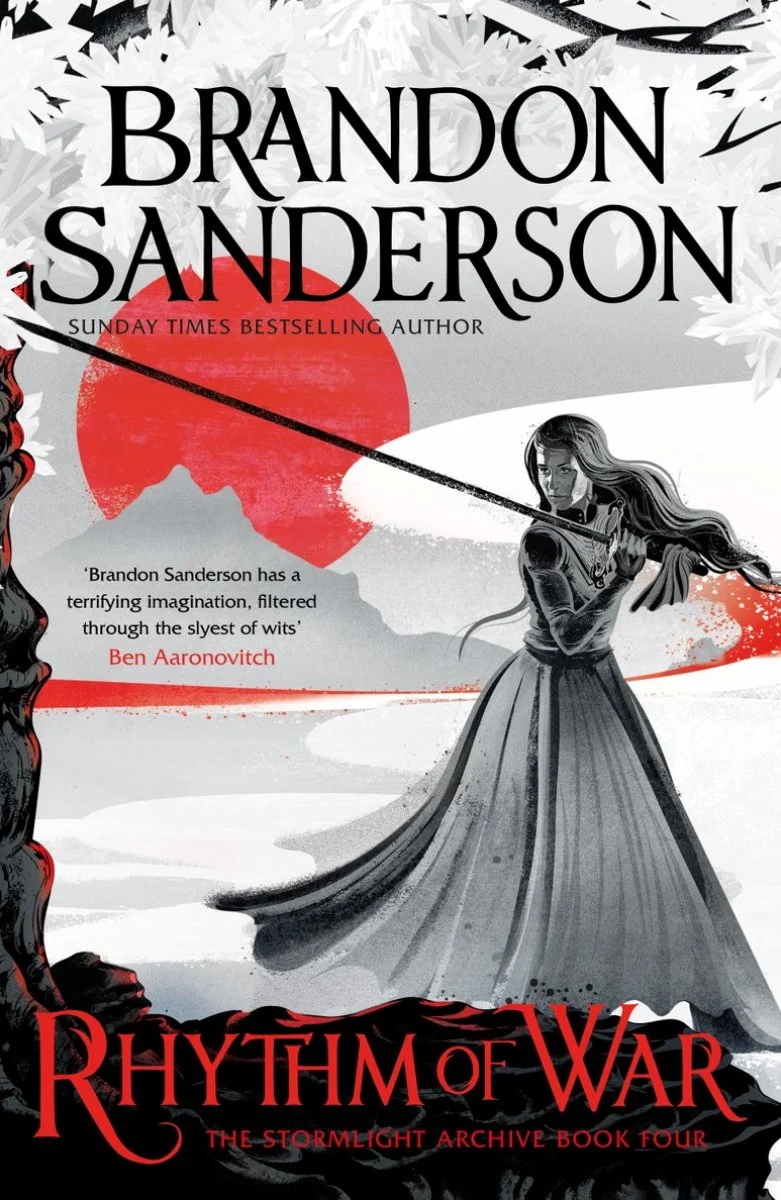
In my opinion, this was one of the most revealing chapters of the Stormlight Saga so far, with a number of stratifying threads.
For one thing, we find the story arc focuses much more on the Parshendi, particularly Eshonai and Venli’s family, through a series of flashbacks.
Those recaps help us appreciate just how devious the ancient spren – especially the servants of Odium – are, and how adroitly they maneuvered the human and Parshendi pieces of the chessboard into place. Only once the board was set was the Everstorm triggered, helping explain why the Fused were so successful in dividing Dalinar’s forces; how they were able to sack Kholinar; and – through the use of anti-Stormlight weapons – how they were able to overcome the newly returned Radiants in their siege against Urithiru . . . which they take with surprising ease, despite an alarmingly high casualty rate.
In tandem with this unfolding drama, we also focus on Shallan and Adolin, who travel into Shadesmar with the hope of persuading the honorspren to join the war; on Kaladin’s personal dilemma, having been left behind in Urithiru while Dalinar and the bulk of their army leave to support the war effort in Emul; and especially do we see the emergence of Navani as an intellect and true scholar as she tries to get to grips with the qualities of the different forms of light that empower both Radiants and Fused.
On Shallan’s part, we discover that her personality disorder goes back much further than we realized. She had a Cryptic before Pattern when she was a young child, a spren she accidentally killed after rejecting the bond following a severe personal trauma. That’s when Veil was created, though it’s intriguing to note that Veil didn’t seem to surface in Shallan’s consciousness until she became involved with the Ghostbloods. A necessary precaution, given that the Mraize of the Ghostbloods has given her a task to complete while in Shadesmar. One that could put the whole party in danger.
Radiant came along later, once Shallan’s powers manifested. Radiant is a heroic version of Shallan. The person she wishes she could be all the time. But this persona also reveals Shallan’s struggle with identity and self-worth. Radiant isn’t just a mask; she’s a refuge and a symbol of Shallan’s yearning for stability and redemption.
And then there’s her new spren, Pattern. A creature with a mind of its own who has been talking to Wit through the communication cube Mraize gave to Shallan. It seemed Pattern is concerned for Shallan’s welfare, and as such, has resorted to asking for Wit’s advice. Interesting, given that Wit is one of those ancient interlopers from another world I mentioned. And someone, evidently, who is keen to take a stand against Odium.
Another spren we see rise to prominence is the ‘soul’ of Adolin’s shardblade, Maya.
It transpires that the shardblades used in present-day Roshar are actually the corpse-like remnants of spren who were once bonded with the Knights Radiant of the former age. They become ‘dead-eyes’ in Shadesmar, hollowed out, zombie-like vestiges of their former selves, who are mourned by the other spren.
However, all is not lost, for it is revealed that a spirit of cooperation and respect may begin to heal these tortured souls. And once Adolin realizes what using a shardblade costs, he does his best to ensure such a travesty never happens again.
For Kaladin’s part, he is caught unawares when the Fused invade Urithiru. The Fused use their anti-Voidlight weapons to corrupt the fabrial powering the city, thereby neutralizing the Radiants, rendering them comatose. All, that is, besides Kaladin and Lift, who retain certain aspects of their surges and do their level best to fight back.
As they do so, we discover Urithiru is, in fact, the Sibling, an ancient spren who once blended with a Bondsmith. The Sibling withdrew from the world after the Recreance, and her slumber caused Urithiru to lose its magical functions. Something confirmed by Navani as she continues her research into the different expressions of light.
She also discovers that Gavilar was aware of anti-Voidlight before his death. Something that directly contributed to his murder by the Parshendi, who, in turn, were manipulated in a masterful way by spren loyal to Odium.
However, Navani’s discoveries are hampered when she is also charged by Raboniel – the Fused overseeing the occupying forces of Urithiru – with the task of proving if Stormlight and Voidlight are opposites. A wily assignment, as Raboniel is a true servant of Odium, and is ever alert to ways of eradicating the influence of the Heralds and Radiants for good.
Navani throws herself into the task, and, having seen the way that tuning forks encourage the transfer of energy between gems, hits upon the idea of music to accomplish her goal. She goes one further and sets about learning the rhythmic tones of Honor and Odium, and in doing so, actually succeeds in mixing Stormlight and Voidlight together in one gem, proving they can achieve congruence under the right conditions.
This highlights an existential point:
Though humankind are the interlopers, it is possible for them to learn the rhythms of Roshar. True, not as well as the Parshendi, but sufficient to prove that, after many, many generations, they are ‘of’ Roshar, and capable of living in harmony with her natural children. . .
A fact demonstrated by Venli, who bonds to a ‘good’ spren, and becomes a Radiant, choosing to side with the humans and those singers who wish to live in peace.
But how does all this mix together in the actual book?
Ah, you’ll have to find out for yourselves. But rest assured, yet another meaty tome of more than 1300 pages will soon fly by. It really is that absorbing. And little wonder, because along with some of the threads I’ve already revealed, here are a few other fascinating little snippets to keep you engrossed:
It is confirmed that the Ghostbloods aren’t from Roshar.
Heralds – along with other beings of power from different worlds – have been hiding right under our noses all along. Some in plain sight, others in much more elusive guises. Not the godsend you might think, though. As has happened to many of the ancient Fused, most of the Heralds are unbalanced. Psychotic, by anyone’s standards, making them just as dangerous as Odium is.
We learn where humankind came from: A planet called Ashyn, and just who it was that first led them between worlds . . . though the reason is not yet revealed.
And the last thing that I really didn’t anticipate was what happened to Taravangian!
That’s all I’ll say. But . . . Ouch!
I can’t wait to see how things develop in the fifth book and beyond. And neither should you. Treat yourselves to the beginnings of this truly epic series. I promise you, you won’t be disappointed.
Until the next time, happy reading.

Andrew P. Weston is a Royal Marine and Police veteran from the UK who now lives on the beautiful Greek island of Kos with his wife, Annette, and their growing family of rescue cats.
As creator of the critically acclaimed IX Series, the Cambion Journals, along with Hell Bound, Hell Hounds, and Hell Gate, (novels forming part of the Heroes in Hell universe), Andrew has the privilege of being a member of the Science Fiction and Fantasy Writers Association, the British Science Fiction Association, the British Fantasy Society, and the International Association of Media Tie-in Writers.
When relaxing, Andrew devotes some of his spare time to supporting animal charities, as well as writing review articles for Amazing Stories and The Magazine of Fantasy & Science Fiction.



Recent Comments