David Agranoff’s latest 25th Century Five and Dime post did a fine job of looking into the late Barry Malzberg’s career and contributions (I’ll never forgive him for being right about the space program and the space race, but dammit, he was right).
On the other hand, I’ll forever be grateful to Barry for setting the record straight on Hugo Gernsback in his Engines of the Night essay in which he acknowledges Gernsback’s “shady” business practices, but then goes on to largely discount them in light of Hugo’s having founded the genre – giving it a definition, giving it a supportive environment in which it could develop and grow, giving it a name AND giving it a Fandom.
 (Founders, like the rest of us, have feet of clay. I think this is an inescapable aspect of the human condition. I personally find it difficult to reconcile my appreciation of Gernsback’s contributions alongside Donald A. Wollheim’s equally important contributions – abetted by his Futurian colleagues – as the two of them clashed, but then history is nothing but messy.)
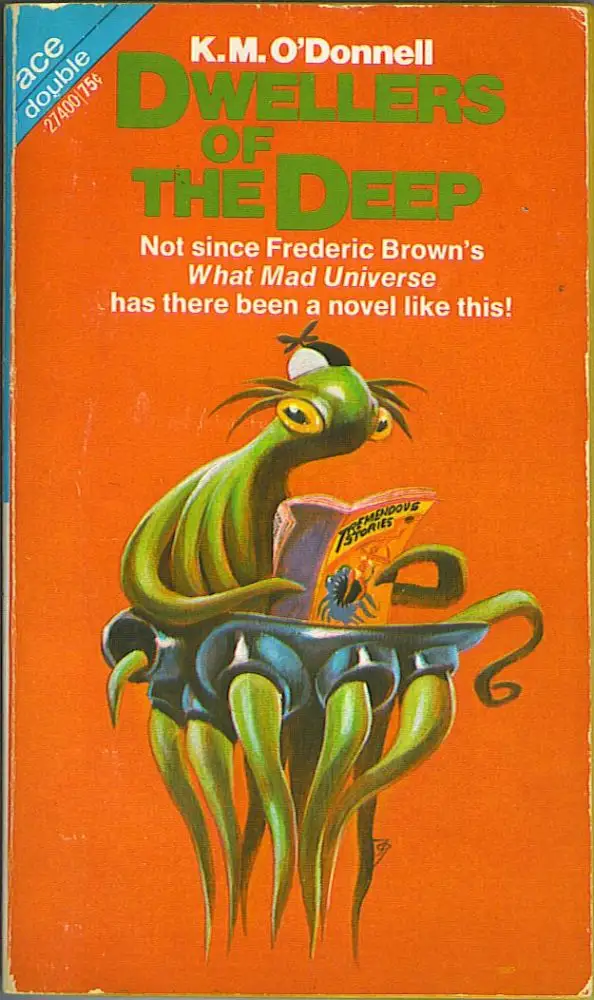
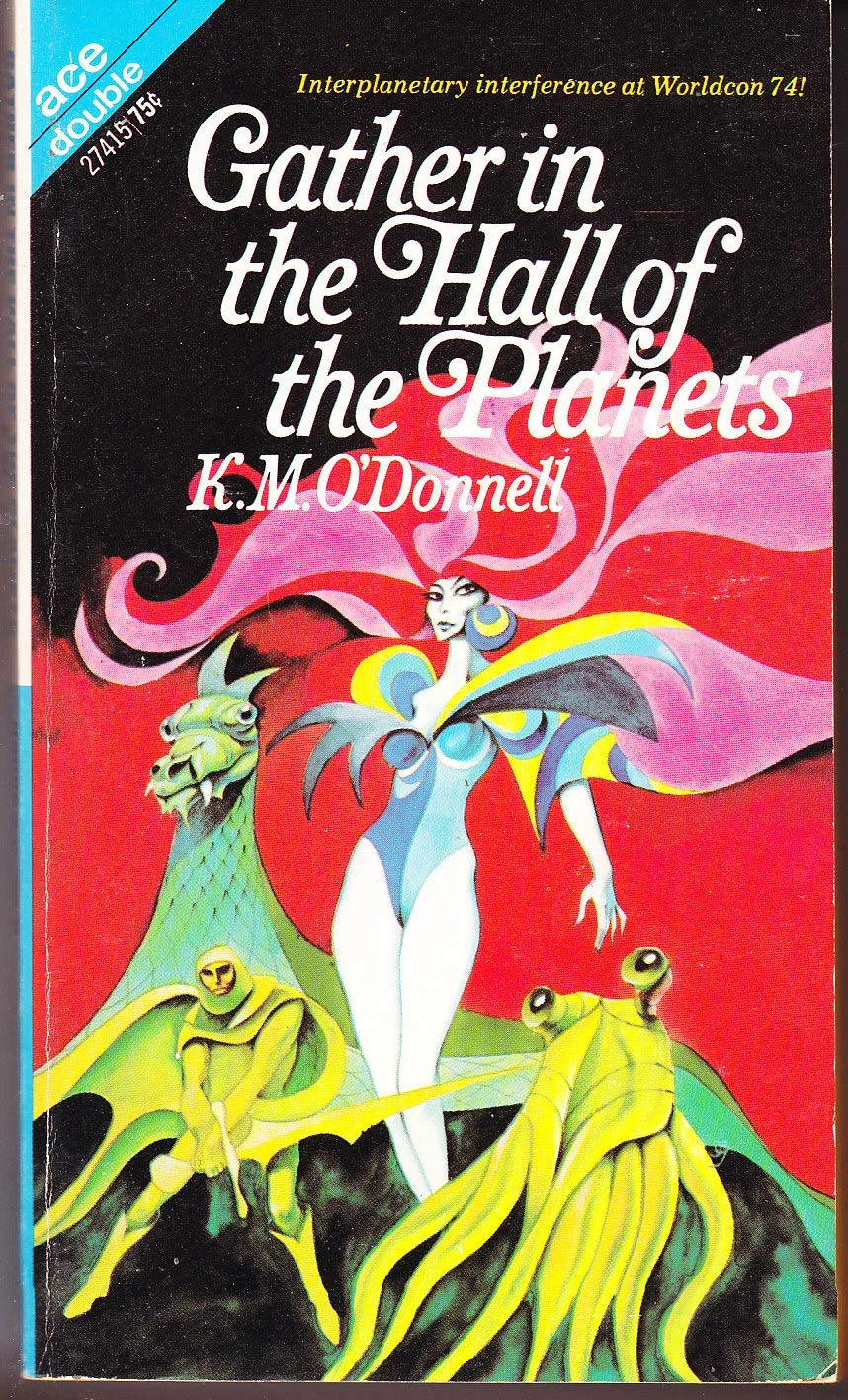
But that’s not the point of this piece, which is to expand a bit upon a portion of Malzberg’s career that David did not delve into deeply, the K.M. O’Donnell phase and, in particular, the comedic, genre-referential short novels – Gather in the Hall of the Planets and Dwellers in the Deep.
Briefly: Barry worked for the Scott Meredith literary agency as he began his writing career and created the O’Donnell pseudonym to avoid potential conflict with his agenting work. (I believe it was Barry who once told me that it was a fairly regular practice for agents at Meredith to sent a whole box of unsold manuscripts to a magazine editor looking for content. If that’s the case, I think he had little to worry about insofar as conflict was concerned.) He based that pseudonym as homage to the writing team of the Moore/Kornbluth writing team who themselves had used the pseudonym Lawrence O’Donnell. That writing team was well-known (under a variety of pseudonyms) for excellent short fiction, much of it cynical in some respects. I’m guessing, but that’s probably one of the things that appealed to him.
Anyway. I came to these two novels relatively early in my reading career, both as ACE Doubles, which I considered a bargain because I got two novels for the price of one.
Dwellers of the Deep was paired with The Gates of Time (Barrett), published in 1970 and concerns itself with interplanetary invasion that entwines itself with Fan clubs and the collecting of science fiction magazines, while Gather in the Hall of the Planets – “
Both novels are spot on and deadly, often cruelly accurate in their depiction of the personalities, circumstances, window dressing and motivations of a certain era in the world of science fiction. A world I would become deeply involved with just a few years later (my public, Fannish debut took place in ’74, though not at the Worldcon presented by Malzberg. It would be appropriate and perhaps even proper homage to Barry for me to wonder which reality is real and whether or not I have confused aspects of both in my own mind…)
 I believe it would be difficult for Fans not experienced with the club/convention era roughly corresponding to the 50’s through 80’s to identify with the characters and circumstances of these two novels, but my contemporaries certainly will. Wondering why folks just didn’t look various things up on the internet to help solve their “problems” is a potentially huge disconnect almost from the get-go.
On the other hand, theses novels taste and smell strongly of an accurate, if acerbic depiction of at least two aspects of Fandom of a certain era, so much so that I find it very difficult to accept what Barry told me about them.
He stated, quite emphatically, that when he wrote them, he had absolutely no knowledge or experience of Fandom, conventions, clubs or anything related and simply based his characterizations and circumstances on his observations of the human condition.
I think Barry was pulling my leg and enjoying a bit of a chuckle every time I happened to mention this fact somewhere. He started with the Scott Meredith Literary Agency in 1965 and had to have been exposed to the…quirks…of the SF community, if only through the quirks of the field’s editors (and the authors who he represented. Malzberg purportedly represented James Blish, Poul Anderson, Philip Jose Farmer, Jack Vance, Damon Knight, Ray Bradbury, William Tenn, Frederik Pohl, Henry Kuttner, Marion Zimmer Bradley, Alfred Bester, Jack Vance.
Blish, Bradbury, Pohl, Kuttner, and Bradley – at the very least – were deeply involved with Fandom, the former four all members of the Futurians, a very influential fan club founded 1n the 1930s. Some Fannishness (if not a lot of it) had to have rubbed off or seeped in while dealing with those individuals.
Barry Malzberg – the gift that keeps on giving even after discorporation.
(A relatively new version of both novels has been published by Stark House – but I think interested readers will find the covers of the original ACE editions to be contributory to potential enjoyment.)
Students of Comedic Science Fiction should enjoy these as they are favorably compared to Frederic Brown’s What Mad Universe.

Steve Davidson is the publisher of Amazing Stories.
Steve has been a passionate fan of science fiction since the mid-60s, before he even knew what it was called.