
- Publisher: Flatiron Books
- Publication date: April 2018
- Print length: 352 pages
- ISBN-13: 978-1-250-10781-7
- Authors: Hans Rosling, Ola Rosling, Anna Rosling Rönnlund
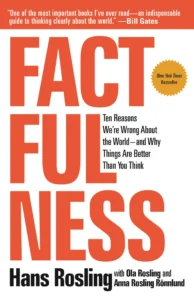
Factfulness: Ten Reasons We’re Wrong About the World – and Why Things Are Better Than You Think by Hans Rosling (with Ola Rosling and Anna Rosling Rönnlund) is an eye opening work. Though it was published nearly ten years ago, it is still gives important lessons on how even the most intelligent, most learned people can be ignorant, or worse. In fact, for the series of topics that Rosling covers, most people are not only ignorant, they are wrong. They believe they know things that are just not true. Some of this comes from how things have changed since they formed their impressions of the world at large. A lot of it is because the media focuses on the big shiny events, especially when those are destructive and violent. He gives some strategies for how to overcome this ignorance, both about the specific issues he relates and in general for any information.
Rosling begins the book with a series of questions for the reader to review and test their perception of their knowledge. You can find similar questions that may have more up-to-date data at www.gapminder.org or you can take the test in the introduction. He has found that normal audiences, in the Western World especially, do very poorly on these questions. They score worse than if the answers were chosen completely at random. We think we ‘know’, but what we ‘know’ is often wrong.
Through the rest of the book, he not only covers why you were probably wrong in most of your answers, but also some of the causes of these errors and how we can reduce the chances of this happening in other subjects. He covers ten instincts that humans have that contribute to misinformation lodging in our brains and being perceived as ‘truth’.
- The Gap Instinct – is the immediate reaction to think of us vs. them. To put society and people in binary categories. He proposed we stop thinking of the world as “The West” and “The Rest” or “The Developed” and “The Developing” and to start thinking in terms of four levels of humanity and societies based on their standard of living. These are not set groups with large gaps between them, but rather a fairly smooth bell curve from extreme poverty to wealth with the majority of folks somewhere in the middle. These levels can be thought of as pertaining to groups or individuals, countries or citizens.
- Level One is Extreme Poverty where people are trying to live on about $1 per day. There are about 1 billion people living at this level.
- Level Two people have quadrupled their income and are living on about $4 per day. There are roughly 3 billion here.
- Level Three have made it to about $16 per day. Another 2 billion are at this level.
- Level Four is where you almost certainly live making over $32 per day. About a billion live here.
- The Negativity Instinct – is the misconception that the world is getting worse, that there is more crime, more death, more poverty, etc. Rosling suggests we adopt an attitude, not of optimism, but of possiblism. It is possible for things to be bad and still be better than they were in the past. Looking at almost every measure, the world and people’s living conditions have improved over the decades. With a very few exceptions, people live longer, there is less crime, etc. He also recognizes there is still a lot of bad things in the world. A billion people live in extreme poverty, but that is down by about 50% in 20 years. Things can be bad, but still better… even if we need to keep working to remove the remaining bad.
- The Straight Line Instinct – is the tendency to see a trend line and assume it will continue in a straight line. In the short term a trend may look like a straight line, but most things in the real world do not meet those straight line trends in the long run. One example is population growth which has been increasing non-stop for centuries, but has spiked into a ‘hockey stick’ trend for the last century or so, but seems to be approaching the top of the growth curve and is likely to level out in the current century.
- The Fear Instinct – is that things we fear tend to override other perceptions. Not only do fearful things jump to the forefront of our attention, but they also impact our ability to think rationally. We miss things that might assuage those fears, or things that could help correct whatever the problem is, because we are too submerged in the fear reaction.
- The Size Instinct – is the tendency to look at an absolute number and judge it without understanding how it relates to other things. If something looks impressively large (or small) we may not understand the true meaning of the number. A billion people in extreme poverty is really bad. Comparing it to 20 years ago when it was twice that makes us understand it is better, still very bad, but still much better. Rosling suggests always comparing numbers. Don’t take just the worst case estimate, compare it to the best case, and the most likely case before judging. Also including things such as per capita rather than gross totals.
- The Generalization Instinct – is the tendency to generalize and stereotype people and groups. He recommends that we look for differences within groups and similarities across groups. e.g. Chances are you have more in common with someone living at a Level 4 income in a ‘developing’ country than you do with someone struggling at Level 1, 2 or 3 in your own country.
- The Destiny Instinct – is the misconception that because things have been one way for a long time that they will never change. In fact, they have most likely not been the same, slow change is often not perceived at all. We need to constantly update our knowledge, and understand that things that are improving slowly are not likely to be in the nightly news. Slow change is not news, but it is still change, and slow change over a long time is major change.
- The Single Perspective Instinct – is the tendency to look at things from a single POV. To get your news from the same source. To treat all problems like a nail if the only tool you have is a hammer. We should beware of simple ideas and simple solutions. Most problems are complex, and that is OK. Trying to jump to simple solutions often makes problems worse, or causes all new problems.
- The Blame Instinct – is the urge to blame an individual or a group for ‘the problem’. The flip side of this is the “Claim Instinct” where individuals like to claim responsibility for good things that happen. Almost always, either one is a result of systems interacting in complex ways. Individuals may contribute to a problem or a solution, but they are almost never solely responsible for either.
- The Urgency Instinct – is when something seems urgent, it likely is not as urgent as you think. Taking swift action without understanding the problem may cause other, worse problems. Rosling suggests slowing down when things seem urgent and taking small steps rather than leaping to conclusions and action without data.
There is a lot of other great information in this book. It was written nearly a decade ago, but it still resonates. Some of the individual data points have no doubt changed in that time. I’d recommend, after you finish reading Factfulness, go over to Gapminder to see how things have changed… probably for the better.
_______________
Phobias Series by Matt Truxaw


Matt Truxaw’s newest book is Monster. This urban fantasy, horror, thriller will keep you turning the pages.

He is also the author of the hard science fiction thrillers: “Plastiphobia/Plastivore” and “Anthrophobia: A Teacher’s Tale”

You can find them all on Amazon in Paperback, Hardback, Kindle and/or free to read with Kindle Unlimited.
When you read any of them, he would really appreciate a review/rating on Amazon or your favorite book seller/book reader site.
More about Matt:
He was born in Orange County California many years ago and he still lives there. He has been reading books for most of those years and writing up book reviews for the last few years. He gets MANY of his books out of the library/Libby so expect a lot of old science fiction classics book reviews and other science related reviews in addition to newer books he comes across.
If you want to be ‘in-the-loop’ on these and other works, you can follow his website( MattTruxaw.com), his author’s page on Amazon or his Facebook page.
For more reviews and articles by Matt here on Amazing Stories (Click here).
Monster: A Novel by Matt Truxaw









Recent Comments