July 25-27, 2025
(Join us in Orange County for the 5th International Philip K. Dick Festival at Cal State Fullerton August 20-23rd one week before WorldCon in Anaheim)
For this column, I am going to take you on my second Philip K. Dick Bay Area pilgrimage. Since it is an off year between Philip K. Dick festivals, the lower-key PKD hangout this summer is a tour of the PKD sites in Berkeley and Marin County. Organized by David Gill of the Point Reyes Reality Investigation Center.
I took the train up from San Diego, which started with a 6:01 AM train when most of the nerd world is converging on downtown San Diego, and I was escaping the other way. Once on the train, I started to read. One of the plans was for everyone gathering over the weekend to collectively read (re-read for most of us) PKD’s 1965 classic Dr. Bloodmoney. I read the first one hundred and sixty-nine pages before the train hit LA. Pausing to catch a picture of the Santa Ana train station, just a short distance away from the apartment PKD last lived in. On my second train, I finished reading the novel just after we passed Oxnard at noon.
Dr. Bloodmoney was a novel I remembered liking, but this second read blew me away. I made a list of sites and places we would need to see.
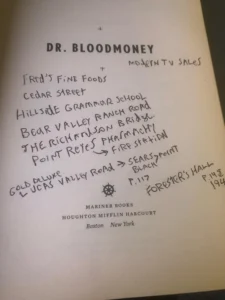
Since I have been focused on the short stories this year, it was fascinating to re-read this one. As good as I remembered this to be, it was even better. The depiction of E-day (The Emergency, the slang for the day the bombs fell) is incredible. From the ones who survived in Berkeley or west Marin, these were people a city away, or further from the blast, and the writing in those scenes are some of Phil’s best. The setting, being between West Marin, where Phil had been living when he wrote it, so it more autobiographical than I realized before.
For the next leg of the trip, I was reading in Collected Stories volume 5, as I am writing the Dickapedia entries for ALL of the short stories. I finally read Father of Our Fathers, the Dangerous Visions story, and it is a classic for a reason. I started and finished reading Mary and the Giant, one of the mainstream novels set in Marin County. It wasn’t great, but it had some strong moments, which is how I describe most of the mainstream novels.
I missed the Friday night party. I hear that RU Sirrus and editor Pamela Jackson showed up. I went straight to my two hotels: the Nash. I stayed at the Nash when I did this trip alone. The argument I made for staying there was that it was a part of the experience and was joined by (with fellow Dickheads Frank Hollander and Tom Scholte) Built in 1930, it was an operating hotel when Phil and his second wife, Kleo, were sneaking into movies at the Roxi theater across the street.
In the morning, I was able to meet my Stepbrother and family for Bagels. Bageltopia – great vegan options.
I met the PKD crew on Shattuck Ave. This is one of the main strips of Berkeley that runs along the edge of the University and through downtown. It is where Phil sold TVs and records for Herb Hollis at Art Music. We went to the site where the store was. It is currently for lease, and would make an excellent PKD museum if rich Dickheads are out there. It is also the spot where the fictional “Modern TV Sales” and “Fred’s Fine Foods” from Dr. Bloodmoney, whose employees and customers have to rush to bomb shelters when a massive bomb hits Berkeley two miles away at the corner of University and San Pueblo Ave.
Next, we walked to Cal Berkeley campus, where PKD didn’t last a semester, but he wrote poetically about it in his late novel Radio Free Albemuth. We filmed David Gill reading that passage. Then we walked to the site of the other Herb Hollis store worked at University Radio. That is of course, close to Moe’s Books, an amazing bookstore. We all drooled over the used SF section. They had a nearly 100-year-old issue, Amazing Stories and Thrilling Wonder Stories. I did pick up a copy of Astounding (from March 1953) featuring the first appearance of a teenage John Brunner under a pen name.
Then we went to San Pueblo Ave. This is a street that connects Oakland and Berkeley, and where Phil liked to go for walks. It is mentioned in his fiction often and plays a major role in the mainstream novel Humpty-Dumpty in Oakland. The crew got lunch, and we walked to the Francisco house.
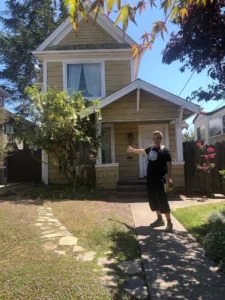
I have been here before, but this one is special to me. Phil and Kleo moved in around May 1950, one month before they got married, and paid $27.50 a month to live there. Almost everything written in the 50s was composed on a table in the dining room behind that front window in the dining room. All thirty-four of the short stories of 1953, Solar Lottery, Time out of Joint, and The Second Variety, the list is incredible.
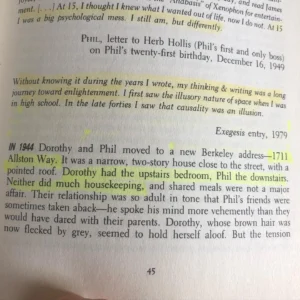
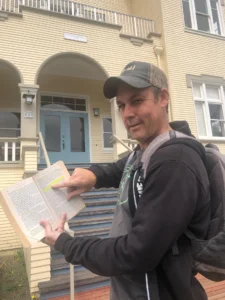
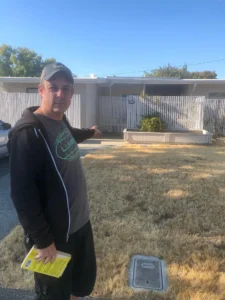
Next, we went to the Alliston house. Phil and his mother moved into the house in 1944, and Phil lived with her through high school. When we walked up, there was a man sitting outside eating an apple. He knew that Phil had lived there. He was amused by a dozen people stepping up to look at his house. I told him Phil lived downstairs. “There is no bedroom down there.” I showed him the mention of his house in Divine Invasions. He looks at the book and then at me. “Come inside, you tell me where you think he made his room.” Once I was inside (wow, totally amazing) we both agreed that he probably set up the dining room off the kitchen as his room. I tried to be respectful and not take pictures.
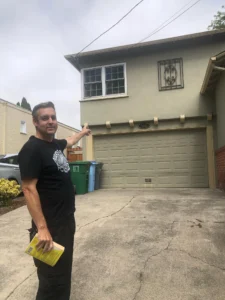
Next, we went to the Boucher house. This was the site of the Thursday night $1 writing workshops that Phil and many other famous writers attended. The window over the garage is where Boucher wrote and edited the first issues of the Magazine of Fantasy and Science Fiction, still being published 70 years later.
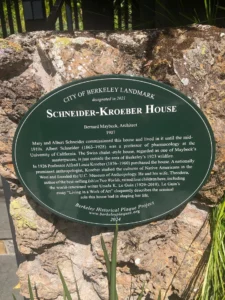
We saw how close the first apartment on 2208 McKinnley would have been. We went to Dorthy and Phil’s first house in Berkley, which they lived in 1938, the Walnut and Arch Street houses. Then went to Ursula K. Leguin’s childhood home. Which now has a historical plaque. Boucher, Leguin have plaques; none of the PKD houses do, probably because of us weirdos.
We took a break, and I went and got an amazing vegan Reuben at the Butcher’s Son vegan deli. When we met back up, we took the ferry into San Francisco. We got a robot taxi that took us to Portsmouth Square. One of the most powerful scenes in PKD’s Hugo Award-winning classic took place at this park when Tagomi sat on a bench and moved between worlds. Sitting in the spot David Gill read the entire scene. It was powerful hearing those words in a 2025 reality that would have looked as shocking to Phil, who wrote about this spot decades ago.
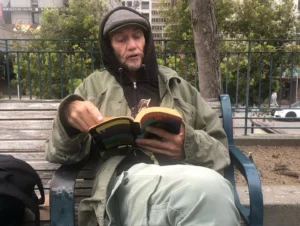
We walked around Chinatown, and this lifelong Big Trouble Little China fan loved this. We found the modern version of the restaurant where Kelo and Phil had their first date. We took the BART back to Berkeley and rested up for Marin.
Sunday morning, after crossing the bay and going through the foothills, was a visit to the art studio of Inez, who is 91 years old. Whose parents escaped Nazi Germany and became friends with Phil and Anne when she was 26. She testified at their divorce. She laughed at a few of our questions, but talked about her father, who flew planes over the Andes Mountains and worked in Hollywood. This was a really powerful moment of the weekend. When she was talking about her father who was in the Luftwaffe but married a Jewish woman. Who became an Art director in Hollywood and worked on the Cage the first TOS pilot. She told us Phil lit up whenever they talked about her father. It was the kinda human detail you would never get in a book.
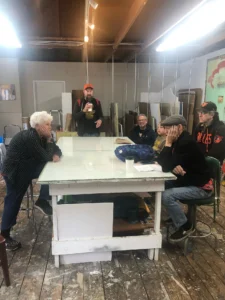
We parked near Anne Dick’s old House. PKD lived here from about 1960-1964. Phil rented a shack he called the hovel, a short walk around two corners. We did the walk he made to write Three Stigmata of Palmer Eldritch, Martian Time, and many others. We walked where he had his spiritual crisis and claimed to see a mechanical face of god.
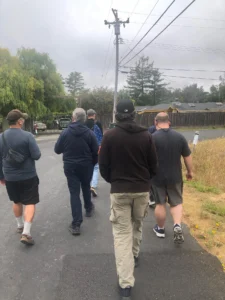
We did PKD trivia in the Point Reyes Old Western saloon, Phil wrote about it in Confessions of a Crap Artist.
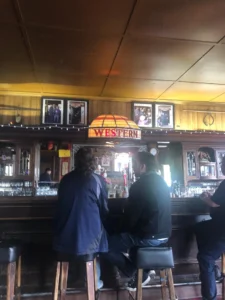
In PKD’s classic novel Dr. Bloodmoney the survivors of the atomic war in West Marin gathered at Foresters Hall to listen to Walt Dangerfield transmit a radio signal stuck in orbit. Foresters Hall is like 90 feet from Phil and Kleo’s first house in Marin.
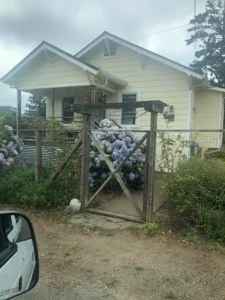
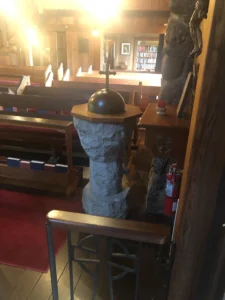
We toured this insanely beautiful country church. Why? PKD was baptized in this church. After his spiritual crisis (that inspired Three Stigmata) he went to talk with the priest Francis Read, the guy in the picture. The church was built as a summer home for a super-duper rich family in the 30’s. The views from the bedrooms were beautiful. Phil wrote about the experiences in this church many times. It was a beautiful building to see, and the history was a bonus.
This shabby little house was where Phil and Nancy lived in San Rafael. UBIK, Galactic Pot Healer, and Do Androids Dream of Electric Sheep were written here. I thought since this was Marin County that the house out in the countryside somewhere, I was surprised that this part of San Rafel was more suburban, but in a sense the keeping up with the joneses aspects of DADES makes sense now.
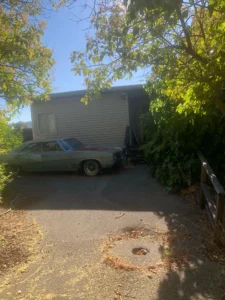
Just our last stop is 707 Hacienda Way. The unassuming tract home is the site of two of the most famous moments of PKD’s life and represents the rock bottom he needed to move on to Orange County. This is the house that has a “break-in” that resulted in an interview, which Paul Williams published in a book called “Only Apparently Real.” AKA as the Scanner Darkly house. He wrote Flow My Tears, The Policeman Said in this house. Bad Mojo here, but fascinating to see it.
Going to all these places may seem strange to some, but connecting to these places really connects me with Phil. Going to the places he wrote about in Man in the High Castle or Dr. Bloodmoney, also gave me a feeling that is hard to put into words. I have talked at length about seeing the class difference between Leguin and PKD, but this trip helped me to understand PKD’s life in Marin, which was very different. Giving up their modest but nice home in Berkeley to move out to the country could’ve been ideal for Phil and Kleo, who would later insist her role was editor was underrated.
Phil couldn’t help himself and entered into an instant family and country life, which only lasted a few years, while he tried again in San Rafel, it got very dark. Still he wrote classics. I hope we can encourage people to visit the homes of other writers Octavia Butler, Ray Bradbury are on my list…
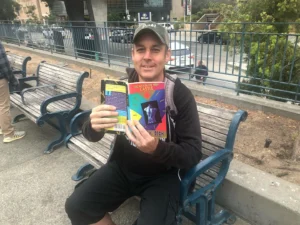

David Agranoff Grew up in Bloomington, Indiana hanging in the park that inspired this novel. His future wife worked at the Spoon serving the real-life Electric Fred. They have two of his notebooks and a house full of rescued animals. David is a novelist, screenwriter and a Horror and Science Fiction critic. He is the Splatterpunk and Wonderland book award nominated author of 11 books including the novels the WW II Vampire novel – The Last Night to Kill Nazis, and the science fiction novel Goddamn Killing Machines from CLASH BOOKS, The Cli-fi novel Ring of Fire, Punk Rock Ghost Story He co-wrote a novel Nightmare City (with Anthony Trevino) that he likes to pitch as The Wire if Clive Barker and Philip K Dick were on the writing staff. As a critic he has written more than a thousand book reviews on his blog Postcards from a Dying World which has recently become a podcast, featuring interviews with award-winning and bestselling authors such Stephen Graham Jones, Paul Tremblay, Alma Katsu and Josh Malerman. For the last five years David has co-hosted the Dickheads podcast, a deep-dive into the work of Philip K. Dick reviewing his novels in publication order as well as the history of Science Fiction. David’s non-fiction essays have appeared on Tor.com, NeoText and Cemetery Dance. He just finished writing a book, Unfinished PKD on the unpublished fragments and outlines of Philip K. Dick. He lives in San Diego where you can find him hooping in pick-up games and taking too many threes.