

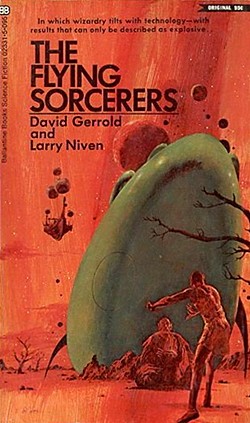
One of the challenges of being a fan of humorous science fiction is finding enough quality material to satisfy the appetite, so it is always a pleasure when I find an older book that I’ve overlooked for one reason or another. I only recently came to realize that The Flying Sorcerers by David Gerrold and Larry Niven is a work of humorous SF. Considering that it was originally serialized in If magazine in 1970, I am not sure how I managed to remain ignorant of this fact for so long. The embarrassing part is that I must have ordered this title more than a dozen times off the backlist when I was a buyer for a bookstore.
The central narrative revolves around a clash of cultures and magicians. A man from a space-faring civilization visits a world with primitive villages where the short and furry locals see everything as the workings of gods and magic. The story is told from the perspective of Lant, a native tradesman and close friend of Shoogar, the temperamental village magician. Much of the most effective humor in the story comes from Lant’s attempts to describe the actions and devices of the spaceman in terms of magic (a la Clarke’s Law).
The tradition filled lives of the villagers are disrupted by the arrival of this man from space whom they presume to be a mad magician. Almost immediately, trouble brews between the two magicians as the newcomer inadvertently insults Shoogar by not observing prescribed customs. Additionally, the mad magician appears to have great power, threatening Shoogar’s supremacy as village magician and bruising his ego. As a matter of pride and honor, Shoogar decides a duel is necessary and sets out to kill his adversary. Knowing that magicians’ duels are notoriously violent, the villagers head for the hills. Life, at least for those who manage to keep it, will never be the same.
Gerrold and Niven engage in a variety of word play, often eliciting a laugh, occasionally producing a groan. Of particular note is the novel’s heavy use of Tuckerizations and inside jokes for SF/F fans. Reader reactions to these will vary depending on background and knowledge of personalities that were active in the SF/F community at the time. Generally, I felt they added to the enjoyment of the story. For instance, I found the perception that certain events were the result of angering the god Elcin (Harlan Ellison) to be hilarious. The story, however, is sufficiently funny and entertaining for younger or more casual fans to enjoy without getting these inside jokes.
 Considering the playfulness of the novel, I think it would be a mistake to overanalyze the story for heavy messages of social importance. To be sure, there are social commentaries on a variety of issues ranging from industrialization to women’s liberation, but these are not the central themes of the story. Even so, the impulse to find hidden things in the story is strong, in part because the reader is already looking below the surface for in-jokes and such. Perhaps if there is a sub-surface message to take away it would be in the subtle exploration of the related natures of magic and science.
As one might expect from a book that involves Niven, you are bound to learn a thing or two about science and engineering (unless you already happen to be a scientist or engineer). From this novel, you will come away with at least a rudimentary understanding of how to build an airship from scratch (something steampunk fans might enjoy).
Ultimately, The Flying Sorcerers is an entertainingly playful, and sometimes silly, comedy written by two major talents in the field. I highly recommend it to any SF/F fan looking for a good laugh.





Recent Comments