
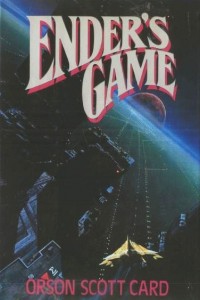
 Troll the internet for “the greatest science fiction novels of all time” and Orson Scott Card’s Ender’s Game will be at the top of every list you’ll find. (Or it was last time I checked.) It’s been at the top of every list for at least two decades now and will probably always be there . . . but I don’t know why. I don’t know why it’s a better book that A Canticle for Leibowitz or The Man in the High Castle or The Left Hand of Darkness or Brave New World or The Earth Abides or Childhood’s End. I don’t know why it’s been deemed by fans as being better than Beyond This Horizon or The Space Merchants or Alas, Babylon or Slaughterhouse Five. I don’t understand it. I never have.
I mean, I do know technically why fans have voted it the greatest science fiction novel ever written. It appeals to all those readers who feel (or have felt) abused; those readers who feel alienated, ignored, or have at some time been helpless before bullies and tyrants and who wanted revenge, not only on them, but on the whole world. Ender’s Game delivers all of that–in spades.
Yet when I read the book in 1985 when it first appeared, I was stunned by my own reaction to it, at how unpleasant I found it. When it started climbing the list of “great” SF novels, I became even more perplexed. This is because when I think of all of the “great” science fiction novels I’ve ever read (and I’ve read most of them since I started reading in ernest in 1958), I think of how much fun they were to read. Is Ender’s Game truly a better book, a more fun book, than To Your Scattered Bodies Go or The Three Stigmata of Palmer Eldritch or The Martian Time-Slip?
Please don’t misunderstand me here. I’m talking about my own personal response to Ender’s Game based on my life-long love for science fiction (as well as the art and craft of writing). The book just wasn’t any fun. Neither was Speaker for the Dead (which I openly admit I never finished). It’s possible, I suppose, to say that I ought to like Ender’s Game because so many millions of other people like it. But that argument is as specious as it is misguided. One ought to like beets because they’ve got vitamins in them. But no argument can compel me to like something like beets (or the so-called music of Lil Wayne or Jay-Z) for any reason. One’s rational and deductive; the other is based on one’s taste which are not rational. (I remember seeing an album by Elvis when I was young. On the cover it said: “Twenty Million Elvis Fans Can’t be Wrong”. Well, yes they can if you don’t like Elvis.)
In my last blog entry I talked about my sense of wonder–which was almost a shift in consciousness–in reading a small passage in Philip José Farmer’s The Dark Design, the third book in his Riverworld Series. It blew me away. The scene not only thrilled me to no end, but it encapsulated for me the best of what science fiction can do: it can take you to places you’ve never been before. It can dazzle and delight. It can conjure and it comes closest to being magical. Truly, it’s beyond any rational analysis. But since you’ve also experienced it, you know what I’m talking about.
Now, I understand that the two or three of you who read my blog regularly probably love Ender’s Game and worship the ground that Card walks on. My students at ASU certainly do and Card’s fans are in the millions world-wide. My opinion here is definitely in the minority. This is about something that Carlos Castaneda says in his book, Journey to Ixtlan. One night in the hills of central Mexico, Don Juan Matus, Castaneda’s teacher, tells him: “Never listen to your mind. Your mind will always play tricks on you. Always listen to your body for your body will never lie.”
What he’s talking about here are intuitions, instincts. We make choices based on taste all of the time–when we go to the grocery store, when we purchasing books on amazon.com, or when we decide which movie to see on the weekend. These decisions, though taking place in the “mind”, really are informed more by our “gut” feelings. There are movies I won’t see because I don’t like the actors or the director or the story. It’s the same way with you. (And forgive me for telling you something your already know.)
But let’s play the devil’s advocate here. There is a possible argument wherein we could accept the “unpleasantness” of Ender’s Game as being worthwhile. It comes up in literature classes all the time. It goes like this: “Since when does ‘literature’ have to be pleasant? Most novels and short stories, after all, are quite unpleasant. Just read any story by Flannery O’Connor and you’ll understand.”
I would counter that some of us get great pleasure in reading writers who are challenging and even might be deemed depressing. Thomas Hardy would be one, D.H. Lawrence would be another, perhaps even the aforementioned Flannery O’Connor. But I maintain that there is something truly creepy in Ender’s Game that can’t be found in William Faulkner or Emile Zola. Whatever else there is in their stories, there is also a kind of joy in their writing. That’s why I love Thomas Pynchon, Jorge Luis Borges, and Saul Bellow. Their characters shine and the writing is spectacular. And many of their stories are actually a lot of fun to read. I loved Pynchon’s Against the Day which is arguably a science fiction novel and for as difficult a read as Pynchon’s Mason and Dixon was, it was still fun.
And that’s what it comes down to. I read for pleasure–first. Aesthetic illumination and literary analysis can come later. But I personally found no pleasure in Ender’s Game. I don’t like it. I never will. There is (for me) no sense of wonder in the book and I found all of the characters unbelievable. This is mostly because I have known many six year-olds in my time and they don’t have the wisdom and verbal articulation skills of fifty year-old men. They certainly don’t lecture adults. I didn’t believe it then, I don’t believe it now. Children don’t speak or emote the way the do in Ender’s Game. (And I absolutely am not interested in scenes of naked boys wrestling with each other. That is the essence of creepiness for me.)
Now, I know that I’ve just engaged in apostasy and that you’ll attack me for not liking your favorite book of all time. But I need to assure you here that this isn’t about you–even though you’ll be offended at what I have just said. I’m just talking about the joy I feel in reading a great science fiction novel or story . . . and how that joy was lacking for me in Ender’s Game.
–Paul Cook









Well, Paul – –
I can't say I share your loathing for the book, but a several weeks ago we were discussing this book elsewhere and I agreed that there's a lack of finis to the ending. The closure isn't there that it needs.
Now that you mention it, the idea of a bunch of naked boys wrestling as a main plot element does seem to have a certain creepiness to it.
But even beyond that, I don't believe that everyone has to grok a majority opinion. As has been proven in the past: 50,000 Nazis (Communisits, Sandinistas, SF fans, –place your preference here–) CAN be wrong. Sometimes I think certain books acquire a certain momentum and the inertia is unjustified.
It's also possibile that people just don't want to acquire the opinion of being a difficult critic. In this case, it matters less to me that we agree in our love of a given book, than it does that we agree in our love of books.
For what it's worth, you have my respect for speaking your mind. I don't think it's necessary to crucify a writer, but honestly expressing an opinion about a book is all I expect from any decent critic. So on that account, your credibility is good in my eyes.
Hi, J.
I certainly wouldn't attack Card personally for this book. All any critic has is the artifact in hand. I was only talking about my reaction–as you were about yours. Both are valid and I wouldn't even attempt to diminish your response because it disagrees with mine. But I think science fiction (and fantasy) could use more back-and-forth as to the worth or impact (or fun or the lack thereof) of everything that's published. Anymore, though, people (such as myself) get skewered for having an opposing opinion, even a minority opinion. That doesn't bother me, though (and it shouldn't bother any critic worth his or her salt). Still, it's the back-and-forth that I value. We're all in this because we love science fiction and that's the point.
You've described my experience perfectly! Except in my case it was "Dune". My usual rule with books is I give them a chapter. If they haven't hooked me, I leave them. But because so many people have said so many things about "Dune", I keep trying to reread it every five or ten years. Once I got as far as chapter three before deciding that the characters and the setting were just too boring for me to continue.
Great example, Martin. I once heard Robert J. Sawyer discussing the importance of humor in fiction, as a way of emotionally connecting with the reader, and he cited Dune as an example of a totally humorless book. After hearing that, I realized that was the reason I could never get through Dune. I couldn't emotionally connect with any of the characters on any level, because they were all just too serious and boring all of the time.
Read "Ender's Game" some six months ago. Really enjoyed the book, and I'm really looking forward the film – but I'm baffled as well by its inclusion in every SF top-10 out there. As far as military SF go, at least for me it's way beyond "The Forever War" (one of my personal favourite books) and even "Starship Troopers". Cannot even be compared to other SF masterpieces such as "Hyperion", "Childhood's End" or "The Stars My Destination".
"In my last blog entry I talked about my sense of wonder–which was almost a shift in consciousness–in reading a small passage in Philip José Farmer’s The Dark Design, the third book in his Riverworld Series. It blew me away. The scene not only thrilled me to no end, but it encapsulated for me the best of what science fiction can do: it can take you to places you’ve never been before. It can dazzle and delight. It can conjure and it comes closest to being magical. Truly, it’s beyond any rational analysis. But since you’ve also experienced it, you know what I’m talking about."
Paul – This is the closest anyone has come, including me, to describing the joy I experience in a book of great science fiction. Thank you for "singing" a tune my heart recognizes so deeply.
I read Ender's Game initially in the early 90's, when I was about 14 or 15, so it was a formative book for me. As someone who tested into Mensa in the 8th grade (largely because I was a fan of Isaac Asimov), I had no difficulty with the concept of gathering together a group of brilliant kids and them handling the situation in the way that they were presented. I recently re-read the book in preparation for my essay in the upcoming Ender's Game and Philosophy collection and found that it held up fairly well.
I say that despite having been let down by the sequels. I loved Speaker For the Dead & respect the cleverness of Ender's Shadow, but the world would be better if he'd never written any Enderverse stories beyond those three and had devoted his time to, say, completing the Alvin Maker stories. In fact, his recent book Pathfinder is one that I've basically cast aside halfway through and have no serious plans to ever return to, something which I virtually never do. Despite having read pretty much Orson Scott Card book (including much non-fiction, and even some of his religious fiction), I've finally reached the point where the return is just too diminishing. For example, he's said that he considers his greatest work to be Magic Street, and I considered that book to be a complete waste of time (mine for writing it and his for reading it).
Any way, back to Ender's Game … the "unpleasantness" you describe there is just something I don't see. My problem is that I've been reading Card for twenty years, but only for about the first five of those was he saying anything that resonated with me. I feel that I've grown as a reader, but he hasn't similarly grown as a writer. He wrote, as you suggest, the quintessential book about being a gifted kid who is an outcast because of it and rises to greatness, but then suffers for it. In some ways, Ender's story (in Ender's Game & Speaker for the Dead, at least) captures the hero's journey perfectly and part of the reason the rest of his fiction suffers so strongly, in my opinion, is that he seems to constantly be trying to re-capture the same feeling in new stories, and it's never done nearly as well as he did it that first time. I'm looking for new stories and he's still trying to tell me the same one that he told me twenty years ago.
Each to their own taste. Personally I find Tolkien and LeGuin impossible to read and boring as all get out. Putting aside the issue of Card's personal views (and just watch how they keep him under wraps when the "Ender's Game" movie comes out) I found both "Ender's Game" and "Speaker for the Dead" immensely entertaining and thought-provoking. I enjoyed them so much I spent much time tracking down Card's other SF (less so his fantasy).
You're certainly entitled to your opinion. But as I accept the brickbats of fans when I lambaste Tolkien's turgid prose and those endless and awful movies, you should realize that when it comes to "Ender's Game" you are in the minority as well.
Daniel,
You're absolutely correct in saying I'm in the minority in my feelings towards Ender's Game. I know that. Card's readers are legion. But I have for years wrestled with my feelings towards that book when I considered other "great" SF novels beside it. It comes down to taste, and it comes down to when one reads Ender's Game. I read Clarke, Asimov, Dick, Burroughs (and Doc Savage) in my formative years. Others read Ender's Game. I get it. All I did was respond honestly. (And, yest, I understand your comments on Tolkien and LeGuin with which I totally agree.)
Paul,
I think that there's some real profundity in your statement that "it comes down to WHEN one reads" (emphasis mine). The timing is not just a matter of your age or maturity, but also the political and social climate of when you're reading. Books like "The Forever War," for instance, of necessity mean something different to people who weren't alive during the Vietnam War.
Geoffrey
I read it in my thirties, not as a kid. I was greatly impressed with it and consider it a modern classic of SF. Indeed, both it and "Speaker for the Dead" won Hugos for best novels in their respective years. Now I'm the first to admit that awards like the Hugos — and the Oscars — are not definitive arbiters of taste or quality, and I've disliked a number of the Hugo choices for best novel or found them vastly overrated. But it does shoot down the idea that the book's popularity is based on reading it when you're a kid. The Hugos are not decided by kids.
Which brings me back to it's a matter of taste. I can explain why *I* am bored to tears by Tolkien, but I don't make the argument that those who like him are wrong (except in jest).