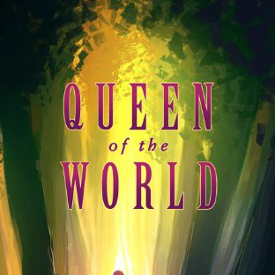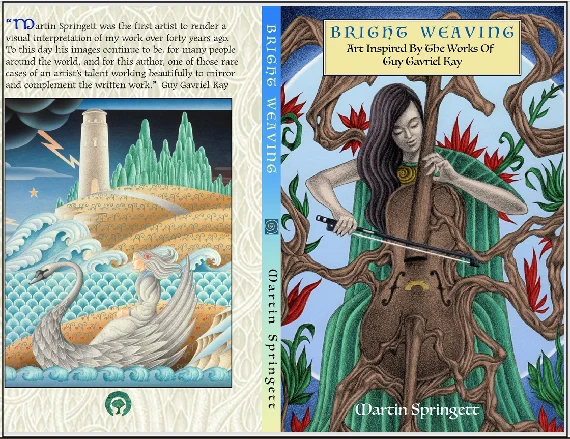
Many people in Canada have heard of the Canadian writer Guy Gavriel Kay. He’s written many thick fantasy and historical fantasy novels, which have gained him worldwide acclaim as a writer, beginning with the three-volume opus The Fionavar Tapestry, comprising The Summer Tree, The Wandering Fire and The Darkest Road in 1984. Fewer people know, though they should, the artist most associated with Guy Kay and those three books in particular, and that artist is Martin Springett (Figure 2).
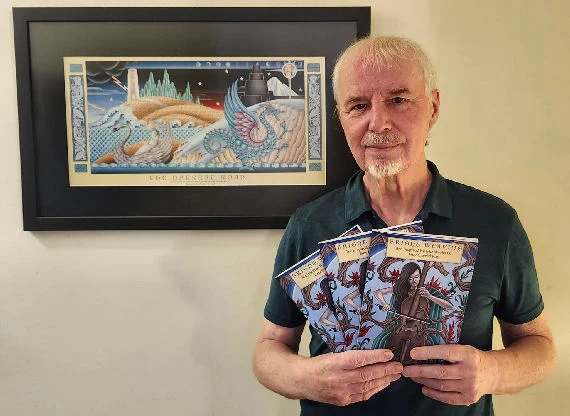
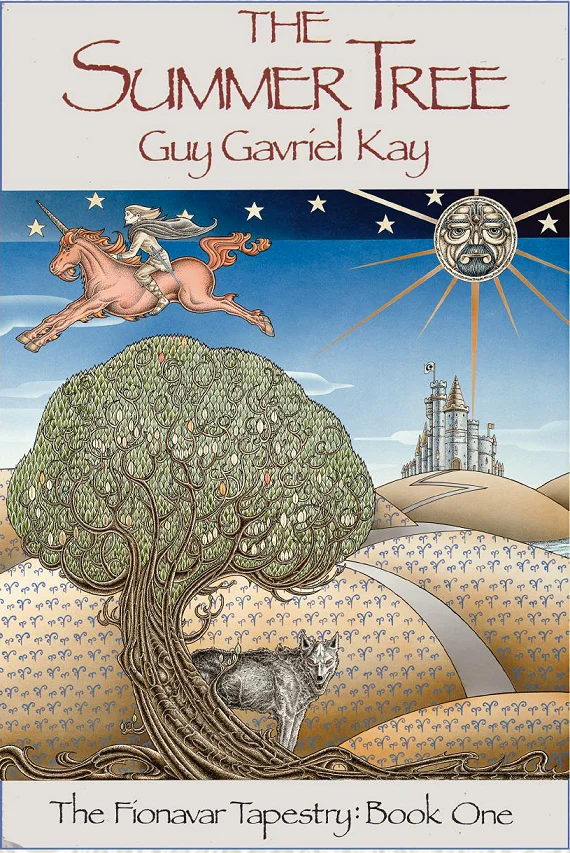
Like me, Martin was born in 1947, but where I was born in California, Martin was born in Englad. He moved/immigrated to Canada in 1965, but returned to England in 1973. He studied art at Brassey School of Art in Sussex, but mainly spent time there learning guitar, as several biographies would have it. He played with several bands in England and toured Germany and Europe, While in London (England, not Ontario), he began designing record album covers for Columbia Music while still pursuing music, and returned to Vancouver, both doing music and producing art for various books and magazines. In 1978, he moved to Toronto. In 1984, he was asked to design a book cover for a new book, The Summer Tree, by a new author named Guy Gavriel Kay (Figure 3).
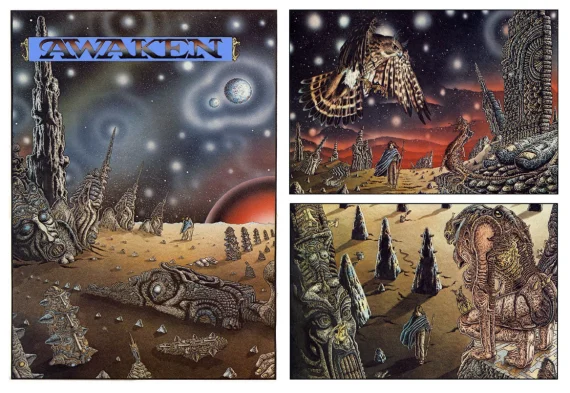
I’m not going to attempt a full bio of Martin, as those are readily available online; for example, on Guy Kay’s website Bright Weavings (Follow link for bio). I will, however notate that Martin’s style on Guy’s Fionavar Tapestry books, is easily recognizable (more about that later), but not necessarily his only style; for eample, his work for the highly-acclaimed magazine Heavy Metal (Figure 4).
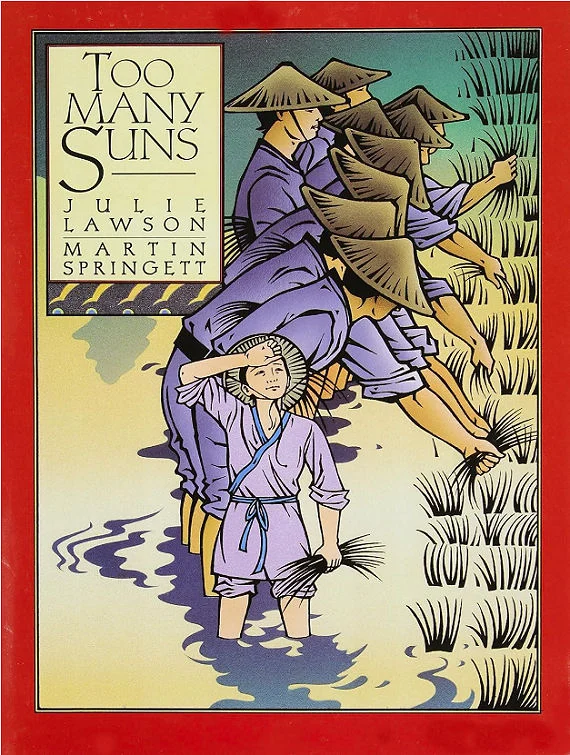
So, obviously, Martin is a talented artist, and I have to confess that I love his work, that which I’ve seen, and I will have to get hold of some of his children’s books (written by him as well as others) that feature his Japanese style, as Japanese art, like that of Hiroshige, has always been a favourite style for both me and my wife, and Martin seems to do it beautifully (Figure 5). Besides his illustration for other people’s work, Martin has also written or co-written several children’s books.
And before I get into the actual review of the book Bright Weaving, I have to talk about the CD of the same name (Figure 6). Released in 2010, this CD features 12 tracks of music composed by and featuring Martin as well as other musicians (some of whom are his family!). Tracks like “First Light,” “The Gardens of Al-Rassan,” “The Fionavar Suite” parts 1 & 2, and so on.
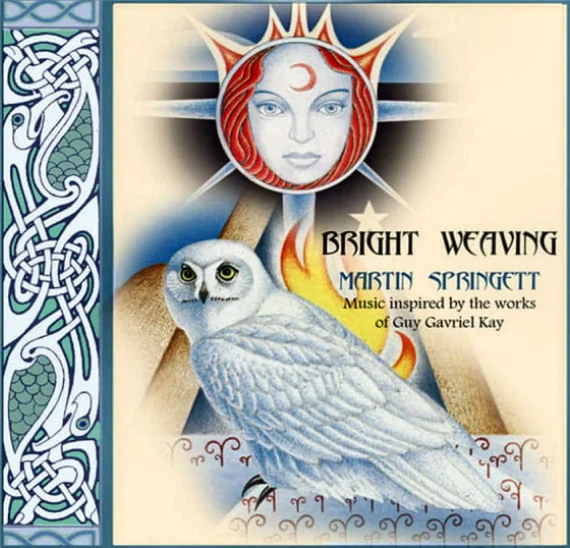
Like the new book of the same name, this CD was inspired by the works of Guy Kay; with tracks that sound quite appropriate to me, although I haven’t read the Fionavar books in well over two decades. What’s great about this CD, which I bought from Martin during his appearance at Vancouver’s (so far, late) convention called VCON—where he was the Art Guest of Honour—is that in 2025, Martin updated it to a two-volume set with new tracks, featuring new music and new guest musicians: vocalist Danie Friesen on “Rachel’s Song,” with Alyssa Wright on cello, Bob Brough on soprano saxophone, Rahlen Sullaphen on bass, Maryem Hassan Tollar on vocals, Chris McKhool on violin, Penner MacKay on drums and percussion, Prof. Rob Burns on bass, and Rebecca Fielder and Miriam Springett on flutes. (Musicians’ names provided by The Collectables Emporium on Etsy, in the link provided—CD available at this time for $25 US.) Martin kindly provided me with “Rachel’s Song,” and the vocals are terrific, so I’ll have to get a copy of the new version; I listened to the original while reading the book and composing this review.
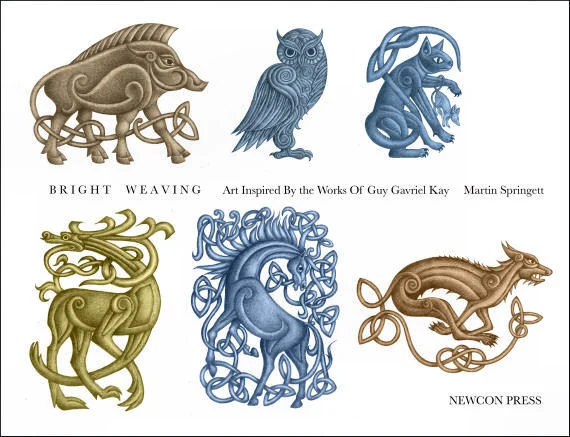
The book (this is a review of the book, remember?) is very short—74 pages—without a whole lot of text, as it’s an art book which, by the way, is only available for $30 on Etsy (Canada), and you can click on the link to order it. I understand it’s coming out this year from a UK publisher, but for now, you’d better order from here (click link) while you can. Figure 7 is a page showcasing some of Martin’s imaginative animals inspired by Guy’s work, which seem to have melded their DNA with that of a Celtic knotmaker, because their ears, their horns, their tales or, indeed, their bodys extend into intricate woven patterns similar to Celtic knots.
Besides the numerous illustrations, the book includes an introduction by Ted Nasmith, a Canadian artist and illustrator who is known, among other things, as a J.R.R. Tolkien artist, having illustrated The Silmarillion, The Hobbit, and the Lord of the Rings trilogy, who is also a musician. The book includes several full-page illustrations, including two-page illustrations, of covers Martin has painted, and also has many of the sketches that led to the final covers; in part, Martin describes some of his working habits and how he goes from preliminary sketch to final artwork, as well as some alternate cover designs.
In Martin’s previous artwork, such as the Heavy Metal art shown in Figure 4, Martin uses a pointillist-like technique, with many tiny dots to indicate shading, plus lots of areas where he must draw the same small details over and over as closely to each other as possible. He has since, he says, stopped using a Rapidograph pen—which is a pen-like instrument with changeable tips and an ink reservoir, whose main purpose is to enable graphic artists and illustrators to draw lines and dots of a consistent width—to latterly working in acrylics. (I’m well aware of how a Rapidograph works (and how finicky it can be), having used one in illustrating booklets for Cooperative Extension at Washington State University in the 1970s; I gave my set to my wife, The Beautiful & Talented Lynne Taylor Fahnestalk, who also does those tiny repeated details in some of her artwork and in cartooning, see link provided). In my opinion, some of the best artwork is produced by people who have the patience to do the repetitive, finicky stuff.
The covers that Martin has designed as tapestries, by the way, usually have fringes as do real tapestries. Martin has not only a great eye for style, but a colour sense second to none, IMO. In all the images in this book, one thing to me is a constant, and that is motion, or movement. All the images have motion—circular, or wavelike—as in flows and billows of ground, clouds and water—or twining branches, flowing hair or clothing. Again, the included sketches show how he develops the finished painting from a sketch. According to the notes inside the book, he works in pencil to develop a fully-toned sketch, then scans that and develops the colours in Photoshop.
For the 40th Anniversary edition of The Summer Tree, Martin added the wings he had originally forgotten in the first cover to the unicorn on the anniversary cover. He remains inspired by the works of Guy Gavriel Kay, both as artist and musician. (I’m often struck by how many of the artists and writers I know are also musicians; it seems that creativity in one art inspires creativity in another.
Some of the vertical pictures in this book could be bookmarks for Guy’s books. There are some gorgeous and stunning artworks here that you probably won’t be able to see anywhere else. I realize I haven’t described all of the pictures in this book, but there are too many to describe in a short column.
Now is your chance to get the original printing of this book before it goes to a UK mass-market printing; I don’t know about you, but I’d rather get the small-press version rather than wait for a later printing. (But either way is okay, although the first printing is often more collectible.)
So there you go—you have the links: buy the CD and the book and just bliss out to Martin’s music and artwork. It just might counteract some of the bad vibes of the mundane world!
I’d like to hear from you—either about this column, or just to say “hi.” I’m on Facebook, or you could email me (stevefah at hotmail dot com). If you liked it, let me know—if you hated it, let me know so I can do better! My opinion is, as always, my own, and doesn’t necessarily reflect the views of Amazing Stories or its owner, editor, publisher or other columnists. See you next time!

Steve has been an active fan since the 1970s, when he founded the Palouse Empire Science Fiction Association and the more-or-less late MosCon in Pullman, WA and Moscow, ID, though he started reading SF/F in the early-to-mid 1950s, when he was just a sprat. He moved to Canada in 1985 and quickly became involved with Canadian cons, including ConText (’89 and ’81) and VCON. He’s published a couple of books and a number of short stories, and has collaborated with his two-time Aurora-winning wife Lynne Taylor Fahnestalk on a number of art projects. As of this writing he’s the proofreader for R. Graeme Cameron’s Polar Borealis and Polar Starlight publications. He’s been writing for Amazing Stories off and on since the early 1980s. His column can be found on Amazing Stories most Fridays.