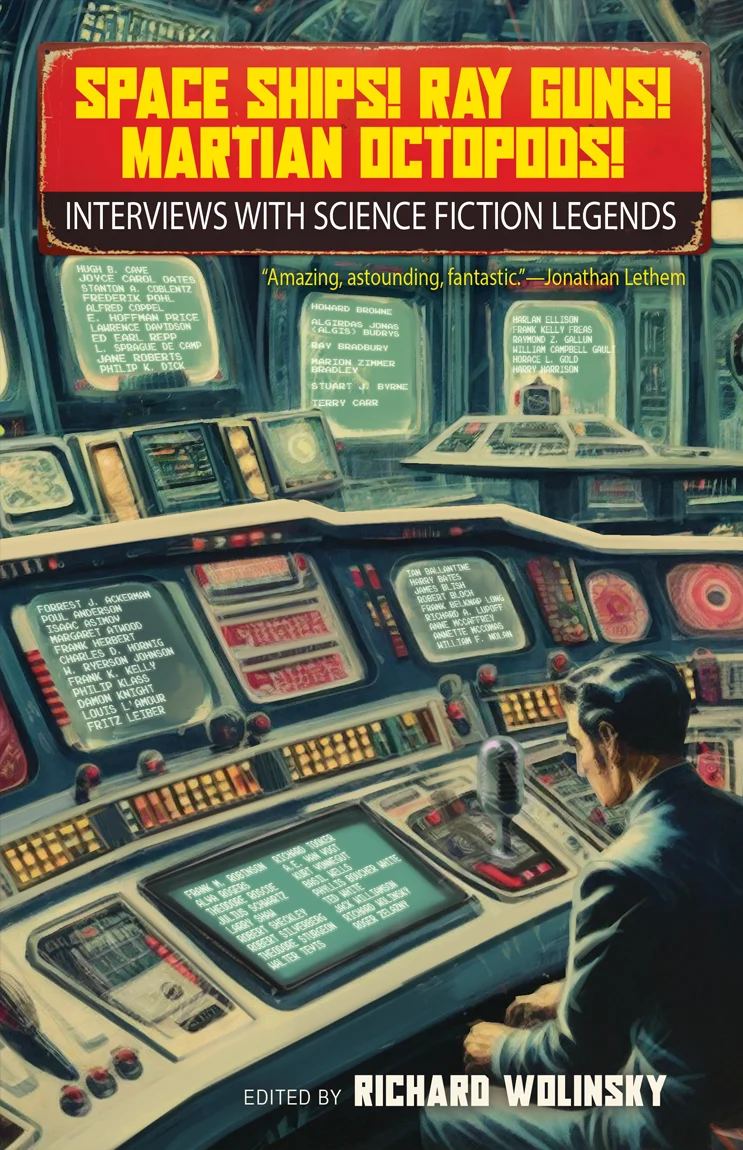
THE PROBABILITIES INTERVIEWS
Probably the most startling announcement any president ever made came on May 25, 1961, when President John F. Kennedy told Congress we would go to the moon before the end of the decade. At that moment, science fiction was no longer the private playground of a small coterie of writers and readers. Now it had become part of everyday life for everybody on earth. Asa genre, science fiction quickly grew from a few books and magazines with a cult following into a pervasive phenomenon, accounting for thousands of literary titles and many of the most popular films and television shows of all time. By the end of the twentieth century, science fiction had accounted for ten percent of all books published, and numbers two through five on the all-time box office list, two Star Wars films, E. T. The Extra-Terrestrial, and Jurassic Park. A quarter century later, the genre itself has split into genres.
There’s space opera, comic book superheroes, post-apocalyptic, near future. . . unfilmable series like Asimov’s Foundation books have found a home onstreaming television, and so on.
Science fiction had become reality because it was a literature of ideasand of speculation about what the future might be like. The fifteen-year-oldswho read Amazing Stories and Astounding magazines back in the 1920s or1930s became the scientists at Cape Canaveral and Houston. The moon wasnot a mystery to them because they’d already been there in their minds’eyes, reading the works of Heinlein, Williamson, Brackett, and so manyothers.
It was no accident that one of the hotbeds of science fiction readingin 1945, according to circulation reports from the leading magazines, wasLos Alamos, New Mexico, site of the top-secret Manhattan Project. Nor was
it any accident that science fiction readers knew the names Wernher von Braun and Willy Ley long before they became famous for their work in the space program.
The first modern era of science fiction began in the 1920s, with the birth in 1923 of Weird Tales, often a repository of science fiction stories, and with the advent of Hugo Gernsback’s Amazing Stories three years later. The first era clearly ended that day in 1961, when John F. Kennedy made science fiction a reality and a mass phenomenon.
This book is devoted to that era, a time when the scientists and technicians who transformed the world began to read, to dream, and to imagine. When Lawrence Davidson hosted our very first Probabilities program(as Probabilities Unlimited), on KPFA-FM in Berkeley in February 1977, that second era was just about to end. Three months later, the first Star Wars film (now subtitled Episode IV — A New Hope) would hit the theatres and yet another era would begin.
A single science fiction shelf in a 1960 bookstore became a bookcase by 1970, three bookcases by 1980, an entire wall by 2000. A quarter century later, in our fractured cultural universe, while genre-specific readers and imprints still exist, in the mainstream publishing world, it’s ubiquitous. Where do you place a book by Margaret Atwood, or Cormac McCarthy, or Richard Powers either in a bookstore or online?
In January 1977, Lawrence Davidson was the science fiction buyer for Cody’s Books, the legendary bookstore on Telegraph Avenue in Berkeley, California. He was approached by Padraigin McGillicuddy, Drama and Literature Assistant Director at KPFA-94.1 FM, the Pacifica Foundation’s flag-ship station in Northern California, to host a new science fiction interview program. The station’s last regular science fiction show had disappeared from the airwaves several years earlier, and Padraigin was casting about for a new one.
At the time, I was volunteering my services as receptionist and press assistant to the station. Lawrence, whom I’d known in New York, asked me to come to the station’s Shattuck Avenue digs with him and his two guests, up-and-coming writers Richard A. Lupoff and Michael Kurland, just to makes sure everything functioned smoothly.
It’s a good thing I was there. Padraigin said she’d booked studio time. But the off-air studio was locked. She said an engineer would be waiting; the place was deserted. The only person in the entire block-long warren of offices and studios was the on-air disc jockey, a red-headed seven-teen-year-old named Kevin Vance. I flew into the control room and asked Kevin to unlock the studio and set up the tape. He quickly cued up an extended Bob Dylan cut, and together we ran down the hallway to the other end of the building where Lupoff, Kurland, and Davidson stood in the dark.
Kevin unlocked the door, turned on the lights, cued the tape, and set the microphones and sound levels. While the three participants waited, Kevin lectured me on how to engineer a program: “This is how you start the tape. This is how you stop it. Just make sure the meters don’t go into the red.” He fiddled with some dials while I looked on blankly. “Good luck,” he added, and disappeared into the darkness. I was alone, faced with half a dozen dials, a group of glaring meters, and three aficionados on the other side of the wall, yakking about the history of science fiction and how Gollum of Lord of the Rings was probably a Christ figure.
Somehow it all worked, and later that week Lawrence and I edited the tape for broadcast. By the second program, I had joined Davidson on the other side of the microphone. As a rabid science fiction reader, I was up on all the latest writers and trends. Davidson, on the other hand, was a pulp junkie. Ask me for a recommendation, and I’d say Dune or the latest Ursula Le Guin, or perhaps something by Phil Dick or Alfred Bester. Ask Davidson, and he’d talk about a story or book that had been out of print for thirty years. I was a child of the second era of science fiction, but Davidson was an atavistic throwback to the first. Fueling his obsession was a growing friendship with the older Lupoff, who had been reading the pulps since he himself was a kid in the 1940s. The two of them would sit there for hours and discuss writers and editors only a handful on the planet would remember. Thus it was no surprise that Davidson walked in one day with an ecstatic smile on his face. “I found Stanton Coblentz,” he said. “He’s living an hour outside San Francisco. Let’s go talk to him.” A beatific look came over Lupoff’s face. The messiah had arrived.
“Who?” I asked.
And they’d patiently explain that Stanton A. Coblentz was one of the masters of 1920s and 1930s science fiction, author of gentle satires and a poet of note to boot.
Before long, Lupoff had joined the program on a regular basis. For every Coblentz whom Davidson unearthed, Lupoff discovered a Frank K. Kelly. For every Ed Earl Repp whom Davidson found lurking in Paradise, California, Lupoff retrieved an E. Hoffmann Price somewhere on the San Fran-cisco Peninsula.
Gradually over the course of several years, a history of science fiction in the middle of the twentieth century began to emerge on tape. Stuck in among the hoary old-timers were younger writers like John Varley, Elizabeth Lynn, Stephen King, and Clive Barker, and younger editors like the late David Hartwell.
By the mid-1980s, we’d spoken with many masters of the field, both writers and editors. As science fiction integrated itself with the cultural main-stream, so did we. The show took a different tack. Over time, Lupoff and I branched out into mysteries and Davidson gravitated to the Old West. By 1990, some thirteen years after we began, Davidson had left the show to pursue other interests, Lupoff was forging a career as a mystery writer, and I was a stalwart KPFA employee, editing the station’s monthly program guide/magazine and then finding myself a day job as an elections specialist. Though none of us had lost interest in it, science fiction had become part of the larger world.
Dick Lupoff retired from interviews at the end of 2001, and from live review programs a couple of years later. By then the program had gone through name changes and become Bookwaves. As I write this, many of these old interviews are being digitized, remastered, edited, and aired on what’s now the hour-long Bookwaves Artwaves on KPFA-FM and kpfa.org,the half-hour Bookwaves via Pacifica Audio port syndication with long erversions on the Radio Wolinsky podcast at kpfa.org. Podcasts for Bookwaves Artwaves and Radio Wolinsky as of this writing are still available through iTunes.
For many years, the three of us toyed with the idea of presenting these interviews in print. It was the late Frank M. Robinson who suggested the current form of an integrated oral history and was enormously helpful in both vetting the contents and offering his sage advice. We chose to set the framework of the book between 1920 and 1960 because that was the first era of science fiction, when the field was largely unknown to the casual observer or reader. You can find the complete list of interview subjects in the back of the book.
Twenty years ago, Julian Francis Clift loaned me his transcription machine, saving time, money, and effort in the process. Support also came from Patricia Lupoff, Tom Lupoff, Suzette Davidson, and Bret Cherry. More recently, special thanks to Jacob Weisman, Jaymee Goh, Kara Wuest, and the staff at Tachyon Books.
A couple of quick notes:
One: This book represents three eras, separated by a quarter to half century. The first was the pulp era, as these writers and editors discuss their early lives; the second when the interviews were conducted, and the third, as the book is being published and read. Three eras, and three different visions of America and the world. That vision includes race and gender.
The pulp writers of the era were all white, almost all male. Diversity, as we know it, did not exist on the content pages of these magazines. Women hid behind pseudonyms, initials or names that could be either gender. People of color were presented in the most stereotypical ways possible, if presented at all. Squishy aliens often got a better deal, and as noted in the book, some editors or publishers would have it no other way. Jim Crow wasn’t just for the American South.
People of Asian descent had it little better, as “orientalism” ruled in the fantasy and horror realm.
The original title of this book, The Girl in the Brass Brassiere (noted by Margaret Atwood in her collection of essays, Writing with Intent), based on some generic covers, attests to the rampant sexism of the pulp era and its devotion to the sexual yearnings of (straight) fifteen year old boys.
Two: While most of the comments were transcribed verbatim, care was taken to correct dates, magazine and story titles, and proper names when mentioned by the various interviewees. Exceptions are noted. It’s possible that reference sources are incorrect, of course, and that memory wins. That’s a battle that won’t be fought on these pages.
***
Richard Wolinsky co-hosted and produced Probabilities, a half-hour radio program devoted to science fiction, mystery and mainstream fiction, from 1977 to 1995 on KPFA-FM. He took the program solo in 2002, renamed it Bookwaves, and it is still running. Along the way, he has spoken with most of the English-speaking world’s leading authors, including Peter Carey, Joseph Heller, William Kennedy, Margaret Atwood, Anne Rice, Gore Vidal, James Ellroy, Joyce Carol Oates, Norman Mailer, Salman Rushdie, E.L. Doctorow, and many others. Wolinsky’s interviews have been published in numerous venues, including the San Francisco Bay Guardian, Heavy Metal, Mystery Scene Magazine, and in such books as Feast of Fear: Conversations with Stephen King, The Louis L’Amour Companion, and Macabre II: Stephen King & Clive Barker. Wolinsky was born and raised in New York City and has lived in the San Francisco Bay Area since 1978.

Steve Davidson is the publisher of Amazing Stories.
Steve has been a passionate fan of science fiction since the mid-60s, before he even knew what it was called.