

We live in housing called “co-operative housing.” Everyone buys a share, so we’re all co-owners, but we are in control (within limits) of our own houses. This is one of the best co-ops in Vancouver. There are several others within walking distance, and a couple that have been turned into condominium-type housing. A couple of years ago, while taking our morning walks, Lynne and I met a man from a neighbouring co-op, Chris Langley, who was walking his dog. Things progressed, and we became friends to the point that every Friday (we alternate) one of us goes over to the other’s house for lunch and a couple of hours’ conversation, which can range wildly. Other than the fact that we’re both men, both tall—okay, he’s 6’3” and I’m only 6’0”—and both reasonably intelligent, we have little in common.
Chris is British/Canadian, and an ex-RAF-type pilot. I’m American/Canadian and an ex-US Navy enlisted man. He has no interest in science fiction, and I’m a bit batty on the subject. He has a dog, and I have a cat. He collects pilots’ wings (you know, those little badges pilots wear on their breasts), and I collect almost anything else. I play pool and darts, and he has no interest in either. I remember song lyrics, trivia, and so much else—he doesn’t. So why are we friends? We’re both, as I said, reasonably intelligent, and we both have enquiring minds. We like to discuss things like science, and can talk about almost anything between ourselves. He goes to a regular Thursday meeting of businessmen (he was also an architect before he retired) where all sorts of things are discussed, and to another meeting at a nearby Community Centre once a month where all sorts of other things are discussed. Which brings us to Mars (Figure 1).

These meetings (Figure 2) are called “Peter Talks” after the man who started them, and range all over the map. Chris emailed me the poster seen in Figure 2, and asked if I’d like to come with him; I said, “Sure!” One reason was that I, like most older SF fans, am interested in spaceflight… I grew up in the late ‘50s, early ‘60s when it was of intense interest to every American. The second reason was the poster, which said, “How soon will there be settlements on Mars, or is it just science fiction?” (Emphasis mine.) To quote an old cowboy named Marion Michael Morrison, “Them’s fightin’ words, pilgrim!” To say something was “just” science fiction betrays not only an attitude, but also a profound ignorance of what science fiction was. It’s my assumption, based on things I’ve read, that a very large number of men and women involved in science (especially space science) are or have been regular readers of science fiction; furthermore, that many of those people got into science/space science because their imaginations were spurred by their reading matter.

Besides, it sounded like a very interesting talk; who knows, I might get some information I didn’t know about upcoming Mars missions. Figure 3 promises that the speaker would be pretty comprehensive. So, Chris and I hopped into his SUV and boogied across town to the Kerrisdale Community Centre (Peter Talks hosted by the Kerrisdale Kaffee Klatsch, or 3K) to hear all about Mars from Richard Wyllie (pronounced “Wiley”) who, according to his bio (Figure 2), was a software engineer—in what branch of software, I don’t know—for 35 years, plus has studied “Mathematics and Logic, Astronomy and Cosmology, Mythology and Language, Philosophy and Technology, as well as Archaeoastronomy.” Quite the QV, I’d say. And so, in front of an audience of about 3 women and 15 men (most of retirement age), Richard proceeded to give his talk about whether we’d actually ever have a “thriving” human settlement on Mars.
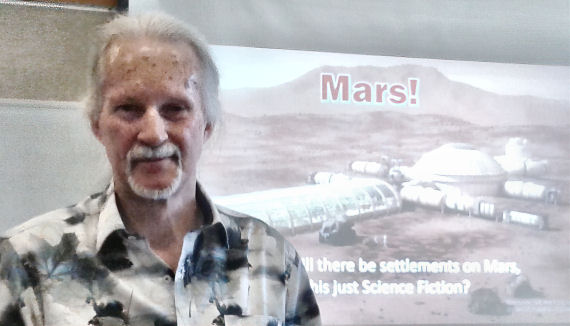
Now, I would have liked to give a bullet-point list of his points, but unfortunately, he didn’t respond to my request for such a list. But I’ll tell you what I can remember. The first half of the talk was a bit unfocused; Richard attempted to give a historical view of the planets and their names; he also talked about their relative sizes and distances from each other and the Sun. (I did learn something during this part of the talk; Mercury and Pluto do not fall within 3 degrees of the ecliptic; something my education seems to have neglected to tell me. Anyway, the relative sizes and distances are part of the problem when sending a manned mission—especially one of possible colonization—to Mars.
Cutting to the chase, Richard’s thesis appeared to be that all space missions were a waste of money. We’d never accomplished anything by spending all those billions—whatever spinoffs the space race spurred would have eventually happened anyway, according to him—and there would be nothing to gain by spending another $500 billion or so to try to land humans on Mars, as there is nothing there worth bringing back. (And even if there were, the cost of ferrying it back here would be prohibitive.)
Some of his points were (not in any particular order, and as I recall them): we could only send people and materiel to Mars during a particular window of a few months each year. We would have to send the support materiel—building materials, fuel, water—none of the water on Mars is drinkable and we’d have no way of making it so—well in advance of the manned mission (I say “manned” as a shortcut—no intention of saying it will only be men), and successive shipments would have to land very close to each other. Fuel/electricity would be a sore point; we wouldn’t be able to use fossil fuels because the cost would be prohibitive and we couldn’t find or refine more on Mars itself; solar power could work if only Mars didn’t have months-long dust storms that cut off the sun from the surface (and thanks to the square-cube law, the solar energy reaching Mars would be 1/4 or less that reaching Earth). We could use nuclear power but—and here he shuddered—without actually saying so, Richard implied that nuclear power was inherently bad. Also, how would we get the astronauts to Mars—a journey that lasted seven or eight months would require a lot of fuel to get there, to land, to take off, and to get back; and due to radiation, the astronauts might not arrive in such good shape.
Those are the points that stuck in my mind. I attempted to refute some of them to Richard’s face, but he was unconvinced. Here’s an exercise for the reader: can you come up with a more cogent reason for, and way to, send astronauts to Mars? First off, NASA themselves, says that we can’t protect the Aresnauts from lethal radiation; we have no way of shielding them. (Here’s an article from the Great Lakes Ledger, click the link.) My thesis is that we could probably use water; according to a different article, it would only take 1m of water, which could also be used for drinking, bathing, etc. (How to keep it liquid would be a different thing; as well as how much it would cost to boost that much weight into orbit.)
As far as using nuclear power—Richard was probably unaware that the U.S. Navy has been running nuclear-powered ships for sixty (60!) years without one single reactor incident! (There have been accidents not involving the reactors, but that doesn’t invalidate my point.) Nuclear power is not inherently bad. Most of the problems have either been of bad design or human error or a combination of both. But Richard thinks it would be a bad thing to pollute another planet. (And as far as moving manufacturing into space? He seemed dead set against it.)
Oh, and as far as space spinoffs? There are many; the link shows a Wikipedia page with some information about them.
All of the points he made can be refuted, I believe. I’d like to hear from any of you readers who would like to cite chapter and verse in support… or the other way around—but be sure, whichever way you fall, to have citations; a vague feeling that “nuclear bad” isn’t gonna cut it with me. I will be happy to provide Richard with any arguments (with citations) pro or con you come up with. My email is still stevefah@hotmail.com.
So what I (and Chris) gathered from Richard’s talk is that he thinks: Mars (huh!) Good God, y’all, what is it good for? “Absolutely nothing!” Do you agree? (Spoiler: I don’t!)
I’d appreciate any comments on this column. Please register (if you haven’t already) and comment here, or on Facebook, or wherever you’re reading this. All your comments, good or bad, positive or negative, are welcome! (Just keep it polite, okay?) My opinion is, as always, my own, and doesn’t necessarily reflect the views of Amazing Stories or its owner, editor, publisher or other columnists. See you next time!

Steve has been an active fan since the 1970s, when he founded the Palouse Empire Science Fiction Association and the more-or-less late MosCon in Pullman, WA and Moscow, ID, though he started reading SF/F in the early-to-mid 1950s, when he was just a sprat. He moved to Canada in 1985 and quickly became involved with Canadian cons, including ConText (’89 and ’81) and VCON. He’s published a couple of books and a number of short stories, and has collaborated with his two-time Aurora-winning wife Lynne Taylor Fahnestalk on a number of art projects. As of this writing he’s the proofreader for R. Graeme Cameron’s Polar Borealis and Polar Starlight publications. He’s been writing for Amazing Stories off and on since the early 1980s. His column can be found on Amazing Stories most Fridays.






Recent Comments