
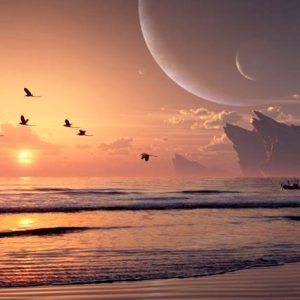
A recent report in Astrobiology raised the possibility of new places to look for extraterrestrial life: on the moons of distant planets. Astronomers have now discovered evidence of well over 3000 extra-solar planets (that is, planets orbiting distant stars) but none of them seem to fit the blend of temperature, size and mass hospitable to life as we understand it. However, more than 100 of these do appear to be gas giants (like our own Jupiter and Saturn) which, unlike our neighbors, orbit their stars in the so-called habitable zone where planetary liquid water can exist. Though gas giants have no hard surfaces where water can pool, the researchers’ thinking is that some rocky moons in orbit around them might.
So what would prevent such an “exomoon” from harboring life? First, it would be constantly exposed to a double whammy of radiation from both the star and the gas giant. For example, Jupiter reflects about a third of the sun’s radiation striking it. That means the moon would need to be about the same mass as earth in order to maintain an atmosphere and magnetic field strong enough to deflect much of that incoming destructive energy. No moon in our solar system qualifies. Second, it would have to survive extreme tidal forces. A gas giant moon experiences planetary tides so powerful they can deform and heat it enough to sterilize any surface life.
Assuming that the exomoon was big enough and massive enough and at just the right distance from the gas giant to make it through all of that (a measure that the researchers call the “habitable edge”), then maybe, just maybe, life could thrive there. No suitable candidates have been found yet, but we’ve only begun the search.
Living conditions on such an idealized moon would likely be very warm, but seriously cool from an SF perspective. If the moon kept one side constantly facing the gas giant, like the moons in our solar system do, the ecosystem would be quite different from ours.

On the planet-facing side, daylight would cycle from full darkness (when the gas giant eclipses the star), to twilight (when the exomoon eclipses the star and receives only reflected light from the gas giant). Meanwhile, the side of the moon facing away from the planet would cycle from direct sunlight to utter darkness every cycle. In between, both sides would receive some mixture of direct and reflected light. The planet-facing side would constantly be heated by radiation from the gas giant. If the exomoon also survived any early solar system jostling, like the impact that gave Earth its axial tilt, there’d be no seasonal variations in climate.
Whatever lifeforms arose there, we could be certain they’d be nothing we’d recognize as “life as we know it”. It sounds like a playground for some world building writer. I wonder if Larry Niven is busy.
If you’re interested in reading more, the paper reference is: René Heller and Rory Barnes. Astrobiology. January 2013, 13(1): 18-46. doi:10.1089/ast.2012.0859
And to see more of Dan Durda’s incredible space art, visit his site at 3D IMPACT






Recent Comments