
Most visitors here are at least passingly familiar with the Hugo Awards, the annual “Science Fiction Achievement Awards” that have been presented at World Science Fiction Society conventions (Worldcons) since 1953, and continuously since 1955.
That’s 70 years of awards (if you don’t count the retro=Hugos, given out for the years dating back to the first Worldcon in 1939 during which the awards were not originally presented), during which time at least one (actually, no less than five) rocket-shaped awards have been handed out.
Categories and practices have naturally changed and been modified over those past 7 decades, more often than not with both the number of categories and the number of trophies handed out steadily increasing over time.
A handful of years ago there was even a discussion about who, among the contributors of something that had won, should be given an actual award, at which time it was essentially determined that anyone who was listed on the ballot for a particular award would get one (with attendant discussions related to both associated costs and award presentation times).
Which of course means that more than one rocket may be given to a single award category during those fateful Hugo Award ceremonies.
It got me wondering – just how many Hugo rockets are there out there? (Not to mention what has happened to them: I strongly suspect that most still reside on display shelves associated with the winners in some fashion, but we’ve seen at least one Hugo rocket out of that context, so there are probably more. Some may be in estate or museum storage. Some may have been lost. Who knows?)
Where those rockets are may be an insoluble question, but how many is at least subject to a ballpark swagy estimate, if only by going through the awards detail (found, naturally, on The Hugo Awards website) and counting up the names officially associated with a given award.
That, I have recently done.
I did not include the Retro’s; when it came time for the dramatic presentation categories I only awarded one rocket to each individual named, not two or more if someone received multiple credits. I also made a couple of other assumptions: that translators credited for a work received a rocket, and that any individual name appearing on the announcement of the winner received one, but that companies named did not receive an individual rocket, only the individuals.
Drum Roll Please
The total number of Hugo Award Rockets that have been handed out since 1953 (excluding 1954, and excluding 1958 during which plaques were handed out) comes to
1,098
Let that sink in.
There are nearly 1100 rockets “floating” around out there.
This is not a definitive number; I expect that I miscounted a couple of times, my assumption about who got an individual rocket might be wrong, there’s probably any number of test castings and a handful of casting overruns out there as well, but I think that number probably comes very close to the actuality.
Here’s my raw data:
| year | rockets | categories |
| 1953 | 9 | 7 |
| 1955 | 7 | 6 |
| 1956 | 9 | 9 |
| 1957 | 5 | 3 |
| 1958 | 8 | 6 |
| 1959 | 8 | 8 |
| 1960 | 9 | 6 |
| 1961 | 6 | 6 |
| 1962 | 6 | 6 |
| 1963 | 7 | 6 |
| 1964 | 6 | 7 |
| 1965 | 11 | 7 |
| 1966 | 7 | 7 |
| 1967 | 11 | 9 |
| 1968 | 12 | 10 |
| 1969 | 11 | 10 |
| 1970 | 9 | 9 |
| 1971 | 10 | 9 |
| 1972 | 11 | 9 |
| 1973 | 15 | 10 |
| 1974 | 12 | 10 |
| 1975 | 12 | 10 |
| 1976 | 13 | 10 |
| 1977 | 11 | 10 |
| 1978 | 12 | 10 |
| 1979 | 16 | 10 |
| 1980 | 13 | 11 |
| 1981 | 14 | 11 |
| 1982 | 13 | 11 |
| 1983 | 14 | 11 |
| 1984 | 14 | 12 |
| 1985 | 13 | 12 |
| 1986 | 13 | 12 |
| 1987 | 17 | 12 |
| 1988 | 15 | 13 |
| 1989 | 16 | 12 |
| 1990 | 18 | 13 |
| 1991 | 13 | 12 |
| 1992 | 15 | 13 |
| 1993 | 18 | 13 |
| 1994 | 17 | 13 |
| 1995 | 16 | 13 |
| 1996 | 14 | 13 |
| 1997 | 14 | 12 |
| 1998 | 18 | 12 |
| 1999 | 13 | 12 |
| 2000 | 14 | 12 |
| 2001 | 17 | 12 |
| 2002 | 21 | 13 |
| 2003 | 22 | 13 |
| 2004 | 23 | 13 |
| 2005 | 19 | 14 |
| 2006 | 17 | 13 |
| 2007 | 19 | 14 |
| 2008 | 19 | 14 |
| 2009 | 23 | 15 |
| 2010 | 22 | 15 |
| 2013 | 35 | 16 |
| 2014 | 21 | 16 |
| 2015 | 28 | 16 |
| 2016 | 25 | 16 |
| 2017 | 32 | 17 |
| 2018 | 31 | 17 |
| 2019 | 36 | 18 |
| 2020 | 29 | 17 |
| 2021 | 32 | 18 |
| 2022 | 33 | 17 |
| 2023 | 37 | 17 |
| 2024 | 0 | 18 |
In every case where the number of rockets exceeds the number of categories, it is assumed that more than one trophy was handed out for a particular category…for example, both Anthony Boucher and Robert P. Mills are listed as the editors of F&SF magazine, the winner of the Best Professional Magazine that year. Of course, they only got a plaque, so that’s not included in the total, but if they had gotten rockets, the assumption is that one rocket would have been given to each of them. Likewise, novels written in collaboration, translated novels with the translator credited, Fanzines with multiple editors, podcasts and Dramatic Presentation awards, the same.
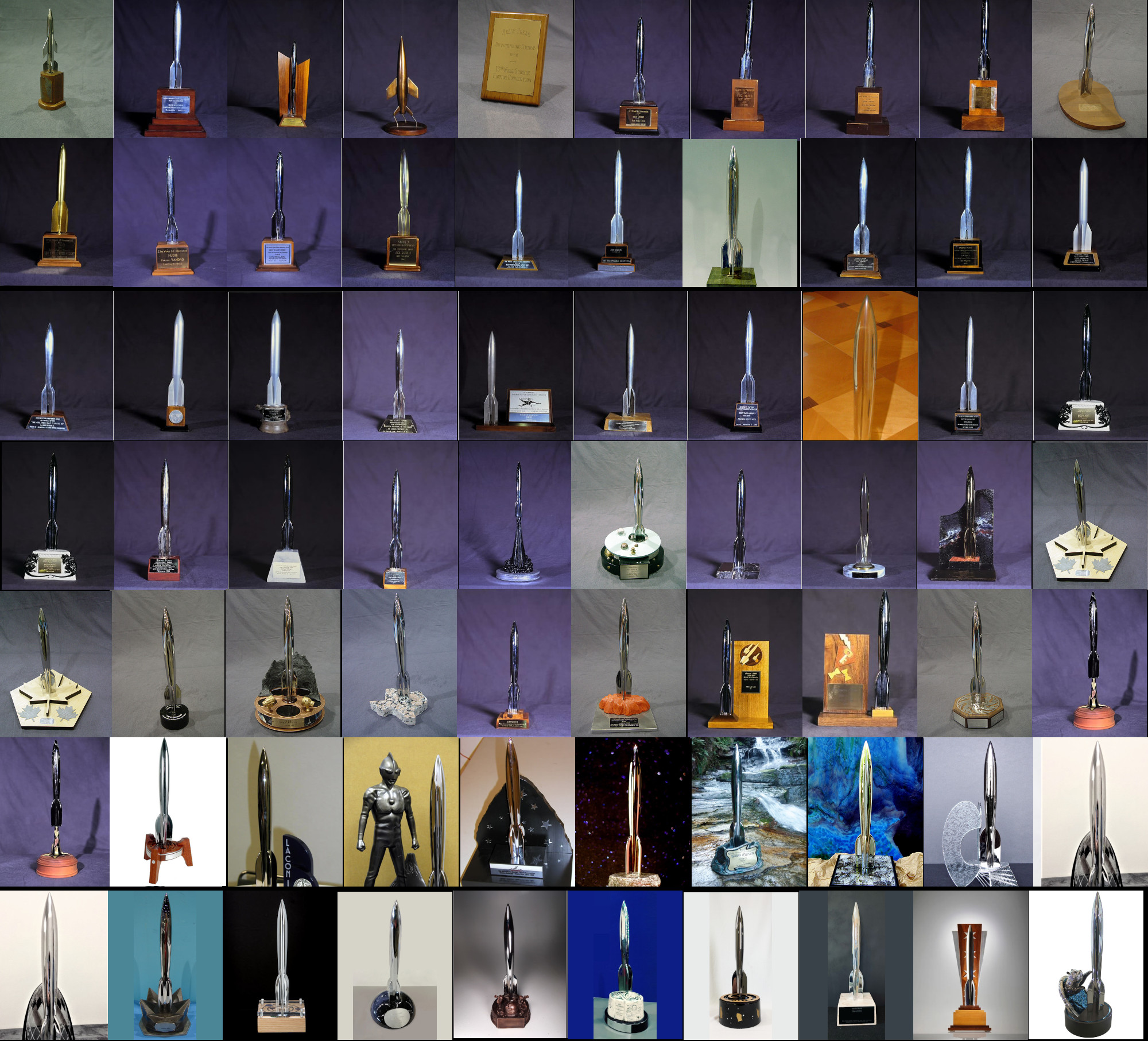
The following image (also the featured image for this post) are from www.thehugoawards.org; some are provided by Steven H Silver, others by Michael Benveniste and Sheila Perry, and others are uncredited.

Steve Davidson is the publisher of Amazing Stories.
Steve has been a passionate fan of science fiction since the mid-60s, before he even knew what it was called.







Recent Comments