Maybe a little belief in ghosts isn’t such a bad thing. Charlie’s old grade school friend comes to visit with him, and Charlie is a university professor. His friend…is a ghost, ready to accompany him…
Spiders. Charlie shuddered.
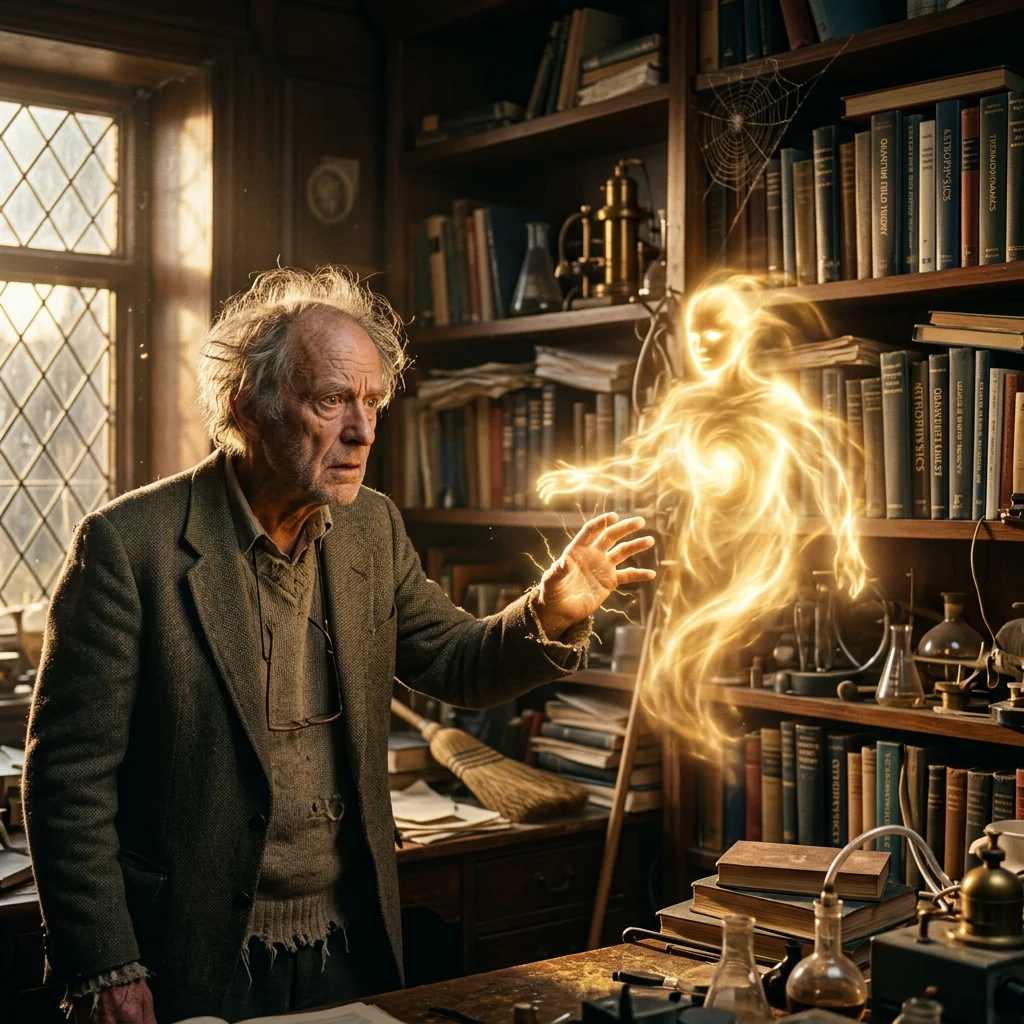
The spider web stretched from the top corner of the walnut bookshelf to the ceiling. He reached for the spider-sweeping broom he kept beside his desk, when a shimmer on the web caught his attention. It flickered, then grew brighter, swirling like a hurricane on a TV weather map. The cloud drifted down the bookshelf past physics texts and tomes of Shakespeare and hovered at eye level.
Charlie waited for the thing to make another move. Fifty years as a physicist had prepared him for strange phenomena, but he’d never had one approach him before.
He tentatively reached out to touch the anomaly—recoiling when he encountered a mass of icy air. His fingers tingled. Ridiculous. You’re losing it, Williams. He shut his eyes tight and counted backwards to ten, but when he opened them again, the cloud remained.
“Art thou but a dagger of the mind, a false creation proceeding from the heat-oppressed brain?” As if in answer to the Macbeth quote, the illusion expanded and appeared more solid than before.
“All right, then, if you insist …” He tried to feel the thing again. Once again, his hand passed through it. “I have thee not, and yet I see thee still.” The thought of how perfectly the Macbeth soliloquy fit the situation gave him the giggles. The thing had now coalesced into something of nearly human shape and size. The absurdity, or maybe the shock of it all, cranked his fit of giggles into delirious laughter. He thrust his still-tingling hand back into the shape. “To be,” he said, stabbing his hand through the form, “or not to be,” he said, drawing it out.
“That is the question,” it answered.
Charlie froze.
A young man, shimmering with a golden glow from the late-afternoon sun, stood before him.
Charlie recognized him immediately—thick red hair, ivory skin spattered with freckles, an easy smile framed by a rust-orange beard—it was a face Charlie hadn’t seen in over seventy years. “Kelly?”
Kelly tilted his head in a way that reminded Charlie of the old RCA Victor dog.
“It’s me! Charlie Williams—from McClellan Elementary School.”
Kelly’s smile broadened until his upper lip disappeared under his moustache. “Charlie Williams! The last time I saw you, you were—” Kelly held his hand just below his collar bone. “Now look at you!”
Charlie snorted a laugh. “Yes. I’m a bit taller than I was in fifth grade. And it’s Professor Williams now.”
“Well, hello Professor Williams!” Kelly bounded forward to hug Charlie, who gasped as Kelly’s frigid arms passed through him.
Charlie muttered, “Art thou not, fatal vision, sensible to feeling as to sight?”
“What did you say?”
“Oh … it’s from … Macbeth.”
Charlie leaned on his desk, struggling for a moment to draw warm air into his lungs. Finally, he managed enough breath to ask, “So … Kelly … what brings you to my office?”
“So that’s where this is.” Kelly turned in a little circle to take in the living room Charlie had converted into an office after retiring from the university. Bookcases crammed with physics texts and science journals filled the walls, while stacks of papers surrounded the fireplace in messy piles.
Charlie’s desk sat a few feet from a leaky casement window. Curtains would’ve helped block some of the cold air, but he preferred to leave the windows bare and watch the elemental parade of seasons and students flowing past, remembering the days when he marched along with them. Tacked to the crown molding above the window hung a faded papier-mâché model of the solar system which rotated gently in the slight draft. Kelly pointed to the mobile. “Hey, I helped you make that.”
Charlie remembered how excited he’d been to make a model of the planets for fifth-grade science class. But when he started dipping strips of old newspaper into the glue, the sensation of the slimy mixture between his fingers nauseated him. He’d wadded his paper into a giant ball and tossed it into the bucket of glue in frustration.
Mrs. Hocksteader scolded, “Charlie Williams!” But before she could dress him down in front of the class again, her new teacher’s assistant, Kelly, swooped in and escorted him outside to the playground.
Usually, when Charlie’s emotions boiled over, Mrs. Hocksteader yelled, then sent him to the office, but Kelly sat patiently on the stairs of the slide until Charlie didn’t feel like stomping anymore.
Once the storm had passed, Charlie settled himself on the step below Kelly—his anger dissolving into tears of disappointment. “I hate papier-mâché. It makes me want to puke.” Charlie picked at the drying glue he’d wiped on his pants.
“Hmm.” Kelly scratched his beard. “What if you didn’t have to touch it?”
“How can I make a model without touching it?” Charlie rolled the peeled-off glue into a ball and shook his hand wildly to get it off his fingers.
“No, you have to flick it off like a booger—like this,” Kelly demonstrated, snapping his thumb against his forefinger. Charlie laughed and copied him until his hands were booger-glue free.
“Come on. I have an idea.”
“Where are we going?”
“You’ll see.”
Kelly led Charlie to the nurse’s office, and the pair returned to the classroom wearing blue latex gloves. Kelly gestured to a fresh pile of newspaper strips. “Your patient awaits, Doctor Williams.”
Charlie giggled. “Nurse, hand me the gauze.” Kelly held out a strip of paper. Charlie dipped it in glue and delighted in pulling the viscous liquid from the strip, then wrapping it around a Styrofoam ball. They continued the game until Charlie had completed all nine planets.
The Kelly who studied Charlie’s Shakespeare collection in his office today, looked exactly as he had seventy years ago.
“The one you gave me is on the third shelf—far left. It’s a little worse for wear, I’m afraid.”
Kelly pointed to a green, leather-bound book with The Collected Works of William Shakespeare in gold lettering on the spine. “You were the only fifth grader I knew who read Hamlet at lunchtime!”
Charlie had devoured the entire collection Kelly gave him in a week. Every day during recess, he’d beg Kelly to act out the duel between Laertes and Hamlet. With fallen twigs, they exchanged blows and lines until they both lay “dead” beneath the maple tree.
“Hamlet is still my favorite Shakespeare play. You said a line from it when you appeared.”
“I did?”
“Yes. I said ‘to be or not to be,’ and you said, ‘that is the question.’”
“Strange. But I guess no stranger than being a ghost.” Kelly’s smile faded. “I don’t even believe in ghosts.”
“Neither do I.” Charlie paced the way he used to, when lecturing his students. “Belief is irrelevant. I observe that you exist. So, instead of ‘to be or not to be,’ the real question is, ‘to be or why to be.’ Why are you here, and why would you look like a ghost?”
Kelly peered through a semi-transparent hand at Charlie. “What do you mean, look like a ghost? I am a ghost.”
“I’m not so sure about that. What’s the last thing you remember?”
“Before you?” Kelly walked noiselessly towards the spiderweb in the corner. “I was holding onto a …” he rubbed his fingertips together, as if trying to conjure the feeling, “a string. I got lost. Then I saw the spiderweb—and you.”
“A string?” Charlie flapped his hands excitedly. “Are you sure it was a string?”
“I … I think so.”
Charlie paced faster, scanning the shelves of science books and magazines. “A string. A string!” He tapped the edge of his glasses to help him think.
“Wheeeere is it?” He pawed through the books on an over-filled bookshelf.
His tapping finger stopped to trace the spine of a well-read volume. “Ah! Superstring Theory by Witton, Green, and Schwartz.” He wiggled the book from the shelf, rubbing the dust off on his cardigan before tucking it under his arm.
“And of course, we’ll want the latest work on entanglement by Holland, Lu, and Cheuk!”
Charlie moved through the spot occupied by Kelly to access the filing cabinet behind him.
“Hey!”
“Sorry about that.” A chill sank deep into Charlie’s bones when their bodies intersected. He shivered, but continued digging through the file drawer.
“Sorry, Charlie—er— Professor Williams, I’m lost.”
“Yes, I know. I’m trying to help you with that.” Charlie found the research paper he’d been searching for and stuck it under his arm with the book.
“No, I mean I have no idea what you’re talking about.”
Charlie circled his free hand, stirring his ideas into the air, “It’s about what we’re made of, what it’s all made of—how it’s all connected—the consciousness and interconnectedness of the universe!” Charlie thought he’d summed up his idea perfectly, but he could see from Kelly’s face, his brain was moving too fast again. He’d learned over the years that other people couldn’t see the patterns he saw right away. He tried to slow his thoughts.
“Max Planck said, ‘All matter originates and exists only by virtue of a force which brings the particle of an atom to vibration … we must assume behind this force the existence of a conscious and intelligent mind.’” Charlie waited for the quote to unlock an “ah-ha!” moment for Kelly. It did not.
“Who is Max Planck?”
“The father of Quantum Physics.” Charlie tried to slow down even more. “Planck thought the universe was controlled by an intelligent mind.”
“Are you saying Planck believed in God?”
“Not exactly.” Slower, Charlie thought. “Schrödinger and Einstein observed that two quantum particles could affect each other over impossibly long distances. It’s called entanglement.”
“Schrödinger—the cat guy?”
“Yes, the cat guy,” Charlie snipped. It always peeved him that one of the greatest theoretical physicists in history had been forever reduced to a cat meme.
I have to move even slower. Charlie imagined himself as a string, adjusting his vibration to match Kelly’s resonance. He needed to find the common frequency.
He stood under the model of the solar system. “Remember when we made this?”
Kelly smiled at the papier-mâché planets with their cracked poster paints, dangling from thin dowel rods and fishing line. “Yes. You were upset that we couldn’t make them exactly to scale.”
Charlie laughed. “That’s right! I forgot about that. But you remembered.”
“So?”
“We are tied together through our shared experiences. We’re like two particles which interacted, and somehow still managed to influence each other over time and space.”
“You think I’m here because we’re connected somehow?”
“Exactly! When you got lost, some part of you felt I could help.”
“Lost on my way to where?”
“I imagine it’s ‘the undiscovered country, from whose bourne no traveler returns.’”
“Ah, more Hamlet.”
“Yes.” Charlie removed the Collected Works of William Shakespeare from the shelf and opened to Act Three, Scene One in Hamlet.
“It ‘puzzles the will and makes us rather bear those ills we have than fly to others we know not of.’ Shakespeare was saying we fear death because it is unknown to us, and we cling to what’s familiar. I’m familiar. And if Witton was right, maybe some part of the universe knows what you need from me.”
Kelly crossed his arms. “Why, Professor Williams, that sounds an awful lot like belief to me.”
Charlie snapped the book shut. “You are an observable phenomenon! I’m trying to reduce quantum physics into something you can understand!”
Kelly burst out laughing. “Relax! I was joking.”
Charlie closed his eyes again. When did I start taking myself so seriously? There were more and more heated arguments with colleagues and students before he retired. It had been harder to control his emotional swings—something he’d worked on for years.
Kelly was the one person who’d never made him feel like some sort of problem to be managed—who actually seemed to enjoy their time together. Charlie realized Kelly had been his first true friend. Maybe his only friend. Ever. Colleagues, he’d had—students—adulation. But never since Kelly had there been someone waiting patiently on the steps for him to calm himself—to celebrate his discoveries, and laugh together when the world turned out to be a Shakespearean tragedy after all. In all that time, there had only been one person who cared about him, who he loved. And he’d never even told him.
He felt a sudden need to hug Kelly. He grabbed his friend and held on tight. This time, his arms did not pass through. The warmth from the hug melted away the chill that had crept into every part of his body.
Kelly gently pulled away and turned Charlie to face the faded velvet sofa against the wall. He said, “I think I know what we have in common now.”
On the sofa, Charlie saw himself, lying with the volume of Shakespeare open on his chest, which did not rise and fall. He smiled. “Ah, I see, ‘What dreams may come when we have shuffled off this mortal coil … ’ It appears we are supposed to shuffle off together.”
“So, Charlie, are you ready to go?”
“Go where?”
Kelly smiled and took Charlie’s hand. “You’ll see.”
And Charlie saw. Everything.
END