Our author’s intro…Set in 1969, this story is a throwback to the humorous fantasy style that editor Ray Palmer favored in Amazing Stories back in the 1930s and 1940s–particularly the work of Robert Bloch. I can’t do better than that.
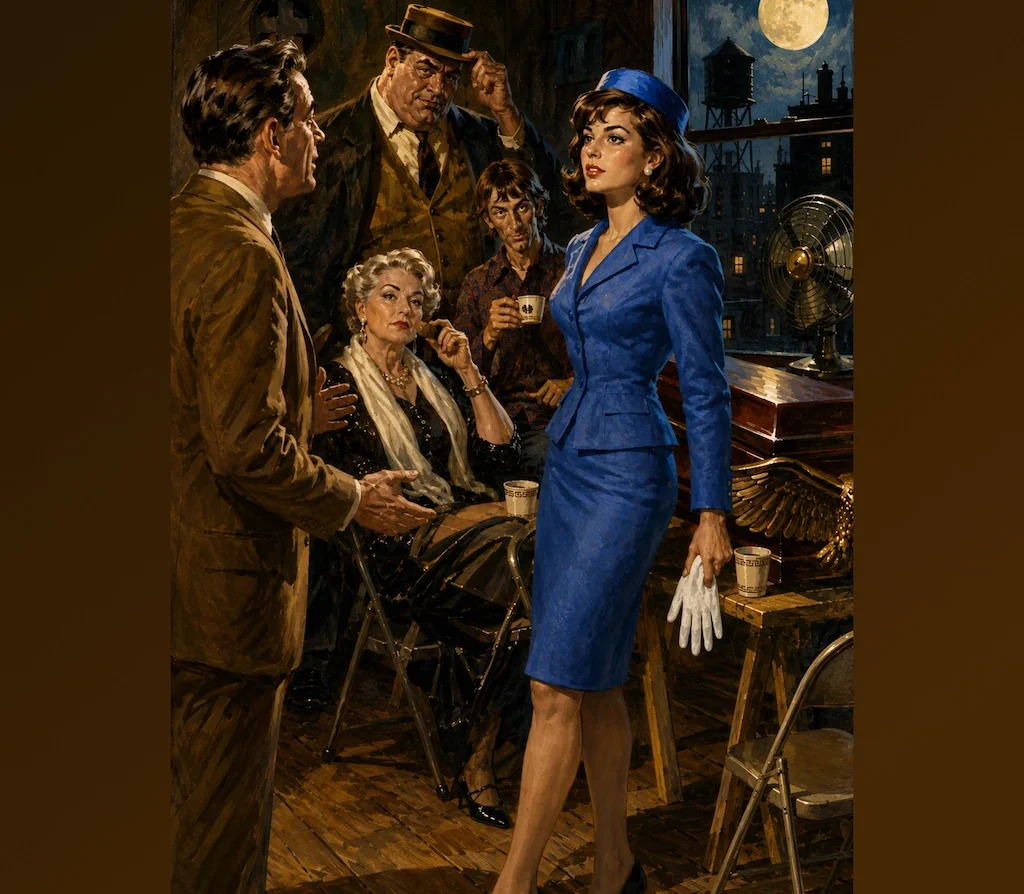
They were gathered at the coffee urn when the giant, Eldon Baermann, ducked into the dim light of God’s Lambs Chapel and raised his porkpie hat. He was not a bright light of the group, but his intimidating hulk, combined with gentle mien, added a certain touch of poetry, even if his vest was crooked, Vanders thought. During the warm season, Baermann worked on the sideshow at Rockaway Beach. Behind Vanders, a polished rosewood box lay across carpenter’s horses. It would have resembled a coffin except for the curious wings emanating from each side. This was not a funeral, although the Bobby Kennedy assassination a few days earlier cast a shadow on all of them.
Besides Baermann, the attendees included Edith Chalfont, a recent president of the Flushing Orchid Society, who, decades earlier, worked for the O.S.S. and still thought herself a femme fatale. She wore a white scarf over a sequined black dress belted with a hooped gold chain. Nibbling at a wafer, Adam’s apple prominent, was Eamond Edwards, a skinny poet in paisley shirt and bell bottoms, and author of Beatnik Girl, I Dig You, and, more recently, The Queen of Diamonds in the Skies Is the Diamond, aimed at a stoned or tripping clientele.
The murmured conversation lulled when a stranger arrived, a young lady in electric blue skirt, jacket, and pillbox hat—dressed perfectly for a mixer at Wellesley, her high heels clicking on the wood floor, audible even over the electric fans. Though she did not take up the same volume as the giant, her entrance had a similar effect, as she was striking without being gorgeous, her brown hair in a flip, her lips dabbed red, eyes bright. Vanders pegged her as FBI, CIA, or NYPD. Agents were infiltrating almost every organization these days. Though Vanders’ group was far from subversive, they were an odd bunch. Chalfont, former OSS spy, cocked an eyebrow.
While welcoming the young woman, Vanders suppressed the dyspepsia from the lamb kebab he’d ordered earlier at a Greek diner. He quickly realized that this same Ida Rumeli had recently sent in a check for membership, and from her looping script and overly polite sentiments, he had pictured an older woman. He hadn’t counted on being dazzled. Vanders was tempted to lift the newcomer’s dainty hand to his mouth for a kiss, but her white glove seemed to preclude that gallantry. Miss Rumeli seemed amused.
Flustered, Vanders began pacing as the others, now seated (Baermann required three of the folding chairs), sipped coffee from cups decorated with Greek columns. “Welcome to this month’s meeting of our society.” Vanders gaze fell on Miss Rumeli. “As proud citizens of the free world, we do not advocate revolution. Nor are we here to reform the English language, revitalize orthography, or dizzy ourselves with reports of flying saucers. We leave proving the unproveable to others with more free time. With no creed, we assert nothing. Indeed, the missions we engage ourselves in, if successful, are forgotten.”
This elicited chuckles from the faithful.
But Miss Rumeli’s face was blank; fearing that he had been long-winded, Vanders plunged on. “We are, then, dedicated to an improbable cause. Those of you who, like I, grew up reading Amazing Stories, may remember its motto ‘Extravagant Fiction Today, Cold Fact Tomorrow!’ Prophetic indeed! However, we reverse the motto to: Extravagant Fiction Today, Cold Fact Yesterday! History too is comprised of stories. Some—but not all—of which we may edit.” He carefully articulated his words, so as not to lose Baermann. “Our group has inherited an apparatus that might remind you of a certain mechanism made popular in British literature. A magician at a Rockaway sideshow, Professor Don Villanova, simply called it his vanishing box. But one day, he vanished for good.” The young woman had her gloved hand raised. “Yes, Miss Rumeli?”
“Werewolves?”
“Werewolves, what, Miss Rumeli?”
“Do they,” she pulled off her gloves, “Fall under your bailiwick? Do you dig them? Do they blow your hair back? Fuse your eyebrows?”
“Thus far, we’ve left them, as it were, afield. No scientific journal has printed a peer-reviewed article about werewolves. Mr. Wells’s Island of Dr. Moreau, with its splicing of tissues and so on, and his earlier essay on the plasticity of organisms made clear that such techniques may one day become a reality. However, assuming such creatures don’t exist, we would not like to urge them forth.”
“But you admit—werewolves have appeared in yesterday’s stories—so wouldn’t this make them cold fact tomorrow?”
“As for the Amazing Stories motto: not every fiction, but only those with sufficient inertial power emerge. Is this circular reasoning, akin to the Darwinian jest of “survival of the survivors?” Perhaps. I would cede this much—as we cannot spend all our missions attempting to eradicate earlier clues of werewolvery—one day they may be, as you say, cold fact.”
“But surely they must be stopped!”
“Again, it’s a question of resources.” This Rumeli was definitely not FBI, but worse, a nut job. His eyes trailed to the front window where, behind the gold letters that announced God’s Lambs Chapel—backwards—a full moon rose above the water tank topped roofline. “But I do not have the final word. The group will decide.”
Miss Rumeli said, “Splendid,” crunched on a vanilla wafer, and sat.
Baermann, the giant, stood, uneasily, and in his low rumble of a voice, that buzzed along with the electric fan, said, “Where is Jacobs?”
Vanders checked his timepiece. “Quite right. He is due.” He walked to the oblong box, gave it a rap. “This, Miss Rumeli, is the apparatus I mentioned. When its operator, Dr. Villanova, disappeared, I bore it off with Baermann’s help. It is remarkably heavy, and an understanding of its workings beyond my capacity.”
“Enough exposition, where is Jacobs?” asked Edwards. He added, in a languid tone, “as you can see, his devoted friend Baermann—a longstanding member of this society—is all aflutter.”
Edith Chalfont lit the cigarette impaled on her holder. “Jacobs, that twit. Can’t wait,” she muttered. “We never should have let an English professor in.”
Miss Rumeli waved at the smoke.
Vanders, who had been inspecting a pocket watch, said, “Very well. Let us proceed.” He thumped on the casket-like object. “Jacobs? You there?”
“Yes,” came a muffled response.
The lid lifted and Jacobs, balding and chubby, sat up blinking, his paisley shirt in disarray. He seemed dazed at first, pushed back his glasses, said, “Wow.” Then a smile emerged on his face, and a flush to his cheeks. “Am I where I think I am?”
“If you think you are in Jackson Heights, New York, yes. Do you recognize us?” Vanders spoke slowly.
“The year is 1969?”
“On the dot.”
“Whoa, right on! Good God, there was no yellow brick road out there—it was just flying monkeys all the way.”
“First missions can be traumatizing,” Vanders said.
Jacobs stood, gingerly. “True. I felt I was ripped to shreds, disassembled and reassembled over and over. My clothes nearly strangled me. The fabric, I suspect, transports at a slightly tilted axis, warp and woof at odds. We really should do this naked.” He then began to hiccup.
Vanders gave him several slaps, like a barber applying aftershave. “So, what — did — you — manage?”
“Manage? I wandered Manhattan for a few days, in the spring of 1904, tulips in bloom. I called on Upton Sinclair in the boarding house off Union Square where he was busy knocking out dime novels about boxers, sailors, prostitutes with hearts of gold, and so on. I urged him to accept a request from union organizers in Chicago to investigate the meatpacking industry and insisted the result would be the finest book of his career. ‘Why should I?’ he asked. ‘You think I’m a Red?’ ‘Of course you’re a Red,” I said. “Just do it. You won’t regret it. Call it The Jungle.’ Well, he did, right?”
Applause broke out from the assembly.
“Well done, get yourself a cookie and some coffee, Jacobs,” Vanders said.
Chalfont said, “I’m puzzled. Every schoolchild knows that Upton Sinclair wrote The Jungle. I’ve known this since I was—well, young. Assuming Mr. Jacobs really went back to 1904, what did he accomplish? Could we say,” she puffed on her cigarette holder, “not a thing?” She rolled her eyes. “And why do we send literature professors anywhere?”
Jacobs said, “Seriously, Edith? When I left, last month, Sinclair never wrote the Jungle. He had ignored the 1903 invitation to tour the meat plants from an editor of an anarchist newspaper in Chicago that I found among his papers. Naturally, you now live in a world in which he did write The Jungle because I fixed it so he would, eh? He was the right man for the job. Mission accomplished.”
“As you can see, Miss Rumeli,” Vanders said, “We run fools’ errand. What we accomplish, if we accomplish, is always forgotten. Only the time traveler retains a memory of the world lost. A method for corroborating has eluded us.”
Miss Chalfont said, “Jacobs has a point about transporting naked—of course it depends upon where you land. I hated mingling with the Puritans in those dreary woods in Massachusetts. But it would have been worse if I landed there naked. I’m fortunate one of my friends is a costumer.” She pointed at Jacobs. “You doubted me. Let me tell you, those narrow-minded fanatics put me in the stocks twice. But, to the point, I convinced Increase Mather to issue a letter denouncing the witch trials six months earlier than in the ‘rough draft,’ and saved seven lives. Though poor old Giles Corey was still pressed to death. A shame. We miscalculated my arrival date.”
Several sighs and “ahhs.”
Baermann raised his hand. “Can I go next? I’d like to meet Alexandre Dumas and convince him to rewrite his novel as the Five Musketeers.”
“Literature again, really?” said Vanders. “You know we can’t fit you in the—transport chamber. It might send you off without arms and feet. What good would that do the world?”
“You keep promising—”
“And as a Vanders, I honor my promises! But that doesn’t mean you can pester me! This is not a hobby group. We are dedicated to a higher purpose. Sit down! And straighten your vest!”
The big man, bewildered, tugged at his vest and sat.
“We’ve all earned a break,” Vanders said. “As is our custom, I’ll now ask everyone to fill out a card with a proposed mission, and we will vote on the best.”
The percolator burbled, club members dashed their ideas down, refilled coffee mugs, and chatted while Jacobs collected the index cards.
Vanders began to sort through the pile. “Help the Lenape of Manhattan gain a better deal from the Dutch.” He looked around, shrugged. No one seemed engaged. “Protect Lincoln at Ford’s Theater.” He looked up. “Tried that before. I’m not sure where the assassination originally took place, but as it was my first case, I have a vague memory it involved a telegraph office.” He again shuffled through the cards.
Edwards shouted, “Let’s get Richard III a horse. You know, ‘a horse, a horse, my kingdom for a horse!’” No one laughed, as they’d heard this jest before. He cleared his throat. “Sorry. Wrong crowd for highbrow humor.” He drew out a reefer and sniffed it like a connoisseur.
Vanders shifted to a new card, said, “Hmm. ‘Stop the first werewolf from entering North America.’ Interesting. Who wrote this?”
Miss Rumeli raised a gloved hand.
Jacobs asked, “But how can you know who the first werewolf was? We seek actual historical moments, and this requires studying documents, combing through rare books, tedious archive visits, hours of study. We don’t just throw out general propositions.”
Heat lightning flickered outside as Miss Rumeli said, “The first werewolf crossed the Atlantic from Europe on the Lusitania in 1909, traveling first class and demanding raw horse steak twice daily for his ‘pet ferrets.’”
“How did you learn this?” Edith asked.
“Omar Rumeli, a peddler turned merchant, was my grandfather. He brought this curse on our family after he was attacked in the Carpathians. Then, he spread this disease to America. I read his journals. He felt remorse. He wrote, ‘If only we could be wiped out, but alas the Rumeli blood is too sturdy and our survival instinct unquenchable.’”
Miss Rumeli smiled, briefly, as she glanced around the chapel. “When I was five, my parents and older brother were killed in a car crash, but I lived on, raised in a nunnery. I discovered my true nature at age twelve. After two nuns and one priest disappeared, I had to diversify. I stalked victims in Central and Prospect Park, spilt their guts, and after feasting, ran off howling. Following the kills, I could see every blade of grass in the moonlight, every spider and squirrel. I felt capable of dancing through the treetops or leaping roof to roof. Invincible, yes, but cautious.
“Next, I ventured to the suburbs seeking a lone tennis player at night, smacking the ball against a wall, or a solo passenger waiting for a train. Such lonely figures with their umbrellas. And,” she lowered her voice, “When I worry the police may be close, I rent a car and go upstate and focus on sheep and cows.”
“This all sounds rather incriminating,” Miss Chalfont observed.
Miss Rumeli bowed her head. “I plead guilty. While the hunt exhilarates me, soon after, I re-enter Hell. I am a monster.”
“And I’m a giant!” the giant said.
“No one asked you, Baermann!” Vanders shouted.
Jacobs said, quietly, “Shouldn’t we head off the assassination of Bobby Kennedy? Baermann told me during the break. I’m stunned. I mean, holy shit! Bobby.”
“The bigger the event, the greater the resistance, as we’ve seen before. Our power to create such rifts in the continuum is limited,” Vanders muttered.
“Hello? Simple question. May I go and destroy my grandfather?” Miss Rumeli asked.
“We would not force you, though, if what you say has validity, it may well benefit the race.”
“I take that as a yes.” She removed her hat. “Judging from what Mr. Jacobs said, I would like to go naked.” She set her hat on a chair.
Vanders wondered if this could be an elaborate prank. Had a rival organization hired a stripper to arrive at their meeting with a cockamamie story of werewolfery? He cleared his throat as she unbuttoned her jacket. “Show of hands. All in favor of the mission?”
Unanimous. Miss Rumeli was down to her brassiere. Vanders tried to speak, but could only stutter, as she reached behind her for its fastener.
Taking charge, Miss Chalfont said, “OK. All you men. Out of the room, now!”
Baermann, the giant, ducked his head at the door. He was followed by Edwards, Jacobs, and Vanders.
“You go too!” Miss Rumeli said to Chalfont.
“No. You will need help. Your ancestor was a powerful man.” She pulled out a derringer from her garter. “Silver bullets. Ed Donovan of the OSS gave it to me, saying ‘you never know.’” Chalfont winked, fastened the door’s lock, herding the men in an alcove where an eternal flame flickered below an oil painting of a group of animals lorded over by a beatific bearded man—Dr. Charles, the founder of God’s Lambs United—who looked remarkably like Colonel Sanders.
Edwards sighed, said, “My sect is finger-licking good,” then leaned down to light his reefer from the eternal flame.
“Must you be so disrespectful? They rent to us!” Vanders tore the reefer from Edwards mouth, flung it on the strip of carpet and stamped.
From behind the locked door of the chapel came giggles. Then, a thump. Then, crashing chairs, snarls, a gunshot. A yelp.
The door was reinforced steel. Not even Baermann could make it budge. Jacobs raced to the office for a key. When he returned, Edwards, who had his ear pressed to the door, said, “All is quiet now.”
“Back!” Grabbing the key, Vanders opened the door, and the men hurried to the apparatus.
The lid opened. Out came Edith Chalfont, who announced, “I think we’ve seen the last of Miss Rumeli. I dispatched her and her grandfather Oma,r and tossed both of them into the Atlantic.”
“Who?”
Edith clutched her arm. “Miss Rumeli. You don’t remember? Oh, bother. Thanks to this old dame, you can forget about werewolves in America.”
“But your arm! What happened?”
“A mere bite. Get me to the veterinarian. I mean, doctor.”
END