
We look at the future of the penal system, the distant future. Can we trust those who demand that criminals should be kept in these prisons? Can we trust the prisoners inside? Should we give those prisoners another chance? How far in the future does this go?
Temporal trans-materialization left him hollow, as if his stomach lingered on the Earth platform before joining him on Penitence. So, the second it was over, when reality took over and Anders Burns stepped five hundred years into the future, he held his breath and patted himself down to confirm everything had arrived as expected.
His hands came back satisfied.
Burns glanced around the as-new facility. The gleaming hallways and pristine cells would soon be filled with the worst of humanity, sentenced to their final salvation. Penitence wasn’t just their last home: it was their permanent exile in time. The Temporal Service created this prison five hundred years in the future and a civilization away; each prisoner sent there an ember in the dying twilight. And to supervise them all, to serve as panopticon to the worst of humanity, Anders Burns. It was the greatest honor of his life, to serve the Temporal Service. He may have gotten older, a bit greyer around the temples, a stray hair poking out of his ear, but Burns was trim and tight like he had been a decade ago, could fit into his old slacks. Wasn’t afraid to let a little chest hair out, either. Not that there was any wind on Luna to move it. From 240,000 miles and five centuries away, it was about as far away from humanity as he could get. Burns hadn’t wanted medals, or accolades, or awards. He was fine by himself. Nothing to disturb his perfect, lunar-quiet peace.
And with Kar lost, he’d gotten exactly what he’d wanted: solitude and silence, all the hopes and dreams of a dying America behind him. He felt his throat tighten; he choked on a breath. After a moment, he walked on, creeping through the vacant halls, his footsteps the only sound echoing back. In just a few hours, prisoners from five centuries of humanity’s penal colonies would materialize in their cells. They came from all times, sentenced to life. By Temporal Service decree, Burns was to be the only Lunar guard. An automated system on the Earth below coordinated logistics. All had been planned, all had been decreed, Burns had learned this in his training. Salvation finds us all at the end of time, the stiff, British voice had intoned.
That was the whole point of joining the Temporal Service. Burns had served twenty years as a prison guard on Earth at some ho-dunk penal colony in the middle of New York, and he’d been just a few years from retirement. Still, this opportunity was too appealing. They said he fit the part, whatever that meant. They said he’d be the savior of mankind. They’d finally convinced him when they said he’d be alone, at last, never to hear the whine of the so-called anti-timers ever again. The perfect end to a perfectly undistinguished career. Three months of training later, he’d become ready to supervise the one place prisoners could truly reflect on the pain they had caused others. To a land of pristine emptiness.
To Penitence, Burns whispered into the empty hallway, and heard his thoughts echo back.
***
Twenty-four hours before his exile to Penitence, Anders Burns lost his sister.
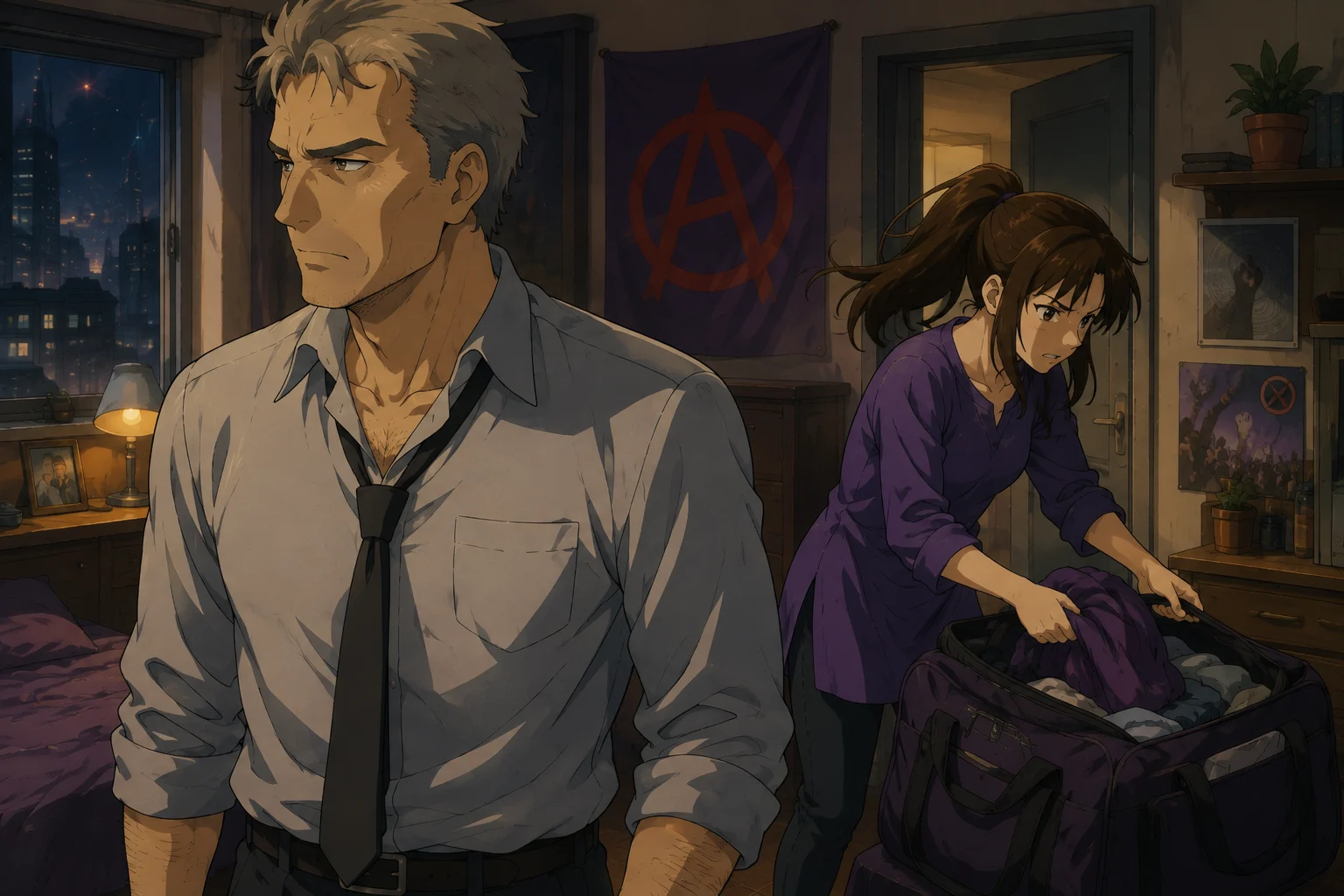
“You can’t be serious,” Kar had said, after he told her he’d accepted the posting. “After everything we’ve learned? I can’t believe it—you know what those Temporal Service bastards are doing. You were there when they took our dads!” Her dark brown hair, pulled tight in a ponytail, swung like a scolded dog’s tail as she yanked the empty suitcase from under her bed. Her skin glowed with the red, waxy sheen of a fresh shower, which contrasted with her bright purple tunic, a color favored by the anti-timers.
Burns’s thin eyes narrowed as they followed Kar’s hurried movements to her dresser. “It was their own fault,” he said in a thin monotone. “You know that.”
The two shared their parents’ old micro-flat. Ever since their dads, two professors from the University of Haver Hill’s Temporal Philosophy department, had been apprehended after the Labor Day riots of 2070, Kar’s fire had been stoked; she scorched the earth she trod upon. Burns couldn’t understand it. After what happened to their parents, why did she want to get arrested too? Why would she want to join those renegade anti-timers, that Commie group Burns saw on the Vidnews every night? Their anti-time platform, that time travel is going to destroy us all, the Temporal Service is hiding the truth, Penitence is unconstitutional—Blah blah blah, all anti-time lies.
To Burns, a posting to Penitence sounded ideal, all he ever wanted. A prison, on the Moon, five hundred years in the future? He could leave all those anti-time traitors behind, ignore the ravings of the regressives, and simply live out the rest of his life in that “pristine land of solitude and silence,” as the Vidnews said. Why wouldn’t he accept the posting?
“The Temporal Service,” he said to Kar as he watched her pack, “is going to free America from the tyranny of the regressive elite.”
She stared at him. “Stop parroting the Service’s words, Andy. You don’t know what you’re talking about. You’ve been brainwashed by those plastic idiots. Try Vidding the news for once.” Finished with the bag, she zipped the sides and pulled it close to her. “The real news, not that propaganda you’re being fed.” Burns caught the floral trace of her soap; great, now his nose itched. He watched Kar wring a second purple tunic in her hands. “I can’t do it, Andy. You? On Luna? In that uniform? I just can’t. Not after all we’ve learned about the Service. Not after dad, not after the way the Temporal Service kidnapped our parents. They’re not on our side.”
“March? Such a sanitized word for mob.” Burns slowed his voice to make sure she understood every word, but it cracked in his ears, like the leather jacket that had been hanging in his closet for a decade.
“I can’t stay here anymore. There’s a protest in Portland, and they’re going to shut down the Service for good.” She faced him, eyes locked onto his. “Andy, listen. Anyone that doesn’t buy their bull gets sent away. Don’t be part of the problem. Be on the right side of history.”
“History is what the Temporal Service says it is, Kar. I’d rather be with them.”
With a groan, Kar spun her hands in the air, as if searching for something to grab, then pulled her ponytail tight. “It’s impossible to talk with you. The Temporal Service doesn’t control us. Doesn’t tell us what to do. Not yet, anyway. I don’t know what else to say, other than they’re lying. To us, to you, to everyone.”
Burns shook his head. “If you really want—” but he stopped himself when he saw Kar edge towards the door. A taut thread linked her deep brown eyes to Burns’s cold, blue ones.
“Come with me, Andy. Help me put a stop to this. There’s always another way.”
“—Go, then.” The words came out before he could think. Kar stiffened.
“Last chance, Andy.” Kar took a step back, but not before Burns saw a tear streak across her cheek. He felt an unexpected pang of remorse, then swallowed it.
Fine. Let her go. Let her face the repercussions of her actions. He was done trying to protect her. If she got disappeared, so be it.
“Please, Andy. I can’t lose any more family,” she whispered. The cool night air dripped silent fog. Kar sighed, grabbed the bag for the last time, and stepped into the wet night.
He watched her ponytail wave goodbye.
She disappeared down the street. As if on cue, a hovercar alarm started its nightly mating ritual immediately beneath his window. It was soon joined by another, and another, until the street was so cacophonous he could feel his skin itch. The sound pressed in on him, a dark oppressive hand that smothered his mouth and squeezed the breath from his body. What was this? He’d never felt anything like this before. He gasped, a fish-like gulp of air that locked his body in spasms. He clenched the blanket in his hands, the fibers rough beneath his fingers. Kar—she was gone! He squeezed and felt blood pump in his fists, the side of his head pound on his temples. The air wouldn’t come; his lungs burned. He closed his eyes and bit his lip until it bled. The pain cut through like a scythe, opening his airways. He breathed. And again. He could cope. The sounds died out and thoughts of Kar faded.
So be it. One less person in the world to bother him. He felt the thin trickle of air down his throat, and the cold air filled his lungs as he collapsed on the bed.
The next day, Burns turned on the Vidnews. The Temporal Service had subdued everyone at the Portland anti-time march. No word from Kar, ever again. A tug of shame pulled at him, but he swallowed it back down. She brought it on herself. She deserved it.
And the day after that, Burns trans-materialized to an empty Penitence, to await the rest of his life. And it was like he had never existed.
***
Salvation finds us all at the end of time. The words were a mantra that pulsed in Burns’s mind, one breath per beat. A month at his posting, and he was used to the cool, recycled air. Funny, the one place he could finally breathe didn’t even have an atmosphere.
The Service had sent him to an empty prison, but soon, it filled. Every day, more prisoners trans-materialized via the massive Temporal Engines, the world’s flotsam washing up on the shores of Luna. They came from all times, all eras, sent across decades, from the nascent days of the Temporal Service in 2070 all the way through Burns’s current now, 2572. The past was a vast expanse, and each criminal from five centuries arrived in continuous temporal mélanges.
At first, Burns checked in each prisoner like the good ol’ boy the Temporal Service had hired: he examined their call sheet, assigned them to their cell, made sure they were outfitted in the proper prison uniform, white robes and sandals. But after a few days and hundreds of prisoners trans-materializing, he realized no one was checking on him. No one cared. So, he stopped cataloguing them all. Why bother to learn their names when they were just one more face he wanted to forget? The only one he remembered was Tony, and that was only because the guy was always running his trap off about the “evils of the Temporal Service.” It was classic anti-timer lies, the kind Kar used to—no, never mind. Burns tuned it out. Nothing to see here.
The Service never sent messages, and in turn, Burns never corresponded with them. No one on Earth knew Burns was here, not the one below or the one back in time, and that was the way he—.
Skreeeeeee!
An alarm wailed, like a screech and a scream had a kid together. Burns fumbled for his VIDPAD to check the readings. His own face reflected in the clear, black glass. Spectral eyes, dark and narrowed, bags hung underneath. But beyond: something’s not right. This VIDPAD should always be on. It had a direct connection to the wireless power grid. He threw it back on the desk where it slid among the papers.
It took him a second to view the prison monitors. He usually kept them off, preferring the peaceful solitude of blank screens to the visible thrum of activity outside his office complex. The screens lit up to show every prisoner out of their cells, screaming in the artificial yellow light. How’d they—? But it was Tony’s contorted face that filled the main screen. A phalanx of other prisoners ran behind him. Burns turned the sound off so all he could see was Tony’s terror-stricken face, then flipped a switch to isolate the one monitor and hear Tony’s shattering voice echo in the room.
“—the hell, Burns! You see what’s on the monitor out there—?”
Burns flicked the switch and Tony’s voice cut out with the image.
Jesus, what now?
The observatory, down the corridor from his quarters, felt miles away. Flashing lights discoed the hall. The observatory door swooshed open, and a blinding white light greeted Burns. Something’s wrong on dear old Planet Earth: the shimmering blue-green planet shone too brilliantly in the window. Burns tapped the glass, and the image zoomed in. The orb became an arc. Then a continent. Then a coastline.
And along the sea: tiny mushroom clouds, blooming into the atmosphere.
Burns stared at them, unable to tear his eyes away from the glow. Nuclear clouds, puckered and red, suspended in the air like ripe raspberries. Radiant white light emanated from the planet to illuminate a deep ruby surface, the condensation fallout stone. Burns may have been protected by 240,000 miles and a thick pane of thermal glass, but he could have sworn he felt the heat against his skin and the luminant sting blind him.
Ah, hell. Burns fell against glass. Damn it. They did it, those bastards really did it.
A honking change in the alarm alerted him to the shutdown of the Temporal Engines. Oh, for—now he had to get to the engine room. From outside the observatory, the hammering of hands on the door seemed to pulsate from Burns’s own head. He turned back to his quiet planet and lowered his black, mirrored HUD-Shield visor against the gauntlet.
Burns cut his way through the throbbing swarm. The visor protected his senses from the piercing shriek and bright flash of the klaxon, but was unable to staunch his growing anxiety. “Coming through, Lunies!” he yelled, as he pushed against the writhing mass of bodies. The choked sound of his voice drowned in the hot sprawl of flesh and sweat. His torso compressed; as one, they thrashed against him. He hadn’t felt this constricted since the night Kar left. He swam upstream, made little headway. There were too many. He should’ve been paying more attention: how did they get out of their cells so easily?
He grunted and squared his shoulders against this great unpopped blister of humanity. No end to this progression of bodies pressing against him, smashing him on all sides, restraining him. His breath tightened; he struggled to gasp. He wouldn’t have wanted to, anyway. The dripping smell of unwashed humanity clouded the air. He tasted salt and copper. He heard one of the Lunies (was it Tony?) grunt “is that Burns?” and grab at him, but the sweating mass helped. He was pulled away by the torrent of bodies.
The HUD-Shield might have protected his eyes and ears, but it did nothing for the stench in the room: Hot sweat and tangy blood mingled in the air, and he gagged from the sheer meaty bodiness of it. The acrid taste of bile burned his throat.
This wasn’t a prison anymore; this was an abattoir.
***
In the engine room, Burns collapsed against the control panel for the Temporal Engines. The banging on the triple-locked, bolted, and hermetically sealed door matched the throbbing in his head. He sniffed, felt the tang of blood in his mouth. His? He hoped so.
He wiped smooth the front of his HUD-shield, the plastic cold to the touch. His fingers streaked across the lightweight, clear machine. He threw the blood-streaked visor to the ground. It had stopped working anyway.
Had it only been ten minutes? He checked the readouts. No power flowed from the Earth below. Made sense, nothing down there left but ash, and as they say, you can’t power a prison with dust. The Temporal Engines warbled. Scores of screens, each one denoting a different section of the prison colony, flashed red borders—danger, escaped convicts. As if matching the shrieking siren, the prisoners’ screams increased in volume outside the door. Burns was safe in the Temporal Engines. But for how long? The Moon’s generators would give out in a week, and after that, everything else would die, too: the air purifiers, the water filters, the prisoners, everything. Even Burns.
Burns took steady breaths, staving off the clamp on his chest. He put his hands on the smooth desk to calm himself. Feeling the hard surface beneath his hands grounded him. He stared out of the window. The emptiness of the lunar surface echoed. Cold, grey rocks scattered like discarded toys. A thin wisp of an atmosphere separated sunlight and darkness. The Earth spotted with dark acne. He was stuck, one man against a hoard of Earth’s worst. All the Tony’s of the world, clawing to get into his room, dying to punish him for the Services’ sins. They’d calm down eventually. Or they’d kill themselves in the process. Nothing he could do about it anyway.
He grabbed a bottle of whiskey and a glass from his cabinet. He’d been saving it for a special occasion, and what the hell, what occasion was more special than his own death? He poured out a dram of the amber liquid, sloshed it in the glass, inhaled the smokey aroma. Nothing like a 16-year-old Lagavulin. He laughed silently to himself, ok, 516-year-old. As the shot of liquor burned his throat and he tasted the mossy mix of earth and smoke in the back of his mouth, an idea formed. Five hundred years.
Huh.
Ignoring the intensity of the battering at his door, he strode to the moondust-covered controls at the time-travel engine. Yes! The base’s backup engine was still active. There was just enough power for one ride, one temporal jaunt. He could get out of here, send himself back in time. Let these miserable prisoners tear themselves apart on the moon while he hid out in some mountain range, somewhere far away in the past.
Burns turned the dials, preparing the machine for the last temporal jump it would ever create, when the truth hit him. He thought back to his training, the reams of pages, millions of classified words about the missions, the expenses, the dangers. He’d skimmed most of it, but recalled one part with crystal clarity: the Temporal Service spent years trying to find the perfect place, the perfect time, to send these prisoners. To send him.
They had all the time in the world—literally—and they’d decided on a month before a nuclear holocaust.
The hard chair back pushed against his spine as Burns slumped. The realization hit him full force. The Temporal Service knew this would happen. They knew precisely when those nuclear bombs were going to go off, and they sent the prisoners here to die anyway. Sent Burns here.
Kar had been right all along. Burns wasn’t their savior. He was their sacrifice.
The pounding at the door grew more insistent. Tony’d probably get through at some point. He heard someone yell his name.
The end was near, so Burns took another sip of the peaty spirit.
In a flash that mirrored the ones on the planet below, he knew what he had to do. There was enough power for one trip, but it didn’t have to be in time. He could save them all by sending them into the vacuum of space. End their misery quickly. It was merciful, really.
Burns stood up, straighter than he had in a long time, and turned to the blinking computers that controlled the temporal shielding. He’d been sent here to guard these prisoners until the end of their lives, and he was damned sure he was going to finish the job. He pressed the top-most button, and a glowing amber turned to green.
The Temporal Engine spun with a bright, animalistic squeal. Now, it wasn’t set to receive; it was set to send. An alarm rang. The pounding on the door eased as the prisoners realized what Burns was doing and ran back to the common area.
The doors to the back-up Temporal Engine opened. Burns flicked on the monitors. They glowed in the darkness, lanterns at sea. The least he could do, to give them one last view of Earth as they drifted away in space. The light from the screens spread across the room, Earth-rise in pixels. Burns saw the prisoners’ contorted faces as they heard the alarm.
And for the first time in a month, Burns felt the world close in around him.
His breathing quickened; he became aware of the oxygen hiss behind him. He pulled at his collar, trying to loosen the fabric around his neck. Here he was, stuck on Luna, in the one place where he could breathe, could find some peace and quiet, and the Temporal Service had to ruin it? The pressure overwhelmed; his vision eclipsed. His mind fixated on the constriction at his throat. He gasped. His hands, sweating, clenched involuntarily, pulled so tight pricks of blood popped under his nails. Sweat poured down his face, the salty taste reminding him of the last time he saw Kar. He collapsed to his knees. He slid against the console, the constricting claustrophobia, the squeeze of humanity pushing against his windpipe and closing off his air supply. Blood pulsed against the back of his eyes; the pressure pushing them against his skull. His hands felt sweaty and meaty; his feet sunk in bog. The throbbing in his head, agony in pulses.
A mass of hardened, terrified faces stared up at him through the monitors, each pleading with him, eyes reflecting the sun’s harsh light.
And in that ugly sea, that backwash of humanity, floated a familiar face: Kar, with her brown hair pulled back in a ponytail, wearing that purple tunic she’d had on when he’d lost her. Could it be her? That one brown head amongst the throng, glaring back at the camera, staring directly into his eyes? She stood calmly among the mass, a mirage or a miracle, still as a statue as everyone writhed around her.
Burns couldn’t tear his face away from the screen. He collapsed against the engine controls, gasping, and flopped down on the green button on the console in front of him. The switch turned it back to amber. The light faded; the Lunies huddled together. Final exodus paused.
How was this possible? How long had she been here?
His breathing slowed. He picked himself up.
If it really was her, she must’ve been captured at that protest. Slipped in amongst the prisoners. He just hadn’t been paying attention; he’d given up long ago. His heartbeat slowed back to normal.
Maybe this was why he never bothered to learn their names, to double-check the rosters he received each week. Because he knew that Kar could have been here this whole time.
Time travel’s a real kick in the pants. Kar’d been taken from the past and brought to Burns’s yesterday. Or maybe she was just a figment of his oxygen-deprived brain.
Either way, he’d found her again.
Burns toggled the microphone and speakers in the common area. The vision of Kar leaned against one wall, head taut, while the rest of the prisoners panicked like animals at a feeding. She was the only one reacting to the tinny squeal of the speaker through the din of humanity. Kar smiled at the camera monitoring the common room. “Nice of you to join the family reunion”—but did he hear through the speakers or in his mind?
Burns gasped. He felt the cold rush of air in his lungs. His slow breathing eased him back into his chair, and he slumped against the straight back. So now what?
He couldn’t do it; he couldn’t send them all to die. Couldn’t send Kar to die. But he couldn’t let her stay here to die, either.
Burns bowed his head as if in prayer. All he’d ever wanted was to be alone, to be left to his thoughts, to breathe a lung full of air. But now, he was stuck.
Ah, goddamn it, he’d been wrong this whole time. Wrong about them all. The last time he’d seen her, the argument before Portland, he’d been so quick to let Kar go. To abandon her to the protests. To trust in the Service. But everything they’d told him had been a lie. Penitence had been a lie. Everything he believed, was taught about the Service, was nothing but the burnt ashes of his own desires. They’d sent him here to die.
The least he could do was save her.
He tried to remember the last words he’d said to her. Go, then, echoed empty in his mind. He shook his head.
What had she said? There’s always another way.
Burns flew to the controls. The hell with it.
A black disc emerged from the console with a whirr. Small indentations along the side made a click-clack as he turned it to the left. The Temporal Service wanted to send these folks to the future? He’d do them one better. Ten years in a twist. He kept turning. Twenty-five. Fifty. He paused when the dial hit one hundred years, then kept turning. Two hundred. Three. Before he left 2070? He pondered what this would do to the timeline. Then he realized—who the hell cares? He twisted three more notches. He’d send them all back in time, to 2065. The year they discovered time travel, before the Temporal Service even, before all this began.
He flipped the audio switch on the panel next to him and leaned closer to the microphone. “Listen up, Lunies!” His voice croaked with disuse; he coughed and continued. “There’s only one way we’re getting out of this, and it’s going backwards. I’m sending you all back to the start. You want to go home? Let’s stop this before it starts. We’ll hit those bastards at the start of it all.” He fumbled with the switch, fingers tight. His voice broke. “I can’t lose anyone else.” He looked back at the screen; Kar was gone. He hoped she’d heard.
Burns opened the clear, plexiglass case with a keyhole at the center. He pulled the gold chain from around his neck and grabbed the key dangling from the end. He turned the switch and the engine’s lights grew more intense. The Temporal Engine roared. The building shook. Burns’s feet rumbled; his guts jostled for place. No one had tried this before, sending this many people back in time that far, all at once. They had one shot to get this right. From outside the lunar base, dust hovered in the air like dark confetti.
Burns let the plexiglass shield close. The monitors displayed the great exodus. It happened to the prisoners closest to the light first. One by one, they disappeared. It wasn’t as if they melted or changed; they just . . . weren’t. As the ones in the back noticed, they moved away, but the throng was too powerful, and they were caught in the center. A few prisoners embraced the light. They held their hands up to the sky and cried when they were engulfed. Others ran from it, their fear radiating to match the light that pierced them. The wall of monitors illuminated a menagerie of emotion: anger, love, shame, relief.
Burns saw face after face disappear. He found Kar just before she vanished as well, a wry smile on her face, as she flashed him a thumb’s up through the camera. If she’d been there at all. As she became translucent and then disappeared into the temporal field, he felt an unanticipated rightness settle over him. He was supposed to be here after all.
The light spread further from the engine, a net ensnaring every prisoner in the complex. The only room it didn’t touch, the only place it couldn’t go, was the Temporal Engine room. The room where Burns had locked himself.
Well, someone had to set it off. Someone had to stay behind.
After five minutes, it ended. The prison emptied. Penitence earned.
When the last prisoner had been trans-materialized back in time to 2065, to the dawn of the temporal age, Burns collapsed. He turned the machine off and settled into his chair. The silence in the prison throbbed. The cool air from the oxygen pumps hissed as he inhaled the cold deep into his lungs. He hoped the prisoners—the worst of humanity’s past five hundred years—would know what to do. Destroy time travel. Stop the Temporal Service. Change his past before it could become history.
What would happen now? Burns had no idea. He hoped all those prisoners, sent back in time, would overwhelm the Temporal Service. That Kar would wreck her vengeance. He smiled at the thought. No more prisoners, no more prison, no more Penitence. The timeline destroyed.
But what would happen to him, a vestigial tail on humanity’s last torso?
Penitence was silent. Burns turned the monitors off until the room was illuminated only by the red and green lights on the console flashing in front of him.
Salvation finds us all, at the end of time.
He craned his neck to stare at the dregs of the planet his little moon circled. Burns was the last person in the future, for eternity. He was truly alone. Forever. He yelled down the hollow corridor. His voice echoed back to him.
He took a breath.
#
END






Recent Comments